Lateral Violence in Indigenous Communities
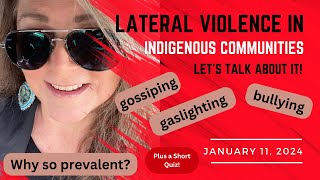
A short educational YouTube talk by Sandi L Boucher (Red Thunderbolt, Woman of the Loom clan, Seine River First Nation) about lateral violence in Indigenous communities. She defines lateral violence as “passive or aggressive words or actions delivered by someone you know, love or trust, intended to discourage you from advancing,” gives concrete examples (passive doubts, direct discouragement, gossip, ostracism, minimizing achievements), explains roots in internalized oppression and marginalization, and urges nonviolent resistance and individual responsibility to stop these behaviors.
Questions this video answers
Sandi L Boucher (also identifies as Red Thunderbolt, Woman of the Loom clan, member of Seine River First Nation, Treaty 3 Territory).
January 11, 2024.
"Passive or aggressive words or actions delivered by someone you know, love or trust, intended to discourage you from advancing."
Chapters
Okay, so dead serious conversation today. Important sharing and information for those watching. We need to talk about what is tearing Indigenous communities apart. And in this case, no, I'm not talking about the addictions or the poverty or lack of support. And all of those definitely are playing a part. And so is today's topic, lateral violence. Let's talk about what it is, what it looks like, and why it's got to stop. Let's talk about it. Hello, everybody. My name is Sandy Boucher. I'm Red Thunderbolt, woman of the Loom clan, a proud member of Seine River First Nation in Treaty 3 Territory in Northern Ontario. And as mentioned today, I want to talk about lateral violence. So first we get better get crystal clear on what lateral violence is. And to do that, I'm actually going to share a clip from an older video from one of my courses, actually, the path away from lateral violence. If you're interested in that, check it out on my website, sandy boucher.com. but here we talk about what lateral violence is and why it's so decimating. So here's the clip.
So now that you know who I am and why this is so important to me, let's talk about this whole idea of lateral violence. First and foremost, if you go look at your personnel policies, I'd be willing to bet even if there's a policy that references lateral violence, they're going to say that there's three different types of lateral violence. Harassment is one of them, discrimination is the second, and bullying is the third. Now, those are very specific legal definitions, but we know that it's way more personal than that. What I'm talking about is the lateral violence that we experience in our families, in our homes, in our communities, and, yes, even in our office places. So I came up with a definition, and this is mine and mine alone. And you can feel free to argue it. In fact, in the homework, you're going to get a chance to write your own. So if you don't like it, you get to change it. That's empowering. I have it written on the screen just behind my camera here. So if you see me looking off in the distance, I'm not ignoring you. I just want to make sure I get the exact wording right so when we put the text on the screen, I won't confuse you. So here is my definition of lateral violence. Passive or aggressive words or actions delivered by someone you know, love or trust, intended to discourage you from advancing. Let's try that again. Passive or aggressive words or actions delivered by someone you know Love or trust intended to discourage you from advancing. Now, that's a big, long definition. So let's look at the parts I mentioned that the words or actions could be passive. Well, when I decided to go to college and I was going to be the first one in my family to do that, my mom, out of sheer love and concern, simply said, you sure you want to do that? Believe it or not, that's lateral violence in its passive form. It had me stop in my tracks, and suddenly I went from excited to going away to college to, is this something I really want to do? Is this a lot scarier than I think? Mom's nervous. My mom's the bravest woman in the world. Why would she be nervous? Maybe I shouldn't be doing this to see how it almost held me back. That's lateral violence. Or it's aggressive being told, you can't do that. You're never going to be allowed to do that. Why do you think you have the ability? Why do you think they're going to hire you? Why would anyone read your book? Sadly, I've heard them all. Why lateral violence is so devastating is because those words or actions are delivered by someone you know, someone you love or someone you trust. This is not the unknown troll on the Internet making a comment that's not lateral violence. Lateral violence is someone right next to you at the same level. Your partner, your parents, your elder in your community. Because we've all been trained in lateral violence. As indigenous people, we have a masters in lateral violence. So we shouldn't be surprised when we run into it. That doesn't mean it's right. It has to be changed. That's the reason we're doing this course. But it is most definitely common. And the greatest indicator, or the hint that you should recognize this is lateral violence is that it's intended to discourage you from advancing. So someone trying to talk you out of bidding for that new job, going away to college, trying that diet, going to that new restaurant that you've never been to before because. And it's an upscale restaurant, and they're trying to say you don't belong there. Do you see how this is very limiting? Lateral violence is incredibly discouraging, and that's why it's so important we educate ourselves on it and overcome it. What you have to keep in mind, the closer the relationship, the more impact the lateral violence is going to have. If it's an ant that you haven't seen in ages who says something, sure, it might catch you off guard, but you're Going to dismiss that a lot more than the man or woman you love saying, why do you think they're going to hire you? Do you see what I mean? It is still lateral violence, which means it's not based in fact, it's training, unfortunately. And we're going to look at that so you truly understand it by the end of this course. Now, why is this so prevalent in Indigenous communities? Why is it in every family, every home, every community? Well, truth be told, the more marginalized the group, the greater the chance of lateral violence. Marginalized, pushed off to the margins, oppressed, held down. The more oppressed or marginalized the group, the greater chance of lateral violence. I would go as far as saying, in Canada, historically and in present time, no one has been marginalized more than Indigenous people. We have been oppressed for so long, we've internalized it. And a characteristic of internalized oppression is lateral violence. So as Indigenous people, what I'm saying is, don't be surprised. There's lateral violence in your community, in your home, or even in your office. We should be celebrating when there isn't because we've all been trained to do this. The reality is Canadian history has resulted in a victim mentality for so many Indigenous people. Why bother trying? They're never going to let us do it. It's a learned helplessness and a learned judgment. No one judges Indigenous people more effectively than Indigenous people, and that's lateral violence.
So now that you know what lateral violence is and who perpetrates it, that this is not the troll on the Internet. This is someone close to you in your community. We need to at all of the forms of it. Now, let's keep in mind first and foremost that lateral violence, violence of any type, but in this case, lateral violence is a condition of the environment. There are three natural human ways that a person reacts to either oppression or internalized oppression. And that is violence acquiescence, the complete and total giving up or nonviolent resistance, finding a way to overcome the odds. Every single one of those are natural human reactions. So we can't judge the people that go the route of the first two. I spend every single day trying to encourage first nations people to go the third route, the nonviolent resistance. But I understand the violence and the acquiescence. So the violence can come in many forms and bullying is one of them. Yes, I have a handy dandy index card. The other one is gossiping. And this one is excused as just the way we are way too flipping often. People don't think it's Any big deal. And it is a huge deal if you're gossiping with your girlfriend in the kitchen and your kids are playing in the living room. You just taught a next generation lateral violence. You just taught them. And by the way, if you're standing around talking about someone, guess who they're talking about when you're not in the room? And I hear it all the time. Well they do it. They talk about me. So I talk about them. Are you really putting your life in the hands of someone else? Be the first to stop. I have zero interest in gossip. 000. And it's something you can do. Ostracizing is the other one. The exclusion of people you know having a conversation and planning and not including everyone. That's lateral violence. It can be, as I mentioned in that clip, passive or aggressive. And it's also often very passive aggressive. Right. That I'm going to say the joke and then if you get offended, I'm going to say well it was. I was just joking. Like gaslighting. Trying to put in on you. All of this has to stop in you can choose to make your community better by being the one that chooses not to do it. I have zero. I have eliminated so many comments on this YouTube channel because an indigenous person felt the need to either attack me or other indigenous people. And that is just not going to fly. This is a safe space and that just cannot happen. Now. One of the things for the people. I'm going to backtrack for a sec. This is an indigenous centered space. But indigenous people are not the only people that experience lateral violence. So I have a like a quick little quiz for you. So for example, has anyone in your life, question number one. Has anyone in your life ever minimized an achievement of yours? You got an A on the test. You got your driver's license. You cleaned your room when you were younger. You built something. You, you know, got your first bird. You went out hunting, you caught a huge fish, whatever it is. And when you told person or people, they minimized it. They joke. It's no big deal. That's such a small fish. Well, look at you built that stool. It's all crooked. Whatever. They minimized it or insulted it. Has that ever happened to you? If it has and it was from someone in your peer group, in your community, in your family on the same level as you. That's why lateral violence then what you experienced is lateral violence. And that can be decimating. And I want to acknowledge that you felt that. I know you did. And that hurt. I Know it did. And I'm sorry that ever happened to you. There are many communities that are now acknowledging that lateral violence is happening in their communities. I have done so many sessions in so many different First Nation communities on lateral violence. But it's the second question that's the stumbling block. The second question is, have you ever minimized someone's achievement? You made a joke about that cake, that first cake they made, or that meal that they made. It would have been better if they had added salt or, you know, they cleaned their room, but you didn't think it was very good. And you told them that you minimize their achievement. You poured water all over you. It rained on their parade. You know what I mean? You drowned their achievement. If you have done that, you have perpetrated lateral violence. Because I've met way too many people that want to acknowledge that they have been the victim of it, but no one's lining up to acknowledge that they've perpetrated it. We've all done it. And as I said in that clip, indigenous people, we have been trained. We are. We have a masters in lateral violence. We remember the feather, teaching the two sides of the feather. Your power is on your side. You cannot control what other people do, but you can control what you do. The lateral violence has to stop with you today. Today. That is the choice you have to make. Let them talk about you. They're doing it anyways. You don't need to lower yourself to their level. My mom. I can hear my mom so crystal clear as I'm speaking to you. And she is saying, do you really want to be a leaf in the wind? And what she meant by that is your. Are your actions really going to be controlled by outside forces? But like the wind, like other people and what they're doing, you decide the type of person you want to be. And if you want to be a gossiper, I feel sorry for you because that's not why Creator put you here. And I wish you would never learned how to do that. But you can be so much better. You can be the leader. You can be the safe place. You can be the place where your friends and the children, your community go because they know there is the one place where we're not talking bad about other people. And it feels really good to find those spaces. That is a condition of the environment. An oppressed group lashes out against each other. It's not because we're not civilized. It's not because we're, excuse the expression, indigenous people. It's not because we're savages. It's not because we're not professionals like white people. It is a condition of an oppressive environment. We didn't ask to be oppressed, so we can't be crucified for reacting to it. We just got to get better at how we react to it. Find a way. Non violent resistance. Choose a different path that doesn't include being laterally violent. I hope that made sense. I love you. Until tomorrow. Bye. Bye.
More from Sandi

How I Handle "The Four Uglies!" (Alcohol, Diabetes, Healing & Cheap Seat Comments)


All the Stuff We Don't Talk About with NO SHAME! (WMT Podcast w Antoinette Godin)


When Authors Chat ... (Radio Interview for the Launch of "Copper Stone - Glimpse of Blood Memory)



MORE PROOF of Indigenous/Non-Indigenous Relationships that Work! (Walking My Talk w Millie Gormely)
