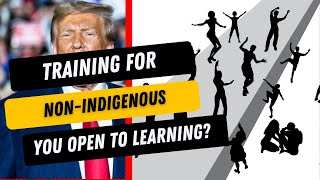
Sandi L. Boucher, Red Thunderbelt from Seine River First Nation, uses a wall metaphor to sort people into three groups: bridge-builders dancing on it, curious learners touching it, and those far away. She wants to train non-Indigenous Canadians about Indigenous values and build generational bridges, not convince the resistant.
Chapters
I am so absolutely excited. You know what I just realized the benefit of doing this and coming up with all these video ideas ahead of time is the fact that when I choose the videos for the week, I can go through and I can pair together the lessons that make sense. This week I am focusing in on oppression and internalized oppression. What it is, what you are seeing because of it. And we're going to end up the week talking about how to overcome it, the teachings that have helped me to succeed. So the allies and Indigenous are gonna love this. This is information you need. Let's talk about it. Bonjour. Hi everybody. It's Sandy Boucher here once again. I'm Red Thunderbolt, woman of the Loon clan. I'm a proud member of Seine River first nation in Treaty 3 territory in Northern Ontario. And yes, I am excited because as I mentioned in my podcast last week, the non Indigenous people willing to hear me, willing to learn, willing to ask humble questions are my fuel. But so often non Indigenous people are confused. They're hearing terms they've never heard before. They're hearing about experiences they've never had. And it makes it really hard for them to meet us in the middle of the bridge. And I am not making excuses for horrific treatment, but if you don't know, you don't know. And I've done the healing and I've done the work. And you know what? Honestly, it is a pet peeve of mine. I. I used to work in Indigenous employment and training, helping Indigenous people get a new job, go back to school, or even start their own business. For 30 years, I have watched training programs for Indigenous people to help us learn how to be successful in mainstream. Where is the corresponding training? Where's the training for non Indigenous Canadians to learn how to work with us, what we need, what our values are, so we can build that bridge. Why? Rooted in some stereotypes and some colonialism. That's why it was assumed that we are lacking and that everything else is just hunky dory on the other side. Wrong answer. So a large part of my work is educating non Indigenous Canadians and anyone else who's interested in on the things you need to understand so we can build the bridge. My intent is to build the bridge. I spend half my time empowering Indigenous people, the other half of my time educating non Indigenous so that that bridge can be built from both sides. Because that's how you build the bridge. So the first thing, speaking of bridges, well, that's kind of lousy. Lead in. I want to talk about a Wall for a moment. And this metaphor I've had for years, but it definitely got easier to explain once Trump came onto the news. And. And for my American followers, I do not want to get into a battle of where I stand on Trump. That is not the point. The point is he talked about building a wall from coast to coast. So what I'm sharing with you now is the wall metaphor. And it's a great way to start this week because depending on where you are standing is how the odds, what your odds are to be able to absorb the information I'm going to share with you this week. So I want you to imagine for a second, and maybe I'll get my handy dandy videographer to put up a picture of this, the. The wall right here. That would be awesome. Magic. I want you to imagine a wall spreading across the continent, North America, from the Atlantic Ocean to the Pacific Ocean. Now, that sounds way more intimidating than I want you to picture. You need to adjust your image for a second. Because this wall is the height of a table. It is wide enough and low enough that you could safely get up on it and dance on it if you want to. Meaning it's not holding anyone in. It's just a line. And like I said, it's strong enough for you to dance on. It's easy for you to get up on. Okay, so that's the wall. The first group of people. There's three groups of people I want to talk about here. You're standing in one of these places. The first group are people like me. I can bop off in the middle of a First nation community or jump off in the middle of a non indigenous community. By the way, I forgot to mention, the wall divides. On one side of the wall, we're going to put all the non indigenous people. The other side, all the indigenous people. Keep that in mind. So people like me are dancing on the wall. Like I said, this wall isn't keeping anyone out. You can get up on it if you want to, but to get up on the wall means you now have the ability to jump into either side and be respectful and understand the rules and the values of those sides or be humble enough to learn them. You're not going to offend anyone. Now, I am not the only one dancing on this wall. There are many, many people doing amazing work that are dancing on the wall. The second group that I wanted to talk about are the people we work with. And there's a really good chance that's you. These are the people in my audience. These are the people on my email list. These are the people that watch my YouTube videos. For the most part, these people want to dance on the wall. They want to feel that comfortable no matter where they stand. And the only thing that is stopping them from dancing on the wall is, is information. They are touching the wall on either side of the wall. They are trying to get that information so they can get up there. And I am thrilled to work with those people every single day. But here's the really important part to remember, especially if you're attempting to do this kind of work, whether it's indigenous, non indigenous, or any DEI kind of work, there are people on both sides of the wall. And I'm going to stress that both sides of the wall, indigenous and non indigenous, that are so far away from the wall they can't even see it. And you recognize them because they say things like, why bother? It's never going to change. Those white people are never going to accept us. Indigenous people. Indigenous people are never going to get it together. I know you know these people. The point is, if I were to take all of my energy and time and try to reach those people, all I would do is exhaust myself, my job, my link in, my family bloodline, my link in this work is to work with the people that are touching the wall, the people open to hearing and learning. Because as my elder explained to me, because she was getting worried about me burning out, this is why she shared the wall metaphor with me. The wall is magic. And with each person that gets up on the wall, the wall gets wider and wider. And eventually those people that are not open to hearing right now will be staring at the wall and they won't be able to deny it anymore. If there's one thing we have to remember is it took generations for us to get here. It's going to take generations for us to do the complete change that we need. That person that is saying it's never going to happen, maybe they're not the generation in their bloodline that's going to get it and that's okay. Let them walk their path. You focus on yours, whether it's dancing on the wall or watching videos so you can learn so you can get up on the wall. I hope that makes sense now. I know it is YouTube. There's going to be one or two trolls that show up in my comments and prove that they're so far away from the wall, it's not gonna matter. I get it. I. I so get it. But the reason I love the work I do is cuz my seminars and my email list and my followers are filled. They are all either dancing on the wall or touching it and trying to get up on it and I am here to help. Now if you were able to hear that then you got a really good chance of enjoying the information this week. Let me know what you think. I love you. Take care. Bye bye.