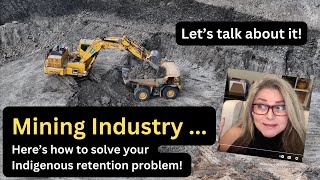
A short YouTube monologue by Sandi L. Boucher addressing the mining industry’s difficulty retaining Indigenous employees. Boucher explains cultural and historical reasons—family separation and intergenerational trauma—that make the common ‘two weeks on/two weeks off’ camp schedule especially disruptive, and proposes an alternative shift pattern (one week on/two weeks off, with alternating/indigenous shifts) to improve retention and support reconciliation. The video ends with an invitation to contact the speaker for help developing solutions.
Chapters
Okay, so I'm trying something different today. I'm actually going after the mining industry. I shouldn't have said it that way. I'm not going after them, I'm targeting them. That doesn't sound much better. This message for people in the mining industry, is that better? That's a little bit better. Because if ever there is an industry that needs employees, that's an industry. And often they have tried hiring, recruiting and retaining indigenous peoples 99% of the time. I shouldn't say that it's not that high. But more often than not it doesn't go well. The retention falls, they hire, they just can't keep the employees. And I know, I have heard my brother was sharing with me because he works with a lot of trades people, different industries, that Indigenous people are just not reliable, that the employees are not reliable. And I wanted to talk about that because this is a huge part of reconciliation. And I think I have a suggestion that might work or at least give you an idea of how to think of the problem in a new way that's going to get you a solution that works. So let's talk about it. Queen addition across Mundo Dam hi everybody. My name is Sandy Boucher. I'm Red Thunderbolt, woman of the Loon clan, a proud member of Seine River first nation in Treaty 3 territory in Northern Ontario. And I live in the world of Indigenous Canadian reconciliation. Whether I'm empowering a First Nation community to heal and find their voices and remember the power of our teachings, or I'm helping non Indigenous Canadian entities, businesses, corporations understand us better so we can improve our relationships and everyone benefits because reconciliation benefits us all. That's a whole different video I could do. But as I mentioned in the opening, I really wanted to speak to those in the mining industry right now because I know you guys are struggling and I know you need people and I also know you've tried that you've hired a lot of Indigenous people. It's just they don't come across as reliable and it's hard to retain. Re retain them. And then you got to go through the expense of yet another job fair and bringing someone on and training them only for them to leave. This is a very expensive hamster wheel you're on. So I have an idea. I'm going to paint a little scenario here so that we're both on the same page. What I'm talking about is in this context is the situation of a mining camp where the people that work there work their steady two week shift and then they're out for two weeks. That's really super common. So they leave home, go to the mine site, travel in, do their two weeks, and then come back out. Now, cultural differences are playing into this. That's why I'm not sure you know that. That's why I'm doing this video. Mainstream in mainstream. In non Indigenous Canadian culture, it is not unheard of to chase the money to move away from your family, to go away to work, to earn a paycheck that is pretty much expected. If your wife misses you while you're gone, oh, well, deal with it. We need the paycheck. She might even be saying that or whatever the partner at home is. If your kids miss you, too bad. We need the paycheck. Deal with it. It's not like that in so many Indigenous communities. Now, before you judge us, keep some things in mind here. For one Canadian history, family separation has been our trauma. Whether it was our kids that were taken or originally we were the ones taken. And yes, the residential schools are closed now. Have you heard of the child welfare system that is constantly removing our children from our families? So family separation, that's a trigger for us. On top of that, keep in mind, Canadian history has touched every Indigenous family, every Indigenous community. So it's not like one person in one family has trauma and healing to do. Every single person in that community has been affected by intergenerational trauma, whether it was the separation, whether it was abuse, whether it's addictions, whether it's violence or all of the above. So if one partner leaves for that two weeks, it can hit the fan while they're gone. And Ben, you've heard of all the kind of stuff that happens in a First Nation community. And the partner at home often really resents the partner that gets to leave and just focus on work because they're there dealing with their extended family and the family that's probably living in the house with them because of overcrowding and what their kids are doing or not doing, what's happening at the school, what's happening outside of the school, the poverty, the addictions, the violence, huge. And they really are not excited when it's time for their partner to leave again. So those are the facts. That's what we're handling right now. And definition of insanity, doing the same thing over and over and expecting different results. And by the way, blaming us is not going to help. Healing is ugly. We didn't ask for all that crap to happen to us. We didn't ask for generations of our kids to be taken we didn't ask for our kids to still be taken. So don't be doing that. Don't be doing any victim blaming. Seems to be a week of victim blaming. We can change that fact. We can change the fact that you need employees. We can change the fact that we have generations of trauma. And we can change the fact that family separation is a trigger for many, many indigenous people. It's time for a crazy idea. And if you hang out in my world for any length of time, you're going to hear me say I have a craz idea. So mining industry, I have a crazy idea. What if it wasn't two weeks on, two weeks off? What if it was one week on, two weeks off? Now hear me out, hear me out. You're only paying them for the week that's there. So like, don't panic. So think about it. Many, many, we're going to play this out. Don't dismiss it yet. One week in the camp, two weeks out. Many, many indigenous peoples are either on social assistance or are surrounded by people that were on social assistance. Or maybe when they were growing up, their parents were on social assistance. Social. Social assistance gives you a very low check. Not a paycheck, but a very low check once a month. So what I'm saying is you're giving them a check every three weeks, right? @ the end of the week, they work. I wouldn't suggest doing it any other time. So they're getting money more often than they would on assistance. So you're helping them to break old patterns. They're only gone for one week, so that's a little bit, that's a shorter period of time. So hopefully it doesn't hit the fan too bad at home. And guess what? Best part, after two weeks away from work, money is really flipping tight again. And now even your partner at home is encouraging you to go back to work. So create alternating shifts. You still need the people there all the time. I get that. But this shift comes in for this week, another shift comes in for the next week, third shift comes in for this week, and then you alternate it. You could come up with an all indigenous shift and dare them to do better work than the other shifts. We like competition. Win, win, win. Because guess what? Coming up with these unique ways to overcome the facts is reconciliation. Trying to force us to do things the way you've always done it, just because you've always done it that way is more assimilation. That's more of the problem. So maybe that idea works for you, maybe it doesn't. But at least I hope it got you thinking along the lines. Take the facts and what can you change to make it work? I happen to think it's a great idea. And by the way, if you need help coming up with a great idea, send me an email. I am literally here to help. I hope that made sense. I find it kind of exciting. Let's quit judging indigenous people for it doesn't work for us. How many generations, how many years have to go by before your industry realizes the two in, two out doesn't work for us? So let's change it. You get the employees you need. We're going to be so thrilled to have a work environment that works for us that you're going to have the most long term loyal employees you've ever freaking seen. Because indigenous people are known for their loyalty. I do believe that's it for this week. Unless I've totally lost track of the week possible whether, whatever. I will see you in the next video. Until then, I love you. Take care. Bye. Bye.