Mistakes Are Teachers (Podcast - Video Version)
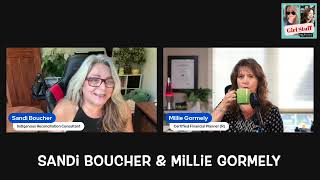
Sandi L Boucher and Millie Gormley talk about business mistakes and what they taught them: building a brick-and-mortar office nobody needed, trusting the wrong partner, and spending money on marketing that didn't work. They share what fixed it: automation, delegation, and quarterly planning.
Chapters
Foreign.
Duper double delicious person, as Millie always says, whether you're watching this morning, evening, afternoon, whenever. Welcome back to our podcast, Millie. Take it away and do your introduction.
Sure. All right, so good morning, good evening, and good night. You know, channeling the Truman show there a little bit. My name is Millie Gormley. I am a certified financial planner working with women across Ontario. And for the purposes of this podcast, I am your token middle aged white chick.
That is never gonna get old. I love. You know what? Every now and then I'm gonna go off on a tangent for a sec. I know everyone's surprised. I never do that, but everything, every now and then in my seminars, in my work, I run into someone who says something like that, like, I'm a privileged white male and I'm here to learn or whatever. And it never fails to catch me off guard. But at the same time, I 100% appreciate the acknowledgment that, like, I'm not interested in shame or guilt, but, like, it's such a great place to start the conversation. So thank you so much and you're welcome. My name is Sandy. If you. Who the heck am I? My name is Sandy Boucher Misko Pocket. I'm Red Thunderbolt, woman of the Loon clan, a proud member of Seine River first nation in Treaty 3 territory in Northern Ontario, Canada. And I work to reconcile the country I in the realm. Yeah, just a tiny task. We'll have it done by Tuesday. Indigenous Canadian reconciliation is my game. So I'm either in the First Nation community, helping with the healing and the empowerment and remembering the power of our teachings and our custom and traditions and wrapping those around mainstream realities and. Or modern day realities, I should say, or I'm working with non Indigenous businesses, entities, hospitals, universities, helping them understand this crazy history we've all inherited and more importantly, how to move forward. And the one thing I've noticed in Anishinaabe culture or Ojibwe culture, we have always believed the quote was, the healing starts in hands of the women. That it was the women that have the children that want to heal for their families, they want to have a healthier community. So working with women is actually where my career started. And now I can see when I'm working in hospitals and even corporations, so many of the people spearheading the chains are women. So in case you haven't noticed, the logo has changed just a little bit. We were just a little bit originally we were talking about the path. And that was a play off of my third book, the Path. But what Millie and I were discussing is the fact that we're both, we been here a little while on this planet and we can remember being told that certain things were not of concern for women, that they were not girl stuff. And what has highlights every single episode is it's all girl stuff. Your finances, your future, your investments, your health, your relationships, everything. Your self esteem and confidence. There is no page that isn't girl stuff. So I just thought a rebranding would be perfect because I think it's going to resonate with the people that they see that and think what's girl stuff? Or how dare you say something isn't. And then they watch a podcast and realize we're not saying that at all.
No, no, no. I mean the entire, the entire concept of things being for a certain gen been something that's been kind of certainly again, when you and I were growing up because we are old, it was a much, much bigger deal. But I am really happy to see how, how the kids these days are, are taking that back and making it not a big deal either because they are so, so hyper focused on their particular gender and their expression of it, or they're just ignoring it entirely, or they're one thing one day and one thing another day. And it's just, I mean, it can be confusing and a little off putting to people sometimes. And sometimes I will admit, it's like, does this have to be everything that you're about right now? But you know what? For some people in certain places in their life, gender is a hugely defining characteristic of who they are. And they've got to work out what that means for themselves. And it takes them time and it takes them energy and we have to respect that. Everybody's got their own, everybody's got their own journey on the path. Yeah.
And what I love is like just my own personal journey has always, for so many years, I felt like I was squished into a box that someone else designed, built and defined. And what I see in the younger generation, including my children, are there is no box today. And it's fluid. Like you said, I don't have to just because I said I'm this, I don't have to stay, stay that way. I can dress any darn way I want to. Whether it's, you know, someone that's feminine presenting is wearing a tie or male presenting wearing a skirt, who cares? It's, it's the way you express yourself. And I just love the, the refusal to get in the box. Right. And it's Like, I wish I had done that. So whether that would have been accepted or not is besides the point.
But.
Yeah, I just love the. The. You're not going to define me. And especially coming from an indigenous perspective, we've been defined by other people since the settlers got here, so.
Absolutely.
Really. Right. And really just fighting back against that. I don't know about you. I was thinking about this this morning. So anyone who follows my work knows, for one, I don't keep things to myself. I. I literally wrote books about my life, so literally.
I don't know if you're capable of doing that. To be perfectly honest.
That would be a box that I'm not getting in. Exactly right. But I recently turned 60 in April, in the spring, and I was thinking about it this morning. This is the best. It's been like a hundred.
I love that.
Right. Like I am. You know this because, by the way, full disclosure, Millie is my financial advisor. So the amazing life I live now is a lot, with Millie's support and patience. And I'll explain this term to you. That comes up a lot. And that's totally okay because Millie never looks down on people and she understands that's not my industry and she's okay with explaining things to me.
But I'm here.
For what? Like, if there was one thing I've always wanted to achieve, I see this now. Hindsight 2020 is self determination. I don't know how much that is female, how much that is indigenous or both, but. And that's what this now is like. My entire life, where I live, what I say, what I do, who I hang out with, you know, who's in my inner circle is all determined by me. And compared to some pretty dark years in my past where I was so far away from self determination, it wasn't even funny. This is it. So anyone out there worried about turning 60?
It just gets better.
Keep going.
No, I love that. And you know what? I just. I just want to step back one. One step just to put the gender thing in. Into perspective as well. The indigenous culture in general has been a lot further ahead on the idea of gender acceptance than mainstream white culture for years and years and years. So, I mean, mainstream could take a lesson from. From that.
Yeah. For gender, for career path, identity. However, we always believe the child reveals to us who they. So it's not about helping them to pick a career. It's letting the toddler go. And did they head to the water? Did they head to the bush? Do they want to learn about fishing or hunting? Or cooking or whatever, letting them reveal who they are. Like, I honestly struggled for years with labels. Okay, what was that comedian's phrase? You know, like I was ADHD when I was a kid, but no one knew that because that hadn't been invented yet. You know what I mean?
Right? Yeah, yeah.
Like we didn't have these labels and I struggled for the longest time with the labels. And I understand there's huge important because it gets you the supports you need to thrive. Like that part I absolutely get. But when it becomes a limitation or a box, I can do that because I really struggled with that because the way I was raised, largely my mom's influence, so Anishinaabe influence. I grew up in the era of that's just the way they are. Right. Like you're not good at math. That's just the way you are. So you find something else to do. That person talks slower than other people. That's just the way they are. Sandy talks incredibly fast just the way she is. Right. So it was, it wasn't a limitation, it wasn't a judgment, it wasn't. It was an acceptance. But it was also came with an expectation. Find out how you would do it.
Right.
You have to pass high school. Right. But you struggle in this area. We'll find a way to do it. Is that. Get a tutor. Is that, you know, think of a different way of practicing it at home. It was never that you can't do this. It was you're going to do it, figure it out way than other people are. Right. Like the way I run my business would probably make a few people's heads explode.
Sometimes. I have questions.
Right. If you want structure and organization and like routine, you should probably find another job.
I know Anita, who is Sandy's. Sandy's right hand woman. And she is the loveliest person. She is calm, she is zen. She is a saint on many levels. And she is exactly perfect for you because she's so different from you.
That woman. Okay, pure transparency here. Because I tend to work out of my home at different times in my career. We've had a formal office, but it tends to be out of my home. That porn woman has come to work I don't know how many times to find her office in a different room. Oh, that would just fatty. And she's just, I'm here. All, all she ever says is, so I'm here now.
I would.
So she is a saint. She's an absolute saint. I'll ask her to do something and then like three hours later, okay. We're not doing that. We're doing this. And she just nods. She thinks it's funny. So. So yeah, but I'm so glad you.
Found each other because. Damn. Together in that sense. Because we both have to be the boss.
Well, yeah, but you know, we were totally. I learned a long time ago it is not conducive to another person's work and well being to share an office with me. I must be contained away from them so they can have some peace. Right.
Okay. Okay. So we're talking about containment and putting ourselves in boxes. So you have. So you recognize.
I define the box. There is a place for some protection for the safety of others. Right. Because if I can. And Anita knows this. If I can see her. And it might be the niche thing too. So Anita is indigenous as well. If we can see each other, it's story time. Okay, so we'll work for five minutes. Oh, my God. You're not going to believe what happened on the weekend. Then we'll work for five minutes. Oh, you're not. And we'll take turns sharing stories. Like you're not going to believe. What happened is always. It's amazing. We get things done, but we enjoy ourselves.
And this is the thing too. I mean, if you can't enjoy yourself while you're working on some level, I mean, yeah, it's not always going to be pleasant. Some days you got to buckle down to do the things. But ultimately, if you can't come to work looking forward to spending time with the people that you're spending time with, either virtually or in person. And you know, and look forward to just. Just the being there. Like I. This is my home office. I love this room. It's my little burrow. It's my little happy place. It's all my stuff is where I want it to be. Which is why. That's one reason why you and I would have a really hard time working together. Because you touch my stuff. I'm gonna have a problem with that.
To me, that's a challenge. Let's see if she knows.
She would. She would, you know, but. But having that words in Millie now. Oh, I'm not sure. Do you know where I am?
That's probably containment.
Yeah. Oh, good.
You don't give that address.
Yeah. Anyway, so what are we talking about today? I feel like we strayed off whatever topic we actually had, but it was.
An amazing place to go. So actually, you're gonna love this. You're gonna love. And I actually just thought of one when we were talking so the theme of today's podcast is mistakes are teachers. The times that we've made a mistake, and I know there's this whole thing out there, we don't call them mistakes. They're freaking mistakes. I've made some epic mistakes and I want. I own those. Those are my best stories. I'm not giving them up. Right. But if you're smart, you learn from them. You take the lesson, leave the rest. Don't beat yourself up, but learn from it. So along the lines of what we were just talking about and today's theme. I don't know if you've ever done this. I'd be curious to find out. But in the course of my 15 year career, there were times I made the mistake of. I guess the easiest way to put it is doing what other people. What I thought I should do because other people did it. One of them was getting a brick and mortar formal office. Right. I should not be working out of my home. If I want to be established, I should be in a formal office place. Do you know what happened? I then had people mad at me because I was never in the office. Yeah, this is not working well. Right. I. Everyone knows I get up incredibly early. My brain is firing on all cylinders. Like I'm working within 10 minutes of waking up because it's just I can get so much done in the first three hours when I had an office elsewhere. Well, now you gotta get dressed and put your face on and pick out your outfit and commute to the office. By the time I got there, I lost like two or three incredibly productive hours.
Yeah.
It's like. Yeah. And then people expect you to be there till 5pm 5pm I start at 6am I'm not working till 5pm that.
Yeah, exactly.
So I'm curious, did you ever do that?
What? Make a mistake? Sure. No. No.
But yeah, she never makes mistakes.
I am. I perfection. I can't even hold a straight face saying that. Good Lord. But actually my morning routine is something that has been, you know, in the works for a long time and it wouldn't be possible if I didn't work at home. So basically I'm up whenever I wake up. So since. Since co. It's like I wake up when I wake up and generally I'm out of bed by 7:30, which is.
Exactly. Even if it's not right.
Even if I did have to go to an office for nine, 7:30 is doable. So by 7:30 I'm in my. I've got a little gym downstairs, so I do my yoga routine and whatever. I'm out of the gym by 8:15 ish. And in the shower, do the coffee, do the things. Then I'll sit down, do a little bit of meditating, do a little bit of journaling maybe and kind of think about the day. And it's, it's a very. Now, now this is a very leisurely thing. So I don't park my butt down. Today was about 9:30 when I sat down here and started getting the studio set up and ready for this, for this podcast. So, yeah, and that's that It's, I find it, it's really grounding for me. And the thing is, while you're exercising and while you're in the shower and while you're doing all the things to make your coffee and whatever, there's ideas percolating in the back of your head. There's things that you've been wrestling with. There's a, you know, I've got to do this today. I've got to do that today. So by the time you actually sit down at the desk and you fire the computer up, you've got at least half formed an idea of this is how the day is going to go today. And you've also got fully formed. This is how I want the day to go today.
Right?
This is, this is where I want to be. This is the, the mindset I want to have. This is the mental place I want to be coming from. And when you're dealing with other people and things that other people get really emotional about, like their money, it's good for you to be the calm and centered and focused person. So, yeah, it's something that's developed over years. Like I used to be, you know, get up, get in the shower, get out the door, you know, grab a coffee. And I just don't want to do that anymore, you know, like this, this.
No, I don't know if we should share an office, but we definitely should not do mornings together.
You would hear my mellow girl.
I would be in the yoga studio going, can I go to the office yet? I'll make a coffee on the way to the office. Right? Like, I do that stuff at about 11. So I. Oh yeah. And then it's like, okay, now I'm mellowed because I got all that stuff done. Now I'm gonna hit my gym. Now I'm gonna shower, now I'm whatever. But yeah, yeah, no, it's very different, isn't it? Okay, so I got a question.
Okay.
I have an Assumption. I'm just wondering if I'm right.
Okay.
Are you one of those people that doesn't talk in the morning like you quietly go about whatever you're doing?
Yes. And I would have to say that's not how I started life. That's something that came as a result of adapting to living with my husband. Because Sean is not capable of speech for at least an hour after he wakes up. Like, not capable of it. Like, he can, he can make his tea, he can, you know, sit down and read the paper and then do whatever he needs to do and then, you know, but he needs, he needs a lot of lead time to get into the verbal part of the day. And so I've just, I've just learned that if I, if I come at him, start going, bye, you know, just first thing in the morning, let's talk about the day. Blah, blah, blah, blah. It's. It's going to be. It's going to be perceived as an assault by. It's too much. You can't. He just can't. So I've. I've kind of adapted to that. And I don't know if. But it, it, it's. It's me now, you know, because we've been together like 30 some odd years now. So that's, that's. That, that's the vibe. And it's not that I'm conforming to what his ideal is. I think it's just a, A function of, of adaptation over years.
100%. It, it works for the two of you. You're not there by yourself. I am that really annoying morning person, girl. I'm that. I am singing to the cats as I put their food down. Right? I am.
They probably eat that too.
Why? Okay, this is terrible. When my daughter was a teenager, like I'm talking, the kids were like 14, 16. They had their rooms in the basement of our house. I was the first one up, made coffee, already showered, whatever, fed the animals. And then I'm gonna go wake the kids so they can get ready for school. And as I would come down the stairs, I'd be singing, good morning, it's time to get up. Rise and shine.
God.
My daughter would hear me from her room. And she shared this years later that she would wish for lightning to hit me before I got to her room just to stop the sound. I mean, on the one hand, that's not nice, but.
Yeah. Yeah, but I. I get it. I know where she's coming from. I get it. I get it. Oh, well.
Every night is on. There's got to be music on. It's. We're a week now. Yeah.
Okay. How perky are you after 9pm, though?
I don't know my name. At about 5pm I have to plan evening events. Yes, yes. Yeah. I am this all day till about 4, 4:30. Then it's like. It's like you let the air out of that floppy dude. Yeah. In the evening.
Yep. Going splat. You know, you get to the end of the day and you've just. You've just had enough, and you just kind of go boom. And you're done.
You know, that is such a perfect definition.
Capable of doing it myself.
I am on the couch. My butt is not leaving until I'm heading to bed. It's like all the gas has come out. All the gas. Okay. You're looking like you're frozen.
Oh, am I frozen? Can you hear me still? Can you hear me?
I can hear you now.
You're back.
Okay, you were. I could hear you. The conversation was great.
But, yeah, I think the clap. Something off the camera went, what the hell is happening?
What are they doing? They're clapping. Oh, my God. So my mistake was thinking I had to run my business, or I guess reality, my life, the way other people did. And I think that's a real benefit of getting older. You just get tired of those rules. So when it comes to you and mistakes being teachers, what's the first thing that comes to mind for you?
Well, it was just prior to Covid, I had gone into a business relationship with someone else, and I made the mistake of trusting someone that I shouldn't have, and it went sour. I mean, I don't want to get into the gory details because it was years ago now and I really should get over it myself. But that was definitely a mistake that I made that taught me a whole heck of a lot and has actually been the catalyst for me living my life the way I do today. So the. The finally sitting down and saying, you'll screw this. I'm going to do this the way that I want to do it. I'm going to build my business in a way that makes sense for me. I'm not going to jump on corporate bandwagon that comes around because I think I quote, unquote, I hate the word should. Oh, Lord, do I hate the word, you know, and, yeah, so that. That's. That's a big one that comes to mind. But, you know, there's always. There's always mistakes we make every day. And this is something I'm trying to learn right now. So I'm working with a new business coach and she is, she's very much about following your intuition and listening to your inner voice. And I mean it can get quite woo sometimes the conversations that we have. But that's something that I need to learn, you know, is going with my gut and listening to listen because apparently I have what's called in human design. I don't know if you've gotten into this, but I'm learning a little bit about it. It's fascinating actually. It's a combination of like astrology and the I Ching and the chakra system and a whole bunch of other stuff. And it's called quite complicated and it's a whole thing, there's charts and stuff. So the over analytical part of me loves that. And according to this, I have what's called sacral authority. So that means I need to listen to my gut.
Right?
It's interesting. Yeah.
And you know what?
I think I'm learning how to do.
That is amazing because. And I, I bet my last buck you're going to agree with me on this. And it wasn't that I made a mistake, but it was an absolute surprise for me and my business. So people who don't understand. I do a lot of public speaking, whether it's keynotes, whether I'm doing a full day seminar and I'm on stage for seven hours or a half day, whatever, and I tripped over it. It wasn't a decision, it just kind of happened. I'm known for being passionate, so sometimes that takes over. The more I became me, the more my business took off. So when I reacted to something, when I'm on stage and someone like, and I am me on stage now and someone will say something, I've reacted with.
The.
We'Re going to handle this. And I explained to them why that was problematic, not in an attacking way, but I let them know, okay, this took some preparation for me to be able to talk to you about this because that if I hadn't done my healing and my work, that would have been problematic. But by allowing myself to be as big as I am, as passionate about things, as heart, you know, vulnerable as I am at times talking about different things, that is what resonates with my audience. I believe 110% that the most powerful story we can tell is our own because we put the emotion into it. We like that people react and resonate with our story because we feel it. So they do too. And that's what with your Business. Listening to your intuition. You have amazing intuition. You're a very compassionate, caring person. That's why you're in the industry you're in. You most definitely like. The fact that you segmented to just work with women proves that, that you weren't into it. Just because you absolutely love the financial industry and there's a part of you that I know that does. So don't even go there.
But I like, I like playing with the numbers. Oh, my God, I've rendered you speechless. I, I, this is, I'm making a note of this. I, Millie Gormley, rendered Sandy Boucher physical reaction.
It's like, that's really not your thing. I love the results of the numbers. I like with my new customer management system. It has gas tanks with the move the needle. And I love the graphics. I open it up every morning. Did the needle move?
Did.
And when I get to do something that I know, move the needle, like literally, that's a literal thing in my industry now or in my business. And I love it. So I love the results. Crunching out the numbers. No, thank you. Not, not something. No, no.
Yeah.
Oh, I got another. I wrote out a list of my, I made a list of my mistakes. Oh, getting a little too close to Catholic confession here. Forgive me, Father, for I have sinned. I can say that I was raised Catholic. I'm not being rude.
Okay.
Business wise, this might be interesting compared to what we were just talking about. If I could go back and change anything. The mistake I made was not being scalable sooner. So everything in my business was what I used to describe Sandy, dependent. Meaning if I was in the room, I made money. If I wasn't in the room, I wasn't. And I rapidly got to the stage where the goals I had set, there wasn't enough hours in the day to, to achieve it without risking killing myself.
Yeah, there wasn't enough Sandy to go around.
Right. I, so I needed passive income, something I could create that would keep generating income. Like my video courses online. I get an email that says someone paid for it. Yes, I had to create it once, but I can sell it a million times. So not understanding that for at least the first 10 years of my business. Well, it wasn't really much of an option.
The first 10 years of your business.
Well, you know what? I still, well, even if I had, like, sold more things, like, I mean, online selling has been around for quite a while.
Yeah. Well, more books, for that matter.
Yeah. And I'm definitely one of those people. And we've Talked about this before. We have to acknowledge so many people really struggle during lockdown. But I'm one of the businesses that really was made stronger by it because it forced me to go online and it forced me to do things like passive income. So now I was smart enough when the world opened up again and I didn't stop doing those things. I now have a combination of both. But I literally got to the point. I'd be interested to know if this ever happened for you. I got to the point that I was so busy, I didn't have time to fix what was wrong.
Yes.
I knew I needed to be scalable. I knew I needed to do things online. I took the course on how to create a video course and didn't have time to do it. So I was so busy, I became my own worst enemy, and it took lockdown to give me the time to fix it.
Yeah, no, I've been in that position as well. One of the things I implemented a few years ago was something called. It's based on. It's not a literal or religious interpretation of it, but it's a book called the 12 Week Year. And the general idea behind that is that you break your year up into quarters, and you set your goal by quarters, and at the end of each quarter, you take a solid week out of your business to work on your business. So no client appointments, no events, no. No anything. But I'm going to do those projects that I've been putting off for the last three months because I haven't had time. And that's. That's kind of been a game changer, you know, because it allows you to. To really focus on what's working. Because three months is long enough to really get a handle on whether something is working and you should keep doing it or whether it's not and you should drop it. Right. Because. Because sometimes we get these ideas where we should do something and we carry on with it far too long, and, you know, it doesn't work. So that gives you an opportunity to get rid of the duds, so to speak. And it's also about relationships.
Suddenly, maybe, I don't know.
Oh, that's okay. Now you've run speechless. If I was doing my relationship, okay, we've had fights that lasted longer than three months, so. Because we've been together since 1986, so I don't know that that works for me, but whatever. Your mileage may vary, but anyway, I was gonna say I need. Yeah, that's a different needle entirely, girl. We're on A different, different, different gauge. Different, different, different gauge. That's it. Yeah, but, yeah, but the idea behind it is when you break things up into quarters, you get a chance to, to sit back and look at what's been happening and what you want to happen differently going forward. So you're, you're constantly readjusting and resetting your course. And I found that very, very helpful.
Love, rather than waiting to the end of the year and you're so far off track, there's no, you know, you can't reset it. You got to try again next year. One of the things with having my expanded team now, I get to spend so much more time working on my business than in it. And when I'm in it, it's like, okay, now I gotta delegate something, right? Like, I, this is not what I should be doing. I love how even though we don't have formal job descriptions because that doesn't fit my world, we each have, we know which section of the business we each have maintainer are responsible for. And it's, it's just working absolutely awesome. But I definitely spent, I did the religious planning at the beginning of the year. These were my goals for the year. And checked it like maybe December 28th. Oh, that did.
Yeah.
I can, I can jump. Yeah, it's like, wow, I was off on that one. Yeah, let's see. You know what, Back to your comment, I'm sorry.
Yeah, no, no, go ahead.
In my case. Well, I was just gonna say your comment about how much. Go for it, Go for it.
Well, in your case, because you have a staff like I have, I have people that I outsource things to, but I don't have like a full time on the go staff person or even part time because you have staff taking that, that one week at the end of each quarter to at least have one day where it's like a full, full on staff meeting. You know, here's what, like do the review. How did it go for you this quarter? What do we, what do we want to do differently? What do you see coming up? And that gives you a wonderful opportunity for collaboration with your team and to reset that. Like that's, that could be really powerful for you.
Just saying we, we don't do it during the summer, but it'll start up again in September. We actually take an afternoon a month that the entire team, we talk about what worked, what didn't work, what are you working on? How can we, we support each other. So yeah, it's us. It builds that real team. Right?
Yeah.
What I was going to say is you were commenting on how much you love your office. This is your favorite place to be. It's. You love the vibe of it. I love my office, too, but I look at it as the engine of my Ferrari. So I love my living room. I love my backyard. I love my. I love my kitchen. I never use it, but I love my kitchen. It looks like, nice. Anyone who's followed knows I don't do the cooking thing, but, oh, God, this is. This room generates the revenue that pays for all the other stuff, right?
Yeah.
So this is that engine. And when I come in here, and that's what I'm focused on, if you want to have a conversation about other things, we can sit in the backyard, dining room, living room, whatever. But in here, it's business. So.
Yeah.
Yeah, I love that. I guess that's another bomb.
Yeah. Well, another mistake that I can think of, another mistake I could think of in my business was that I spent way too much money on marketing stuff that was silly. And that just appealed to my ego. You know, buy an advertisement in this, this publication and your picture will be here. And like, one guy in our office actually bought a film board one year and that kind of stuff. Right. Like putting yourself out there, quote unquote, is. Yeah, I mean, a lot of that kind of marketing, and forgive me, online marketing or real world marketing people, it's so difficult to track whether or not it works that you kind of have to assume a lot of it doesn't, you know, so I've spent thousands of dollars on crap like that.
Yeah. So for one, ego is not a term I would ever apply to you.
Oh, I've got one.
You may have kid yourself. Well, you hide it well.
You're appealing to my ego.
But. So that may be like, we think it's ego because it's your face on the billboard or whatever. Right. But I know for me, if I was driving down Fort William Road and I saw a billboard with your face, that's my financial planner. Right. Like, I wouldn't take it as Millie showing off. I would take it. I'm working with someone who's someone. You know what I mean? So I think you may have saw it as a negative, but I wouldn't have.
So this is why, this is why businesses need to talk to their clients. Right. You know, because that's, that's. This. That is a very good insight that I had not thought of before. And that's again, my own inner work that I need to do to. To you know, whatever. Right.
That falls under that holding ourselves back. Right. Because we're worried.
Yes.
People will think.
People think. And assuming that other people will think negative. Because that's sort of our own inner voice is negative, which is terrible. And that's another whole. That's another whole podcast. Good Lord.
We gotta do an episode on that for sure. But for me, like, now, in this stage of the game, when I meet people in real life, I just met a fan on the plane to my last event. I was literally struggling to get my suitcase into the overhead bin. And maybe it was a little bit bigger than it should have been, but whatever, that's. Besides, they let me on the plane, so I was trying to make it fit, and all of a sudden I hear, are you Sandy? And I was like, okay, well, I'm not the only person with that name. And then she's like, no, Sandy Boucher. You have a podcast or whatever. It was cute. It was definitely a fangirl moment. But what I hear from my audiences so often, Back to your advertising comment. I hear. Because I'm online a lot, right? That's how I put my name out there. I hear, oh, my God, I see your face everywhere. And to me, that's a positive. That, yeah, they know I'm trying to reach them. It's just I'm not in some dark little corner. It's like, yeah, I saw this post and I saw that picture and I saw this comment. So, yeah, so being out there, like, is not a negative to anyone who works for you. And it makes it way easy for us to say, don't call the one on the billboard.
I'm not about to go out and buy a billboard right now. But. But still, that's a good insight to have. Thank you for that.
Yeah, no problem. It's interesting, and I've had the same kind of conversations where I think this will have this kind of reaction or whatever. And then, like you said, you hear from your customers, and that's not even close to how they interpreted it. And I was like, wow, it's different from yours. Under the fence, right? So, yeah. Yeah, different. Oh, you know, what's another mistake I did.
Do tell.
I'm wondering if you've run into a version of this so people may not realize. When I went into business alone originally for like, the first year and a half, two years maybe, and then I started a speakers network, and the. I. There are two sides to this coin, feather, whatever. One part of me was, I wanted to be the place that if you needed an Indigenous speaker. You came to the network and there would be all these indigenous speakers speaking on various topics, all related to reconciliation. But we have power in different places, Right?
Sure.
So that was the good side, the reality. The other side that no one knew, I hope, was the fact that I was only two years in business. It was still scary as heck. I was still afraid I was going to starve to death. So if I did it with other people, it wouldn't be as scary. That part wasn't the mistake. The mistake was assuming that if someone goes into business, because all the people that would be part of my network were their own. Like, they weren't my employees. They were speakers in their own right.
Yeah.
The mistake was assuming everyone wanted success as much as I did. And I rapidly ended up. Now, a couple of them were absolutely amazing others. It became really obvious that they expected me to generate their success, that I was going to get them all these bookings and I was going to do all the arrangements. And it's like, I'm not an admin person. I'm just giving you exposure. More exposure than your own website. Right. And happy to do up, you know, advertisements and ads and all that. But, you know, you need to be working this, too. And they had no interest in that. They were quite happy to have someone else build their success, which we know is not going to happen.
Right.
So. And it was funny at the time, I had a business coach, and I had the business coach. I don't know what yours is like, but I had the type that would never tell you what to do, would ask questions to help you realize things, but would never tell you what to do.
Like business therapy.
Yeah. And eventually when I walked into an appointment and I said, okay, that's it. I've shut down the network, his response was, oh, thank God. I was like, what? And he said like, sandy, you put in so much time, so much effort, so much passion into that, and they just were not meeting you in the middle. And like, he was just praying I would realize this. And I had no. And I'm kind of looking at him, like, would have been nice if you sent me something because I appreciate your insight. That's why I'm working with you. But that wasn't the coaching.
Right. Because sometimes we get so emotionally attached to the things that we create. It's like, but this is. This is my baby, you know, this is something that I put so much effort into that. That sunk cost fallacy, you know, I've put so much effort into this. If I just put A little bit more. If I just work a little bit harder, something's going to happen, it's going to be better. And sometimes when other people point out that, well, maybe it won't, we get our backs up and say, well, well, well, but, but, but, you know, so, okay, yeah, yeah.
I've been divorced three times. I don't do sunk cost. I don't care what I put into it so far. If it's not working, it's not working. I'm out of there.
Fair enough.
And honestly, so speaking was my baby, not the network. I knew I never would have quit even if someone told me it was never going to work. But for him to say, to recognize, like, I was already feeling the treadmill, that I'm working damn hard and I'm not getting anywhere. I think honestly, hearing that from someone else, it's like, oh, thank God I'm not imagining it. It's not that I'm being lazy and not working hard enough. Anyone who knows me, that's not the case. But, yeah, I would have appreciated that insight. And eventually I did just shut it down and go out on my own. So, yeah.
Yeah. I don't know. I mean, sometimes I think the whole. Certainly my industry is trending towards the idea of teaming, right. Where you've got another financial advisor working with you as a team or you've got a whole bunch of people, administrative people, and, you know, you've got a team and there's like six people on your website and blah, blah, blah.
And.
And I just have a hard time with that now. I don't know if that's again, my own issues, but I just want to do my thing. I don't want to build an empire. Yeah. I don't want to have my name building. I just want to do good work with good clients, make their lives better. And. And that's it. You know, like, I don't need to be huge and sometimes 100 and I.
Don'T want to be necessitates that. Yeah, yeah, yeah. The thing is, I think the model you're thinking of where they're attracted to you and end up working with your teammate rather than you is definitely not a model that would work for you. And. And it wouldn't work for us either, honestly. But I have, like, no one on my team is doing seminars. No one on my team is writing blog posts. The stuff that is me, I'm still doing. They're doing the stuff like sending out a contract that I don't have to do.
Right.
They are Doing Right. Like I had someone doing the ads, I don't need to do that. They are managing like I have someone following up with old customers now, which I had never done before. And as soon as they're interested it gets kicked to me. But sending and I even help design the email they'll receive. So but I don't need to do the actual outreach. As soon as they are interested then I need to do it. Because now we're going to talk about what your offering is. But all that other stuff, I didn't give up anything. That has to be me, I guess.
Yeah, no, I think that's, that's a good way to approach it. So you use people for that. I use automations and I use technology for that. So I don't have an appointment secretary. I have Microsoft bookings or calendly or something of that nature. Right. So if we're looking at booking an appointment, I'll send you my calendar link and then you can pick and choose whatever time works for you. And I already know that that time will work for me because that's what my app is set up to do. And you know, so I've, I've got a bookkeeper who takes care of my, my bookkeeping because yeah, not my idea of a good time. And so yeah, I really leverage technology to do a lot of those admin type things that I definitely would have had a person.
Yeah, I definitely use a lot of technology more than I ever have. We have the customer relation management system now and you're gonna love this. A year ago, no, the beginning of this year. So it wasn't even a year ago. I still had my paper daybook and that was my calendar which when I brought on my salesperson who's in Toronto almost had a corner when she asked me to show my calendar and I held it up, she was like problematic. Now my staff has access to my calendar and they book things in for me. Right.
So that's how it should be.
Six months, right? Yeah. I can still see Tara's face like. Oh, paper. Really? What year?
Well, you know, yeah, it's funny, I still have, I still have my, this. Okay. I've had this leather daytimer for. Oh shoot. I probably had this 20 years now. Oh, I can't believe it. Yeah, but I still have it on my desk. I still have calendar pages in it. I use it for like scrap notes and whatever and it's, it's, it's morphed so it's not what I base my day on as far as this is where I need to be. And when it's more of a journal, it's more of a note taking thing. It's more of a, of a reminders, you know, that kind of stuff. Or I'm on the phone and I can make a quick note. So that's what it's for. And I'm still, I'm still emotionally attached to having that, that little old leather binder that I've had forever. But I think things change their role over time. Yeah. You know, so like that, that, that daytimer has changed its rollover time for me and I'm not ready to let it go. I've got a whiteboard back here. Yeah, I bought, I don't know, I got it a couple years ago. I had a plan for it at the time and then it didn't really work out. So every once in a while I kind of pick it up when I try something different with it. So right now I'm tracking, you know, who have I talked to this week. So I've got clients, I've got prospects, and I keep a little list and then I kind of track that and it's just.
That's what our CRM does. Yeah.
Yeah, exactly. Right. So this is in addition to that. So it's just the things that we work with in our business will change their role over time and it's just being ready and willing to think of different ways to use them. My iPad. My iPad was strictly for fooling around for a very long time, but now I use it to take notes on, like during client meetings. I'm not scribbling on a piece of paper. I'm scribbling on this because I've got the, the screen cover that you can use the pen on. And so I can actually write notes, which rocks because that way all of my client notes are in one place and I can't lose them.
I bet my GM is going to talk me into that. We're going paperless this year. I'm giving up seven falling cabinets somewhere. Don't want to talk about that yet.
I know that's a lot. But you know what? You won't regret it. You will not regret it. You know what it'll be Hell.
I just realized it'll be awful.
I'm not gonna lie.
Oh, it is. It totally is. But I figured out why we're friends. Oh, many reasons why we're friends. So my day book, okay, my second husband bought it for me and we split 96, so I'm guessing he bought it for me in 95. That's how long I've had my tiny timer cover. I tell everyone it's my longest relationship, but same thing in that I didn't want to give it up. That even though it's not my calendar anymore, I needed. I had that personal attachment to it. Like, I love it. So we are coming to the end here. So we got to do our what we're reading what we recommend and our quote. Okay, so mine's going to be super easy because the book I'm recommending is also the book I'm reading. I already read enough of it that I know I'm recommending this. And it's John c. Maxwell's The 16 Undeniable Laws of Communication. Look at the tabbies.
Oh, yes.
And this is not just obviously I picked it up because I'm a public speaker, but this is one on one. This is with family. This is influence. This is like there's 16 different laws. It is so easy to read. It is so matter of fact, highly, highly recommend. Highly recommend.
All right.
And now this is going to get me in trouble, but, oh, boy, whatever. It's something I'm contemplating. So it's definitely the quote. I can, I, I can get it. So it's by Jay Shetty, so he's out there as an influencer too. But the quote was, comfort creates self care, but discomfort creates self respect.
Ooh, interesting, right? That's kind of a nod to resilience probably. Right?
And like, going to the gym is not fun.
It's, oh, God.
Discomfort. But it leads to self respect. When you do your yoga every morning, you walk out of that room feeling good that you did it right. I don't know about you. Like, I may become one with my couch in the evening, but I don't feel great when I'm becoming one with my couch. It's like, it's a necessity. But the pride comes from when I do the work. Right? Like, I earn that rest. But the self respect comes from, I got that video out on time. I, you know, did the meeting, whatever, so.
Well, it's maintaining the proper balance between the rest.
100%. 100. You need self care.
Exactly. If we don't feel like we deserve rest because we didn't accomplish all the things that, that we said we wanted to, that's. That's problematic as well.
Well, I think that time management, like, I will never get all the stuff I need to get done done. I will get done every single day. What I assign to today, I just got Way better at what I can do in a day. That's reasonable, right?
Realizing what's reasonable. Yeah. Yeah, exactly.
And I think nowadays. Well, I was just going to say one last point. I think there's a tendency to emphasize self care, not realizing that we need self respect. When we feel good about who we are, we are. We do take care of better, take better care of ourselves.
Same two sides of the same coin, for sure. For sure.
Yeah.
So my reading has. Has kind of flipped a little bit. I'm reading a nonfiction book because that's what I do a lot of the time. This is David Halberstam's the 50s. So it's a historical recreation of basically the last time when the white man was unquestionably the authority on everything.
Yeah.
You know, and you could start to see in the history where it's starting to shift. I'm still fairly early in the book, so I'm just sort of in the Korean war and Douglas MacArthur and Truman and the 1952 election, that kind of thing. So it's interesting. I'm interested to see how this morphs over time. Like, this is not a decade I was around for. Right. My parents were small children during this time. Right. But there's a lot of things that started shifting during the 50s that have really impacted, you know, the way we live now. As far as the books I'm recommending, I'm recommending Two and Sandy. I'll send you the links if you want to add them to the show notes. Okay. So the reason I'm recommending them both is because they're both very similar and yet both very different. One is We Should All Be Millionaires by Rachel. I can't remember her last name. And. Yeah, I know, exactly. Right. Rachel. Rachel. What the heck's her last name? I don't know. I'll send it in the show notes. You'll see it in the show notes. Yeah. But she is a former lawyer, now a business coach. She's a woman of color in the US and she's got some very interesting perspectives on why it's important for women to take charge of and be. Build those resources and be that person who has the money, because that means that you can make the difference that you want to make in the world. And she's got some very.
So buying this book.
Oh, you're so buying this book. You're absolutely buying this book. And she's got very concrete, step by step kind of instructions for ways that you can improve your income. Because it's not about in her, her thesis is that it's not about, you know, not buying Starbucks and saving money that way. It's about generating income and being that engine of, of economic wealth. Right. So that's, that's the one I'm recommending. And the second one is called Rich As.
Okay. Isn't that the one I told you about?
I don't know if you told me about it. Probably. Okay. Yeah.
I haven't.
Maybe it is.
I love that book. Did you. I wanted to know what you did thought of it from that financial perspective.
Well, it's. So the, the difference between that one and the we should all be millionaires is that Rich's fu is a lot more. Yeah, Rich is f. Is a lot more about the, the mindset piece and the philosophy behind things and it's a bit, it's a bit looser in its sort of decrees on what you should actually do. So for someone who's very practical minded, it can be a little bit woo. You know.
Yeah. It's not step by step. Yeah.
It's not step by step. No. But the passion and the attitude and the mindset that you have to have is very well outlined and it certainly gave me a lot of food for thought and a lot of ways to start, you know, thinking a little bit differently. And so I think that those two books are actually go hand in hand. Excellent. Yeah. So we'll get to the next one.
I only have half to get the other half. Yes. And your quote.
Oh, my quote. My quote is a Henry David Thoreau book. Or actually it's a Henry David Thoreau quote from we should all be Millionaires which is written by Rachel Rogers. Okay. Now that I've got it in front of me, like I didn't already have it in front of me before, but here we are. Okay. The quote is wealth is the ability to fully experience life.
100.
Right. Pretty simple, pretty straightforward. But yeah, without having to. I. I like to add without having to worry.
Exactly. It's if anyone, you don't realize how much time and energy you worry about paying the bills when you can't. And the freedom that comes with not having to worry about that is price. Yeah. Right. So back to my self determination. Freedom. That's what financial management is. It's not control, it's finding your way to freedom. Right. So highly, highly recommend. Also highly recommend. Milling. Just saying, just saying. Just putting it out there. Exactly. Thank you so, so much for joining us.
Thank you, darling.
Millie, you are amazing.
I love you. Right back at you, babe.
Until next time, everyone.
Until next time, everybody. Bye.
Bye.
More from Sandi

How I Handle "The Four Uglies!" (Alcohol, Diabetes, Healing & Cheap Seat Comments)


All the Stuff We Don't Talk About with NO SHAME! (WMT Podcast w Antoinette Godin)


When Authors Chat ... (Radio Interview for the Launch of "Copper Stone - Glimpse of Blood Memory)



MORE PROOF of Indigenous/Non-Indigenous Relationships that Work! (Walking My Talk w Millie Gormely)
