"P" is for PATIENCE (April 1 2024 Episode 2)
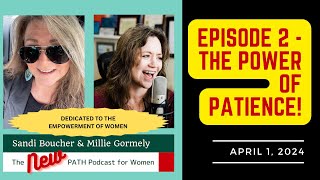
Sandi L Boucher and Millie Gormley explore patience as the foundation for women's empowerment, linking it to financial stability and self-determination. They share personal stories about learning to wait, and recommend Daily Stoic and Wolf Pack.
Chapters
Foreign. Welcome everybody, to the new Path podcast. I had so much fun last time and I'm so looking forward to this, our second episode, because we're just amazing experts at this. And right now I'd like to introduce my dear friend and financial planner for full transparency, Millie Gormali. Millie, take a shot at introducing yourself.
Well, thank you very much, darling. My name is Millie Gormley. I am a middle aged white chick from Thunder Bay. My project in this life is to help women get their financial act together so that they can go out and do their mission while being calm and comfortable and confident about their futures because they've got the money piece taken care of. I'm a musician, I'm an actor, I'm a cook, and I appreciate a nice glass of wine at the end of the day with my husband and my cat. Not necessarily in that order.
Sometimes the cat totally vetoes the husband.
Some days, yes, she does.
I'm gonna give you that one. I have two cats, no husband, so my name is. Yeah, read into that what you will. But my, that's a totally different P.O. guess. Okay. My name is Sandy Boucher. I'm a proud member of Seine River First Nation in Treaty 3 Territory in Northern Ontario. And I've got a simple, small little vision of reconciling a country. I am just, you know, something we can get done by Tuesday. I'm all Indigenous Canadian reconciliation. So whether I'm in the communities empowering Indigenous people to remember our strength and our resilience and the power of our teachings, or I'm working with non indigenous corporations, businesses, nonprofits to help them understand one, what things look like from our view, and two, all the stuff that wasn't taught to them in school. There's so much missing information. And I get to work with the best people because they want to understand, which just gives me hope. And then when I'm not doing that, not hanging out with my cats, I get to come on here and hang out with Millie and do this podcast, which I absolutely love. So I got a question for you, Millie.
Do tell.
Okay? Do tell. She is the bravest woman I know. Because there are people out there that if I say I get a question, they get really nervous.
Well, this is why we're not doing this live, right?
This is true. This is true. Not answering that, Sandy. None of your business. I don't ask those kind of questions. But anyways, what kind of feedback did you get to episode one?
Good feedback. I had quite a few people coming in on my Facebook page and telling me that they loved it and that they've subscribed, which absolutely makes my day. So thank you very much for that. And yeah, I mean, I know I enjoyed it. And to be honest, whether or not millions of people decide that they love to. To hear from us, I think it's important that we talk anyway, you know, so I'm happy with the response that we've gotten so far. So thank you to everyone who, who reached out and we do have more, and we are going to make good content regardless of whether or not, you know, it becomes, you know, popular quote, unquote. But yeah, so far, so good, I would say. How about you?
I was really happy with the number of views.
Good.
Which, which surprised me.
Cool.
Amazing feedback. What I loved the most, and I think the most common response I got, and it just made my heart sing, was that people loved our friendship. Like, the laughing, the. The bantering and, and I was like, I know, right? So I think, and I'm just guessing here, but I think, like, we live in some pretty scary times and there's some really heavy things going on and being able to talk about important things while laughing, while enjoying a friendship, I think people wanted to be part of that. They wanted to listen and, and, you know, get the dumb jokes and, and just enjoy our banter. And I, like you said, I know I have such a blast doing the first episode. And I think that comes across when you're authentically enjoying what you do, yet don't have to say you're enjoying what you do. Right.
Well, that's the thing. I mean, you and I have both been involved in, you know, producing content, I guess is the technical term. I mean, you're, you're, you do way more of it than I do. It's something that I've been doing and that I want to do more of because it's a way to promote my business and a way to introduce himself to clients and all that kind of good stuff. But the idea of being authentic and being yourself when you put out content or when you record something or when you put it out into the larger world, people say that a lot. And that's definitely something that people respond to. And the whole idea, actually, this whole. I have got a whole book downstairs, I have to pull that up and reread it again about being authentic. You know, how. How authentic are we being because we're not telling everything about ourselves. I'm not telling you, but I weigh today mostly because I don't even know. I haven't gotten on the Scale in a while. I don't want to know. But, you know, that. That whole idea of putting yourself out there, putting your real self out there, but keeping a little bit back for yourself, it's always. It's a fascinating kind of a balance that we are. We're always kind of, you know, walking a little bit of a tightrope that way. But I know that I want to be able to say things and talk about things and not be ashamed or afraid of what other people will say when I say them, you know, if you don't like what I say. All right, good. Good on you. Good for you.
Yeah. In the words of the amazing Brene Brown, shame needs silence to survive.
Yeah.
And I just refuse to do shame and guilt in my own life or with my audiences. It's one of the reasons I'm so popular with non indigenous audiences. I don't know who they hired as a trainer before me, just putting that out there, but I walk into so many audiences and they're on guard. Like, they're expecting an attack. They're expecting to be crucified. And it's like, why did you show up? Like, I wouldn't go because it's mandatory. I have zero interest in doing that. We inherited this. We, the collective we. And if we can actually talk about it and. Okay, I'm. I'm going out on a limb here. We're going to talk about authenticity and not having shame and go ahead and crucify me for this. I don't care, because it's honest.
Yeah.
As an Indigenous woman, I knew. I was well aware of the fact that Indigenous women in Canada are desperate for safe spaces. There are so few places where, never mind physically safe, because even those are limited, but safe to carry our teachings, to share our worldview and not be attacked or crucified or considered devil worshippers for doing that. When I started working, sad to hear that. It's just right. Right on our traditional lands, like, right. But when I started working with non Indigenous audiences, and it didn't take me long, but it took me a little while to clue in. Second, third time, the comments I kept getting after the session was, thank you so much for creating a safe space where we could answer our questions. And I'm like, what? Well, like, why wouldn't I? I was minimizing it. And then I realized, to my shock, and I will own this, non Indigenous people need safe spaces, too. Well, that's some place where they can say, I don't know that word. I don't know that History. I don't understand what intergenerational trauma is and not get attacked for it.
Well, yeah, that's the thing. Right. Because there is so much ignorance in mainstream or white communities that we weren't taught these things, but it feels like somehow we are now expected to know them and to understand them and to know all the terms and understand exactly how everyone else feels. And it feels like if we ask a question or if we say the wrong thing, we're going to be targeted or outed or considered racist. And yeah, you know, white fragility is a thing where we're afraid of being called racist. We don't feel racist even though we have racist attitudes that we're even. I'm sure I've got some crap in the back of my brain that was put there intergenerationally. I know for a fact there is. You know, and yeah, so the idea of one of these days I am probably going to say something that will offend you and I apologize in advance for that and I'm terrified of doing that. But I don't know that it's not an inevitability.
You know, the way I explain it is a safe space to me. And what I share with my audiences is not a place that is free of those comments. A safe space is a place safe enough that we can have the uncomfortable conversations.
Yeah.
And I can say, you know what, that word you use, that's like, you, you're obviously not aware of this because I'm going to give you the benefit of the doubt, but that's seriously offensive. And I wouldn't know you well enough. You'd be like, ah, okay, I'm sorry, what should I do? That's what I tell my audiences. I refuse to crucify someone for something they don't know how if they don't know, they don't know. So I tell them, use whatever term, you know, if it's problematic, I'm going to point it out. Two, I'm going to explain why it's problematic so I can save you from using it in the future. Three, I'm going to give you a better word to use. And four, most importantly, I'm answering your question. Yeah, that's what we're here to do. Right.
And that's assuming that people are coming in with genuine desire to learn. Right. As opposed to willful ignorance, you know? Well, I just never bothered learning all the new terms. I'm just going to call them Indians or. Yeah, whatever. Right.
Yeah. And in 99 of my audiences are There willingly.
Yeah.
I swear to God I didn't do it. But I seriously considered it charging more for mandatory training. Only because the risk is higher for me.
Yeah.
Like I'm gonna have to deal with way more, excuse the expression, idiots.
Yeah.
In a mandatory training than I would a group of people that are willing and open to learning. What I find is except for the. And one or two idiots sneak in. Don't get me wrong, they always seem to come in there. But 99 of the time the whole group is on guard. When I get there. As soon as I explain the rules and then I'm not attacking anyone. This is not about shame and guilt. I, I can almost see the walls coming down by coffee break. We're having really good discussions. And by the way, I'm just going to throw this in there. Exact same reason why I love working with you. As a financial planner. I was safe enough and comfortable enough to say I don't even know what that word means. And you never once like even facial expression. Because we all know facial expressions can say a lot. Never once. It's like, yes, you know what, I use these terms all the time. I'll be happy to, you know, explain it to you. So. And I think that is so huge that we're going to lose the arrogance. Right. We have to realize we know what we know. But that doesn't mean everyone went to the same school. Right. And. And just meet each other in the middle. There's nothing wrong with not knowing. And we should be in places where we can say we can't.
Absolutely. You know, and yeah, it's. I know what I know because I've been doing this for 18 years.
100% in the same way I'm going to use terminology in a reconciliation conversation, depending who I'm talking to. Sure. If it's someone who's also in the industry where I'm going to say things that no one else understands. Right.
Well, exactly.
If I did that to an audience, I don't deserve to be paid for that event. I'm sorry. Because. Right. Yeah.
Exact same way. Looking down on someone is not a way to, to convince them of what you're trying to tell them. You know, it's not a way to, to convince them to take your advice or a way to convince them that, you know, you are. It's a, it's a way to convince people that you know what you're talking about. But in a very off putting and wall raising and putting up a distance between you. I am above you because I know this stuff and you don't. And if we are really trying to be of service to the people that we're working with, I mean, you're working with groups. I'm working one on one. If we're actually trying to serve those people, it's got to be about where they are and meeting them where they are and helping them to understand the things that we're bringing to the table in a way that is easy for them. It's not about us. It's about the message. It's about the. The concept. It's about the service that we're providing, and it's about how to get it to them in the most effective way possible.
100% the difference between arrogance and confidence. Right?
Yeah.
And this is a perfect lead into the next thing I wanted to discuss, because if you're still looking for validation from other people, like, if I walked into an event and I need all of these people to believe I'm an expert in this field, again, don't hire me, don't pay me for that event. I know what I know, and I am there to help you understand. I got this. Like, we live and breathe the stuff we do. Right. And if you can't have your confidence in your own abilities, then you shouldn't be standing on the stage as far as I'm concerned, because. And we've met those people that are still looking for that external validation and news flash to them. It's obvious, and it's. It's not appealing in any way, shape or form if you have to tear someone else down to build yourself up. Yeah, hard pass.
Makes you think of American politics, but we probably shouldn't.
Oh, that's a rabbit hole. I gotta keep going down.
Another gift.
Too much time. I spend way too much time in that rabbit hole. Anyway, so the question is, because we announced in the first episode that this podcast is all about the empowerment of women. And that's personal for me as Anishna Big Quay, because we believe the healing starts in the hands of the women. So empowering women in matriarchal societies just kind of makes sense. But empowerment is one of those words my mom would call a $15 word really big word that really doesn't say much. But I thought it'd be really cool if just from a personal perspective, because I honestly believe everyone probably has a different opinion of what empowerment, what comes to their mind when they think of empowering people. So I'm throwing it over to you. Empowerment of women. What does that sound like? What does that look like for you?
Yeah. And I think this is going to show a lot of differences between us culturally right here, because when I think of empowerment, I think of it on a very individual level. So for a person to be empowered that they have the independence, that they can rely on themselves, that they can take care of themselves without having to rely on somebody else, that they can do what they want when they want to do it, that they have the power and the control over their lives that they want in a way that benefits them and whoever else they want to benefit. I mean, their family, their society, their workplace, their business, whatever. But to me, when I think of a woman who is empowered, it's someone who is babe in total control of herself.
I love that I have that on my playlist. I need the T shirt. Yeah.
Yeah. So for me, it's. It's a very. It's a very individualistic term, and I suspect that might be a little bit different for you, but correct me if I'm wrong.
You're wrong. I love you. Anyways, so the way I always look at it, because I get hired by first nations all the time, and it used to be we want to create a healthy work environment or we want a healthy community. And I used to come back with that requires healthy people. Like to use an analogy you will love, I use all the time. It doesn't even apply to me. But it's like cooking. If you want to make an amazing meal, each dish is amazing, and inside each dish are amazing ingredients. You're not going to have an amazing whatever you cooked if you use crappy ingredients. Right. So the reason why we as in. We as in the collective indigenous, we don't have healthy communities and healthy work environments yet because we're not healthy yet. It's. We. We're getting there. I definitely see improvements in my near 60 years on the planet, but we have to keep going, and we have to give people time to heal. So, by the way, I'm super impressed that you just rattled that off, because I had to write it down. So you get.
It's something I've spent some time thinking about.
I was like, wow, okay, so for me, and you're in love, so that helps. Oh, I'm. I've. I've switched to water. So by the way, I should throw that in there because we didn't touch on it. If my voice sounds different, I'm getting over Covid, and my doctor told me that I have to stay lots of fluids. When I thought of empowerment, the first thing that came to my mind is self determination. Right. Which is everything you talked about. To me it is having a voice. Right. Then I am free to express my opinion about things, to have a say, to have deceived decision making power in my life. Not over you, but I get to decide, you know, if I'm going to purchase this or that or if I want to have this for dinner, if I'm gonna do, skip the dishes a game. Right. I have the power to do that for me. And again, this comes from the lens of having an impoverished background, stability. So I know the rent is paid, I know the lights are not going to go out. So that financial stability, which comes. And it comes with a lack of fear, I don't need. If there's one thing I knew, and I wish people had stressed this sooner, like everyone talks about making a lot of money or you should, you know, you, that should be your goal or whatever. And then, you know, I didn't, that didn't really appeal to me.
Yeah.
And of course I had a whole bunch of stereotypes I had to unpack because I was taught if you had a lot of money, you did that because you rip people off. So there was all of that unpacking. But to me, having that financial stability is lack of stress. Oh like 100%. When I look back at my life and think of how much energy each month I put into worrying about the hydro bill or worrying about how to pay the rent, then I can now take that energy and apply it to my career. If someone had told me I could bring down my stress and have more freedom, then I would have bought on a long time ago. So it was really into how it was. Free phrase. Right. Like I don't care to have a million dollars in my bank account. Not going to say no if anyone wants to give me that. Just putting it out there. But, but that's not a goal. But having my home, my dream car, like these things I enjoy, that was important to me. To have my ridiculous amount of clothing in my closet because that's something I take joy from. Right. Is, is. And also knowing my kids are grown. I did what I had to do for my children. I raised them, they're on their own. And now that means I get to enjoy perks that I wouldn't have done before. So.
Right.
So that's empowerment to me.
It's. Well, it's a climbing the hierarchy of needs. Right. You know, Maslow's, you know, having that safety, that security, that, that knowing that, you know, if you're going to Go to the grocery store, you can bach and. And go. That cost a hundred dollars. But then you pay it and you. And you go away, you know, with the. Where you're not having to worry about where your next meal is coming from or when the next tiger bill is going to be paid or like.
Every single person out there hearing my verse voice, who has ever had to eat what's in the cupboard, not because you wanted to, but because that's the only thing that was left and there was no money. And why do we buy those gross things that we have to eat on those days? Yeah, but like you were just saying one of the things I noticed this was so weird because it lasted so long. Like even after the money was way more stable and I wasn't in that situation anymore. The almost panic. And I don't want to minimize people that have panic attacks, so. But the almost panic I would feel at that split second when I'm going to pay for my groceries and will it go through? Like, will my bank card work?
Yeah.
And I would catch myself like, of course it's going through. What are you doing? But identifying that holy moly's. I used to put in that stress, that energy every single time.
Yeah.
And it absolutely.
It took me. Yeah. And it took away from you being able to. To get beyond that point. Like, it's been a very long time since I've had to worry about, you know, only eating what's in the cupboard because I have no money coming in for another, you know, week and a half or whatever. But you remember that, you know, you remember what that's like. And to be put back into that situation again is terrifying. And yeah, you're right. It takes up so much mental and emotional space in your life worrying about the basics that it's not possible for you to. To really accomplish anything beyond the basics. Right. Being. Being poor is freaking exhausting.
Yeah. It sucks. And we all get on it. Like, there is a huge difference between humility and poverty. I like to believe that I am still a humble person. I know that everything I have is because a lot of people took a chance and handed me a microphone and believed in what I could do and. And gave me a leg up. When I believed in me, I didn't yet believe in me. So there is no arrogance in my game. That doesn't change because there's money in my bank account. It doesn't make me better than the person living outside. Right. So. And. And that's a choice. So you can still be. I know. Amazingly Beautiful, big hearted people that are well off. And I know amazing people that are impoverished. I also know idiots that are impoverished. So it has nothing to do with your bank account?
No. Your character is not determined by your net worth.
Yes. You know what? I heard a quote, and this is not my fave quote for the day, but I heard this ages ago. And I don't know if you'll agree with this, but it made total sense to me. The person was describing money and the way they looked at money was it's a magnifier. So if you're a good person already doing good things and you come into money or you earn money or whatever, you're going to be a good person who's able to do more good things. And if you're an idiot who's already ripping people off and horrible to be around, you're going to have the power to hurt even more people and do more damage with money. But it doesn't change who you are, it just magnifies who you are.
I think what changes sometimes though is your relationship with other people. So you know, you win the lottery and all of a sudden you've got way more friends than you used to and people are coming around asking you for stuff and, and people are, are starting to, to second you. They're starting to make you second guess yourself about whether you're still the same person that you were before because they want a piece of it.
And you know, for the record, it does not take winning the lottery for that.
Well, yes, I mean that's, that's sort of the classic example. But yeah, I mean anytime someone sort of, I don't want to say rises above because it sounds so, it sounds so arrogant to say that I am now above you because I have more money or whatever. But it's, it's very difficult for some people to deal with it when someone else is succeeding. It makes them feel self conscious, it makes them feel ashamed that they haven't done that for whatever reason. And then the way they cope with their own feelings of inadequacy is to try to tear that person down. And that is one of the saddest things.
So there's that thing again. You either build yourself up or tear someone else down. And it is, let's get real, it's easier to tear someone else down rather than do the work to build yourself up. Yeah, I would rather build myself up any day of the week. Back to that self determination. Like personally, I had one person, this is years ago, who, and it was someone I Knew like a friend that I had had for years and through the grapevine or moccasin telegraph, or however you want to put it, I had heard that she was telling people that I had forgotten who I was because I was now doing well and the whole bit. And I was like, if you honestly believe that, you had no idea who I was or am, because the only thing that's changed is I'm no longer wasting time worrying about my rent. That's it. Right?
That's it. Right. And why should that make someone else feel entitled to poop on you?
And I think in both our cases, if that person instead had reached out and said, how'd you do it? Because I've tried a whole bunch of things and I. It doesn't work, I would have the time to share that with them. It is not some dark secret that, like, no, you're going to figure it out on your own. I would happily tell you what worked and what didn't work for me. Not saying it's going to work for you, but I can definitely share my story. Right? Like what?
Because people don't see the work. They don't see the amount of time and effort and energy and strength and utter BS that you put up with and struggle through to get to where you are. They just see where you were and they see where you are now. They don't see the in between, and they don't get it.
And I think if there's one thing that's absolutely true, nine to fivers do not understand entrepreneurs because we're weird ducks. And I know I totally own that when. True story. When I first started my business. So living alone, I'm the only one that's got to pay my rent and pay my utility. So I. Looking back now, I am so thankful for that, because failure was not an option. I have to succeed at this. Otherwise, I'm living in my car. So this is where my brain went. Yeah, I'm gonna. Like, a couple times I was like, oh, my God, I'm gonna end up living in my car. But wait a minute. Then I could drive across Canada and I could write a book about living in my car and I could sell the book. It's a true story. Like, I'm gonna. Well, if that's what's gonna happen to make me successful, then that's what's gonna.
Yeah.
Oh, my God. So thank you. Know what? I can honestly say I'm in my 15th year in business now. Fifteenth year is way easier than year one to five.
Oh, God.
But you have to do one to five to get to 15.
You've gotta. You've got to struggle. You've gotta.
Well, I had to learn that what I was doing didn't work. Like, I had to have it fail so I could learn a better way. The things I do as second nature now, I didn't even know back then, but people think they have to know all that stuff first. This is a trial by error kind of.
Well, and that's the thing. Because what worked for you might not work for somebody else 100%. Right. Like there's so many. There's so many things out there that you can do to, to work with people or get clients or sell stuff or, you know, whatever it is that. That is the market or success in your business. But yeah. And I've spent many years observing what other people do as well, thinking, well, why doesn't that work for me? Because it's not me. You know, and it takes. It takes time to figure out what is you. And there's like. Entrepreneurship is a personal development journey, for lack of a better word. I'm starting to hate the word journey because it's getting overused.
What is the best personal growth journey ever? Like, I. I love that you said that. I have had to dance with every ghost that was part of my party. Like at some point. Lack of self confidence. Oh, well, we better deal with that if you think you're going to convince other people to believe in you. Like all of that baggage had to be dealt with. And I honestly don't think that would ever happen if I was working nine to five for someone else. And I did that for a lot of years. I'm not slamming that in any way.
Yeah.
But whole. You want to be an entrepreneur, do you?
Yeah.
You've got to figure out who you are 100%. And that's where we're back to authenticity again. So I guess the difference in the way I look at authenticity is everything I say has to be real. That doesn't mean I say everything.
Yes.
Right. Yeah. So. Because some people just have not earned the right to hear my mom's personal stories. Quoting Brene Brown again. Right. But when what I do choose to share is authentic, it's real. Yeah. Can I'll quote it six months from now. It's going to be the same thing. Because it's real. Trust. I don't have the memory to lie even if I wanted to, because it's.
Exhausted to try to remember what. What Persona am I today? And try to remember what that Is like, I. I do community theater and have for years. Right. And the amount of energy it takes to be somebody else and to remember who they are and remember what they're supposed to say. It takes a lot of energy to do that. If you're trying to carry that around into regular life with people who don't know the script, it's exhausting. It's hard, and you can't do it.
I know. In my career, I honestly believe that's why I'm successful. Authenticity and vulnerability. That I will share those stories to make a point so that the people that are still suffering from whatever I'm talking about don't have to try to explain it. I put the words to it. And I believe we live in a time that authenticity is still so rare that when you hear it, it resonates. Right.
We should take advantage of that while it lasts before AI figures out how to be authentic.
Okay. Seriously, sir, I'm terrified. Author. Right. My career started with blog posts almost daily. I have some program offering that AI could write your blog post for me.
Yes.
And it's like, would you like to, like, there goes my career. Like, authenticity right out the window. Do not get me started. So last episode we mentioned, this is the New Path podcast. And for anyone who follows my career, Path is actually. The Path is the name of my third book. I'm moving the wrong way. It's that way. There, there. Okay. There it is. And the Path was what I called the four sacred or essential tools that you need to reconcile. I don't care what groups are reconciling. So it was patience, awareness of what's going on. For the other group, tenacity and humility. But what we alluded to in the first episode is this is the New Path podcast. I'll focus on the empowerment and women now. And we're still using the Path acronym, but it's changed. So. And we kind of just left this open. We knew what the theme was. But I have no idea what Millie's gonna say. She has no idea what I'm gonna say. Welcome to our world.
Sometimes we have no idea what we're going to say ourselves.
That's totally, completely true. I will give you that. The P in the new acronym is for patience. Because I honestly believe whether you're talking about empowerment or whether you're talking about success, whether you're talking about personal growth, there are times you have to be patient with other people or with yourself or with your growth or whatever it is. So what we wanted to share with you, this, this episode almost said this week, that's a precursor of future. Anyway, is what when patience reared its head in our journey. And hopefully that resonates with the people that are listening. So, Millie, I'm going to throw it over to you. I'm dying to hear what came to your mind. Talking about patience, because we're both known for being patient people. Just putting that out there.
Yeah, right. Okay.
So.
But, but that, that. My knee jerk reaction to hearing we're going to talk about patience is I don't have any of that. You know, that, that's, that is not something that I've sort of traditionally ascribed to myself. I don't feel like I was born with a lot of it. I don't, I don't have a lot of it. I've had to gain some and I've had to learn how to be patient over the years. But, you know, I was one of these kids that was always running around trying to get to the next thing. And apparently I came home from kindergarten that, you know, five years old and, and I was all ticked off because I told my mother, my mom tells me this now, that I didn't learn anything today. You know, I went through time, I wasted my time. I went there for like a whole half a day. Because that's what you did back. Back in the day. I went there for a whole half a day and we had like a snack, we played and I didn't learn anything. I was right, ticked.
I just figured out why we're friends. So.
So, yeah, so the whole concept of patience is something that I've had to consciously cultivate and consciously learn. And probably the biggest example of that was quite a few years ago now. I had some health issues. I had to have emergency back surgery. I had to have a second back surgery eight months later. I spent an entire calendar year on morphine. It's sucked. I do not recommend it. And it took me a long time to recover from that. And it required an enormous amount of patience that I had to come up with. I had to pull out of my butt that I just did not have prior to that. That whole experience taught me how to be patient with myself, with my, with my body, with the rate that I was healing, with the fact that I couldn't do everything that I thought I could do. I thought, thought that I could work 16 hours a day and multiple jobs and run myself into the ground and that was the way to succeed. And I learned that that is not the case. And I learned that, you know, being Patient with yourself is actually kind of harder than being patient with other people. Like, we hold ourselves to standards that we wouldn't hold our best friend to. You know, like, if you were going through that and you were trying. You were telling me all the things that I was doing back in the day, I had my. Okay, this is how long ago this was. I had my BlackBerry in the hospital with me. I'm on a freaking gurney in a side room because I didn't have a full bed at the time. I had to wait for my emergency surgery for four days. So I was on the morphine and jello diet. So you wake up in the morning, they say, okay, you might get your surgery today, so we can't feed you. All right, fine. Then you wait till like 6 o' clock in the evening. No, you're not going to get your surgery today. So. But you can have something to eat. Well, there's nothing left. It's. It's, you know, peanut butter and crackers and working. And so you did that for four days? You know, I lost six. I lost six pounds. I don't recommend the diet, but it is effective, you know, so where was I going with that? Patience. Yes. And I had my BlackBerry with me in the hospital, sending out emails to clients, like, that's flipping insane. And I did it because I thought that's what I needed to do. And it took a long time to learn. Obviously, I didn't learn it well enough the first time because after the first surgery, I went back to work within a month when I should have.
I was just gonna say, I was like, you can confirm or deny, but didn't you have to have this second.
Surgery eight months later?
Kind of pushed it, as I kind.
Of pushed it too hard after the first one. Yes.
I was like, I remember this.
Yes, yes. So it was. It was a thing. So, yeah, it. Patience is something that was forced on me. It's not something that I actively sought out. It's something that I had to. I had to obtain and learn to work with or I would have destroyed myself completely.
Yeah.
So patience is a big word for me.
Yeah. From. I always joke around. It took me 10 years to learn how to spell that word. I just don't have it in my vocabulary. From an Anishinaabe teachings perspective, by the way, any elder will tell you that physically healing is the greatest teacher of patience. Like anyone who's been down any kind of journey like that, your brain is going, I need to work today. Body's going, don't care. Right. Like, right, yeah, yeah, I totally, totally get that. So patience for me, so again, learned virtue. Definitely didn't get handed that one when I was born. Like, nothing move red thunderbolt woman here. Okay. Nothing moves slow in my life. My friends have teased me for years that if there's any length of time in between, we've seen each other. When they ask me so what's new? And I rattle off what's changed, they're like, you live like three lifetimes in the time that one person lives a lifetime or a normal person. For me, I had to learn that desire doesn't equal patience and that hard work doesn't equal patience. When I started my business, I have no issue with hard work. I will, like I am my parents daughter and I will give it everything. Working hard and putting in all that time and effort doesn't mean that 10,000 people found my website, right? That it takes a while to build a following. It takes a while for people to believe in you. It takes a, it takes a while for the income to get steadier and that there's going to be those ups and downs. So really having patience with the world, not wanting to kill them for not just believing in me and jumping on and why? What, why are you doubting me? Hello. But so I had to, I see a go trip there, by the way, anyway. So I had to learn that. I had to learn, learn patience with my audiences because I have first nations people who have so internalized their oppression, they don't believe anything can change. And instead of. And having compassion and empathy for that rather than judgment because they get enough judgment. Thanks anyways. And then even with my non indigenous audiences. So here's a story, story for you. It always seems, excuse, everyone's going to crucify me for this one. But just based on my experience, okay. It always seems to be like a 6 foot 5 white guy wants to get in my face saying, well, why don't they just. In some horrific thing about indigenous people, it's never a female person or it's never someone smaller than me. It's always someone who, like power tripping, towering over you. And when that first started happening, when I first started working with non indigenous audiences, that used to get my blood pressure going. Like, hello, physically intimidated, right? Like, like I will go red thunderbolt on your butt. And like, just because I don't do it often doesn't mean I don't have the ability. So like just back up the bus. But I realized, okay, like one day, sitting by myself in my office Thinking, okay, Sandy, if you want to do this career, you can't keep putting your health on the line. You can't keep having your blood pressure go through the roof. Your doctor's gonna freak. This is not healthy for you. You gotta come up with something here. So what I started doing, and I actually have some pictures that I use when I share this in seminar, instead of seeing this person in front of me, I started envisioning the four year old little boy he used to be and understanding that all that stuff he's saying, someone taught him that. Yeah. And it actually got me to the point where I started thinking, instead of like, what an idiot I was thinking, I wish you had never been taught that. Like, I am really sorry that happened to you. Now let's talk and maybe I can share some things with you that might change that a little bit. Maybe not, but I'm not going to hate you because you had no control over what you were fed as a child, neither, by the way. And this is not about hating the person who taught him that because they were taught that by someone. Right? So it's less judgment, more patients. They're not ready to understand it yet. Maybe they will be in six months or six years. Or maybe they're not the link in their bloodline that gets it. Maybe it's their children that are going to get it. All I can do is the best I can do.
Yeah, it's a different form of, I don't want to use the word trauma because that's not quite what it is, but it's a different form of intergenerational trauma that people have these attitudes that.
That were passed down to them that programming the stereotypes. And again, if we weren't allowed to interact with each other, like that's why I'm always, I'm so adamant that one culture can never speak for another, because cultural lens, right? You're going to see something an indigenous community does and interpret it based on what you know. And that may or may not be accurate. And I've read some really horrific intelligence interpretations of like what we do at powwow. And it's like that is not even close to why we do it. Right.
So the anthropologists have a lot to answer for.
Right. So patience just in. And again, I lean so hard on my teachings. I am so thankful every day to be Anishinaabe, we believe without question that everything happens when it's meant to. So if I'm not succeeding at that yet, it's because I don't know what I need to know to succeed at that yet. So as long as I keep growing and keep learning and. And I'm humble enough to look at what I've done and realize that doesn't work for me, like you were saying earlier, that might work great for them. That is so not me then. And I think, I bet you will agree with this. The benefits of getting older, the more authentic you get, the more successful you are. Like, yeah, two, three years ago. She's gonna deny that. She's gonna say I'm lying. Trust me, from the career perspective, put personal aside for a sec, all right? I was always way more blunt, way more direct in my personal life than in my professional. Professional life. And that's. That's. My sister in law would call it toilet training. That's just, you know, growing up indigenous in Canada, you learn, you're not that vocal. Okay, Maybe five years ago, when I decided to do ranch warning, okay, this has to be said. And all of a sudden, my popularity went up. I was getting hired more often. I was more confident. It's like, whoa, what? Right when I stopped holding myself back, stopped playing small and shared my voice, backed with fact, backed with what I knew that's what people needed to hear. It's like, don't play nice. Don't tiptoe. Tell us what we need to hear. And of course, I do it respectfully. I'm not attacking anyone. But sometimes it's like, okay, we got to talk. Right? And for me to sit back and go, I had to be more me to be successful. Like, I had no idea, but it's true.
Okay, so here's the white lens coming back at you again. So when you say that you became more. More confident and more able to speak out from a cultural perspective of indigenous women, wasn't that going against tradition to some degree?
And that was actually going back to tradition. Remembering matriarchal societies. We used to run the communities. The silent indigenous people is. Or Indigenous women is missing and murdered Indigenous women and girls. That's colonialism, okay? Like you. And if you ever have a chance to get around any Haune women, Iroquois women in southern Ontario, They scare the daylights out of us. More humble Ojibwe. I'm not saying they're not humble, but they are strong. And they make no apologies about their strength.
And it's put up with no crap. Whoa.
Like, it's just like, you know where you stand and that you have nowhere else to move. But yeah. So it was going into your warrior strength, going into our responsibility, being Older leaders to inspire the ones that come next. So it was going against what colonialism wanted us to be and going back to who we are.
Well, that's it. Because it. It benefits colonialism if people are quiet and afraid. 100% benefits.
Especially if you're different.
The oppressor.
100%. Silence always helps the oppressor. Exactly. So there's patience, guys. So there is hope for you if you have no patience.
Because we're living proof, like naturally born patient. I don't know if I know any, to be honest.
They don't want to be anywhere near. But you know what? Honestly, like. And now. Okay, I'm going out on a limb here again. Okay, Is it patience or is it complacency? Right? Because some people I've met that they're just waiting for that ship to come in and it's like, is that fear of trying? Because there's a difference between. Right? Like there's a difference between I have to wait till my next Amazon order comes in and if it doesn't come soon, I'll order something else. But. And not trying. Yeah. Right. So I think. And I get it. I get the fear of trying. I get. Right. And by the way, that's oppression as well. Internalized oppression. Women are an oppressed group.
We are.
Right. So the fact going out on your own, daring to have a voice, daring to do it your way is scary. So some of the best thing I ever did.
Likewise, 100%. Yeah.
Y. So we're coming close to the end here. We promised you that every episode we were going to share a book recommendation with you and a quote that since the last time we chatted, just really resonated with us. So, Millie, what do you have for your book recommendation?
Right, so for my book, this is something that I keep on my desk that I try to read from. So I. There you go. So this is. Is called. Called the Daily Stoic by Ryan Holiday. 366 Meditations on Wisdom, perseverance and the art of living. So it's basically stoic philosophy, ancient Roman type of type of stuff. Roman and Greek. And it for me it has replaced sort of a daily devotional. I used to do that a lot. I was raised Christian and very Christian and I've kind of left a lot of that behind. But to me, stoicism is the idea of just taking life as it is, working with what you've got, not making it personal and just taking care of what need do, do what your business needs to do and take care of yourself, you know, so it's, you know, every day you've got a little, little reading to do and you learn some, you learn some stuff. So for instance, I'll. Yeah.
So.
Oh. Xena would also say, I don't know who Xena is. Nothing is more hostile to a firm grasp on knowledge than self deception. Think about that.
Ah, yeah, yeah. And that's it. The point, right? It's going to make you think about it.
It's going to make me think about things, which is good. And as far as a quote goes, I've got my little vision board on the side of the. On the wall of my office as one does. And I've got something on a post it there that I've had for years and years as a reminder that, you know, sometimes you just gotta let stuff happen at its own time. And it's called, it says sitting silently doing nothing. Spring comes and the grass grows by itself 100% right. And I need to be reminded of that sometimes that I cannot force things to happen on my timeline. Things are going to happen when they're going to happen. So that's. Yeah.
We are so friends. Because I have definitely tried to change the calendar. I can just will this to happen by tomorrow. No, I can't. No, I totally can't. Other side. I knocked my little Fluffy off my microphone. Other side. My cats are going to love that. They're going to be playing under the table, under the desk in two seconds. Other side of the realm from your book. So that's where you, you know, your strength and your stoicism. But if you want to go hardcore activist, then you got to read Abby Wambach Wolf Pack. Now this is. I read it in like an afternoon.
Okay.
I also read it like 25 times. So. Ambie, Abby Wambach is a two time Olympic gold medalist, FIFA World cup champion and the highest all time international goal scorer for male and female soccer players. So she is an activist for equality and inclusion. Now her, the whole premise of this book is we're not breaking the old rules. Rewriting them. Right. As women. So her, it's very short little chapters, but at the beginning of every single one she starts with old rule, new rule. So old rule, for example, beginning of chapter three, old rule is wait for permission to lead. New rule is lead now from wherever you are.
I like that.
Chapter five, old rule be against each other. New rule before each other. Right. And I think women grasp that in my opinion, faster, more easily than men will. Right. Yeah. That is not the competition like I said earlier, you want to know how I got here? I will share every flipping detail you want. Right? Like, that's not. I don't do that competition. When someone else starts doing the same kind of work, work as me, my brain goes, think creator. Because we need way more of us. This is a big country. I can't do it on my own. The one that's going to be my quote for today is from chapter eight and it says, old rule, you're on your own. New rule, you're not alone. You've got your pack. And that's why it's called Wolf Pack. Right, Wombach. I, writing it down, highly recommend this book. Like I said, it is such an easy read. It is so authentic. It's her story. It's what she learned from her career and after her career, just realizing the boxes you don't fit in even, or if you ever did. Right. So definitely, definitely recommend it. Cool. That is bringing us to the end next time. So we're continuing on with this acronym. The P was for patience, which we both struggled with.
Yes.
A. Yeah. You can imagine what the next episode's going to be like because A is for action and how important it is if you want to become that empowered version of yourself. Thank you so much for joining me again, Millie.
This has. So happy to be here. Loving this, having so much fun doing this. And I hope you guys enjoy listening to it as well. So please make sure to like and subscribe or whatever the format is to follow us and, and keep hanging around and. And let us know what you think. Seriously. We do want to know. But be nice.
Yeah, and. And we do read the comments. We're not so snotty and so whatever that we don't. I love reading the comments. I love knowing it's resonating. If you have a question in the realm of women's empowerment, please post it on whether it's on YouTube or any of the social media posts. And we will see it and we will definitely add it into the repertoire. So fabulous. Until next time, hun. Did you just come back from holidays or you're going soon?
Going next. Well, let's see. When does this. When are we airing this? I will have just gotten back from holidays when we. When we air.
So we'll have to talk about that next time.
Yes, well, there won't be much to talk about. I sit on a beach and I stay stare at the ocean and I read a book for a week. That's pretty much it. And I love it.
Yeah, no, pretty much what I did in Cancun and highly recommend. And actually, I don't know if you know this, but one of the things fits the podcast that I do as far as empowerment. I'm big time into visualizing and manifesting, and we should definitely talk about that in an episode. So because I'm such a visual learner and because I create content all the time, I actually created a manifestation video that was a series of things I wanted. My Mustang is in it. And recently, like two days ago, what I did was I realized things have changed since I made that video the first time. And I went through it and I added in check marks for the things I've achieved. One of them was that Southern beach, and it now has the check mark on it. So, yeah, it's. It works. It's amazing, right? I can't. I'm going to be sharing it with my staff at our staff meeting. So it's like, guys, I couldn't do this without you. So, yeah. Okay. You take care of yourself. Beautiful, everyone, thank you so much for checking out the New Path podcast, and we'll see you next time. Love you.
Bye.
Bye.
More from Sandi

How I Handle "The Four Uglies!" (Alcohol, Diabetes, Healing & Cheap Seat Comments)


All the Stuff We Don't Talk About with NO SHAME! (WMT Podcast w Antoinette Godin)


When Authors Chat ... (Radio Interview for the Launch of "Copper Stone - Glimpse of Blood Memory)



MORE PROOF of Indigenous/Non-Indigenous Relationships that Work! (Walking My Talk w Millie Gormely)
