Racial Gaslighting - Heard of It?
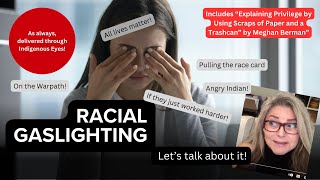
A short, personal YouTube monologue by Sandi L. Boucher introducing and reflecting on the concept of "racial gaslighting." Boucher defines racial gaslighting (minimizing or denying race-based harms), gives multiple workplace and societal examples affecting Indigenous people in Canada (e.g., "All Lives Matter," "pulling the race card," stereotypes, and "just work harder" explanations), connects it to racial battle fatigue, and shares a privilege-exercise anecdote illustrating structural advantages. She closes by inviting viewers to share examples.
Chapters
So a while back I shared how in the beginning of my career I would be walking around my apartment or walking around my office and suddenly I would get an idea, something I would want to say to you, the listener, to impact you, to encourage you, to support you. And I would race over to my desk where my video camera was back then and I would turn it on and I would shoot the video and I would release it. I knew nothing about editing, I knew nothing. I definitely didn't batch videos together. It was straight from my heart to yours and I'm okay with that. And then your career goes on and suddenly I'm scheduling videos and deciding ahead of time and I'm shooting them together and it started to feel robotic, it started to feel less authentic, less impactful. So a while back I shared how I wanted to go back to that authentic type video. And that's what you're getting today. This, this is a Sunday morning on the deck attire. That's it's Sunday morning when I'm shooting this. And I was watching some videos and then my left video. Are you surprised? Not really. And doing some social media and I came across a phrase that I hadn't heard before but it was one of those lightning bolt moments that wow, that sums up everything. And the phrase, the term is racial gaslighting. Let's talk about it. Samju Mishko Pagnan Queen Additiona Kasmandodam Hi everybody, my name is Sandy Boucher. I'm Red Thunderbolt, woman of the Loon clan, a proud member of Zane River First Nation in Treaty 3 Territory in Northern Ontario. And as I mentioned in the opening today, I want to talk about racial gaslighting. So in common layman's terms, I think you know what gaslighting is. It is you going to your partner and sharing that something is bothering you or you're concerned about something or something they did or said has upset you and their response is to make you feel like you're crazy, to make you believe you're imagining things or you're over exaggerating it is way more than minimizing. It is not only are you wrong, you're crazy to believe that that's gaslighting. And when I heard the phrase racial gaslighting, honestly I kind of stopped in my tracks and thought, well that's kind of my life. That's kind of what indigenous people deal with on a regular basis, especially out in the non indigenous world when we're interacting, working in a non indigenous space and trying to, to have a voice and to Matter and to. To stand up for ourselves, to dare to act like we have value in a world that tried to teach us, we didn't. And even if that organization is not setting out to do that, if we get dismissed every single time we say something bothers us and it's dismissed and gaslighting is used. Well, now we're dealing with racial gaslighting, which results in another term I've used in the past, racial battle fatigue. We get exhausted. Then to one of two things are going to happen. We're gonna ghost, we're gonna leave this job. And. And your reputation's taking a hit, at least in Indian country, because we're telling everyone how horrible it was to work for you. It's a way to protect our own. Or we go silent and then we're still there. It still hurts. We're still exhausted, we end up on stress leave. Or just incredibly mentally and physically exhausted. So I wanted to talk today about racial gaslighting. As I said, I was on my deck, so I have my book. Not a handy dandy index card. Pretty sure the index card would blow away. But anyways, I actually came across the term. I was scrolling LinkedIn and the article that was referencing it was referring as an example of racial gaslighting is the All Lives Matter movement. So, which was in response, of course, to the Black lives matter movement. 110% an example of racial gaslighting. Like, I mean, I saw All Lives Matter and went, duh. Problem is you're not acting like Black Lives Matter, which is why there's a movement. And of course, I came out of the States before and then accelerated by Floyd, what's his first name? I just had it and then it escaped me. So many examples of black people being killed, harmed, hurt by non Indigenous, non black people, white people in law enforcement. So All Lives Matter matter would be an example of racial gaslighting. So trying to imply that the people that are saying Black Lives Matter are crazy, that it's overreaction, that of course they do. Right? What. Anyways, so I asked myself, as I always do, what comes to my mind as an indigenous woman living in Canada, what comes to my mind when I think of racial gaslighting? And the phrase that came to my mind almost instantaneously is pulling the race card. Every single time we talk about that employer is hard to work with, or that college isn't very supportive, or that program or process is the example of systemic racism, you will see the eye rolls, you'll hear the sigh, and you'll hear Someone say they're pulling the race card. Again, that is an example of racial gaslighting. Dismissing what we say not only as an exaggeration, but wanting us to believe there's something wrong with us for even thinking there's a problem. You see how insidious this is. Another one is the entire angry indigenous woman, angry indigenous man, angry indigenous person stereotype. I mean, look at the chapter of Indigenous history that involves settlers, settler descendants, or Canada. It is not hard to find an example of some reason why we have the right to be upset. A million plus empty promises comes to mind. So dismissing our justified response as just an overreaction or an angry indigenous person stereotype is racial gaslighting again will lead to racial battle fatigue. Next one. Oh geez. So sticking with the we're upset and we're angry. I don't even want to count how many times I've heard someone say so and so's on the war path. Again, it's always laced with this overreacting. They're not professional, they're not being fair, they're just emotional. Whatever you want to put in there. So again, blaming, attacking and diminishing racial gaslighting. The last one I came up with, and I forget what this, there's a phrase for this. I forget what the academic title for it is. I really don't care what the academic title is. I'm more understanding this is happening and helping people done to understand it. And it's the whole idea that indigenous people wouldn't face, wouldn't be in the situation we are in economically, health wise, socially, whatever the case may be, if we just worked harder. So I actually used to do this in seminar. I haven't done it in ages. Megan Berman, years ago, I don't know, it was ages ago, wrote a blog post and called it explaining privilege using scraps of paper in the trash can. And like I said, I've done this in seminar. So I'm standing at the front and I put a trash can. Think of that kind of trash can you used to have in every classroom I've ever been in. That kind of trash can, put it up at the front and get every single person in the room to take a piece of paper and ball it up into a ball. And then I would explain the instructions to them without moving your butt, your butt has to stay in the seat. Take your best shot at throwing it and getting it into the trash can. So I step out of the way. One, two, three, go. All of these projectiles are thrown. I am certain Many hotel cleaning staff has hated me as a result of this exercise. We did our best to pick them all up, but you never know. And then I would ask the question, was that exercise fair? And of course, used to be a pretty dramatic response, no, that wasn't fair. The people in the front row seem to be pretty quiet, so obviously. But it is a perfect example of privilege. And what I have noticed in my 15 years of doing this work is the people in the very front row. So in real life, you would think of these people, they come from affluent families, they had access to and took part in the highest levels of education, they had access to tutors, their the student teacher ratio was smaller in their private school, they had access to health care, they traveled and experienced other languages and other cultures. The epitome of privilege. That's the front row. And what I have found over the years is the people in the front row never argue that they have privilege. It is so obvious they know they have privilege. The problem, and we see this going on right now, is the front row is where our politicians come from. And it's pretty understandable why they can afford it. They can afford what it costs to run a campaign. They can afford to take the time, they have the connections to the donors that will financially support their campaigns. All of that understandable, not attacking anyone, problem. They represent the front row, the decision, their cultural lens. The decisions they're going to make are to support and encourage and, and guide and help the people in the front row, the people like them, because that's their life experience now. Same too, with the people in the very back row. These people know they're in the back row. And I always think of indigenous people in our most northern communities. We're talking about no fresh running water, we're talking about a nurse at a nursing station. That might work 9 to 5. We're talking about having a baby or any kind of health crisis. You're flown out to a city far away, you may or may not be able to have a support with you. Mental health, again, you're being flown out or a mental health professional comes in for two or three days out of the month. We have communities that are sharing policing now, and these are flying communities, which means the policeman's there for like a morning or afternoon or a full day and then flies to the next community and is there. Trust me, the people in the community know the bad actors in the community, I should say, know when the police are there or not. So then there's so many barriers. They're Facing that the other people in the room just never face. But these are the people that hear. If only you would work harder. I've been in communities where there's no economic base, there is no job to get. And don't even start with go online and create a social enterprise because they don't have the Internet access or incredibly weak Internet access. I've tried streaming a video in one of my seminars and the audience just was so beautiful and humble and just waited for me to figure out that wasn't gonna happen. So easy to judge. When we assume our life is everybody's life, that our advantages are everyone's advantages and our disadvantages are everyone's. There are people that are so much more, have faced so much more barriers, so many more barriers. That's the back row. Front row doesn't argue with me. Back row doesn't argue with me. The people that argue with me are in the middle. They are the first to say, I have worked hard for everything I have. Well, of course you have, you have barriers. You're not in the front row. But that doesn't mean you don't have advantages over the people that are in the back. It doesn't mean you don't have privilege. I have privilege. I'm an indigenous woman in Canada who's fair and I have seen the difference even between me and my own son who happens to be darker than I am. But to not own my privilege, and privilege is blind, by the way, until someone points it out to you or you're self aware enough to see the disadvantages of someone else and you go to empathy and not judgment, then you can become aware of it. But the fish doesn't see the water it's swimming in, right? So if they just work harder, you might as well just take run to Billboard and say I have privilege. And because you just announced it to the free world. So saying they should just work harder is a perfect example of racial gaslighting which will lead to racial battle fatigue. Now I am dying to hear what other phrases you've heard, if you want to be totally honest, phrases you've used in the past. I don't want to hear any dismissing, I don't want to hear any racial gaslighting in the comments, that's for sure. And if you're non, indigenous or not racialized, not black, a person of color or indigenous, this might be a really good chance to sit back and learn. Unless of course you've heard one used, you know, when you were shocked, then of course feel free to share this, but I'm holding some space for the people to give examples that they've experienced so the rest of you can learn. I hope that made sense. I'm gonna prep this video, then I'm pretty sure my deck is calling me back until the next day in the next video. I love you. Take care. Bye. Bye.
More from Sandi

How I Handle "The Four Uglies!" (Alcohol, Diabetes, Healing & Cheap Seat Comments)


All the Stuff We Don't Talk About with NO SHAME! (WMT Podcast w Antoinette Godin)


When Authors Chat ... (Radio Interview for the Launch of "Copper Stone - Glimpse of Blood Memory)



MORE PROOF of Indigenous/Non-Indigenous Relationships that Work! (Walking My Talk w Millie Gormely)
