RANT WARNING - Phrases That Have GOT TO GO!
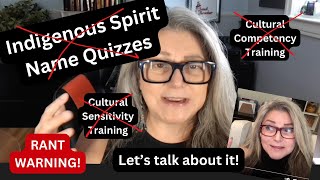
Sandi L Boucher, Red Thunderbolt Woman of Seine River First Nation, calls out phrases that get in the way of real reconciliation. She takes aim at "hurt people hurt people," "cultural competence," and "cultural sensitivity," arguing for "cultural humility" instead. She also critiques how non-Indigenous people trivialize Indigenous spirit names.
Chapters
So I had someone comment on one of my videos recently, quote, unquote, I love it when you rant. I said, thank you. I said, I think thank you. When I read that, I understand it, I guess, the passion. I also couldn't help thinking, how impressed is my mom? And then that got me thinking, well, you know what the mom I had in my younger years, if she would have been panicked, anything that would center me out or have me stand out, well, that's dangerous for an Indigenous female. So she wouldn't have been thrilled with that. But then the mom I had in her last couple years was saying things like, well, then give the land back. So my mom was decolonizing before we even knew the word. In other words, being Indigenous in Canada, being Indigenous in a non Indigenous country can be confusing. And often I rant. Well, sometimes I rant because I can't believe what someone just said or did or whatever. And other times I rant because I can't believe I bought one, whatever I bought for so long. So today what I want to do is I'm going to look at three or four different statements that we got to throw out the window. And I've used them. So don't beat yourself up. Let's just agree to throw them out the window. And then I get a question to ask you to see if you can. If, in your opinion, things have changed, let's talk about it. Bonjour. Hi, everybody. My name is Sandy Boucher. I'm Red Thunderbolt, woman of the Loon clan, a proud member of Seine River first nation in Treaty 3 territory in Northern Ontario. And before I go into the scheduled rant, I just, with my introduction, I just thought of something else. First and foremost, I'm going to say I'm an Indigenous woman born and raised in Northern Ontario. I've lived here for 99.9% of my life. Brief time out on Vancouver island, but beside the point. And what I do. For the last 15 years, I've been committed to Indigenous Canadian reconciliation. So whether it's empowering Indigenous people to realize the value of our teachings, to realize our resilience and persistence and our value, that's one part of it, or I'm working with non Indigenous corporations, businesses, municipalities, nonprofits, hospitals, universities, blah, blah, blah, blah, blah, to help them change the conversation and change the way they look at Indigenous people so we can actually change the quality of the interactions between Indigenous and non Indigenous people. And all of that, in my humble opinion, is part of reconciliation. But I have some statements we got to Throw out the window. And the first one isn't a statement. I guess it's a really bad joke that we got to get rid of at the beginning of every video. Well, after my opening in my little video, I introduce myself. I use my spirit name, I speak in Ojibwe. I share that I'm Red Thunderbolt Woman, which in Ojibwe is Mishko Paganon Quay. And that's where I stopped this morning. Because I know I haven't seen in a long time. Maybe they're not around anymore. That would make me really super happy. But there used to be these really dumb quizzes you could do on Facebook to come up with your indigenous spirit name. Like how insulting at its base is that we're going to take something that is an incredibly spiritual ceremony that only a few select people are gifted to be able to give names and reduce it down to a goofy 10 question if it was that long quiz on Facebook. And that leads to the really bad jokes about indigenous names and how they come up with, I can think back to. I really want to be careful how I describe this there. I grew up hearing the really stupid joke about the man looking outside the teepee and seeing the sunrise and that's what he named his first child and seeing the sunset and the second child. And the joke ends with the third child is named after what he saw two dogs doing outside the tent. That is a really disrespectful, non funny joke about our spiritual names. But it does. It shows me the non indigenous people did pick up on one thing and that is the fact that our spirit names. I want to say always, I've never run into a case where it didn't, but maybe there are. 99.9% of the time our spirit names tie us to Mother Earth. They ground us. They remind us that Mother Earth is our mother, that she gives us everything we need to heal and be happy and healthy. If you're stressed out, go sit by the water. If you're confused, go sit under a tree. Everything is there. Mother Earth gives us everything we need. And like a good child should, it is our responsibility to in turn take care of our mother. We're failing at that. Just want to say so let's not make fun of indigenous spirit names or do any goofy quizzes to try to come up with one. I know there are some elders that believe in giving non indigenous people spirit names. I'm not going to say an elder's wrong. I am just going to remind people that just because you got A spirit name doesn't make you indigenous. Look at all my videos on pretendions and descendants. So that was point one. And that wasn't even what I was planning on talking about. It just popped into my head. Welcome to my world. Are you done wasting money? Are you done losing the contracts? Have you realized that your indigenous engagement game just isn't up to what it should be? For the benefit of you, your company, your non profit, your municipality? Are you done guessing why the relationship ended or why that community's so upset with you? Have you been bcred out of a community? All of it is possible without the proper training. And just when you get your team trained, you hire someone new. You can't afford to keep sending everyone to the same training. Isn't it time you got your onboarding program up to snuff? I have just what you need. Check it out on my website. The first statement that I wanted to go after, I've used and I've heard it a million times. And it wasn't until I decolonized my view, something I work on daily, that I realized, wow. The statement, hurt people, hurt people, hurt people, hurt people. I get the point. When someone's hurting, they may lash out, whatever. Two things about this. I just saw an Ed Mylett video. I know you're shocked. I'll put a link to the one I was watching. It's actually the first clip in the video because he interviews a bunch of people in this video, but it's with prime, the coach. Anyways, prime, in response to a question from Ed, responded with, isn't everyone hurt? That's kind of my point. Hurt people are helping people every single day. Indigenous Enon. You're at work, you're. You're doing the paperwork, you're cutting the hair, you're running the company. Even though your marriage just fell apart, even though you just got a diagnosis you didn't like or your loved one did, even though you're not sure where your child is because they didn't come home last night. Hurt people help people. Let's keep that in mind. And even worse, what set me off on the rant? What a really good example of victim blaming. Oh, you know, hurt people, hurt people. Yeah, you just gotta accept that, then just don't have it together. Why do we not have it together? Because someone hurt us. So how about instead of judging us or expecting things from us or being disappointed in us, you recognize we're hurt and you support and encourage us. And by the way, I'll do that for you because really good chance you're hurting from something too. This is kind of global. This is not nation specific. This is the human experience. So I think every person hurts people intentionally or unintentionally on a regular basis. We got to get better at owning that and making amends for it. But hurt people help people. So let's quit blaming them and work to support them. That was, I guess rant number two is the first one about the name. Next. Next. Okay, Brandt, this is about terminology and this comes up in my industry describing the type of training I do in like non indigenous corporate terms, which I really don't like doing anyways. But I guess I gotta so people understand what I do. So I don't know which one came first, but definitely for a long time now we've been dancing with the term cultural competence. I have never liked that term because my response always to it is I'm not culturally competent in being Indigenous because I'm learning every single day. It's humility teaching. I'm not going to stand out there and say I know everything about being Indigenous, I know all the teachings and you should just listen to me seriously. Just as harmful for the non Indigenous people taking that training, I would never want you to take. I don't care how long the seminar is. It could be a week long, it could be a month's training. I don't ever want you leaving there thinking I am now culturally competent to work with Indigenous people because you're going to land on your butt hard. I have said it I don't know how many times that we have. More than 600, almost 650 might be right around there. Different First Nation communities in Canada, every single one of them is different. If you ever go to EGO and say I'm competent or I've worked in so many First Nation communities, I'm good. You are going to fall on your butt. So cultural competence out next. Debatable. Which one's worse? They both have to go in the garbage as far as I'm concerned. Next came cultural sensitivity. Didn't like that one from the get go either because in my mind that reinforced, reinforced the poor Indian mentality. Oh, look at all that happened to them. We need to feel bad for them. We need to feel sorry for them. No, we you don't. We don't need anyone saving us. We don't need anyone feeling sorry for us. We don't need anyone looking down on us. And we are dense people. Definitely not sensitive. We don't need you being sensitive to us. That's insulting because in the indigenous people I have met across Canada are some of the strongest people I have ever met. And no matter what you think of them, you have no idea the challenges they have overcome. Really good chance challenges they've overcome just to get to your flipping office or meeting room. Cultural sensitivity. Definitely gotten. I came across a new one recently. It was shared with me. It's not my term, but holy moly's do. I love it. For now. That might change, but I'm thinking this one's good. You know what it is? Cultural humility. What have I been preaching since the beginning of time? Humility will put you on safe ground. Cultural humility. Walking into a First Nation community knowing nothing that I know about. Operating a community applies here. Find a guide. Ask questions. Ask if it's okay to ask questions of other people. Follow the person that invited you there. Like cultural humility and understanding that even though you have worked in a First nation community for 20 years, you still have so much more to learn. Humility. I love that one. So can we throw out those other two? I don't even want to say them. They're not helpful. Cultural humility training. That's what I do. If you're interested, check out my website. Last but not least, I have always said that I think it's. I find it funny. I understand. Maybe I shouldn't. Maybe I'm not being sensitive. But I always think it's funny when non indigenous people assume that we receive our teachings sitting around a campfire under a full moon or something like that. Or a sacred fire on a new moon. Do you know where I got most of my teachings? Like 90% of them. One, doing dishes with my mom. She washed, I dried, or vice versa. And having tea with my elders. Sitting, laughing. It comes out in conversations. That's why we preach relationships. Don't come in trying to extract our teachings, actually get to know us. You're definitely going to benefit from it. So this morning I was actually getting ready to do this video and okay, this is going to be of zero interest to anyone and very few of the guys. But makeup, foundation. I grabbed a foundation I haven't used in a while and it's a little bit darker than I would like, so welcome to my world. I put it on, looked in the mirror, and I thought, oh, that's not good because they're gonna think I'm trying to look more Indigenous. Welcome to what it's like to be indigenous in Canada, where you're judged for every step you take and every Action you take or don't take or every word you spe or don't speak. I do look indigenous because I am indigenous. I'm a fairer shade of indigenous, but I already look indigenous. I don't need a foundation to look more indigenous. But I think you get my point. And you know where my brain went. And the question, I guess I said I'd leave you with is, do you think things have changed? Because I thought back to my high school days and me and my best friend, and we were at that age where we're definitely getting into the makeup and checking out the magazines and trying to mimic how they do their face. Not a lot different in nowadays, except they do a lot more things. Contouring and bronzer and all that stuff. We never did that. Anyways, wearing foundation was part of doing your full face makeup. And I can remember one particular evening going out with my best friend and her face, which she's gorgeous, still is gorgeous, Was incredibly gorgeous then, has always been incredibly gorgeous. And her face looked absolutely stunning. Immaculate makeup, beautiful face. Like, she had a great foundation. And I mean her face, not the foundation she put on it. But I couldn't help noticing. So this would have been like a summer night, like July. And she had this beautiful makeup. It didn't match her neck because her neck was the beautiful brown we darkened into in the summer. She's already darker than me, but we both get darker in the summertime. And it didn't match. And I noticed, I'm sure not going to say something. It's too late for her to do something, so that would just make her feel insecure, not going to do that. But I couldn't even then, even though I never knew at that age I was going to end up doing this work. Even then, I couldn't help noticing that the magazines preach that white was beautiful, that fair skin was the beauty standard. And here she was adopting that because Canadian history taught us brown is dirty. That's what's been used to crucify so many Indigenous people. So I thought of that and how, and I knew I looked the exact same way by the way that I had done the exact same thing for the last time. But I couldn't help thinking back then, we were using foundation to try to look lighter. This morning, I used a foundation that I might get criticized for trying to look darker. So I guess the question is, have things changed? There's my multifaceted all over the place. Welcome to how confusing it is to be Indigenous video. I hope you found it informative if anything, I hope it helps you understand a little bit more what things look like through indigenous eyes. Until tomorrow. I love you. Take care. Bye. Bye.
More from Sandi

How I Handle "The Four Uglies!" (Alcohol, Diabetes, Healing & Cheap Seat Comments)


All the Stuff We Don't Talk About with NO SHAME! (WMT Podcast w Antoinette Godin)


When Authors Chat ... (Radio Interview for the Launch of "Copper Stone - Glimpse of Blood Memory)



MORE PROOF of Indigenous/Non-Indigenous Relationships that Work! (Walking My Talk w Millie Gormely)
