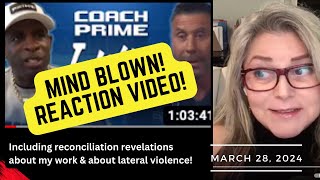
Sandi L Boucher (Red Thunderbolt, woman of the Loon clan) posts a reaction video to an Ed Mylett interview with Deion Sanders. She explains why the episode resonated: Deion's remark "Aren't we all playing hurt?" reframed pain as a common human experience and a bridge between Indigenous and non-Indigenous peoples. Sandi reflects on lateral violence in Indigenous communities, the dynamics that can arise when community members begin healing and gain confidence, and a quoted wall sign that informed her thinking: "Don't let my confidence offend your insecurity." She recommends viewers watch the original Ed Mylett episode and says the insights will shape her future seminars and workshops.
Chapters
So yesterday, I highlighted how this channel is a lot. My work, my opinions, information for you that I share. But when I come across something, someone else's work, and it blows me away, and I think it's going to help you, then I am all about sharing that with you. Now, if you've watched a couple of my videos or you're subscribed to my channel, you would also know that Brendon Burchard and. And Ed Mylett are two people that I follow on a regular basis. I watch their inspirational or motivational videos. I just think it. It works for me. And over the course of my career, there's been people I've listened to in the past that it no longer resonates. But, you know, as I grow, I think the. The mentors I reach out for change. And Ed Mylett is someone that I try to commit to, making sure that I watch his. I watch his podcast on YouTube. You can listen to it on all the other options. But he recently did an event with Deion Sanders, and we need to talk about it. Hi, everybody. My name is Sandy Boucher. I'm Red Thunderbolt, woman of the Loon clan, a proud member of Seine river first nation in Treaty 3 territory in Northern Ontario. And as I mentioned in the opening, this is another reaction video to another one of Ed Mylett's videos. And this time he's interviewing Coach prime, who. His given name, his Christian name is Deion Sanders. So amazing athlete. Was pro baseball and football. Like, I mean, just the records this man set is phenomenal. And I can honestly say, like, I am a huge football fan. I love football, but I wouldn't say I'm a huge sports fan. That's probably the only sport I watch, but. So I wasn't sure that this podcast episode would resonate with me and like, talking about, to a. A coach, pro athlete. But then I decided to check it out, and I am so thankful I did. Teaching myself. Lose the judgment. Just go for it. You never know where you can find something that benefits you. And that's how I would sum up this video. So we are talking pro athletes, and Ed Mylett was a professional baseball player. So a lot in common between the two of them. And athletes get hurt, right? They. They're either hurting because their muscles hurt and whatever, you know, the game that they're in is just really hard on their body. Football, they're getting squished like, you know what I mean? Or like, God forbid they actually have an injury that they're dealing with the pain. And at One point, like, there's two things I wanted to highlight out of this video. The link to the actual video is in the notes below this. I highly, highly suggest you check it out. I'm not going to share everything they talk about, but I have probably like seven pages of notes. Not kidding. So at one point, Ed asks Dion, like, to comment about playing hurt. You know, when you are hurting, when the muscles are killing you, when you're exhausted, whatever. And what his process was, his mindset, whatever he did, his routines, what did he do to help him play hurt? This, his response was a lightning bolt moment. My red thunderbolt, lightning bolt, knock you on your tush moment. Oprah Winfrey, aha Moment. That kind of thing. Without batting an eye. Are you ready for this? Sit down. You should sit down, Dion. Without batting an eye. Answers, aren't we all playing hurts? Aren't we all playing hurts? So I'm thinking of the event I just did. Like, like so many people in a room, so many non indigenous indigenous there as well. And like both sides of the feather. For me, like, for Indigenous people who have been hurt so much to. Instead of judging or making assumptions or running with stereotypes about non indigenous people, realizing that non Indigenous are hurting too. In the same way that years ago, I was blown away when I realized that non Indigenous people need safe spaces to ask their questions just as much as we do. And yes, that was eye opening. I'm raised Indigenous. Knowing what non Indigenous needs wasn't in my realm. But we can all grow and learn. So I realized how absolutely important it is for indigenous to realize pain can be a common bridge. And then for the non Indigenous, we talk about trauma, informed care to realize that when they're working with Indigenous people, it's not about go, go, go. It's not about hitting the target. It's not about making this meeting. It's about trying to work together and build a relationship when so many Indigenous people are those flowers trying to grow in soil, dowsing gasoline. So recognizing that we're working with people that are hurting for a multitude of reasons. And wouldn't the relationship change so much if we could just remember that? Maybe I'm being dramatic. It wouldn't be the first time. Maybe it didn't resonate with you as much as it did with me, although I hope it did. For me, it was eye opening. It's definitely something that is going to affect the work I do in the future. The seminars and the keynotes and the workshops that I do. And then now I'm going to cruise to the indigenous side of the feather for a second. Because lateral violence is a thing in our communities. Indigenous tearing apart Indigenous. The judgment, the gossiping, the bullying. Violence is a symptom of response to oppression or internalized oppression. So the fact that it's happening shouldn't shock anyone. But obviously it needs to end if we're ever going to heal and if we're ever going to heal our communities. And to get past it requires the healing of those individuals. But, but here's what happens. You have some indigenous people that have the opportunities, that have the elders in their lives, that have the time or the means to access supports, and they start going on their healing journey. And over time maybe they build confidence, maybe they have that self acceptance and self love that they've worked so hard. And that is when the attacks really start happening from other indigenous people that who do you think you are? And you've forgotten who you are and all the other crap. So at one point in. There's a point to this, I promise you. At one point in this Ed Milat interview with Deion Sanders, Dion references a sign that he has on the wall in the office, the room he was in during this interview. And I could so relate because I have like 5000 post it notes and different signs and things all over my office and. And this one, some people are going to think this is rude. Give me a second to explain it. What the sign he referenced says is don't let my confidence offend your insecurity. Don't let my confidence offend your insecurity. I read that not as judgment, but again, realizing the people that attack, the indigenous people that have an issue with my level of confidence, that is their insecurities that they have yet to have a chance to heal from. I have a voice and maybe they resent that they don't yet have a voice. I love the woman I am. And maybe they don't know how that feels. Feels yet. Do you see how it's not about judgment, it's about meeting people where they are. And I know some people really resent my healing and my confidence and my voice. And maybe at some point and like go out on a limb here, maybe I resented people with a voice. I don't honestly think so. I talked about this at my event. I didn't resent indigenous women that had a strong voice. I wanted to be them. I couldn't figure out how. I was like, how are they so confident? How are they so strong? They're not attacking, but they're not backing down. They're sharing truths, they're sharing what needs to be said. They're not letting this conversation end without making the points that need to be made to. To move the needle forward. I wanted to be them. And maybe that's the difference because it's really easy to criticize someone else. It is a lot harder to work on your own game. And again, I. I do not take lightly how many gifts I have in my life now. I have so much to be thankful for. I have a million people that helped me get here. I defin did not do it on my own. And with the gift comes responsibility, says my teachings. So I take the responsibility very seriously. Obviously I work full time doing seminars and workshops and videos and I am balancing the feather for the first time. Like people are just starting to realize that just as all that training that's been for indigenous people for decades were finally realizing if we're not going to practice white supremacy, maybe non indigenous need training too. How about we don't assume that we're the problem, that only the indigenous need help. There's guidance needed on both sides of this feather. So if you're indigenous and you have achieved some level of success and you've noticed that the bullying and the gossiping is increased, pray for them. Help them find supports. Realize that they're wishing they had your confidence in your voice, even if that's not what it sounds like. That's just your confidence triggering their insecurity. That doesn't mean you give up your confidence. This episode of the end my lapse show I highly, highly, highly, highly recommend link is below in the notes. I hope that that maybe knocked you on your tush because I know it's definitely not a show I'm forgetting anytime soon. Until tomorrow. I think we have one more video to go. I love you. Take care. Bye bye.