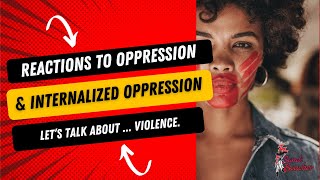
Sandi L Boucher examines how oppression shapes human behavior, arguing that violence and destructive acts are environmental responses, not character flaws. She uses a local story about an intoxicated Indigenous man to show that fighting back, even harmfully, means someone hasn't surrendered entirely. The real problem isn't the person's reaction. It's the oppressive system that caused it.
Chapters
Hello again. This week we're taking a real deep dive into understanding oppression and internalized oppression, explaining what we see, why we see it, and what we can do to help. And I'm finishing off the week by sharing how I overcame my own internalized oppression. The beginning of the week we talked about the wall and where you're standing. Yesterday we talked about acquiescence, the giving up. Today I have another reaction for you. Let's talk about it. Hi everybody. My name is Sandy Boucher. I'm Red Thunderbolt, woman of the Loon clan, a proud member of Seine River first nation in Treaty 3 territory in Northern Ontario. And before I forget, I have a question for you. Over the last couple of videos, when I do my introduction and I mentioned that I'm a member of the Loon clan, I realize for many non indigenous people you may not know what that means. It might even sound like something a pretendium would say, which it absolutely is not. So if you would be interested in hearing more about the clan system comment below, let me know. That definitely could be a future video if it's something you're into. Now, as I mentioned this week I got really excited because we're doing a deep dive into oppression and internalized oppression. And I explained what those are. And I explained that there's three natural human reactions that if you belong to a marginalized group, one, there's a really good chance you've internalized that oppression. You're starting to believe the stereotypes yourself. And two, like we see these reactions. You can watch this. I always reference the 6 o' clock news. I'm showering my age here. Does anyone still watch the 6 o' clock news? Feel free to comment below. I don't know if that's gone by the wayside, but maybe someone still does. Anyways, you can't not watch the 6 o' clock news and not see these reactions. So yesterday we talked about acquiescence, the complete and total giving up. And not only is that the group that receives such ridiculous judgment from outside, but it's also the group that we're at the risk of losing. These are the people just on the edge of the ultimate giving up. And these are the people we have to reach and encourage and teach them that what their experience is experiencing is a reaction to their environment. It is not because they're not strong enough or not intelligent enough or wise enough, whatever the case may be. This is something we have to help them through and to let them know they're not alone, that we've all felt that way. And whether you think they should just know that or not is irrelevant. These people are at risk and we need to hear them and reach them. Today I'm going to talk about another natural human reaction to long term or internalized oppression. And this is another reaction that gets a lot of judgment. Remember the cat and the mouse picture, Videographer, picture, please. The judgment is never ending. And it doesn't help if you want to help stop the judgment because it's just making the situation worse. The second reaction that I want to talk about today is actually violence. When you are trying to grow up in an environment that seems to constantly be telling you you're less than, you're no good, you're not worth the air you breathe, you're never going to amount to anything, blah, blah, blah, blah, blah. All the crap that we as indigenous people hear on a regular basis, for some people, they get to the point where they just want to lash out. And as I mentioned yesterday, when they lash out, it's really hard to hit the federal government in the nose. And I don't care which party's in power, they're all oppressive of indigenous people. So let's not go there. Not the point of this video. But they lash out and they lash out against their partners, they lash out against their children, they lash out against community members, and they lash out against the people in the nearby municipality. I am not saying this is right. I'm saying that oppression and internalized oppression aren't right either. This is a reaction to the environment. I have said it a hundred times. Indigenous people in Canada are flowers trying to grow in soil doused in gasoline. And we have to quit judging the results and fix the cause. I mentioned last week I did a video on my podcast on racial battle fatigue and it feels like a death by a thousand cuts. Those little comments and jokes and eye rolls, it's just awful. But I have a story to share with you to explain to you why I don't think violence is the worst reaction. I actually think the acquiescence is. And here's why. Now, in the city I live in, there was this little grocery store that I used to love going to. Anyone in the city knew where it was was just this awesome little grocery store. It also happened to be. It happens to be located really close to an lcbo, which is the Liquor Control Board, where you buy your alcohol. Not the beer store, but hard liquor. I don't know what it's called in the States. I think you can buy it at a corner store in the States, I don't even know. Anyways, so often houseless people in that area, often indigenous people unfortunately trying to escape the horrors that are their lives, access the lcbo, get their hands on alcohol, and now you have intoxicated people in the area. So it was a beautiful summer day and I happened to come out of the grocery store and sure enough, not that far, half a block away in the distance, was an indigenous man. I would say probably random guess here, but like late 20s maybe, incredibly intoxicated. And I say that because he was not able to stay on the sidewalk. He kind of walked on the sidewalk and then out into the street and back on the sidewalk and out. And I stopped to watch him because the city I live in is known for its anti indigenous racism. I was literally afraid he's going to get run over by a car, by someone just peeved off that an indigenous person has the right to get in there their way, that it would not be uncommon in this city. So I watched and I waited. And as he got closer to me, I could tell. One, he was incredibly angry. Two, he was having a knockdown, drag out argument with the invisible person next to him. There was no one else with him, but he was arguing with someone, whether it's in his memory or whatever the case may be. And as he got close enough to me, I could hear him saying, you're not allowed to talk to me like that. Don't you say those things to me. You're not allowed to do that because of the work I do. I know that so many people would have seen him and just judged him as a drunk Indian. I realized that he may have had to get totally intoxicated to find that fight inside him. But at least he's still fighting. The flame hasn't gone out yet. Now is this the ideal way to fan the fire? Of course not. But at least he hadn't given up yet. And it's when they give up that it gets really super scary. So we've talked about two natural reactions to either long term or internalized oppression. Now the acquiescence, the complete and total giving up and the violence that so many people love to judge us for. Again, think of any marginalized group. You see the acquiescence and you see the violence. This is not. You don't judge the flower when the flower doesn't bloom. You don't blame the flower. You fix the environment in which it grows. We got to fix this environment tomorrow. There's one more natural human reaction and it's the one I focus on every single day until then. I love you. Take care. Bye. Bye.