Self-Identification & How to Ask a Potential Employee if They Are Indigenous
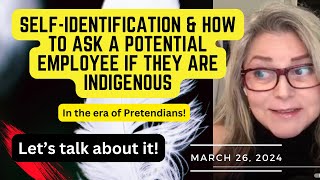
Sandi L. Boucher, Red Thunderbolt woman of the Loon clan and Seine River First Nation member, explains how to ask Indigenous applicants about their identity without inviting fraud. Self-ID shouldn't be a checkbox. Instead, use open-ended questions about First Nation, status, community ties, and cultural practice, then involve Indigenous networks to verify unclear applications.
Chapters
Okay. We've spent a lot of time on this channel talking about pretend Ians, why it's so harmful who they are. We even did some time talking about descendants. But the reality is, and I see this all the time, there is a difference between knowing the information, knowing the definition, and how do I put that into practice? What do I do with that? So today I want to talk about what happens if you have an indigenous specific specific. Whether it's a job posting or it's, you know, apply for funding or whatever the case may be. How do you go about asking someone if they're indigenous, especially if you're not? This we definitely need to talk about. Hi, everybody. My name is Sandy Boucher. I'm Red Thunderbolt, woman of the Loon clan, a proud member of Seine River First Nation in Treaty 3 Territory in Northern Ontario. And you may not realize this, but when I'm not making YouTube videos, I'm doing seminars and workshops and, and keynote speeches across Canada with a variety of groups. Some of them are virtual, some of them are live. I love my life. I love the work I do. It always puts me in front of the most amazing people. And these are not amazing people, but because they have all the answers, these are amazing people because they're open to learning. They ask the questions. They have the beautiful humility to say, I don't understand. Can you help me? And those people, I will build a bridge for every single day of the week. So recently I did a virtual event and they have. I like to give them the option to submit questions ahead of time. It can be anonymous, like, it really doesn't matter who submits the question. Just ask the questions so that while we're in a safe space together, I can actually answer them. This is going to be one of those rare times where a non indigenous person can say, I don't know what that term means, or I don't understand why this keeps being a problem and we can have a discussion. I am not into shame or guilt. I am never going to make someone feel bad for something they don't know because they don't know it, which means they were never taught. So that's where I come in, sharing that information. So that's what happened. Someone sent me a question ahead of the event. I just happened to think it was such an amazing question that I wanted to share with you. So it was sent to the organizer of the event and then forwarded to me, which will make sense when you hear the wording of the question. So this is what the question was I would love to hear Sandy's thoughts on best practices for when and how to consider self identification as part of the recruitment process. That is for restricted competitions considering the balance between having people provide proof and being aware that some people may abuse self identify identification based processes for personal gain. That was one of the best questions I've ever received. It's a long one. I'm going to do it again. I would love to hear Sandy's thoughts on best practices for, for when and how to consider self identification as part of the recruitment process, I. E. Restricted competitions considering the balance between having people provide proof and being aware that some people may abuse self identification based processes for personal gain. So we're talking about self identification and that's where pretend Ians come in. People saying I'm indigenous and not having the proof. But so a couple things we got to consider here. First and foremost, the first thing I said to this audience was as a non indigenous person or entity, whether you're a corporation, nonprofit, school, whatever, non indigenous should never put themselves in the position where they're going to decide if someone's indigenous or not. That's Canadian history and that's how we got in this mess in the first place. Now having said that, you can have criteria and self identification comes into play because the Canadian federal government has all these insane rules about who is status and not status and it is literally torn families apart. Meaning, like when you start gaining status because of who you marry, things are going to get a little funky. And families have been totally torn apart, half for status, half or not. It gets ridiculous. And that's why they're both indigenous. Right. They have the same bloodline. It's just a different federal classification. So the one thing. So first and foremost, you don't want to be the one that says someone's indigenous or not to. Yeah. Don't want it to be a checkbox that is going to lead you down a dark path where they click off if they self identify as indigenous or not. Not enough. That is literally saying, come on. All you pretend ians come on in. All you're going to do is put a check mark and you're in. Don't do that. Please don't do that. What I suggested to this participant and then I'm now suggesting to you is if you think of either the interview or can you tell I'm thinking of an application, I'm envisioning it instead of just checking the box. Right. Feel free. They can check a box. Who cares? You're self identifying as Indigenous. Directly underneath it is a nice big box that you can write in or type in or whatever the case may be and it asks them to highlight their indigeneity and you can put in brackets. Please include your First Nation, whether your status or not. Status, your relationship to your community. Do you practice your traditional teachings? What is your story? Now you're going to get a whole bunch of answers. You might get an indigenous person that says I am indigenous but I'm 60 scoop. I was adopted out. I've never had anything to do with my culture, but my family is the blank family from whatever First Nation I was taken from this first nation. What you got to be careful of. And I have warned so many employers and entities and public buildings, public service entities of this so many times. Be aware of the suggestive wording I have seen. Like I'm in the public speaking industry. So often I see advertisements of other speakers and when I see something like they were inspired by the elders of such and such First Nation that at no time said they were indigenous. That meant they got exposed to indigenous elders or community members. They could have been living in the municipality next door. They might be Scottish, right? Or like inspired by, guided by. If they are not saying they are indigenous and here's how this is my family from this area, then they don't have enough information to be bidding for this position. And if they say that their great great great great grandfather was indigenous, they're not indigenous, they have indigenous ancestry. They would be a descending right. So there are. You should be able to prove you're indigenous even if you're non status. Even if you've been in foster care your entire life, you still have. Your bloodline is crystal clear. No, but it's really going to go a long way in covering your butt and preventing you from accidentally hiring a pretendian if you are not sure of some answer. You should have indigenous people in your network. You should have built relationships with local indigenous communities. You reach out to your indigenous colleague and you ask them what they think of whatever the blurb said. You get the advice from indigenous people. Us vetting ourselves. That's a good thing. Okay, So I hope that makes sense. It cannot be a checkbox. You have the right to ask. The funding and the opportunities are incredibly limited. Just be really careful because Pretendians can get really good at flowery language language and how they describe themselves. It shouldn't be that hard. It should be way more crystal clear. And if you're not sure, reach out whether it's to your local community. Which would be the best option. If you don't have those bridges built, then you need to send me an email because we have to stop the pretendions before they get into the positions, not finding them out afterwards. Oh that made sense. Let me know what your thoughts are. Doesn't it make sense to you if you have especially if you're in HR or that kind of, you know, you do employment ads or positions? If you want more clarification, comment below, ask your questions. I will watch for them and I'd be happy to help until tomorrow. I love you. Take care. Bye bye.
More from Sandi

How I Handle "The Four Uglies!" (Alcohol, Diabetes, Healing & Cheap Seat Comments)


All the Stuff We Don't Talk About with NO SHAME! (WMT Podcast w Antoinette Godin)


When Authors Chat ... (Radio Interview for the Launch of "Copper Stone - Glimpse of Blood Memory)



MORE PROOF of Indigenous/Non-Indigenous Relationships that Work! (Walking My Talk w Millie Gormely)
