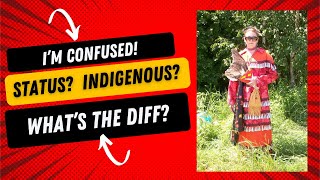
Sandi L Boucher explains the difference between legal status under Canadian law and Indigenous identity. A status card requires meeting Indigenous Affairs Canada's requirements, but many Indigenous people lack it despite clear family ties and cultural practice. Historically, Indigenous women lost status if they married non-Indigenous men, while non-Indigenous women gained it by marrying Indigenous men.
Questions this video answers
Having a status card — meeting the requirements of Indigenous ancestry as set out by Indigenous Affairs Canada.
Chapters
There were so many comments, so many points made, so many questions asked on the two videos I released concerning Buffy Saint Marie. And one of the misconceptions, one misinformation point of confusion for people is the difference between being Indigenous and being status. And there's a huge difference. Let's talk about it. Hi, everybody. My name is Sandy Boucher. I'm Red Thunderbolt, woman of the Loon clan, a proud member of Seine River First Nation in Treaty 3 Territory and Northern Ontario. And we got to talk about this difference between status and indigenous. So let's start with status. And I can't believe I'm about to say this, we're going to start with status because that's the easiest one. Status Indian means you have a status card. It means you have met the requirements of Indigenous ancestry as set out by Indigenous Affairs Canada. So, and those are like in the US you have blood quantum. In Canada, we do not have blood quantum. It's not how much percent blood you're Indigenous. Here it is a whole bunch more complicated. For example, and this is probably the easiest and the worst example up until 1985, I believe it was right around there. If a non indigenous, not native, white person, white woman married an indigenous man, she was given status. So what that now it has such racist undertones. The belief of the time, the federal government, we could debate whether that's changed or not. But the belief was, oh, and by the way, if an indigenous man married a white woman, yeah, I said that. But if a native woman married a white man, she lost her status. So here's the reasoning. It'll make more sense in a second. It's insulting, but it'll make more sense. The government believed that indigenous people had to be on these lists because they were going to have to take care of us. It was very paternalistic, very insulting that we were going to be on these rolls forever and they were going to have to take care of us. So that's the status. If an indigenous woman was smart enough to marry a non indigenous man, in the eyes of the government, it's oh wow, we don't have to take take care of her anymore. Her husband's going to take her status. But if a white woman was dumb enough, their opinion, not mine, dumb enough to marry an indigenous man, well, now we're going to have to take care of her too. So she was given status. These people are status Indians by the Canadian government. They are considered Indigenous. They, they have no indigenous blood. And if there's one thing I am always an Advocate of is transparency. That was the problem with Buffy, that there were so many questions and no transparency. Like half truths. We don't handle that well. If you were to introduce yourself as I married in I'm Indigenous because my husband is any of that, then fine, you didn't pick that. That wasn't your rule. But at least you're being honest. If you start coming out as a teacher and you're going to pass on all these traditions, I have a problem with that because you're not Indigenous. If you instead say, you know what I married in. My husband is this very traditional man and he's taught me a lot of things. I know this is what he taught me about this topic. But you make that humility is there. You're not trying to make yourself out as these are my teachings. You inherited them through your marriage. Again, transparency. So that person would be considered Indigenous. Even though they have no blood, they legally are status Indian. But what we were talking about was the other side of the fence and the fact that there are many, many, many Indigenous people in this country that do not meet those qualifications and then therefore are non status Indian. They have the bloodline, you can trace their family, but because there are so many convoluted rules in Canada, they may not qualify to be indigenous. So Buffy St. Marie saying she's Indigenous, that had nothing to do with her saying status. And by the way, I can't help wondering, you know, she claimed she was Canadian Indigenous and not US Indigenous. And in the States they do have blood quantum. It would have been a simple test and. Yeah, or being able to prove that you're at least 50% indigenous. She couldn't have done that. She totally couldn't have done that. So you can be Indigenous. And I think I mentioned this in another video. I believe there's a difference between having Indigenous ancestry and being Indigenous. And it comes down to were the teachings passed on. If you have an Indigenous great grandmother, but she was kind of hidden in the back room and no one ever talked about it, no one else is Indigenous. You have Indigenous ancestry and you should be saying that. Not that I'm Indigenous, but I have Indigenous ancestry. If, on the other hand, there were Indigenous people in your family, even if not all of them, and those teachings were discussed, discussed, the language, the worldview, maybe even the customs and practices and ceremonies. Now we're talking Indigenous. It has nothing to do with skin tone. It has everything to do with worldview. It has everything to do with who your family is, what community claims you. As I mentioned, in one of the other videos, there are many First Nation communities that have identified the children that were taken in the sixties scoop. They claim them. The problem comes in and we're talking about that traditional adoption that Buffy mentioned. I know people who have received spirit names, indigenous names from elders, because the elder thought they were indigenous. So it was under false pretenses for lack of a better way of putting in. And I know a lot of people that have passed on teachings because they thought the person was indigenous. Do I only pass teachings on to indigenous people? No, but I only pass them on to respectful, humble people who understand that you can appreciate without appropriating. You can appreciate our teachings without taking them as your own. You can be an ally and fight for indigenous people without saying you're Indigenous. So there is a huge, huge difference. Just because an indigenous person cannot get their status does not make them not indigenous, especially. But they have the family, they have the bloodline, right? And if without that bloodline, it starts getting scarier, I hope that made sense. Have you figured out yet that being indigenous is very complicated and confusing? There are so many different stories, so many situations, all of them unique, all of challenging. So again, I repeat, no one would sign up to be Indigenous, not if they understood what the real challenges are. And I know there's some people out there that love to talk about the benefits we get nothing compared to the price tag we pay for it. I know because I've lived it for 59 years. I hope that helped. Comment below. I tried to read all the comments. I try to comment back if it's a question. If you have a serious question, email me those. I definitely respond to. I'm gonna keep going and hope this helps. I have one more video for you, and this one I may get judged for. That's okay. It's the truth. That's what I'm going to stand on until tomorrow. I love you. Take care. Bye. Bye.