The 16 Undeniable Laws of Communication IN ORDER!
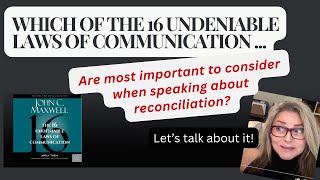
Sandi L. Boucher (Red Thunderbolt, woman of the Loon clan, Seine River First Nation) records a YouTube video reflecting on John C. Maxwell's book The 16 Undeniable Laws of Communication. Drawing on 15 years as a public speaker on Indigenous Canadian reconciliation, she reorders Maxwell's 16 laws by importance for her audiences and explains why, giving concrete examples from her practice. She emphasizes authenticity/credibility as her top law, followed by simplicity, adding value, conviction, and storytelling, and places anticipation and results at the bottom due to her cultural lens and topic sensitivity.
Chapters
Hello, you absolutely amazing person, you. As promised, today we're going to continue our discussion of the 16 undeniable laws of communication. Yesterday I asked you, of the 16, what do you think are the top four? If you were listening to a speaker talking about reconciliation, one of the four things that are going to make that message resonate with you, then it's going to be easier for you to connect with them. And I promised you that today I was going to rank the 16 in my order of importance. Maybe I'll do it backwards and build some suspense. Now my rating is going to be based on 15 years of doing this work. I used to actually collect like written evaluations and now I just listen to the audience the what their comments are when they come up and talk to me or ask me questions. So let's talk about it. What order would I put the 16 laws in? And do you agree with what I have to say? Let's talk about it. Hi, everybody. My name is Sandy Boucher. I'm Red Thunderbolt, woman of the Loon clan, a proud member of Seine River first nation in Treaty 3 territory in Northern Ontario. And for the last 15 years I've made my living as a public speaker. I do a lot of keynotes and workshops and seminars, all dedicated to Indigenous Canadian reconciliation, either working in the First Nation communities, helping them to heal and remember the power of our teachings and our worldview, or now I work a lot with non Indigenous Canadian entities, whether they're non profits or corporations or even government bodies, helping them to understand why the reconciliation efforts up to now either haven't happened or didn't really work. And as mentioned yesterday, no surprise, I was watching an Ed My lap video, but he was interviewing John C. Maxwell. And John just released this new book, the 16 Undeniable Laws of Communication. I have not read it yet. Full disclosure, it is next, right after Ed Milette's book. But I and it'll be interesting to see if my rating changes after I read the book. But when I did, I took the 1616 and I put them in order from number one. What my audiences tell me is the number one reason my message resonated with them. Down to 16 what? Based on 15 years of doing this, if I was advising a new speaker, what I would tell them, you know, be aware of, but not really what you need to focus on. So the other thing I want to share is in the book, in the table of contents, which is as far as I've made it, there's a little phrase that goes with each law and that helped me decide my order as well. So coming in at number 16, and this order is going to be all over the map now, is the law of anticipation. It says what? You can't wait. When you can't wait to say it, they can't wait to hear it. Not my style. And don't get me wrong, I am passionate. I can get very excited about things, but it's not about me, it's not my career. I wouldn't do this work if I wasn't excited to do this work. But, but because of the topic, because we're talking about reconciliation and what indigenous people have endured since contact, I, I don't do excitement, maybe at an amazing comment from the audience, but that's about it. So I put anticipation last. And of course it was hard. The number one, two, three, those were easier. Where you put the other ones, that's a little bit harder. So that was number 16. Now before I tell you my number 15, I'm going to remind you that everything on this channel is through indigenous eyes, through a First nations lens. So John C. Maxwell is not indigenous? To the best of my knowledge, I don't believe so. And he definitely has that mainstream colonial, non indigenous language lens. So I don't even know what order he'd put these in. It's just the 16 laws. But because of my lens, my number 15 is. Oh, where, Hang on, I gotta find it on his list. I almost said the wrong one. Did he? Where, oh where? Oh, duh. My number 15 is his number 16. The law of results. It says the greatest success, success in communication is action. That, that is so I never ask an elder to prove their point. Right. How many people have been helped by your teaching? It's ludicrous for me to even say that. So. And I can honestly say that does not come up in my seminars. That is not a question I've ever asked. That is very. A colonial matrix. Yeah. Did I resonate with them? Did I provide them great guidance? Yeah. So I guess the result was I helped them understand something. But yeah, just, just the wording on that, I don't. I focus on the people in my audience and answering their questions, not on what my results are. To me it came across as very much ego. It's not about me when I'm on the stage so my results don't play into it. Did that make sense? I hope that made sense. That was a lot of talking. Number 14. Was his number five. The law of collaboration. Some of your best thinking will be done with others. So this was wanting to know that the speaker facilitator is working with other people. Now if they never mention another speaker, facilitator, influencer, leader, yeah, that would make me suspicious. But there's no. We come from entirely different treaty areas with different teachings and customs and traditions. So not being open to collaboration, I guess could play into it. But yeah, that's not something that's ever. It doesn't come up. I mean, I mention Pam Palmer, Senator Murray Sinclair, Cindy Blackstock. I mentioned them in my seminars. So I've spoken to Pam. I haven't had the chance to work with her. I'd be open to working with any of them. But yeah, that was low on my list. Just because me not, not what I'm focused on or concerned about when I'm about to get on stage or preparing to get on stage. Number 13 for me was John's number 7. The law of connecting. Communicators know it's all about others. So I. The only reason this is down at number 13 for me is because I believe if you do 1 to 12, you're gonna connect. Right. It was kind of not like if you just focus on, you know, I want to be a good friend, I want to have a good conversation, you're probably not going to be a good friend or have a good conversation. The connecting, I guess would be a result that. So do you have to connect with your audience? Absolutely. But how you do that is what I put in number one to 12 again, I hope that made sense. Now my number 12 is his number 14. The law of change up sameness is the death of communication. So I absolutely agree. I mean there's public speaking rules. You don't speak. Nothing happens for nine more than 90 minutes. At that point they need to break their brains maxed out every 20 minutes you have to change whether you're talking, to doing, to having them share answers, do an excise exercise. Something has to change every 20 minutes. So do I change it up? I think I change it up naturally. So all of these are important. Just again, I think that comes with experience. Right. You're just going to know or if the monotone speaker. I know when we were in lockdown and we all switched to doing virtual events, it is my humble opinion that you can have a very dry, unengaging speaker at a live event and you're going to survive. You're going to end up talking to your, the person at your table or whatever. But if it's online, that's. Yeah, that's hard. That's really hard. So my personality tends to change things up. So we're good there. Number 11 is there. He's number 13. And it's called the law of the thermostat. Communicators read the room and change the temperature. So again, we're talking about number 11 here. Is it important to read the room? Absolutely. But yeah, I think you actually need experience to do that. Honestly, when I can remember back to when my very first book came out and I did the book reading and I guess I had watched videos of public speakers and you know, the, the crowd goes wild and standing ovation and all this, and my audience was absolutely quiet, like not moving, not doing anything. And fear took over and I was thinking, oh my God, I bored them to tears. It wasn't that at all. The first book is very much about grief above, about healing, about the growth from lack of self confidence to confidence. It's deep. And what they were doing was thinking. And as soon as I was done speaking, they may not have applauded, but they swarmed me with their questions and comments and wanting to share their story. So I most definitely connected. Yes, you have to read the room. I use metaphors all the time to help make things simple and connect with people. But again, not top of the food chain, but important. We're getting into the top 10 here. Speaking that number 10. Where did he have that one? Okay, having trouble flipping a page here. The book is not cooperating with me there. My number 10 is his number six, the law of content. When you have something worth saying, people start listening. Is content important? Absolutely. But I think you could have, and I think you've probably seen this happen. Best content in the world. If it's not presented in a way that engages your audience, no one's going to hear it. So, yes, you have to have valuable things to say. You have to. I always say that. I always want to make sure that when I share is worth the time the person put in. They're never going to get this time back, so it has to be worth their time. But great content is not the only thing you need, which is why it's number 10 on my list. Next, closely related. Where did he put this one? My number nine is his number 11. The law of visual expression. Show and tell is better than just tell. I agree. I am a visual learner. I have a PowerPoint presentation every time he speaks, speak. And now I'm not one of those people that read the slides. It's images to back up. I. I find it easier to remember an image than I do the written word, so I use it all the time. But again, can you reach an audience without it? Absolutely, which is why it's lower down on the list at number nine. My number eight, actually, in retrospect, wondering why I rated this so high. So my number eight is his number two. The law of observation. Good communicators learn from great communicators. So does my audience appreciate that I've honed my craft? Absolutely. Is it easier for me to connect with an audience now than before? Yes. But you know what? I was my worst critic for a while there. I was joking around that I felt like I owed everyone that I had done a seminar for in my first year. I owed them a free seminar. And every single person I said that to that was at one of those first seminars told me that I was wrong, that I may not have been polished, I may not have had my timing down pat, but what I shared resonated. So is it important to learn from others? Absolutely. I think if you. If something matters to you, you work at it. But is it high on my list? No. Okay, next. Number seven. My number seven. Hang on two seconds. Sorry about that. My son's doing some home renovations for me in the backyard, and I could hear the hammering, and I thought, is the mic picking that up? So I wanted to make sure. So my number seven is his number eight. Well, that's kind of close. The law of leverage. Good communicators lead with their strengths and use them often. Kind of surprised I put it this high. So I don't think you become a public speaker. Speaker if you don't like public speaking or if you haven't realized you're good at it and someone told you. And again, this is kind of the ego trip, right? Yes, you use your strengths, but it's not about your strengths. Like the. The. The story, the message, the reason you're there, the how much you're going to help someone, that's way more important as far as I'm concerned. So number seven. Leverage. My number six is his number four. The law of preparation. You cannot deliver what you have not developed. Ego comes to mind again, because so much of what I have share, or what I do share in seminar wasn't developed by me. It was developed over the generations by my elders. It's the. The teachings. It's the worldview. So do I prepare a seminar? I've had some pretty powerful keynotes and conversations and comments as part of a panel that were a question I didn't know I was going to be asked so which is going to tie into what's my number one. So I don't want to give that away yet. So is it important to prepare? Yes. But I think people that are not yet secure in their message probably put way too much weight on preparation. It's more you knowing your stuff than it is the fine tuned speech, in my humble opinion. Next, number five. Now we're getting into the top, or in my case, top five. Where did he put was there? My number five is his number 12. And it's the law of storytelling. People see their own lives and stories. The top five on my list are definitely based and totally related to the feedback I get from my audiences. And they love my stories. They love how I make it real, how I take a fact or a theory and show them how it impacts people in their lives. How instead of talking about internalized oppression, I tell them the story of how I battled it and what it looked like and how they will recognize it in others. So storytelling way up there now the, the top five, where now we're talking the essential stuff as far as I'm concerned. Number four. I alluded to this one already. Which is what was his number? Number three. My four is number three on his list. The law of conviction. The stronger you believe it, the more people feel it. 110% I have had first it was first nation audiences and then non indigenous audiences. Tell me a hundred times like I believe because you do. Like it is so obvious. You believe in us, in our ability to change, that we want to change. And that's not blowing smoke. That's not, you know, because it's my job. I do believe in the people that I work with. I wouldn't work with them if I didn't. My energy and time are far more valuable. So definitely way up there. Conviction and belief. Now this is what I was saying. If you totally believe in your message and you're telling that story, it doesn't matter if you're polished or not or how much preparation you did. They're going to hear the conviction. They're going to listen to the story. Okay, next number three. I think they had this further down. Yeah. My number three is actually his 15, but he did it in a different order. The law of adding value. People may forget what you say, but they'll never forget how you make them feel. I am a hundred percent about adding value. I am all about. The line I always use is that I'm all about the takeaways. Then I'm giving them concrete information and tools they can use information as soon as the keynote workshop or seminar are over. So 100% adding value to their life's journey, to their work, to their ability to help the people they're trying to serve. 110% adding value. Now, number two, which is his number 10. I don't think this will surprise you if you've been following my channel for a while. It's the law of simplicity. Communicators take something complicated and make it simple. That's my metaphors. That's the cat and the bird image. That's the wall metaphor. That's the back to back teaching, just taking a com. That's the cartoons and Elmer Fudd the settler showing up. It's. It's taking complicated things and putting in a way without being insulting. I'm not talking down to anyone, but if I use something you are familiar with to explain something you're not, it's easier to build the bridge. So 110%, I'm all about simplicity. I'm not going to do the $15 words. I'm going to have a conversation, not an ego trip. And the number one is his number one, although I added another word. So his number one is the law of credibility. Your most effective message is the one you live. And for me, the word you've heard me say it a hundred times, is authenticity. Walk your walk, don't just talk your talk. Right? And I have met way too many speaker trainers that just talk the talk. So there you have it, my friend. In order now from number one to number 16, credibility and authenticity first, then simplicity, adding value is third. Conviction or belief is number four. Storytelling is five. Preparation is six. Leverage is seven. Observation is eight. Visual expression is nine. Content is ten. Thermostat in reading the room is eleven. Twelve is changing it up three. Thirteen is connecting. See how I told you you're going to connect if you do all the stuff before it? 14 is collaboration. 15 is results. And 16 is anticipation. So what did you think? Are you surprised by my answers based on what you know of me? I'd love to hear. I can't wait to read the comments. Until tomorrow. I love you. Take care. Bye bye.
More from Sandi

How I Handle "The Four Uglies!" (Alcohol, Diabetes, Healing & Cheap Seat Comments)


All the Stuff We Don't Talk About with NO SHAME! (WMT Podcast w Antoinette Godin)


When Authors Chat ... (Radio Interview for the Launch of "Copper Stone - Glimpse of Blood Memory)



MORE PROOF of Indigenous/Non-Indigenous Relationships that Work! (Walking My Talk w Millie Gormely)
