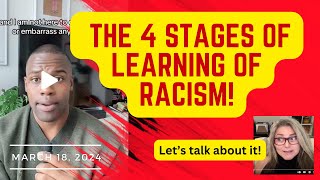
Sandi L Boucher (Anishinaabe Kwe) presents a short YouTube monologue connecting humility and Indigenous experience to a four-stage framework for learning about racism (adapted from Dr. Darian on TikTok). She maps the classic stages of competence—unconscious incompetence, conscious incompetence, conscious competence, and unconscious competence—onto anti-Indigenous/anti-Black racism, gives concrete examples (e.g., family presence in emergency rooms, public interventions like saying "ouch"), and urges non-Indigenous viewers to move from awareness to action and to earn allyship through ongoing behavior.
Chapters
For those who have been watching my videos for any length of time, you know that one, I'm Anishinaabe Kwe and two, that humility is everything to us. It's one of our sacred seven sacred teachings, sacred grandfather teachings. And I know for me when someone comes to me with a question, if they bring humility with them, that's a bridge that's already starting to be built. And when it's arrogance or judgment, that's got a better chance of being a wall than a bridge. Why I'm mentioning that is I think a large part of humility is being able to acknowledge when someone else knocks it out of the park when they share information and you just nod like there's nothing to add to that. Those people that always have to add their experience or a little bit more to it, that's either arrogance or just pure ego, right? That insecurity of arrogance. I could prove I know something too or just I'm all that in a bag of chips. Today I want to share something shared by Dr. Darian on TikTok. This blew me away. I am going to attempt to find the link and put it in the show notes but but otherwise you're going to get value from this. So thanks for coming out. Let's talk about it. Foreign. Additiona Costem. Hi everybody. My name is Sandy Boucher. I'm Red Thunderbolt, woman of the Loon clan, a proud member of Seine River First Nation in Treaty 3 Territory in Northern Ontario. And today I want to talk about Dr. Darian and what he shared on Tick Tock. But before I do that, yes, I'm still getting over Covid. 2 I am feeling a hundred percent better. I'm not at 100 yet but I've definitely improved. And three, just a huge kudos Chi McGwitch to all of the people that sent notes or emails or commented to say they were concerned about me and encouraging me to rest trust. I am not doing this 24 7. So thank you so much for caring. So let's talk about Dr. Darian in he was talking about that culture shock of being in a place that is definitely not of your culture and that the survival instincts what we do to try to make ourselves comfortable, especially if it's an unsafe space. Now Dr. Darian happens to be black and he was talking he happens to be a doctor as well. Duh by the name and he was talking about what black patients go through when they're in emerge often having a family member on the phone with them to so one they're not there alone. But two, just to bear witness to what is said to them or the questions or the attitude of the questions. And as Anishinaabe can definitely relate to that, not myself personally, but any visit to emerge that exposes you to listening to what's going on and all with all the other people, that's an. An issue in itself. I had to deal with what I thought was a cute little old man and emerged the last time when I found out. So when I had coveted, no, I can't even remember, oh, the, the rash, the allergic reaction, the hives, had to listen to a little old man share with me how he was totally disappointing with their government because they hadn't dealt with the Native problem that got shut down real fast. Okay, so back to Dr. Darian. In this video, he talks about the four, four stages of learning about racism. And use the framework of the four stages of competence or learning a new skill. So just to refresh your memory here. And yes, I got a handy dandy index card. This is someone else's work. I have to honor it. So, stages of competence, what? The stages you go through when you're learning something new. So the first is unconscious incompetence. You're totally ignorant of that ability, that task, that situation, not even in your realm. So it's not that you're aware, you don't know it, it's just not in your realm at all. Next comes conscious incompetence. So now you're aware of an issue, but you have no idea. You're conscious of it, but you're totally incompetent as to how to deal with it. So the awareness is there, but not the skill set yet. Third is conscious competence, otherwise known as learning. So you're aware of whatever it is and you can, you now know how to act, but it's conscious. You have to think about it. You're still in the learning stage, so it's not automatic anymore. But if you consciously think about it, you can respond. And for unconscious competence, you just do it. The. This is the mastery stage. Okay. When it comes to learning about racism, this applies way more to non indigenous than it does indigenous because I don't know, as indigenous people, how old were you when you first became aware of racism? Like before you could talk that person that made a face at you or shied away from you because you had darker skin? Yeah. So stages of learning of racism, thanks to Dr. Darian, one, the unconscious incompetent stage. These are the people that are not even aware racism exists. These are the people that say there is no racism in Canada. This, these are the people that have no knowledge or understanding of the back to back teaching. They believe that what they see and experience is what everyone sees and experiences. Way high on the arrogance or ego. These people cannot do anti racism work because they're not even aware it exists and could even go as far as denying it. I'd be willing to bet those people either A or not on my channel, not watching this video or B they're the troll comments. So yeah, by the way, if you're new to my channel because I think 70 of the people that watch my videos are new to my channel. Makewich for showing up here. We talk about all things Indigenous Canadian reconciliation, whether it's empowering indigenous people or enlightening non indigenous. Giving them the missing pieces of information that our formal education system has yet to pick up. Okay, so welcome. Stage two of learning about racism again. Is that conscious incompetence stage. So now this is a lot of my followers. So they are aware that anti indigenous racism exists, but they can't do anti racism. What can I do? I don't know what to do. I don't know what to say I or there's nothing I can do that that acquiescence which is literal death to indigenous people. Not being dramatic. Watch the six o' clock news. So one, I appreciate that you're here. I appreciate that you're trying to learn. We need so much more from you than just you learning. Take the risk of making a mistake. In other words, do something. Okay. Three, conscious competence. Now you're aware of the racism, the anti indigenous racism. So that's the conscious part. And you are doing something, you're saying something. You're making the choice here. And I previously I talked about if you overhear a racist comment just saying very enthusiastically ouch. Because when people in the area hear that you said ouch, so you got hurt. Their minds quickly scrambling to find out what hurt you and they quickly connected to whatever was just said. So then that person gets the unwelcome attention, which they should. We need to make it uncomfortable to say racist things in public. Forget freedom of information is not our freedom of speech is not freedom from consequences. There needs to be consequences. So these, these are the allies right in stage three. And then when we want to get everyone to the university master's degree, the mastery level, unconscious competence. They act without thinking. They just act. Meaning it's not that they I should say something. They say something. It's not. I should send an email. They send the email. They know that they've taken on the responsibility of being an ally. Because remember, ally. We should think of it as a verb, not a noun. You're an ally when you're in action doing something. And by the way, you should never refer to yourself as an ally. It's not a self appointed thing. I don't care if four different first nations consider you an ally. If I've never met you, don't introduce yourself to me as an ally. I don't know if I can trust you. So you can earn that by showing me what you do. So there you have it. Unconscious incompetence. Not even aware racism exists. Conscious incompetence. Aware. But I have no idea what to do. Conscious competence, they're aware and active. They're choosing to take the steps. And unconscious competence, they. They just act. And. And you know what? I should come up with a list. We should honor the mastery level allies. Because they are so valuable and so needed and they definitely are a breath of fresh air. And give us the chance not to have to fight every single battle. I hope that made sense again. I'm going to try my best to get that link for you. If not search Dr. Darian on TikTok. I do not think you're gonna regret it until tomorrow. I love you. Take care. Bye bye.