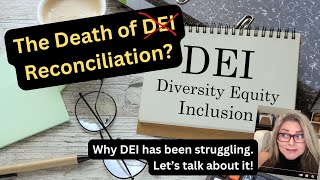
YouTube talk by Sandi L Boucher (Red Thunderbolt) contrasting DEI (Diversity, Equity, Inclusion) with Indigenous reconciliation in Canada. Boucher defines DEI components, critiques DEI as centered on marginalized people asking for inclusion (the “wrong side of the feather”), and argues reconciliation is a reciprocal, Indigenous-led partnership that acknowledges past harms, asserts boundaries, and builds a shared future. She predicts DEI initiatives may decline while reconciliation continues and urges voluntary engagement over mandatory training.
Chapters
I wanted to end off this week with a very important discussion. One, oh, Blue has no interest in it, obviously. That's okay. She's heard me talk about it a million times. It's the discussion over DEI and more specifically the death of DEI with all the changes that are happening south of the border. So today I wanted to focus in on the difference between DEI and reconciliation and why I may see a different future. Let's talk about it. Hi, everybody. My name is Andy Boucher. I'm Red Thunderbolt, woman of the Loon clan, a proud member of Seine River first nation in Treaty 3 territory in Northern Ontario. And I have dedicated the last 15 years of my life to Canadian Indigenous reconciliation, not DEI work. So, as I mentioned in the opening, I want to look at the differences between the two and then, I guess my predictions for the future. So let's talk about it. DEI for those who are not aware. And that would mean you've probably been avoiding the news lately because it's really been all over the news. DEI stands for diversity, equity and inclusion. So let's look at the parts because as I've preached many a time, you can't do the big until you understand the little. Get the little. Right? You can build out to the big. So diversity, that is a group or an entity or a business servicing and hiring to represent the diverse population that lives within Canadian borders. One of the methods that I see a lot of entities and organizations using that I am a huge fan of because it gives a definitive benchmark to hit, is percent of population. So to give an example, if you are a business operating in the city of Thunder Bay, then you need to know the percent of, of the population for the different groups. What is the percentage of people with a thin heritage? What are is the percentage of Italian? What is the percentage of indigenous? And your staff should represent that percentage. Now, that's a percentage you often hear of with police services. Police departments often use that. I'm a huge fan. I mean, because then you are servicing the people in your community. And unless you're an agency or an entity targeting a specific group, it just makes sense that you would want to service your entire population, especially if you're in business, because that's going to translate into green, the color that you're probably concerned about as a business owner, that is not a shot. I'm in business. I get it. I get it. Now, equity is where many, many people miss the boat. We're not talking equality or equal. We're talking equity. And equity means that you do Take into consideration where someone is starting and the barriers they face where that someone else may not. So, for example, in Ontario, this is a very current example. Doug Ford, our Conservative premier, recently sent out a $200 check to all. I don't even remember why he said he was doing this. As a thank you or reimburse something, anything. Sent out a 200 check to all of the people who had paid their taxes, submitted an income tax last year, and you got this check. I think that was how they decided the population of Ontario was to get this check. So that is equal, everyone getting the same amount. But as you can well imagine, for an impoverished family, that $200 check will make a huge difference as compared to someone who's bringing in six figures and more every single year. So it could easily be argued, how fair was that? After all this time? You would think, you would think I would have learned to silence my phone before shooting a video, but I didn't, obviously. So back to what I was saying. Sending the same amount to absolutely everyone with zero consideration, no context, you didn't take into consideration their financial situation and how much it would benefit them is equal. It's not equity. So if we had given more to the more impoverished and less as the income level goes up, that would be equity. Okay, so I always think of that one. It was a cartoon and if I can find it, I will definitely post it in this video. Debatable whether I can find it or not. It was two people in the hurdles about to run a race, and I believe one was a black woman and she had so many different hurdles that she was going to have to jump over than the stereotypical CIS white male in his lane. So that's equity. Taking into consideration the barriers. You're not supposed to feel shame if you don't have barriers, but your privilege shouldn't blind you to the fact that other people do. Okay, so that's equity. That's why it was so important. As I mentioned, privilege plays into this. So this is Peggy McIntosh's quiz, unpacking the invisible knapsack that helps you determine your level of privilege. I will put the link, it's open source now on the Internet, so I'll put the link in the description under the video. So if you want to take the quiz, feel free. And of course, inclusion is, I guess, what so many think is the ideal. I can honestly say as an indigenous woman, I don't. Because inclusion, to me it sounds like in simulation, because inclusion is. Include me in what you're doing. Include me in your discussions, include me at your table. I think Canada has long said, you can join us long as you become us. And that's not what any Indigenous person doing this work wants to be. I'm certain there's some out there that are okay with being assimilated. What reconciliation is talking about is something totally, completely different. We do not just want to become a cog in the non Indigenous machine. So long story short, my biggest, I think the biggest challenge, not mine, but I think the biggest challenge with dei, it's all about the wrong side of the feather. It's about marginalized people saying, you need to do this, you need to diversify, you need to bring in equity processes. You need to include us, you, you, you. Wrong side of the feather. There is no power there. So a lot of frustration and not a lot of difference as far as I'm concerned. Now, reconciliation is completely separate from dei. And one of the things I've really loved recently is seeing a lot of articles that said just that. It DEI initiatives may go down. That's got flip all to do with Canadian Indigenous reconciliation or even U.S. indigenous reconciliation, in my humble opinion. Welcome to my channel. That's all you get here. Reconciliation is balancing the feather. There's the action, reaction, action, action. It's. It's beautiful. So, for example, it is Indigenous standing strong and tall and strong and non Indigenous hearing us. That's reconciliation. Reconciliation is Indigenous healing ourselves and our communities while asserting boundaries in our relationships and what we'll tolerate as stewards of Mother Earth. This is not someone please notice me. This is Indigenous saying we have a voice and we need to change this conversation.
Can you tell I have notes over here?
Reconciliation is acknowledging the past and changing the present while we build the future we desire together.
Okay, so it's not us joining in.
What you are doing, like DEI promotes.
It is something new.
You bring your ideas. You bring your ideas, I'll bring mine. We're going to collaborate and finally use the wisdom of both sides. You have heard me say this a million times.
Reconciliation, short and sweet, is not about telling other people what to do. It's about us as Indigenous people standing up again and others, as in the non Indigenous, not wanting to miss the boat. The boat being the opportunity we represent and they're wanting to not miss that boat by choice. That's reconciliation.
If you are forced, it is why.
I charge more for mandatory training. Not even kidding. Because if I have to deal with a group of people that don't even want to be there, that's a huge emotional drain on me and anyone else doing this work. You should be doing the same. I would rather have a smaller group of actually interested in learning people because they're the ones that are ripple effect going to make a difference, not anyone being told they have to. So, long story short, DEI initiatives may be dead. They look like they're being legislated out of indigenous in the or out of existence in the States. Reconciliation is not. It's just the next logical step in this journey we're taking together. And as I said, I honestly believe. Here's my prediction part the people that choose to walk with us, their entities will still exist in the future. Those who don't are going to miss the boat and pay the consequences.
It truly is that simple. So you with me? I hope you're with me. And I hope now you have a clear understanding of why reconciliation is powerful. It's not telling you what to do, it's talking about what we can do. Whatever side of the feather you're on and why DEI has been struggling. Wrong side of the feather until next week. I love you. Take care. Bye. Bye.