The Difference Between Safe Spaces & Echo Chambers
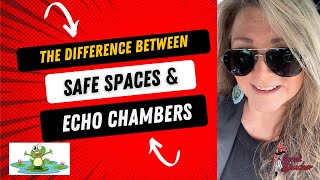
Sandi L Boucher explains that Indigenous safe spaces allow disagreement but reject attacks and stereotypes, unlike echo chambers that only reflect back what you already believe. Safe spaces protect from lateral violence while welcoming diverse Indigenous perspectives.
Questions this video answers
Sandi L Boucher
December 11, 2023
"A place safe enough to have uncomfortable conversations."
"An environment in which a person encounters only beliefs or opinions that coincide with their own."
Red Thunderbolt woman of the Loon clan; member of Seine River First Nation in Treaty 3 Territory.
Chapters
So I thought I'd start off this week by pushing back on a comment I've seen a couple times in the threads on my videos, and for those new to my channel, I do a lot of seminars and workshops, and a lot of times we're talking about Indigenous engagement and the differences in Indigenous worldview and mainstream worldview and how we look at things differently and how we can build the bridge. And, and I mentioned in a previous video that when someone shares something that is either factually just inaccurate or it's reinforcing a stereotype or both, I push back. And that's the action I use. It's like, okay, I'm going to push back on that. And that's my signal to the audience that, okay, we're not going to let that statement stand. We got to revise it. Because reinforcing stereotypes is not anything I want to do that causes harm. I'm trying to reduce harm to Indigenous people. But there was a comment, like I said, made several times by different people that I thought I should address, and that is the difference between an echo chamber and a safe space. So today, let's talk about it. Sam. Bonjour. Mishko Pagan on Quaint addition. Hi, everybody. My name is Sandy Boucher. I'm Red Thunderbolt, woman of the Loon clan, a proud member of Seine River First Nation in Treaty 3 Territory in Northern Ontario. And as I mentioned in the opening, I'm a facilitator, trainer, author, been a television host for a while. There's a lot of different things. I do anything that is going to advance Indigenous Canadian reconciliation. I'm trying to put a country together before my time is done here. So maybe my kids and grandkids don't have to do this work, not because it's not important, but because it's done. Wouldn't that be amazing? So, as I mentioned, I want to tackle the difference, and I understand the confusion. I also picked up on the judgment that was laced in the comment, but I wanted to talk about the differences between echo chambers and safe spaces. So let's look at some definitions. I don't think I have to define a safe space if you're not sure what that is. I've done enough episodes on it, including a podcast, or done enough videos on it, including a podcast episode where I went through the five steps you need to take to create a safe space. So a safe space is a place safe enough to have uncomfortable conversations. So it's not like people aren't going to ask you to clarify what you Just said it's not like people aren't going to disagree with you in a safe space. It's just you're not going to be attacked for it. So that's a safe space. An echo chamber. I wanted to be all accurate and all that stuff. So I actually looked up the definition for you, the legit definition. Got it on a posted note here. And an environment in which a person encounters only beliefs or opinions that coincide with their own. So let's unpack that for those people that believe safe spaces, and I'm going to assume they're referring to my YouTube channel, that I've made it crystal clear. I view my YouTube channel as indigenous centered space here. We look at things through an Indigenous world view here. I'm not allowing any comments to stay that would inflict more harm on Indigenous people. And I do that. And I've done it on my Facebook page and I've done this for years. I definitely do it in seminar and workshop, live. And that is because there are so few safe spaces for Indigenous people in this country. So I'm really adamant about this. So look at this. People thinking a safe space for Indigenous people is an echo chamber. Do you honestly believe that all Indigenous people think exactly the same way? Keeping in mind that in Canada there's more than 640 First Nations. You honestly believe, and they belong to different nations. Anishinaabe, Cree, Haudenosaunee, Dene. There's so many different nations with different cultural backgrounds, different experiences, different traditions and teachings. You honestly believe we all feel the same way? That we all have the same opinions on things? That would be pretty sure the definition of a stereotype. And it's why I don't like the word Indigenous very much, because it's misleading. It implies we're all the same. But you can say Canadian and people understand that. There's a whole bunch of Canadians. They don't all have the same opinion. You can say Americans and people understand it. Same thing for Indigenous. So a safe space does not mean that the opinions in that space are all the same. We can totally have different opinions, but we're not going to attack each other. And I think the other difference between the two and this I'd love to hear feedback on from the nice, respectful people that follow my work and subscribe to my channel. That is not an invitation to the trolls. Just putting that out there. I think the difference between seeing an Indigenous. I'm talking an Indigenous safe space. Let's Talk about my YouTube channel for a second. And the fact that I don't allow those comments. I think the difference between seeing this as a safe space and seeing this as an echo chamber depends on your cultural lens. It's whether it's indigenous cultural lens or non indigenous cultural lens. Because I can be in the community I've never been in before and my body just sighs because I know here people get me or they will as soon as I tell them who I am. Then we have that same world view, that comfort that comes from knowing you're in a safe space. Whereas people that would view it as an echo chamber, they are non indigenous. Focusing totally on the fact you're not allowing me to say what I want to say. Do you see the difference? So it's all about them and not about the safe space. So. But the reality is you can say all that stuff anywhere else in flipping Canada. Like I said, there's very few indigenous centered spaces. Probably wouldn't try it in a First Nation community. Probably not wise in the middle of a First Nation agency. But there's a whole bunch of places, especially online, then you can spit out those opinions that are problematic. And I've had people ask respectful questions on my channel. Totally cool with that. If it's dipped in a stereotype or judgment, I'm gonna push back on that. But no, this is not an echo chamber. In fact, often in my videos, like I just did earlier, I ask your opinion, knowing that a large part of you are non indigenous. So do I think this is an echo chamber? Absolutely not. I. That's a different world view again, because we go into every meeting, every gathering, we as in indigenous generalizing, of course. But anyone who practices those traditional teachings, no matter what nation you're from, learning is a lifelong process for us. We go into every meeting open to listening and learning. Every time an elder speaks or a knowledge keeper speaks, I know I'm going to learn. So I'm not looking for an echo chamber because an echo chamber would mean I'm not growing anymore, I'm not learning. My mom comes to mind here. We'll throw up her picture. Picture somewhere here my mom used to always say, so I'm going to backtrack for a sec. I don't know how many of you like putting puzzles together. You know, like the 500 piece, thousand piece puzzle, those kind of puzzles. And I know a lot of people do. And I ask this question in the seminar all the time and I always get a bunch of people putting up their hand. I'm not one of those people. I'm totally not. No Disrespect to those that are. My mom was one of you love putting puzzles together. To me, taking a perfectly good picture, cutting it up into 500 pieces and then asking me to put it back together sounds like a migraine. So I'm not doing that. But my mom used the metaphor of a puzzle to describe life. And she would say that how as youth, you only have like five or ten pieces of a 500 piece puzzle. Of course you don't know why you're here or what you're meant to be doing. Your puzzle pieces don't even match. You're probably asking yourself, why the heck did I meet that person? Or why did that have to happen? I didn't need that to happen. There's no lesson there. There is always a lesson there, by the way. But my mom would be the first to say, like when I'd come home from high school and I was confused, I got in a fight with my best friend or whatever and I didn't know what to. And I'd be sharing this with my mom often. Her response is was, it sounds like you need more puzzle pieces, meaning you need more information. You need to think about this longer, you need to gather advice or whatever the case may be. That is our goal in life. Our job every single day is to gather more puzzle pieces. I just finished watching an educational video adding to my puzzle pieces so I can better serve you so that my puzzle is more complete. I didn out what I was supposed to do for a living, which is, by the way, this and all my work until I was in my mid-40s, until I had enough puzzle pieces to see what the picture was. And that's the other thing. My mom used to say that for people who actually do puzzles, we all know you can actually cheat. You can look at the picture on the box and you can see, oh, that blue is the sky and that blue is the water and that green is the grass. When it comes to life, we don't get the picture on the box. We have to keep gathering puzzle pieces until we have enough of them to figure out what the pieces, what the picture is. So a safe space is not an echo chamber because I'm gathering puzzle pieces and hopefully by these, watching these videos, you consider them puzzle pieces in your puzzle, things that you now understand more or things that you see differently whether you're watching what's going on in indigenous community around the six o' clock news. So is there a difference between a safe space and an echo chamber? 110%. I'm not against other opinions in this space. I am very interested in other indigenous opinions. Unless it's lateral violence, if it's coming across as an attack, that wouldn't make this a safe space. If there's that sarcasm that someone commented that this is an ego trip for me and I don't take that to heart, that shows me how much healing they have to do. If you can watch one of my videos that actually think I'm doing this work for me, then you're. You've missed the boat. And I hope you go clean your glasses so you can get a better opinion. So there you have it. I hope that made sense. Went off on a tangent. Well, no, I didn't because the story was right on point. I'm not going to bash myself for that. But this is not an echo chamber. It is an indigenous safe space. That may be new to you. That's okay. I'm going to guide you in how to operate here. But we're definitely going to keep it a safe space. I hope that made sense. Whole bunch index cards for you again this week. I love you. Take care. Bye. Bye.
More from Sandi

How I Handle "The Four Uglies!" (Alcohol, Diabetes, Healing & Cheap Seat Comments)


All the Stuff We Don't Talk About with NO SHAME! (WMT Podcast w Antoinette Godin)


When Authors Chat ... (Radio Interview for the Launch of "Copper Stone - Glimpse of Blood Memory)



MORE PROOF of Indigenous/Non-Indigenous Relationships that Work! (Walking My Talk w Millie Gormely)
