The FOUR Non-Indigenous People We Do NOT Want to Meet!
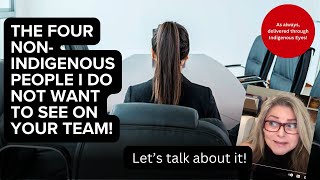
Sandi L Boucher (Red Thunderbolt Woman, Loon clan, Seine River First Nation) identifies four types of non-Indigenous people who make negotiations harder: those who treat Indigenous people as invisible, those who see them as a threat, those with racist attitudes, and paternalistic white saviors. She urges non-Indigenous teams to do preparatory work before engaging with First Nations.
Chapters
Hello, you super duper double delicious person, you. Today I wanted to talk about the 4 non indigenous people that Indigenous people like me don't want to meet. And no, of course I'm not talking about Sam and Bill and sue and Jim. I'm talking about four general types. Four people. You've heard me talk about our defensive walls before, you know, hovering in the middle. Do we have to slam it up to protect ourselves or is it safe and we can bring the walls down? These are the four people we're on the watch for, the people that will make us slam our wall up. And of course, what I'm hoping is you are not any one of these. Let's talk about it. Hi everybody. My name is Sandy Boucher. I'm Red Thunderbolt, woman of the Loon clan, a proud member of Seine River First Nation in Treaty 3 Territory in Northern Ontario. And before I jump into the main contact today, I wanted to talk about Indigenous centered space and non Indigenous centered space for a moment. So if you've been on my channel for a while and if you haven't been, welcome. If you love this video, please subscribe. Stick around, I got lots of things to share with you. And if you have been along on this journey with me, thank you so much. I love that we're on this trip together. Now, if you have been following my videos for a while, you have probably heard me reference the fact that my YouTube channel is indigenous centered space. And no surprise for a lot of people, especially non Indigenous people, that phrase is kind of confusing. They don't understand what it means. So it is easiest to understand by looking at the reverse non Indigenous centered space, which would be Canada. So what I mean by non Indigenous centered, it means that policies and decisions and programs and whatever supports are out there have that target audience. They have that non Indigenous program person in mind, the Canadian. And if it benefits Canadians, then this is what we want to do. That is Canadian centered space, or what I refer to as non Indigenous centered space. But in a First Nation community or in a First Nation agency, or on my YouTube channel, it's indigenous centered space space. So here I do things in line with my Indigenous teachings. Here I am helping non Indigenous understand how we see the world, why we find that offensive or insufficient. Whatever the program or policy is, it's Indigenous centered. Now that becomes a huge issue in Canada. But when it becomes, when we talk about elections or politics and even a lot of government initiatives because they're Canadian centered and that does not mean they benefit or even support Indigenous Peoples I don't think it'd be too hard for you to list off something that Canada thought was a good idea that Indigenous people absolutely didn't. And that becomes a big conversation around federal elections time because there's a lot of Indigenous people that don't vote federally. And I can admit I'm one of those people that for years have chosen not to vote. And it's because I know whatever political party gets in, they are not an Indigenous centered party. They are not going to fight for what's good for me. They're fighting for what's good for Canadians. And hopefully that accidentally or coincidentally is also good for Indigenous people. In other words, the federal government is who we negotiate with. We're sitting on the other side of the table. If there was an Indigenous centered federal party, you can bet my last buck I'd, I'd sign up to vote for them. But I know when push comes to shove, if it's for the benefit of Canadians or for the benefit of Indigenous people, Indigenous are going to lose because it's a Canadian party. Now, I'm not saying don't vote. I know an elder who absolutely does vote in the federal election process for almost the exact same reasons. He just looks at it a little bit differently. And what he said, which I thought was quite humorous, is I can't think of any other opportunity where the quote unquote enemy allows me to pick who we're going to fight against. Right? So. And that's it. When Indigenous people elect a federal party, we are choosing who we will be negotiating with. And hopefully we elect someone that's not going to be as problematic. Talk more about that tomorrow. But that's not the focus of today. I needed you to understand Indigenous centered space because we know. I know when I leave my home, when I leave my office, that I am walking into non Indigenous centered space, which means my best interests or my worldview is not what governs the space space. So I'm already expecting that things might be said that I don't agree with. Things might be said that are misinformation, especially about me or Indigenous people in general, because I'm in a non Indigenous centered space. And that is where we're on guard and watching for the four non Indigenous people we do not want to meet. And unfortunately we meet them often. So if you're wondering why Indigenous non Indigenous negotiations, engagement, partnerships are challenging, it might be because one of these people or even more of these people are on your team. And that's something you can check out before you Come meet with us. So who are these four people that we're on guard for? And another way to look at it is for attitudes that are not going to be helpful. And that's putting it mildly. They could be a way a lot worse than just not helpful. So the first one is the non indigenous person who thinks indigenous people are invisible, that we don't even exist. These are the. We are all the same. How I look at the world is, of course, how you look at the world. If it's not a problem for me, why should it be a problem for you? I found a way around it. Why can't you. Those people that honestly believe that their truth is the truth. Have you met another human being? I mean, there's. Think of any family you can think of. They may go through the exact same experience I can think of in my family. The passing away of my father, the death of my father, which I guarantee you, affected every single member of that family differently. Even though the situation, the passing of my father happened at the exact same time. We were different ages, we had a different world view. We had different personalities, different experiences. Experiences up to then, different things we had healed or not healed from. It affected us differently. There is no such thing as the truth. There's your truth and my truth. And if we share with each other, we can come up with common ground. So the first person who thinks indigenous people are invisible, that we're just all the same, that's problematic. We don't want to run into that person. The second person is exhausting and I understand where it's coming from. I'll touch base on that in a sec. The second enemy, the second non indigenous person we don't want to run into is the person that thinks indigenous people are a threat. Kind of insulting. You could definitely look at that way. I tend to go more to the empathy side of things. These are people. It's fear based. I have literally heard. They didn't say it to me personally, but I've definitely heard of people who said that they're afraid of reconciling with indigenous people because they're afraid we are going to do to them what they did to us. For one, I love how encapsulated in that is the acknowledgment that what you did to us wasn't cool. I kind of like that part. That's not even our teachings. Anishinaabe medicine wheel teaching. There's room for all of the colors in the medicine wheel. In fact, the circle doesn't come together until we Come together and share our teachings together. Anyone who has ever sustained incredible pain, you don't want to inflict that on anyone. I have been through things I wouldn't wish on my worst enemy. So, no, I don't want to take your children. No, I don't want to force you to learn my language. Let's all keep in mind that the settlers, the original settlers, would not have survived their first Canadian winter without the indigenous people teaching them how. Right from the get go, we were willing to share and help, and that came back to bite us in the butt. But that's not our doing. That was the other side of the feather. So the people that think we're a threat, that if. By the way, the one thing that scares the daylights out of these people is the fact that indigenous people are the fastest growing group in the population today and have been for years, we're not going away. So how about building bridges? Okay, so the first one, the people that think we're invisible and just all the same. Ick. Two, the people that see us as a threat. These are two people we do not want to see at the negotiation table. Only because we know the racial battle fatigue we're about to feel, the emotional labor we have to put into just having a conversation with these people because they haven't done their work before they came to the table. Trust me, an indigenous person and a negotiation table has had to do. And no, I can say that in the video, a lot of work before they came to the table. We are only asking for you to do same. We prepare, prepare. And it's not a non indigenous entered space. You got to prepare to swim between the lanes. Tamina's in the middle. Anyone who has followed my channel for a while, you know, I live in the city of Thunder Bay and I run into number three people, this third type. Way too often. Racism is horrific. Let's not beat around the bush about that one. It is. It is soul crushing. It's exhausting. It's ridiculous. It's just. It just slows everything down. And it just. But one of the things I've noticed not just in this city, but definitely in this city, is the fact that racism comes drenched in disgust. That it's not just, I don't want to be around indigenous people, it's I'm disgusted by indigenous people. I'm disgusted by that dark skinned person that just walked into the restaurant. I'm disgusted, disgusted that I have to walk by those indigenous teenagers on the sidewalk. It's the disgusted person. What can you work on that before you even come to the table because you have no right to inflict that on me. For one, I am absolutely sorry that anyone ever taught you that garbage about indigenous people, but you're a grown, grown person now and you need to unpack that. Your suitcase is full of crap. It's really super heavy. I'm gonna guess you're feeling exhausted about it, but shooting disgust at me. And you've never even met me. If I do something disgusting, feel free. But. And, and we see it all the time here. I've had this discussion so many times over the years. Let's talk about an intoxicated person first because way too many people still think of that when they think indigenous. I have had people admit to me that if they saw a white non indigenous person trying to walk down the street totally intoxicated, they would think, oh, buddy had one too many, he should be getting home. But if they see an indigenous person intoxicated on the street, that's disgusting. And it goes into all the stereotypes they believe, like we're supporting those people. Why are they not going to get it together? No, no, no, unpack that. Because we don't want to have to try to work with disgusted people. It is way too emotional, way too much emotional labor to do that. And just as bad, but almost the other side of the fence. Is it though? I don't know. Might have to think about that. The fourth non indigenous person we do not want to run into is the paternalistic non indigenous person. That white savior, the one that wants to help us, that wants to make up for the past. It is insulting. We are grown adults and we are coming to this table. We don't need you talking down to us. We don't need you taking care of us. We need you entering into fair and reasonable negotiations. We will take care of our side of the feather. Remembering that we have the power to is part of our healing and treating us like we're for or that we need to be saved is how we got into this mess in the first place. Let me be crystal clear. If you're non indigenous, you have no idea what we need unless we have told you. And to assume anything else is your ego trip. It is not a negotiation. So the four non indigenous people, we do not want to meet because it just makes us have a harder day. The person who thinks we're invisible, that we're all the same, the person who sees us as a threat. What? The person who is disgusted by our very existence and the person that wants to take care of us. Do me a favor, please, and thank you. Check out your team. The team you're about to bring into a First Nation community. Can you make sure that none of these four are on your team? Because it increases your chances of success along with ours. I hope that makes sense. I would love to know what you thought of this video. Until tomorrow. I love you. Take care. Bye. Bye.
More from Sandi

How I Handle "The Four Uglies!" (Alcohol, Diabetes, Healing & Cheap Seat Comments)


All the Stuff We Don't Talk About with NO SHAME! (WMT Podcast w Antoinette Godin)


When Authors Chat ... (Radio Interview for the Launch of "Copper Stone - Glimpse of Blood Memory)



MORE PROOF of Indigenous/Non-Indigenous Relationships that Work! (Walking My Talk w Millie Gormely)
