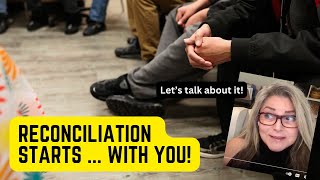
A short spoken presentation by Sandi L Boucher (Red Thunderbolt Woman, Loon clan, Seine River First Nation) outlining four stages individuals move through to engage in Indigenous Canadian reconciliation. She frames the stages using Anishinaabe medicine wheel life stages: Stage 1 (baby) — learn Canadian history; Stage 2 (youth) — learn modern-day manifestations of Indigenous oppression; Stage 3 (adult) — take concrete actions and advocate for change in daily life and institutions; Stage 4 (elder) — engage in conversations and sustained reconciliation. The talk emphasizes local, individual responsibility, non-performative action, and repeated conversations as the path to societal change.
Chapters
So what if I told you there are four distinct stages that you move through to get yourself prepared for or actively engaged in reconciliation? And of course, I'm talking Indigenous Canadian reconciliation. Would you be surprised to hear that? And even more so, could you answer the question if I asked you, what stage are you in today? Let's talk about it. Bonjour. Hi everybody. My name is Sandy Boucher. I'm Red Thunderbolt, woman of the Loon clan, a proud member of Seine River First Nation in Treaty 3 Territory in Northern Ontario, and one of the analogies I always like to use when it comes to talking about the work required to get ready for Indigenous Canadian reconciliation is the idea of a feast like think Thanksgiving dinner or Christmas dinner for those that observe those holidays. You have all of those amazing dishes that come together to create the meal. And every single one of those amazing dishes was made with amazing ingredients. If they weren't, you're not going to have that amazing dish or that amazing meal. It's been my experience that so many people in Canada want to have the feast, but they don't realize it starts with really good fresh ingredients. They want to solve the national problem and don't realize it starts with local efforts. And it starts with you. It starts with the conversations you have on a daily basis. It starts with the education you have, the sources you follow, and the actions you take. So what I want to focus on today is no surprise, you and the four stages that will get you to reconciliation. Because if you live within Canadian borders, you're part of reconciliation, in case you didn't know that. So the first distinct stage, and by the way, I'm going to use the medicine wheel teachings here and the four stages of life as represented in Anishinaabe culture. I'm Ojibwe or Anishinaabe, and so these are my teachings. The four life stages are baby, youth, adult and elder. So baby and youth are learning stages. Baby, think of the baby. They have to learn how to talk, how to walk, how to sit up, how to eat, the basic teachings that they're going to build their life on. Then when you think of a youth, you think grade six, seven, eight in high school, it's still a learning stage. They're still learning to be an adult, but it's more advanced learning now. The adult stage is an action stage. And way too many adults would love to stay in the learning stage cuz it's comfy if you don't move towards action. We are never getting to reconciliation. And the elder stage is where the reconciliation happens. You've now taken the steps, you've made some changes, you have the education, you are ready to have the conversations. You cannot solve the problems on your own without the conversations. Because that really wouldn't be reconciliation, now would it? So what is the first stage, the baby stage? The baby stage is learning of Canadian history. And you notice I said Canadian history, not Indigenous history. The that's a mistake that a lot of people make. What happened to Indigenous people was done by Canadians. It's Canadian history. It is literally how this country was established and settled. So all that land that Canadians love to brag about, Indigenous people paid the price by being moved off that land and at dire personal cost. And the oppression of Indigenous people continues today, which you understand if you take the time to learn the history. So you're not going to reconcile with anyone if you don't understand where the problem came from. Think of your relationship. Same thing. You need to know what went wrong and why it happened. Where did that come from? That's the baby stage or stage one. And yes, I have my handy dandy index card. Stage two, the higher learning stage, the more advanced learning is all about understanding modern day manifestations of the oppression. So you look at the history and the oppression of Indigenous peoples, but now you bring it into the modern day. What are examples of modern day Indigenous oppression and what does oppression do to a person? How do they react? How do they behave? Do you see examples of this? I guarantee you once you have the education, it'll be impossible not to see the examples because modern day oppression of Indigenous people most definitely exists. Stage three, as I mentioned in the beginning is the adult stage. This is the stage of change. So now you understand how we got here, you understand what's still happening. Now you sit down and decide how you can help. And it's not just going to rallies and it's not just wearing an orange shirt on September 30th. Can you say performative? It is going to your committee meeting and noticing there's no Indigenous people there and asking why. It's insisting on Indigenous people being invited. It's about intending Indigenous events to learn more and not just to learn. It's not all self centered. It's about getting to know your neighbor and being inclusive for once. It is looking at everything. The hiring practices at where you work, the, the policies. Do they just have an honor, Christian holidays or Indigenous holidays included too? And if not, why not? It is looking at Canada and the way you do your every single day through a more informed lens. And now seeing. Well wait a minute, you're watching. If you have indigenous people in your area, excuse me, watch how they're treated by salespersons or what? That's a nice big. Did you hear that engine in the background? I hope not, but it's looking around, even watching the six o' clock news. And here I am showing my age again, talking about the six o' clock news but listening how people describe indigenous people as opposed to others. Are we still being othered? And nothing drives me nuts more than when I see a conference agenda. And they're going to talk about the economy and they're going to talk about politics and they're going to talk about health care and they're going to talk about indigenous issues. We just got othered. We just. Because our issues are the economy, our health care. Right. We are part of those discussions or should be. So you start noticing what's going on in your area and you start advocating for change and making change in your own circle. Then through natural progression you're gonna start having conversations and, and you're starting to work towards reconciliation. It truly is that easy. Don't over complicate it. Don't ever think there's going to be a one size fits all solution that is handed down by the government because that is not going to happen. I honestly believe the government's going to be the last one to get on board with this. I have many amazing non indigenous friends and colleagues and guess what? We're friends and colleagues because we have a conversation, we respect each other and we have open communication. When something goes south, we discuss it. I know they're not bad people, but that doesn't mean I'm just going to silently endure. If they accidentally say something, I know it's not with intent to harm, but harm doesn't require intent. We need to learn that. So stick around. My channel can be a great source of education for you, but only if you're advancing through the stages. If all you ever do is learn, then nothing changes and things have to change because indigenous people are dying. And I know you care about that as much as I do. So there you have it, the four stages. One, learning of the history. Two, learning of the modern day implications and manifestations of that oppression. Three, identifying what needs to change and how to change it. And four, starting to have those amazing conversations. It's going to take a million conversations, thousands and thousands of questions and yes, probably thousands and thousands of apologized apologies every single time we misstep and say something. But guess what? It's not fatal. It might be embarrassing. I've definitely had to apologize for something I've said. You learn from it and you go on. I think that's called reconciliation. Just saying. Until tomorrow. I love you. Take care. Bye. Bye.