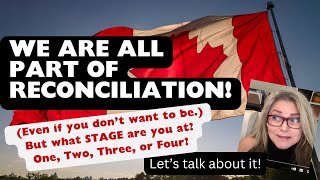
This is a short YouTube talk by Sandi L Boucher (aka Red Thunderbolt) presenting a four-stage framework for reconciliation (illustrated via a couple’s argument metaphor) aimed at guiding Indigenous / non-Indigenous relationships in Canada. She names and explains four stages: (1) denial/"I didn't do anything wrong" attitude; (2) performative/empty apologies to end conflict; (3) genuine apologies without behavior change (likely to repeat harm); and (4) genuine apology plus new communication/behavioral changes — the path toward reconciliation. The video includes speaker provenance (Seine River First Nation, Treaty 3 territory) and a brief event/context mention (panel with Afnada).
Questions this video answers
July 26, 2024.
Sandi (Red Thunderbolt), a woman of the Loon clan; member of Seine River First Nation in Treaty 3 territory (Northern Ontario).
Chapters
Hello, you super duper Double delicious person, you. We're gonna finish off the week on a little bit of a lighter note, a hopeful note, at least to me. I hope you agree. But before I jump into that, I did want to mention for those that are on my email list or have considered joining my email list, I used to send out daily emails and that just proved to be way too much. Even though I was sharing this day's video and the day's blog post, it it's just too much. Inboxes get full. I get it. And I don't want to be part of the problem. I want to be part of the solution. So starting next week, every Thursday you will get one email and it'll summarize the videos that I shared since the last email. Kind of like if you're on the email for the TED talks, they give you all the different videos and you can click on the one you want to watch. So that's what I'm going to be doing. So if you would benefit from that, you could subscribe to my YouTube channel, which of course I would. Super duper double delicious. Appreciate. Or you can get on my email list and get that summary every Thursday. That is not what we're talking about today. So what happened where this video idea came from? I have an event coming up in September with Afnada. If you don't know who that is, I'll put a link in the show notes so you can check them out. Definitely worth checking them out if you're indigenous or you're just non indigenous and curious. Worth your time and effort. I'm going to be part of a panel at their conference. So I had received an email. Please go fill in your registration. Just signify that you're one of the presenters. That way it covers my registration fees. So I was going through the registration, yes, handy dandy index card. And the question they asked was what organization are you affiliated with? A lot of people that attend these conferences are affiliated with an indigenous non profit I wrote in Mishk Enterprises, my company supporting both indigenous and non on their reconciliation journey. And that got me thinking and got me realizing, or had me realizing that we're all on this reconciliation journey, even the people that don't think they are. Let's talk about it. Hi everybody. My name is Sandy Boucher. I'm Red Thunderbolt, woman of the Loon clan, a proud member of Seine River first nation in Treaty 3 territory in Northern Ontario. And and as I said in the opening, I now see how we are all On a reconciliation journey. Now, to help you understand that before you start arguing with me and start typing those nasty comments, I'm going to take that back. Most of the followers on my page don't type nasty comments. Randos might, but that's besides the point. What I was going to say is some people are confused when they think about Indigenous, non Indigenous reconciliation. So I always get them to bring it down to the bare minimum. The metaphor, Sorry, my phone is not on silence. So think of the couple that just had the confrontation, had the argument, had the disagreement, whatever it is, the incident happens and then how this. So someone got hurt, or maybe they both got hurt, or whatever the case may be the person who did the hurting, even if it's both of them, there's like four different places they're standing or four different stages they're at. And this is what made me realize every person living within Canadian borders is one of these people. So the first stage is the attitude, right? The puffing up the chest. I didn't do anything wrong and there's nothing I need to apologize for. If you're not Indigenous and questioning whether those people exist, you need to come to one of my seminars because they're in every single audience. Well, that was in the past. I didn't send anyone to residential school. Yeah, then that's why in stage one, there's a lot of work and a lot of educating and a lot of patience needed to get that person moving forward. Right. You're not reconciling at that stage. Whether it's the personal, intimate relationship or the nation not happening. I think you can agree with that or see where I'm going with that. Stage number two, I'm sorry. But in this case, the I'm sorry is empty. They are saying I'm sorry to end the fight. They are still. There's a good chance they still don't think they did anything wrong. They might think their partner is just being difficult. They're only saying I'm sorry to end this. This situation and hopefully go back to before the argument. So it's an empty apologize apology. It's not genuine. It's just I'm sorry, you know? And we've all heard those apologies. That's the performative apology that I often talk about when it comes to the Canadian government or even Canadian entities that want to give a land acknowledgment but don't want to do anything else. It's performative. Right. It's not worth the error it takes to say it or the Time it takes to hear it again. Reconciliation is not happening with empty apologies. The third stage. Now, this is where I think a lot of the people I work with are, which is a good fact for me to know because I can guide them more effectively if I know where they are. The third stage is the I'm sorry, but it's genuine. Now. They are sorry that they did whatever they did or said whatever they did. They are authentically sorry. But they have not learned new ways or they haven't taken in new information. So it's going to happen again because there's nothing has changed. And without change, nothing changes. So in that moment, they're absolutely sorry. But because they haven't learned a new way to communicate or haven't taken in any new knowledge as to why this isn't effective or helpful to the relationship, it's going to happen again. So and unusually often. Let's go that way. The person they're apologizing to realizes this. Maybe they believe it the first time, second, third, fourth time. They see nothing is changing. It's just they're getting better at apologizing. Reconciliation is not going to happen at this stage either, because harm is still happening. Remember my hashtag, no more harm. The bare minimum for reconciliation. It's not happening at this stage. The final stage, stage four is I'm sorry. And we've discussed new ways to communicate. Yeah, I can use a word, I can say banana. And you know, that means I'm over exhausted today and really not up for a conversation. We give those those safe words or we figure out, you know what, we shouldn't have serious conversations right after work. We need that de stress time. And you've worked it out, whether it's together or on your own and just presented it. Whatever it is, there's a new process, a new way of doing things, a new way of communicating. Something has changed. Now we're on the path to reconciliation. So just to reiterate again, the four stages. I didn't do anything wrong. I don't have anything to apologize for on stage one. Stage two, I'm sorry, but it's just the. Can we stop this now? It's not authentic. Three, I'm sorry the words are genuine, but there's no change in process or behavior. There's no learned skills, new ways to do things. So it's going to happen again. And four, I'm sorry with new skills and ability or understanding. So we are all on this reconciliation journey and I am learning every single day how to do my job better. How to help support people whatever stage they're at. So the question, of course, is what stage are you at? And do you know people on the other stages? Don't need to call them out. Let's not name names here. But do you know people at those stages? Because I know I do. I hope you have a super duper double delicious weekend. For the people that watch me on YouTube, I'll see you on Monday. For the people on my email list, you can check it out on YouTube or you can wait till the summary on Thursday and all of these videos will be there until next week. I love you. Take care. Bye. Bye.