The Power of FOUR (Four Frameworks to Help You Understand) - The PATH Podcast Season #2 Episode 8
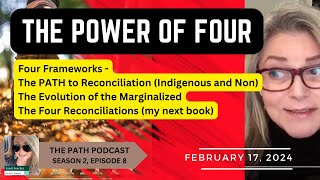
Sandi L. Boucher (Anishinaabe Kwe) presents a YouTube PATH podcast episode outlining four related four-part frameworks aimed at advancing Indigenous Canadian reconciliation and personal healing. She introduces the PATH tools (Patience, Awareness, Tenacity, Humility) and applies a four-stage medicine-wheel model to both Indigenous and non-Indigenous paths (baby, youth, adult, elder). She also describes the four-stage evolution from marginalized to empowered ("I can't be me anywhere" → "I can be me within my inner circle" → "I can be me among people like me" → "I can be me anywhere") and proposes four reconciliations (with your past, changed future, who you are, and with another person) as steps toward national reconciliation.
Chapters
Hello, you absolutely amazing person, you. Welcome back to the PATH podcast, where we go in depth not only on Indigenous Canadian reconciliation, but tools and steps we need to take to move the needle forward. I am all about taking action. I am all about next steps. If you've ever attended one of my seminars or listened to one of my keynotes, you know it is all about the takeaways. I always say that the magic happens after I leave the room when you decide what you're going to do with the information I've shared with you. Now, as I alluded to in my video yesterday, today's podcast episode is all about the power of four. And as Anishinaabe Kwe, as an Indigenous Ojibwe female, I know that the four pops up in our culture on a regular basis. We have the four sacred medicines, sage, sweet grass, cedar and tobacco. We believe in the four parts of your being. Emotional, spiritual, physical and mental. We believe in the four life stages, baby, youth, adult and elder, and how they all have valuable lessons and teachings and that they all need to be respected and included. Mainstream dream. Are you listening? We? What else is there? The four directions. And there are so many times the four shows up. And today I want to share four examples of four times it shows up. And these are all related to reconciliation, personal growth, your own healing. Because yesterday I talked about that healthy marriage between two parts. Two healthy parts. So you got to heal, too. I got to heal so then we can come together and have a healthy relationship. You can't have an amazing meal if the individual parts. The dishes in that meal aren't amazing. So I'm as interested in your healing as I am in my own, because I think being a human being is often not easy. So let's talk about it. Bonjour, Mishko Paganan, Queen Additiona Kasmang Dodem. Hi, everybody. My name is Sandy Boucher. I'm Red Thunderbolt, woman of the Loon clan, a proud member of Seine River first nation in Treaty 3 territory in Northern Ontario, Canada. And as mentioned in the opening, today, we're talking about the power of four in four different ways, four different steps, four different frameworks that all relate to moving us towards Indigenous Canadian reconciliation. And this one's so big, I have two huge index cards. Not even kidding. So, first off, where did I put it? There it is in my book, the Path. It is. This is the action plan to reconciliation. Because seriously, as an Indigenous woman, I was waiting for it. When is the government coming up with the action plan? When are the Indigenous peoples Coming up with an action plan, the steps to get us to reconciliation. Can we come up with the plan and then we can implement it and we can evaluate later, Evaluate ourselves on the steps we've taken? No, didn't happen. So I sat down and I wrote one. And anyone who's watched my channel for a while, you know the word path is an acronym and it stands for what I consider the four essential or sacred tools. Patience, awareness, tenacity, humility. You need to use those tools in every single path, conversation, relationship, partnership, whatever the case may be. If you're not, it's a cross cultural relationship that's going to have challenges. You're bringing different worldviews, different values, different interpretations, different needs to the table. You better have patience with yourself and your partner. You better be aware of what's going on for your partner. Right? Like what kind of challenges are they facing besides trying to work this out? Bring your tenacity. Don't give up. You're going to give up easy. If you're looking for convenience, you shouldn't even be at the reconciliation table. And always bring your humility. Remember, humility builds bridges, ego burns them. Now, the one thing about the path, the book, it's kind of misleading because there are actually two paths highlighted in the book. There's a path for indigenous people and a path for non indigenous people. And actually in the full day seminar that is based on that book, the last exercise is a reconciliation exercise and it shows the two paths. So that's the first thing I wanted to talk about today. We're going to start with the path for indigenous people. Now I'm going to fold this in half so I make sure I'm looking at the right one. The path for indigenous people. So we start in the west, mainstream likes to stand, start at the top and go around. We do go clockwise, Anishinaabe do, but we start in the west or in the east. I should say in the west. In the east, where the day begins, where the sun comes up. So the first step for indigenous people. If you followed my work or watched my videos for any length of time, I do not think this answer is going to surprise you. Any guesses? Anyone? Anyone? The first thing that indigenous people have to do is heal. You're not even ready to be figuring out how you're going to work with non indigenous people if you have not healed from, from what this country has done to you. And remember, 10 year domestic abuse survivor. My healing after those relationships ended was not dependent on my abuser suddenly becoming a Nice person. Your healing's on you. It doesn't matter what Canada is doing. The responsibility for you and your children and your grandchildren, for their sake, please do your healing. Whether that's through, you're. If you're Christian, all the power to you, follow that. If you're traditional and you're working with your elders and ceremony, follow that. What is that quote? Healing is a long and often painful journey. But without it, life is a long and often painful journey. Trust me. Trust me. The other thing, if you don't heal, then your pain and your trauma becomes the lens that you're looking through and is going to taint everything you hear. Every partnership you try to get into, you are going to hear an attack. When there isn't one, you are going to hear an insult when it was a question. Now, I'm not saying that all questions aren't insults. It definitely happens. But you're not that super sensitive and, and that's why people going to talk about this in a little bit. But you know, looking at Indigenous communities or indigenous agencies and I've heard Indigenous people demanding that they should be healthier. Back to my analogy of the dinner. You can't have a healthy work environment with a whole bunch of unhealthy people working there. It's just not possible. And I'm not saying they shouldn't work there. I'm just saying lower your expectations. You're starting to sound like mainstream, demanding that people get it together. If they haven't, they obviously need more time and support. We got to get better with the time and support that is stage one of the Indigenous reconciliation path. Can you see this is going to take a while? Second, you have to unpack. You have to look at the things. You have to look at your internalized oppression. You have to look at what you believe and where that came from. Like if you honestly believe that Indigenous people will always be looked down upon. Who told you that? What gave you that impression? Are there other examples? You know what this reminds me of? Anthony Robbins, Tony Robbins, very, very, very well known motivational speaker. He talks about the reinforcement of a belief. So if you think of a stool, right, you know, it's got the flat top and then it's got the legs. If someone tells you, for example, you're never going to succeed, you're going to be a failure your entire life, I know that's a horrible thing to tell you. There's a reason for this. So that becomes the tabletop. And then if you can think of examples of when you have Failed. Those become the legs. And if you can think of a whole bunch of examples, you have totally reinforced that belief. What I'm saying is buy different stools. If someone has told you you can never succeed, a couple, I don't know, a week or so ago or earlier in the week, I asked you to list off all the things you've accomplished. So if someone's telling you you're a failure, that's an exercise you need to do. You need to make the top of that stuff. Stool, I am successful. And then you got to list all the things you've been successful doing, all the things you've learned, all the things you've graduated from, all the grades you've passed, all the books you've read, whatever the case may be. Build that stool. So that's the second stage. Now, you notice I use the medicine wheel. That's what this diagram looks like. We believe that the very first stage is the baby stage. And if you think of a baby, it's very much a learning stage. You're learning foundational things, how to add sound, how to subtract, how to speak, because you're going to need those in future levels. Stage two, we consider the youth level. Now, it is still a learning stage. You're not an adult yet, but it's higher, more advanced learning. So you're not just healing from your pain now you're unpacking. Where did that come from? And do I want that in my suitcase anymore? Can we all agree the speedo doesn't look good on anyone? Can we pull it out of the suitcase once and for all, please? The third stage is the adult stage. Now, in both paths, the adult stage, you know, you're there because you're starting to make change. This is not. You can still keep learning, but it's not just learning. You. You get to that stage, you better be using what you've learned. Otherwise you're stuck in youth stage. So. And that is not desirable as much as mainstream would like us to believe. So for indigenous people in stage three, we're going to talk about this in another framework in a second. It's learning to use your voice, learning to share an opinion in a respectful way, learning to say, you know what? That really doesn't work for me. Learning to say, you know what? That sounded really disrespectful to me when you said that. Is that the way you meant it? Right. That's coming from a place of empowerment. Stage four, the elder stage, where we got all the wisdom. Well, in both paths, stage Four represents reconciliation and it's not defined because it's going to depend on who you're trying to reconcile with. There is not any Pan Canadian solution. There is not going to be a one size fits all because one size fits all, fits no one. Well, we have to look at reconciliation as how do Indigenous people in Ontario or each community reconcile with the province of Ontario? How do we reconcile with the country? How do we reconcile with the municipality next door? All of these are going to be reconciliation processes. That's the first framework one. The second one is the exact same deal for non indigenous people now, same framework. So we're going to start in the baby stage. So the baby stage is a learning stage for non indigenous people. Do you get the impression that stage one isn't an easy one? Ask a baby how easy it is to learn a language or walk. We forget because we did it, we forget how hard the path was for non Indigenous people. Stage one is accepting the facts, accepting the truth, accepting the history of this country, accepting what this country and its leadership and and its peoples did to Indigenous people. No excuses, no minimizing, accepting the truth. Don't worry about guilt or shame. But acknowledgement is what we need. Of course you have to have a desire to fix this. Now for non indigenous people. That's stage one. That's going to take some work, that's going to take some education, that's going to take some reading, that's going to take some seminars that might take subscribing to my channel. Just saying, you never know. Stage two, the youth stage, the more advanced learning stage is unpacking your suitcase. And in this case you're looking at the benefits you enjoy with the corresponding oppression that happened for Indigenous people. The fact that I'm doing this video in English is an example that the fact that the Europeans were able to still use their languages when they were here and it was our languages that were outlawed. The fact that the justice system, European style, the education system, definitely European style. So all of these things that were brought over and imposed on us but were a benefit to non indigenous people. So it's quite the unpacking process. Stage three. Remember we're adult stage now, so now we've done our learning, we gotta change some things. Stage three requires a commitment to no more harm. So that means changing processes that hurt Indigenous peoples, making it possible. Did you realize that your HR policies at work honor a whole bunch of Christian holidays and are just starting to include Indigenous celebrations? The annual hunting parties that many communities take part in still Isn't recognized or possible in many, many entities. Personally, I. If I was working for someone else, I could care two beans. I'd work Christmas Day. But I'm not working June 21. I'm not working October 30 unless I'm doing something to empower indigenous people on those days. Right? So that's what I'm talking about. Those are the kind of changes where I live. Is it built soundproof enough that I can use my hand drum and do the ceremonies? That can I smudge in my apartment if I can't? That's oppression. That's forcing us to assimilate. That's the kind of stuff that has to change. And again, stage four on this path, same as the indigenous path. It's the new reconciliation style. In all the work and all the conversations that are going to have to happen, I believe I have something tickling my face. I believe reconciliation is going to be a million conversations, 10 million questions, 10 million apologies. It's going to take us working together and building a relationship, kind of like that new couple. So that is the path. So we've done two frameworks now. Now I want to go into. We're going to go back to indigenous for a second, because remember that whole healing and unpacking and starting to use your voice. We're going to look at that a little bit more. And this is what I have called the evolution of the marginalized. How you go from marginalized to empowered. And I have done it, and I've seen so many people do it, and I've just been around long enough to realize and recognize the steps. So. Oh, there's one thing. Hang on a sec. Hang on a sec. I want to look something up, because what I did. Best, I am typing and looking on my computer. Oh, did I find it right away? Yes, I did. So there are images that I want to insert into this video because there are four stages in the evolution, but every single one of the stages is encapsulated, described in one statement. So stage one, this is what I needed to look up to make sure I got the wording right. Stage one is the most oppressed, the most marginalized. The statement for that stage is, I can't be me anywhere. Now, these are the people. This doesn't just happen to indigenous people, by the way. These are the people that feel they can't be themselves no matter where they are. They can't be themselves at home. Their parents are expecting other things. They can't be themselves at school because they don't Fit in. They have no friend group. This is a very dangerous stage. The people in this stage feel they have no voice. And even if they were to speak, no one would be listening. They, you know, the parents might be saying what the rules are, or the teachers are telling them what the rules are. And if they disagree with that, they disagree silently. And this just reinforces for them that they don't fit in, that this doesn't make sense to them. These are the people that tend to have their head down and that disinterest is often what they're accused of. They're not interested in being part of the family or being part of the school. That's not it at all. It is disinterest. But what they believe is other people are not interested in them. So the remedy to move out of stage one is acceptance. If you know or love or care about someone that's in this stage, you have to show them, demonstrate that they. You accept them just as they are. Not telling them they should dress differently, not suggesting a new hairstyle. Oh, that reinforces they don't fit in that you don't accept them. Telling them that you love their laugh, that you love their sense of style, whatever, always authentic. Don't just say this because they're going to pick up on that. But whatever you can do to show that you accept them just the way you they are will help them move on to the next stage. If you don't accept them the way they are. You need to start unpacking why you don't. If that's your child, why are you not accepting who your child is? That's scary. Now we're going to go into stage two, so not as marginalized. Still not out of the woods. The statement for stage two is, I can only be me within my inner circle. So I know adults that are still in this stage that they only feel comfortable in themselves when they're with their friend group. They can be very shy and introverted at work, but they're this bubbly, outgoing person with their friend group. You need to be asking yourself why that's happening. Why are you accepting that is even more important. So these people, you recognize them when they're with that friend group. They tend to be very loud jokes about them. Now imagine a group of friends at school, even a gang for that matter. Other people tease them and make fun of them so that those jokes actually reinforce the circle. If you're a parent and you're criticizing the friends that your child hangs around with, you're reinforcing the fact that they're going to hang around with those people. You're just saying you don't accept me, but my friend group does, right? So be super, super careful with that. They feel they belong and are accepted in the inner circle, which is why they're never going to consider leaving because the only other option to them is that I don't fit anywhere. So they don't want to do that. The other thing that is. And again, I see these in adults, especially today, in this time an era, people, it's group think, they're not thinking for themselves, not thinking as individuals. They're thinking they're in line with the group. Why? Because they don't want to disagree with what the group thinks. Because they don't want to be on their own again. The only way to get them out of this stage is acceptance of the group, right? You accept that that's their friend group, but you show them that you accept them too. You become an alternative. So now they have two places they're accepted. And over time, hopefully, if that. The problem here is the group they're accepted in could be a very negative group. It could be a gang. And that's why it's so essential to show that they have another place they're accepted to. So then when they start thinking I don't really agree with what the gang wants to do, they know there is another place they're accepted. It doesn't mean they have to be alone again. Okay, stage three. Now we're starting to get empowered. Now we're getting somewhere. I would say, I was going to say most of the people I know are in stage three. That's not true. I know many in stage four now, but I know a lot in stage three. Stage three is I can only be me among people who are like me. These are usually the staff and management of an indigenous agency or the people in an indigenous community if they've made it out of the first and second stage. These are people that are very strong indigenous activists among indigenous people. But they go silent when they come out of the community. They don't have that empowerment anymore. These are indigenous people that would never consider working for a non indigenous entity. They just don't feel comfortable enough. What we start seeing in stage three. And that's why I said this is the empowerment starting to come out now. Leaders start to emerge, you start to hear voices and opinions. We're moving away from the group thing and people are daring to have an opinion and share that they people tend to be more engaged in this stage, they're not just followers, they're, you know, sharing at those meetings. Problem. And this is why we get crucified all the time. Lateral violence is really common at this stage. Because I'm going to share my opinion. You're going to share your opinion? Well, now I'm going to revert back to old ways and go, well, who does she think she is? And I'm going to start gossiping about them. Healing is ugly. Healing is not pretty. It's not linear. It's back and forth and up and down, the whole bit. And our agencies get crucified by our own for not being healthy. But what they are is stage three. They're getting there. They just got to work out the kinks and the bugs. And that means they're going to have to have conflicts and figure out how to have healthy conflict resolution skills. This is new for indigenous people, but you start to see individuals and, and them being proud of being individuals. Like I said, the groupthink is being left behind. Stage four is the goal. I want every single person listening to my voice right now to be happy and dancing around in stage four. Stage four, I should have this on a T shirt. It is. I can be me anywhere. Stage four, you see, state people in stage four floor tend to be either leaders or influencers. And that has nothing to do with the job they have. That is the way people look at them. These people come to them for advice or guidance. So it's just a natural thing happens. The people in this group, their voice is heard by multiple groups. Not just the people that are like them, but people that belong to other groups as well. And you start to see those cross, cross cultural relationships happening. Because these people are comfortable enough to go out of their culture now. Not that they're abandoning it. They know who they are, they know their culture goes with them. They are often attacked and judged. That lateral violence that we see in stage three, but in stage four, it doesn't affect us anymore. We realize that if someone's gossiping about us, that says what stage, stage they're at, not what stage we're at. That if someone's trying to criticize us and cut us down, that's got everything to do with the way they're looking at the world and not who we are. So it's just a great place to be. And the term, it was actually. Oh, what's his name? Ah, I'm gonna, I will put it in the text underneath this video. But he talked about humble confidence. And as soon as I heard him say that phrase, Adam Grant. I knew I would get it. I knew it. That is it. That is stage four. That humble confidence. I am not better than anyone else, but I definitely am an essential puzzle piece, just like you are. So those are the four stages of from marginalized to empowered. When you think, now, remember, women are an oppressed group. There's many racialized and marginalized groups, definitely indigenous people. Think of the people, you know, what stage are they at? What stage are you? At last but not least, the last set of four is actually. What did they call it? Foreshadowing. This will be. Well, can I commit to this? Probably. Or change my mind later, Whatever. This is a new book that I'm working on, but it is definitely different from my others. Probably closest to the path, but definitely different from the other three. And it's called the Four Reconciliations because I believe this national reconciliation we're talking about is like stage five. Another reason why it hasn't happened yet. So the first reconciliation that I believe has to happen for us all on a personal level and a country level is reconciliation with your past. The mistakes you've made, the people you've hurt, the things you've done that you're not proud of. We all have those things. If you can't haven't figured it out. Canada has to reconcile with its past. The national apology was nice, the official apology, but could we actually be acknowledging that in our actions and not just our words? So shame needs silence to survive. Thank you, Brene Brown. When you own your past and acknowledge your past, there is no shame anymore. People can say, well, I know you used to do this. Yeah, I did. I mean, that was a really stupid thing I did, right? The fact that I was married to an active alcoholic. And I've had some people say, like, holy moly's, you used to drink a lot. Duh. I was married to an active alcoholic. I chose to go down that path with him. I'm just really lucky. It was a path I was able to get off of. So am I ashamed of that? No. Could I have made better choices? Probably. But that's the choice I made and I've reconciled with that. Okay, so reconciling with your past, another one that I see Canadians really struggling with, and I think lockdown and the pandemic did this for many people as well, is reconciliation with the changed future. I don't know anyone my age that had their life turn out the way they thought it was going to turn out. And a lot of things changed. During the pandemic and lockdown, future got really scary and it wasn't what we pictured. A lot of students graduated, you know, virtually at home or in drive through ceremonies. It was not the graduation that they pictured nurtured. Maybe your health isn't what you thought it would be. Your relationship isn't what you thought it would be. Did I think I'd be single at 59 years old? Nope, didn't have that in my cards. But that's the reality. So reconciliation with your changed future. And as far as reconciliation is concerned, Canada is now wrestling with what is this new relationship going to look like with indigenous people? And does it scare the daylights out of me? That's why I'm such a fan of developing that action plan. If you know what's going to happen, it doesn't scare you anymore. It's the unknown that's scary. So reconciliation with your past, reconciliation with your changed future and hand in hand, the next one that happens, which is hardcore stage four on that empowerment stages, reconciliation with who you are, period. I am not a size zero. I am not. I don't know what else I could put in there, but reckons, oh, I am not a cook. I'm one of those people that has a kitchen because it came with the house. It, the appliances look nice and I can put pretty things on them. That's about it. The stove is someplace I can store stuff, right? And I'm so totally cool. It's that self acceptance, that reconciliation with who you are, that's not an excuse to be the lowest version of yourself. The, you know, we should all be trying to be the best versions of ourselves. So no, it's not an excuse, but there's an empowerment in acceptance. Stage four, like we are quite a ways down this journey now is reconciliation with another person. And that's why I said national reconciliation is like stage five. Because if we can't figure out how to work together, you and me, then how in the world is a community and a municipality going to figure it out? You figure it out at the small level and then multiply it to the big level. But what Canada is trying to do is do the big level and then hopefully it works for the small level. Doesn't work that way. You'll learn how to speak to another person before you stand on the stage and speak to a thousand people, right? So we gotta reconcile with another person, then another and another and maybe with a group. Then we can start talking about reconciling this country. That is the power of four. That are four different frameworks. So the path for Indigenous people, the path for non Indigenous people from marginal, the evolution of the marginalized, so going from totally marginalized to empowered. And last but not least, the four reconciliations that I believe every human being should go through so that you can be that amazing ingredient that shows up at the meeting or the boardroom table to be part of Indigenous Canadian reconciliation. I am dying to hear what you thought of this episode a little bit longer than usual, but I shared a whole bunch of information with you and I hope you can employ the power of four. If you have questions, comment below. I always read the comments. Or if it's something more personal, something, send me an email. I'm totally okay with that too. I love you. Until next week's episode of the Path podcast, I'm Sandy Boucher. Take care. I love you. Bye. Bye.
More from Sandi

How I Handle "The Four Uglies!" (Alcohol, Diabetes, Healing & Cheap Seat Comments)


All the Stuff We Don't Talk About with NO SHAME! (WMT Podcast w Antoinette Godin)


When Authors Chat ... (Radio Interview for the Launch of "Copper Stone - Glimpse of Blood Memory)



MORE PROOF of Indigenous/Non-Indigenous Relationships that Work! (Walking My Talk w Millie Gormely)
