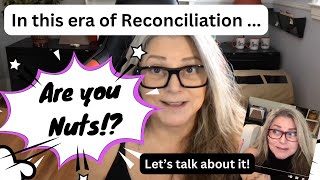
Sandi L Boucher argues that before reconciliation can work, people need to move closer: verify claims instead of accepting stereotypes, ask why problems like poverty and workplace racism exist, and seek practical remedies. Listen to primary sources and ask questions with genuine curiosity.
Chapters
Okay, today let's talk a little bit more about Jordan Peterson's interview with Pierre Poliev. I released a little commentary on that yesterday. And then I want to talk about the one thing you have to do before you even start discussing reconciliation. Let's talk about it. Hi, everybody. My name is Andy Boucher. I'm Red Thunderbolt, woman of the Loon clan, a proud member of Seine River First Nation in Treaty 3 Territory in Northern Ontario. And guess what? I have a handy dandy index card. It's the first time this year I was feeling nostalgic, I guess. So first off, I promise we're gonna. I'm gonna touch on the Jordan Peterson interview with Pierre Poliev. First and foremost, I apologize huge for the sound quality. I tried screen recording for the first time yesterday and that really didn't work out well. Trust I will not be doing that in the future. But I have discovered how to grab clips. So rather than us watching the whole thing together, I'm trying to teach you how to see things or maybe understand things from an indigenous perspective. So I figure I'm going to grab out the clips of the problematic parts problematic to me, and share with you why they're problematic, just so you can gain that understanding, which is in line with my branding and my work. So stay tuned for that. I'm probably going to try. It's an hour and 40 minutes and if anyone had told me I, I was going to spend almost two hours with Jordan Peterson and Pierre Pov, I would have said something. But the reality is I, I think it's important and I am going to watch it. I'm probably going to do it this weekend so you can watch for those videos next week. And that brings me to the point of today's video. The one thing I need you to do before you even consider thinking about taking step towards reconciliation. And that can be summed up in two words. Move closer. So what do I mean by that? It me watching this interview is a perfect example of moving closer. Rather than just buying the rhetoric or whatever is being said on social media and just going along with the masses and looking at it for yourself, looking like, seriously, we would not be in the insane mess we were in if people didn't just. If they would just stop just buying the BS and use the brain cells. My mom would always say, God grave you, God gave you a brain. Use it. If people would do their own research and apply their brain cells. If someone says everyone in one group are the same way, there's got to be Bells and whistles that go off to tell you that's a stereotype. Because there is no group on the planet that all act the same way. All indigenous are not the same. All black are not the same. All newcomers are not the same. All two slgbtqiap plus people are not the same and not all trans people are the same. And if the stereotype worse, because 90% of the time, not only does it imply that everyone in a group are the same, but everyone in the group has the same negative trait. That's ridiculous. Are all white people the same? Are all white people uncaring and hungry for money? No, they're not. Stereotypes against white is not any better than any other group. So here's what I need you to do. Because remember the feather. You only have your control on your side of the feather. So the next time you hear someone say something. My brother shared something with me when we were talking about getting employers to hire more indigenous people. And what he shared was that so often he hears from employers that they're not reliable. I get it. I get why an employer would say that. I'd be willing to bet that has been their experience. But in the vein of reconciliation. First off, when you hear something like that, you ask yourself, do I think that's true? Do I think all indigenous employees are unreliable? I am hoping you came up with the answer no. Now, you could even go as far as saying, maybe a lot of them are. Maybe even most of them are. Which takes you to the second part of this analysis. First part, is it true? Second, why could it be true? What is contributing? What is making this the reality? Now, remember my mom's teaching, when you see someone doing something that you would never imagine doing yourself, they're saying or doing something or making a decision you would never make, ask yourself, how scared would I have to be, how overwhelmed, how exhausted? How fearful would I have to be to think that decision is a good decision? So if indigenous people, if one bring it down to the person, if that one employee is not reliable, why? Because I guarantee flipping to you, no one loves poverty. No one loves having to say no to your kids, that you can't afford it. No one loves bill collectors banging down the door. So if you've bought into the stereotype that indigenous people just love living on welfare, you're nuts. I'm sorry, but get real. Nobody loves poverty. So if an indigenous employee is not reliable, why, and this is why we need that person on staff, that intermediary media, that's a word, to help offset the challenges. Is it a transportation issue? Does he not have he she have a he she. They have a vehicle. Is it poverty? Can't afford a bus ticket? Don't own their vehicle, don't have a means. Okay, well, if you go into a mindset, get on the bus, right? Is it a problem with housing insecurity? They're living on a park bench. Really hard to get to work on time. Find out what it is. I was thinking if I could wave a magic wand. I really have to keep my magic wand close when I do these videos. Like, think of a mining site. I would love to see an indigenous shift where everyone on that shift is indigenous. So chances are really good they're not going to have to deal with the racist BS that is so common in those work environments. My son has shared with me about them. My brother has shared. It happens. It happens. And why should anyone have to endure that for a paycheck when everyone else there doesn't? Okay, so if even if that shift was in the lunchroom with other shift workers, if there was that one lead hand, the boss of that shift, that could shut down when someone else says something, for one, the comments would stop and that shift would have a chance. Like, this is going to be the elite shift. They got to show that they are not the stereotype. Give them the challenge and the opportunity to live up to it. The employer is going to benefit. So before you start thinking about reconciliation work and what new policy you need, ask yourself, when you hear those comments, is it true? Do the research get on Google. Is it true? And if it's true, why is it true? Do not assume lazy. Do not assume the negative. Give the benefit of the doubt. Because I'd be willing to bet there's times you wish people had given you the benefit of the doubt. If I. Let's leave it this way, guys. If I can give up to two hours of my time to Jordan Peterson and be because I want to make sure I understand what they're saying from their mouth and not just what other people are saying. They're saying you can too. Okay, so let's meet in the middle. That's not just go with the masses. Let's use our brains. That's why we have them. Let's move closer to each other and abandon those stereotypes once and for all. I hope that made sense. Until tomorrow. I love you. Take care. Bye Bye.