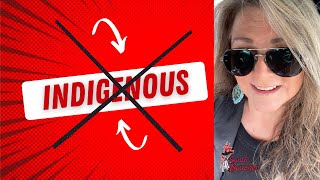
Sandi L Boucher (Anishinaabe; member of Seine River First Nation) argues that the word "Indigenous" is a dangerous, overly broad umbrella term that masks the diversity of distinct nations (e.g., Anishinaabe, Cree, Dene, Coast Salish). She explains why she prefers to capitalize specific nation names while using a lowercase "indigenous" as a grouping term, illustrates the point with personal anecdotes (Vancouver Island, strong connection to Northern Ontario), and discusses how nation-level authority matters in reconciliation disputes (reference to the Buffy Sainte-Marie/DNA test episode).
Chapters
So today I'm going to focus in on something that I touched on yesterday, and it is why I have such a serious dislike for the word Indigenous. Now, for those of you who think that means I prefer Aboriginal, that word actually had the exact same problems. And that's what I want to talk about today. So let's talk about it. Hi, everybody. My name is Sandy Boucher. I'm Red Thunderbolt, woman of the Loon clan, a proud member of Seine River first nation in Treaty 3 territory in Northern Ontario. And as I mentioned in the opening today, I really wanted to touch on why I think the word Indigenous is dangerous. And it's exactly what I said yesterday, that the Indigenous is an umbrella term that in Canada, from a legal, federal government perspective, Indigenous makes up three very distinct groups, or it includes three very distinct groups. So there's the first nations, which I belong to Saint River First Nation. We belong to that first group. There's the Metis, and that's a totally different ball game. And then the Inuit that are in our most northern territories. So that's the three groups that make up Indigenous. But as I mentioned yesterday, in the First Nation, part of Indigenous only, There's more than 640 different First Nations. They have different languages and dialects. They have different traditions and cultures. I spent a month out on Vancouver Island. This is years ago. I was considering relocating out there and obviously I wanted to investigate the teachings and learn about the land. And none of those teachings resonated with me, nor should they have. They're not my teachings. And when I returned to Northern Ontario again, I just felt like my. My blood memory side. I refer to Northern Ontario as the land where the trees know my name. This resonates to me. The plants here resonate to me. The type of trees resonate to me. This is where my spirit was born and where I grew up and where I loved and lost and continue to live. The connection to the land here is huge for me, which is why I live here, even though other people would suggest I live somewhere else, especially because of my career. So Indigenous implies that we're all the same, which is wrong. The other aspect to that is not only are we not all the same, most of us didn't even traditionally communicate with each other. The first nations, the Mi' Kmaq out on the east coast didn't traditionally trade with the coast Salish in B.C. right. We didn't trade with the Coast Salish, and we're in the middle of Canada. So those implying again that we even know of each other, I know as much about. I'm gonna think the Sioux on the prairies as I would trying to think of another one. The. I'm trying to think of the name in Quebec, as much as I know about their traditions, because that's not my home turf. Those are not my teachings. Would I be interested in learning? Absolutely. But that's why you can't ask an Indigenous person to talk specifics about all Indigenous people. No one can speak for all Canadians. We don't speak for all Indigenous either. So we're not one voice. We're not one nation. We're not one opinion. We are as diverse as any other large group. And those large groups were grouped together by the Canadian federal government, not by us. That's their word for us. Even though I'm. I'm okay. I love Indigenous in that, in my mind, my. Totally my opinion, it ties us to the Indigenous people of the world because there's Indigenous people all over this amazing planet. I like that. But, yeah, now what I did a couple years ago, and it achieved its purpose, even though I got some serious backlash for it, no one should do this. Indigenous may want to do this. Non Indigenous should never do this. And I'm not saying that to be restrictive of what you do. I'm saying that to protect your butt. What I did now, for those who have followed my career before, I focused on YouTube and I still put out a daily blog post every single day on Facebook and on my website. I started using a small eye on the word Indigenous, which anyone who's like one of those grammar hawk things like their heads just about exploded. But the reasoning behind it was, well, twofold. I look at the word Indigenous, like the word people. It's a grouping term. It's not a proper noun. So in that way, it's. It shouldn't be capitalized. 2. The second aspect was I always capitalize Anishinaabe or Cree or Haudenosaunee or Dene, the names of our nations, the true proper nouns, those I capitalize. But I knew what would happen. And it did. It absolutely did. It started the conversation, which is a large part of the work I do and my goal for every video or every blog post. When I started sending out these blog posts because the people on my email list get it emailed to them every single day. When I started using the small, I had the most beautiful, respectful people right back and going, sandy, I don't want to be critical, and you know, I'm not trying to criticize your work, but you used a small. I is That I thought we were supposed to use a capital I on indigenous. Am I wrong? Which led to the most beautiful conversation because I got to explain what I just explained to you. No, you're not wrong to use this though, capital I. But remember that we are not Indigenous. I always used to say that there's no such thing as an indigenous person. That's just a grouping term. There are Anishinaabe or Dene or Coast Salish or Honajoni or Cree, the nations. And I think we get way closer to building this reconciliation bridge if we group those. We don't talk about the western provinces very often. We talk about Saskatchewan, Alberta, Manitoba. We talk about the different provinces. We can talk about the different nations. I trust we can. So I hope that made sense. I have. I have seen so many well meaning heart in the right place. Non indigenous people led astray by the capital I Indigenous word that just no one explained to them how huge and encapsulating it is. So they make the assumption. Rightly so. You can see how they do it to make the assumption we're all the same. And we are so not. There are commonalities. I've yet to find a First Nation that doesn't value an act in stewardship over Mother Earth. But we are different. And we're going to see things different. And that's why with the whole Buffy St. Marie thing, I really backed down. I don't know if you saw that in my comments, but. But I really backed down when the chief of the PT First Nation said we need a DNA test from her. That's all that matters. It doesn't matter anymore that if I agree or disagree, this is the nation that was involved. This is the nation that decides what they need to reconcile this incident. In the same way, if you get in a fight with your husband or wife, it's not what your friend thinks you should do, it's what the injured party says you should do. That's how you're going to reconcile this? When he said they needed DNA tests to keep their community from being blown apart, this was dividing them. For one. My heart went out that. Buffy, if you can say you're Indigenous. Indigenous don't inflict harm on Indigenous. Yes, the lateral violence. We know that, but. Or the. The violence that's tearing our communities apart, that's a part of reaction to oppression. That's not what I'm talking about. But the people that have healed and are in standing leadership positions, we don't cause more harm. We understand enough harm has been caused. So to that end, as soon as that chief spoke up, this community that she supposedly cares so much about, I assume we're going to get a DNA test any second now because for her not is proving she's not indigenous and that she doesn't care two beans about this community that supposedly took her in. If that's how you treat people that brought you in as part of their family, I don't want to know you. So I have a problem with the word indigenous. I am Anishinaabe. I think that's easy to remember. I hope that makes sense. I'd love to hear your comments. Love it. I love watching your comments. So I will watch for your comments and I will talk to you tomorrow. I love you. Take care. Bye. Bye.