TLC Discusses Being A Good Indigenous Ally
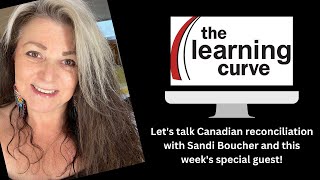
Sandi L Boucher and Jana Rae Yerxa discuss what it actually means to be an Indigenous ally. Allyship is action, not a title. Real allies listen to Indigenous leadership, build reciprocal relationships, and stop trying to save people.
Chapters
Hi, everybody. My name is Sandy Bouget, and welcome to the Learning Curve. Now, if you don't know me, you may not understand why this program and being your host is so important to me. So let me explain that to you. I am an Indigenous woman, an Anishinaabe Kwe, which is Ojibwe for Ojibwe woman, and a proud member of Seine River First Nation. Now, in a later show, I'm going to explain to you why that was important for me to say. But what you need to know is I'm an Indigenous motivational speaker, a published author, and most definitely an activist. I work with a lot of groups and a lot of different people to help create understanding, especially between cultures and especially when it's between mainstream and the Indigenous communities. Now, I live in the city of Thunder Bay, and I have for 25 years. I love this city, and I don't like a lot of what's happening here. Those tensions between groups, those misunderstandings, those topics that just keep coming up over and over and over. And that's what the Learning Curve's about. Because the reality is, not so long ago, the world seemed a lot more simple to understand. Certain things were done certain ways, and that's the way it was. What we now understand is those ways of doing things worked for some groups, but it really didn't take into consideration the experience for the more marginalized groups, and that includes indigenous people. Nowadays, cities, countries, communities, small towns are starting to embrace diversity. We know that there's a bunch of different cultures and many different groups of people within our city boundaries. The problem is we really don't know how to communicate with them. Often it gets uncomfortable. We get nervous. We don't know what to say, and often we don't want to say anything because we don't want to hurt someone. Someone or we don't want to disrespect them. The Learning Curve is going to touch on those topics. I'm going to bring in guest speakers to help you understand and get the facts you need to have the conversations. I'm not here to change your mind. You decide how you want to use the information we're going to share, but I'm hoping you're going to use it to build bridges. Now, I am definitely going to encourage you to call in or to email me topics suggestions for conversations that you would like to learn more about. What is that topic that you're so confused about? I have a few here that I want to share with you. We're definitely going to be talking about areas of concern or misunderstanding as I mentioned. And there's many of them. Taxes. Well that's a regular one. Do indigenous people pay taxes? When do they pay taxes? What taxes do they pay? And I can tell you personally, I'm a status Indian and I pay taxes on my income in certain circumstances. And we'll discuss that in detail in an upcoming program. Another one we're going to talk about is our regalia and those are those beautiful outfits that we wear when we dance at powwow. They are not costumes. They are not appropriate to wear as a Halloween costume. And we're going to talk about that in detail and what it does mean and why they're so special to us. Another thing we're going to talk about is education. Now that's a hot button topic. Why do we get our post secondary education paid? But did you know that we get less funding every single year when we're at public school level? That's a topic we're going to discuss. And we're also going to talk about our elders. They're not just older people to us. They hold a very special place in our communities and they're very important to our future. We're going to explain that to you. We couldn't do a show about topics that are important to Indigenous people without touching on missing and murdered Indigenous women and girls. There are women from this community who are no longer with us and it's a topic we need to discuss. We're going to talk about water and why Indigenous people are up in arms to protect the water for us all, not just for Indigenous communities.
And.
And we're going to talk about the Blanket of Shame, which is the title I've given to internalized oppression and what's that done to marginalized people in our communities and in this country. We're going to look at different teachings and values. Where are we on the same page with mainstream and where are things a little bit different? And that's information you need to know. Bottom line, we're going to ask questions. I'm going to invite a whole bunch of friends and colleagues in here so they can share their knowledge with you. So we can build those bridges we talked about. And we're definitely going to. This is a favorite topic that we're going to do on an upcoming show. Is it Indigenous? Is it Aboriginal? Is it First Nation? I'm not even sure what term I'm supposed to use. We're going to have an amazing discussion on that one. We're going to talk about and this is a new topic that I've already talked to the guest speaker about it. There was a series of workshops done here in the city of Thunder Bay called the White Problem. He's going to be here to discuss why he created a seminar with a title like that and what was he hoping to achieve. Today I have an amazing guest speaker for you. Jana Rae Yurza is a professor working at Khan College here in Thunder Bay. And she's going to talk about being a good ally and where is the line, what is appropriate and what is too much? And I know you're going to learn so much and really enjoy the conversation we have with Jana. So bottom line, sit back, get comfy. We're going to spend a few minutes together and we're going to walk this path together. The learning curve, it may be a little bit uncomfortable. It's definitely out of our comfort zone, but we're doing it together. So stay tuned, sit back and wait for our first guest. Talk to you soon. Bye bye. Hi everybody and welcome back to the Learning Curve. I am really excited to introduce my first guest to you because she's amazing and you're going to find out why. Her name is Jana Rae Yer and she's the professor coordinator of the Aboriginal Community Advocacy Program at Cahn College here in Thunder Bay. And thank you so much for joining me today, Maui.
Thanks for having me, Sandy.
Are you kidding? You were the first person I wanted on here. So as I mentioned in the beginning, today we're talking about allies. We're specifically talking about non indigenous people who see what's going on with indigenous people in Canada and they don't like what they see. Started looking at their privilege and seeing how things are different for them. They want to help, but they don't know what to do and they're really scared of going too far. So Jana, I wanted to ask you, talking about people like that, what can they do?
What can they do? That's the big question, right? Sandy? I think that when we're talking about allyship, one of the first things that we need to talk about is how allyship is not a designation, it's not an identity that somebody claims. I think that it is really something that is action based. And because it's action based, you need to continue to stand in solidarity for whatever struggle or cause you're supporting with marginalized or marginalized groups. Right?
Right.
So when we're talking about indigenous people specifically and people that are non indigenous people that are settlers, Canadians, immigrants that might not like what they're seeing and they're wanting to stand in solidarity. How do they go about doing that? And like you mentioned, they might be looking at their own privilege and unpacking that. I think one of the big things is to begin to question what their own personal relationship is to settler colonialism. And looking at how settler colonialism has impacted their identity and how it has impacted their views of indigenous people. And I need to say that when it comes to looking at how we've been impacted by settler colonialism, indigenous people need to do that work just as much.
Yeah, exactly. And actually knowing you has taught me that. So I ask that question all the time. But I love what you just said and I always do every time I talk to you. But that being an ally is not a title. It's not something you just claim. It's not something on a business card. It's action oriented. Right. You have to be out there doing something. Right. And I think of Facebook and all the people that just want to claim that I'm an ally, but they really don't do much more than that. Now, what about all those people who are afraid of crossing the line because they know indigenous people have been hurt incredibly by mainstream policies and systems, and they don't. Their worst fear is they don't want to add to that. So what would you say to them?
Well, I would say that everything is contextual based. I think the context is really, really important when we're talking about, you know, how do I proceed, how do I move forward, how do I act? And so I think that it's so important for people to. I think we need to think of it as our responsibility. We all have a responsibility to disrupt settler colonialism all the time, every day. That's what we need to do. All of us collectively need to do that, whether we are indigenous or not. However, when we are working together, I think it's really, really important for people that are non indigenous to listen, to follow in some cases, and, you know, not to take up so much space. What I really love is when people are willing to stand in solidarity without taking up space, they show up, they support the cause, and they're wanting to stand in solidarity without taking up the space. When indigenous peoples voices are the ones that need to be elevated in that moment. However, because it's context based and when we're not always there and say that, if there's racist comments being said, I think it's the responsibility of everybody to let people know that, you know what? That's not okay with me. Here's why it's not okay. Taking that moment to provide some education and to disrupt it.
Exactly. I couldn't agree more.
Yeah, yeah, yeah.
I've said that so many times that I need to hear your voice saying, this is not okay. And not just when an indigenous person is in the room or not just when something horrific happens on the news. We need to hear it all the time in those conversations.
We need to make it not normal. Right. And when we're talking about racism, anti indigenous racism that is pretty prevalent here in our city, it's so important that we connect it to the larger structure of settler colonialism and see how that racism is the tool to normalize. Because one of the ways that this project continues to operate is by dehumanizing indigenous people to justify the theft of our lands.
Yeah, you touched on something. We were chatting before the program and you touched on something that I was just like, yes, yes. Which always happens when I listen to you. But with the cross cultural communication training I do, if there's one thing I've noticed about mainstream culture or people raised in that culture, they got to the point where they know they should ask before they just go do something, but they haven't yet figured out that we have the right to say, no, I don't want to answer that question. Right. They get offended, for example, or regalia. Right. They'll walk up to one of our dancers and say, oh, you know, what is your outfit? And we're going to assume they say outfit and not something worse that what does your outfit mean? And for a lot of us, that's very personal. We don't want to just be sharing that with a complete stranger. And they take a photo when we say no.
Right. And I think taking offense is part of the way settler colonialism manifests in that interaction that you're highlighting. Because one of the things with settler colonialism is it conditions people that are non indigenous to have indigenous people knowledge for consumption. And so it's tricky. I understand that it is tricky for non indigenous people who are wanting to come out of that and wanting to have more just relationships. And, you know, so when you say like, indigenous people have a right to say no, but then it's like, well, how do we learn?
Right?
How do we learn? And so I think that one of the things that is important, that is missing maybe in that type of context is a meaningful relationship. It's so important for us to build relationships. And one of my mentors, she talks about how, you know, we need to be having dinner together. We need to be having coffee together. We need to be inviting each other over to our houses and knowing each other's families. She talks about that a lot and I agree with that. Like, we do need to build meaningful relationships with each other so that when people are wanting to learn, it's not extractive, it's not just about taking, but again, it's reciprocal sharing. And I think that when we're talking about like allyship, and I don't know what word I would put in that in its place, but it requires vulnerability on, on all of our parts. How do we be vulnerable? So when we're looking at how we've been impacted by history and questioning our identities, that creates discomfort and that creates vulnerability. Right?
That's excellent. I have to take a break. We'll be back in 30 seconds. Thanks and welcome back to the Learning Curve. We're here with Jana Rae Yerxa and she's sharing some amazing information. So I just want to continue with that conversation. So as I was saying during the break, and I have the chance to talk with Jana all the time and she really helps me with unpacking. Right. And looking at privilege and colonialism and how it's affected me and my life. So we had an amazing conversation about the term ally and you really got me to look at that differently. So I really wanted you to share that so the audience could learn as well.
Well, I just think the term ally is a really loaded term and I'm a firm believer in the language that we use. Language is so powerful because it shapes everything. Right. I'm all about context. So the term ally is a loaded term. And I think that it's a term that in some ways, and I don't know why this is, but people have seen it as a term that they could give themselves, that they could embrace. And when we're thinking about structures of power and domination, that that is very problematic because for people that may not.
Have.
Access to power, like equal access to power and resources takes away their ability to name who they identify and see as somebody working with them and standing in solidarity.
That is absolutely excellent. And what it brought to mind again, in the cross cultural communication training I do, we talk about a guide that when you're going to work in a community, you need to find that guide. But we stress that the community decides who that guide is, the person that can help them understand the protocols in that community. So you can be respectful, right. That you don't just go in there and assume you know this stuff. Find someone who's willing and capable of doing that. And that's not someone you assign that task to.
And just because certain people may have embraced you in that role doesn't mean that everybody has to. Exactly right. And I. And I think that that's something we can think about beyond our own communities as Indigenous people, but also we need to have those discussion within our communities as indigenous people, too.
Exactly. The other thing that came to my mind when we had the original discussion about ally was that saving mentality again. So I went to, like, the military definition. And when do we need our allies? Well, when we're under attack. Right. During a war. But I want friends all the time. I don't want people just flying in when there's a crisis and taking up space, as you said, or grabbing the mic. It's like back to what you were saying earlier. How about some meaningful, true relationships?
Right. And I think that going back to seeing in understanding settler colonialism as a state structure, a structure that we are all socialized in and marinated in, and how settler colonialism implants myths into ourselves and how we see ourselves in each other, I think that that allows us to build meaningful relationships, but also build relationships, friendships, to not only help liberate a certain population, but all of us. Right, all of us. Because we are all impacted by this. By this system of oppression.
Exactly. And quit putting us into that box. Right. And then classifying us, real relationships, human beings. Right. Asking me care.
Yes. And it impacts us differently, though. And I think that's the key piece, right. Is that it impacts us differently. And so because it impacts us differently, we have different roles and responsibilities in terms of trying to address that.
Yep.
Yes.
Yeah. And I totally, totally agree with that. And the other thing I run into all the time, and it's that generalization, like, mainstream loves to go fast. So if they get the information, the answer from one person, they want to assume that the answer is across the board with everyone. And I know we're going to do another show on it, but when it comes to Indigenous, Aboriginal or First Nation, I get one, asked that all the time. And two, no matter what my answer is, the response is usually, well, so and so told me that I could use this word. I was like, well, go ahead and use that word with that person.
Right, right.
But it can't. It's not across the board, as you said.
No, it's not across the board. And I think, too, that. I mean, we just got to call it what it is. Right. Like, that type of approach is racist. It's Rooted in racism. And whether we realize that or not. And I just need to say, too, for the audience, like, when we're talking about racism, one of the myths out there is that bad people are racist. And that's not true. It's not true. Nobody likes to see themselves as racist. But I think that when we are, like, our education systems improving now, but when we are rooted in a structure and we are misinformed and we're not told proper information, you know, we carry ideas. We carry ideas. And so, for instance, you know, with the Truth and Reconciliation Commission coming out, and there has been so much talk about residential schools, you know, but one of the things that I think about with residential schools is where are the ideologies that has allowed indigenous children to be kidnapped from their families? Where do those ideologies exist? And are they still alive? And I would say that those ideas are still alive and their homes are within us.
Yep. I would say it's still alive, too. Look at our children in care. I mean, the system has changed. It's not residential schools anymore. It's just a different format. But our kids are still being taken away. Our kids are still being rewarded for being more like the oppressor than our own cultures or traditions. And that's the kind of stuff we have to look at. Right?
That's right. How have we as indigenous people internalized this way of being? Right.
Exactly. And it's. It's such a deep topic, and it's a. It's a journey. I know for me, it definitely has been, because I want to honor traditions. But then when you start looking at, well, where did that tradition come from? Just because my mom did this. Well, who taught her to do that? And why did she do that? Right. And sometimes those aren't our traditions. And that's where you see, the colonialism had its effect.
Yes.
Right.
And I think too, like, does this way. Does this way of doing things being. Does it leave me feeling. Feeling empowered?
Yeah.
You know, does it leave me feeling empowered? That's a good way to measure it.
Yep. Yeah, exactly. That's excellent. I want to thank you so much for coming out today. That was absolutely amazing. I think we could talk for four or five hours.
It's a big topic, right?
It's a huge, huge topic. And that's a really good lead in. Thank you for that. I do want to say, if you're watching this and you feel more confused than ever, welcome to the journey.
It's a good place.
Yeah. We're walking there together. We have to keep asking these questions, disrupting the norm. We have to learn. And if we actually walk together, then we've got a chance of making a difference. So if you're feeling uncomfortable, if you have any questions, please email me or give me a call. The information is right on the screen. And just remember, it's a learning curve. And when you're learning something new, it's always going to feel uncomfortable. But together, we can do this. Thank you so much and I'll see you next time. Bye. Bye.
More from Sandi

How I Handle "The Four Uglies!" (Alcohol, Diabetes, Healing & Cheap Seat Comments)


All the Stuff We Don't Talk About with NO SHAME! (WMT Podcast w Antoinette Godin)


When Authors Chat ... (Radio Interview for the Launch of "Copper Stone - Glimpse of Blood Memory)



MORE PROOF of Indigenous/Non-Indigenous Relationships that Work! (Walking My Talk w Millie Gormely)
