TOP 4 LAWS Needed In Reconciliation Facilitators
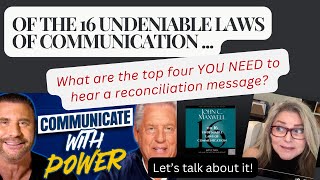
A short YouTube talk by Sandi L Boucher (Indigenous educator from Seine River First Nation) about applying John Maxwell’s "16 Undeniable Laws of Communication" to reconciliation facilitation. Sandi lists all 16 laws, explains she hasn't yet read the book but will review it later, and asks viewers to select the four laws they consider most important for reconciliation facilitators; she will share her own top four in a follow-up video.
Chapters
Hello, you absolutely amazing person you welcome back to my channel. If it's your first time here, welcome. I hope you enjoyed today's content. Now if you have been here for a while or know anything about my channel, you know it's all about Indigenous Canadian reconciliation. I spend a lot of time in the education realm helping people, delivering the missing pieces people have, whether it's missing pieces of information, misinformation, stereotypes, we unpack all that stuff. I'm helping them to build the bridge between Indigenous, non indigenous, increase their understanding, increase their willingness to build the bridge. It's all about communication, which is why I watch and do a lot of training to always be upgrading my skills. If you've watched any one of my videos, you know Ed Mylett, I'm a die hard fan. I'm reading his book right now. I watch his videos, definitely worth my time and the video I'm actually watching right now. And we'll finish today is Ed interviewing John Maxwell, who you may know now. John I don't traditionally or regularly follow because John is very much a man of faith and that comes across his Christianity comes across in his message. So doesn't resonate as deep with me, does not mean what he says isn't a value. Of the things I have checked out, I welcome and definitely learn from but not as good a fit. But John and Ed recommended John's new book the 16 Undeniable Laws of Communication. As I mentioned, the work I do, communication is everything and that got me thinking of the back to back teaching and reconciliation and these 16 laws. Let's talk about it. Foreign. Hi everybody, my name is Sandy Boucher. I'm Red Thunderbolt, woman of the Loon clan, a proud member of Seine River First Nation in Treaty 3 Territory in Northern Ontario. And like I mentioned in the opening, talking about this book got me thinking of you and me and the back to back teaching and reconciliation. So let me explain my thought process. So obviously I'm interested in the 16 laws and I checked them out and I'm actually going to share them with you in a few minutes. I have not read the book yet. I will do a book review when I'm done reading it. It's next on my list, which is why it's on my desk. But I am going to share what the 16 laws are today and the question is when it comes to building a bridge between indigenous and non and communicating in that context, what are your top four of the 16 laws? Sometimes all of them aren't present. But what would be your top Four. Four that are going to. If the communicator is using these top four, then it's going to resonate with you. I want you to pick the top, the four that you think above everything else. You better make sure to have these and please know well you need all of them. We know you need all of them, that's why they're in the book. But this is bringing it down to that top four. And then in tomorrow's video I am going to share with you my top four. And that's where the back to back teaching comes in. And it's one of the reasons humility teaching is such a huge part of my career, because I've actually done this. People comment on my humility all the time. But if you got your ego smacked down enough times, you learn humility. I've been around on the planet long enough. The lesson has sunk in. In the beginning of my career there, I can think of quite a few times where I designed a seminar that I was positive was going to resonate with people and I put in the work and I put out the advertisement only to have no one sign up for it. That's back to back teaching. That's humility. The idea that everyone has a different perspective. Perspective. And just because I think this may be what you need, that may not be how it looks to you. Which is why I was wondering today if you had the opportunity to pick the four most important laws that you want to see in your reconciliation facilitator, what would the four be? Tomorrow I'll share my four. It's going to be fair. But I want you to go first. My phone is in the other room and it's going stupid.
We're just going to going to ignore that. So let's talk about this.
The 16 laws.
I'm just looking at the table of contents here. So the first one, I'm not sure what order they are in. I haven't read the book yet, but I don't think it's in most important to least important. It's, it's. They're all important.
But I want you to pick four.
Okay, so the first one's the law of credibility. How important is it to you that the facilitator, trainer speaker you're listening to on the topic of reconciliation has credibility?
I am wondering why my phone is going off like crazy.
Oh, okay.
We're going to deal with that later.
Second is observation. How important is it to you that your reconciliation trainer facilitator is observing and learning from other facilitators okay, it's slightly different than what you might have thought. The next one is conviction. How important is it that your reconciliation trainer facilitator demonstrates conviction to whatever they're teaching, preaching conviction to the cause. Number four is preparation. How important is it that your trainer facilitator is prepared for the speech, the seminar, the workshop that you're attending? Next, collaboration. How important is it to you that the trainer facilitator collaborates with other people in the field? Number six, content. How important is it to you that the message, the content that's being shared, that it's something you consider valuable? Number seven, connection. How important is it that the reconciliation trainer facilitator feel you feel like you're connecting with this person?
Leverage.
How important is it to you that the trainer facilitator uses what they have, leverages it to get bigger and better results?
Right. Adds it to other skill sets of.
Other people or whatever the case may be? The law of anticipation is 9. How important is it that the trainer facilitator has you anticipating the outcome, a.
Positive outcome has you believing in that.
Possibility and actually looking forward to it?
How important is that to you? 10 is simplicity.
How important is it to you that.
The message that's being delivered delivered is being delivered in simple terms that resonate with you? Number 11, visual expression. How important is it I want to see.
Yes.
How important is it the visual backup of the speech or the workshop? Do you need pictures? Do you need that presentation? You'd rather not.
Wasn't there.
Where does it sit on your scale? The next one. Storytelling. How important is it to you that the reconciliation trainer shares stories as part of the workshop or seminar? The next one. Thermostat. Or in other words, being able to read the room. How important is it to you that your speaker trainer facilitator can do that? Number 14. Wow. Change up is being able to change the way we speak about things or look about things, like, you know, they presented in one way. It doesn't seem to be resonating. The ability to switch it up, change it up and present it in a different way. How important is it to you that the speaker trainer facilitator can do that? Next, adding value. How important is it to you that you leave the workshop, seminar, keynote feeling that they added value? You now have more to work with. And last but not least, the law of results, that they can give you things that present results and they can share with you their results. So there's the. Did I do all the 16 I better make sure. Sure. Yes, I did. So again, the question is if you two were to attend a workshop, seminar, keynote on the topic of reconciliation, of these laws of communication, which are the top four that you. If it's going to resonate with you, you need to see these top four. There is no wrong answer. This is you telling me how to communicate with you. We should be asking our partners these questions. And like I said, tomorrow I will. I will actually go through each one of them. I'm going to give each a scale out of 1 to 10 and explain why. And we're gonna end up sharing my top four. Okay. So. And why I believe they're important. And hopefully our 4 and 4 match up or else that might be. Well, it's going to be useful because that might be why I'm not building as many bridges as I should. I'm building lots of bridges. I'm not worried about it, but of course I'd love to build more. I hope that made sense. I hope that didn't confuse you. Your top four out of all of those 16, one of the four you most definitely need to see in a speaker trainer, facilitator to help you build the reconciliation bridge. I cannot wait to read your comments. Until tomorrow. I love you. Take care. Bye. Bye.
More from Sandi

How I Handle "The Four Uglies!" (Alcohol, Diabetes, Healing & Cheap Seat Comments)


All the Stuff We Don't Talk About with NO SHAME! (WMT Podcast w Antoinette Godin)


When Authors Chat ... (Radio Interview for the Launch of "Copper Stone - Glimpse of Blood Memory)



MORE PROOF of Indigenous/Non-Indigenous Relationships that Work! (Walking My Talk w Millie Gormely)
