Treaties (Zenith Lillie) , Trauma (Percy O'Nabigon), All-Inclusive Consent (Me), & More!
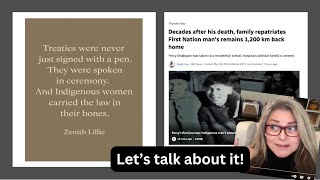
Sandi L Boucher (Red Thunderbolt, Loon clan, Seine River First Nation) presents a four-part YouTube monologue about truth and reconciliation. She emphasizes that truth is integral to reconciliation and unlearning misinformation. Part 1 centers Indigenous women’s historical political authority in treaty-making and how colonial laws (Indian Act, 1876) erased those roles (informed by Zenith Lilly). Part 2 recounts the Percy Onabagon repatriation: taken to St. Joseph's Residential School, later discovered in a Woodstock cemetery, family exhumation and repatriation efforts, appeals for ~$45,000 in funding, and calls for government responsibility and implementation of recommendations from Kimberly Murray’s report. Part 3 critiques disingenuous outreach (e.g., companies claiming personal interest but selling) and argues resource development must respect consent, protect water, lands, and women’s safety. Part 4 mentions ongoing study of the Yellowhead Institute’s Land Back course and stresses inclusion of women, Two-Spirit people and youth in decision-making and consent processes.
Chapters
Hello again, you amazing person, you, and welcome back to my world and my interpretation of Canadian Indigenous relationships as seen through Indigenous eyes. My name is Sandy Boucher, and I'm hoping that you're going to join me for this entire video, because today we're talking about truth. It is not an accident that it was called the Truth and Reconciliation Commission because many people believe truth has to come before reconciliation. Now, the way I like to look at it is that truth is the first step. Truth is actually a part of reconciling, not only the sharing of truth, but the listening to truth. Because reconciliation often requires. Always requires unpacking. Whether you're Indigenous or not. You got to look at the missing pieces of information, the misinformation you've been handed, the stereotypes. You have to be willing to unlearn all that misinformation and often be willing to learn for the very first time the stuff that you weren't taught. So it's essential that we're open to hearing and learning in growing in our understanding of Canadian history as it relates to the Indigenous Canadian relationship. Truth comes before reconciliation or is the first step. And that's what we're going to be looking at today. As always, I have four parts for you in. In this case, I highly suggest you grab a coffee or your favorite beverage. You might want to grab some Kleenex, curl up in a comfy chair. Let's talk about it. Hi, everybody. My name is Sandy Boucher. I'm Red Thunderbolt, woman of the Loon clan, a proud member of Seine River First Nation in Treaty 3 Territory in Northern Ontario. And I have dedicated my life and my career and my business, my energy, my time, my passion to reconciling the Indigenous Canadian relationship. I help Canadian business understand why their efforts to date have not worked and how they can make it work if they're willing to make some changes. So today, as I mentioned, we're going to focus in on truth. We're actually going to touch on a couple terms again that maybe you hear. I know we hear them all the time. I'm not sure the extent to which people understand them. So the first part of this video, we're going to look at treaties. Now, there's a word. A treaty is a contract between two parts. Indigenous people signed treaties in agreement to share the land with the settlers. Did you notice? Agreement to share? Not. This is now yours. We could do a whole video on that. But that's not what I want to talk about today. In fact, I want to take it one step further. And instead of just talking about treaties, I want to talk about Indigenous women and the part we played in treaty making. So to give you the context, the backstory, here I was cruising on LinkedIn like I so often do. If you ever want to find me, pretty safe bet you can find me there. And I saw A post on LinkedIn by Zenith Lilly. Was that for an epic name she describes herself? Or on her profile she's described as an Indigenous social work master's candidate, a traditional Indigenous knowledge keeper, and she's from Sault Ste. Marie, which, I mean, all of that just makes me a fan. What got my attention was this image, this quote. And as you can see, it says, treaties were never just signed with a pen. They were spoken in ceremony. And Indigenous women carried the law in their bones. My ancestral knowledge, my blood memory, just resonated. That quote resonated so deep for me. Now she had a post to go with that image. I could not do it. Like, I'm just going to read it to you. She does an absolutely amazing job of explaining, explaining her point. I'm not even going to attempt to do a better job. She does an epic job. So this is what Zenith Lilly had to say, and this is truth, so you might want to add it into your understanding of Canadian Indigenous history. Indigenous women were not silent observers in treaty making. They were signatories, leaders and holders of political authority. Before colonization imposed patriarchal systems on our nations, many Indigenous societies were matrilineal, matriarchal, or at the very least, deeply gender balanced. All of that to say either it was men, women, or the women were the leaders. But we definitely weren't silenced or invisible. Women held responsibilities for land, governance, lineage and law. In Haudenosaunee, Dene Cree, Anishinaabe, and many other nations, women played central roles in deciding when to go to war, when to make peace, and who could lead. When Europeans arrived, they encountered this reality but couldn't understand it. So they rewrote it. Through The Indian Act, 1876, they stripped indigenous women of political power, status and voice. The Indian act removed women from leadership, removed their names from treaty rolls, and defined them as legal dependents of their husbands. This was never our way. In many communities, women were custodians of land and law. They understood treaties as sacred agreements rooted in relationship between nations and between generations. Historical records show women participating in treaty talks. In Treaty 3, for example, Anishinaabe women were present, vocal, and had to give their blessing before agreements were finalized. In Haudenosaunee law, clan mothers choose and removed chiefs. They were not just advisors, they were the authority. Yet colonial records erased them. Legal recognition was reserved for the men. European officials could understand. But our oral histories remember our aunties, grandmothers and elders remind us who actually held the bundle. So when Indigenous women speak today about treaties, sovereignty or land, they are not speaking on behalf of others. They are speaking from inherited roles, from memory, from law, from bloodline responsibility. We are not returning to power. We never left Canada, just stopped listening. I would love to hear in the comments if you were aware to the extent that women were involved in treaty making and I love the reference to Treaty three, Anishinaabeque, that would be me. Now, part two, we're going to touch on another phrase term that is so often misunderstood, and it is the phrase intergenerational trauma. Now, I am going to be very upfront here. The next part is not going to be easy. It may be harder for me because I know the woman involved. Claire, you'll hear more about her in a moment. But I. I don't know. You tell me. Did it touch you or does it touch you? So I want to share. This is actually a post I came across on Facebook that was put out by the Matawa First Nation chiefs. Which is a treaty area or an area of First Nations. I am again just going to read the post and I'm going to do my best to do it without crying. Here is the image that accompanied the post. It's a day the Anabagon family has spent decades waiting for the repatriation of their Uncle Percy Onabagon back to Long Lake. 58 First Nation Percy was taken from the northern Ontario community as a young child and put in St. Joseph's Indian Residential School in Thunder Bay. From there, he was sent to a number of hospitals and institutions on account of being epileptic and partially paralyzed. His family was never told where he was sent or what became of him after he was removed from St. Joseph's by a federal Indian agent. After years of research and advocacy, Percy's niece, I can do it. Claire Onabagod, found him in a cemetery in Woodstock, Ontario, more than 1200 kilometers from home. He died at age 27 of tuberculosis at the Ontario Hospital. On Thursday, the 59th anniversary of Percy's death. Seven family members and a pipe carrier traveled to the southern Ontario city to exhume his remains. But it wasn't easy. The family appealed to both the provincial and federal governments to cover the roughly $45,000 cost. Because Percy died as an adult, not a child, the family was told the federal government would not provide coverage under the residential school's Missing Children Community Support Fund. After CBC News shared the inaugural story in September, the Ontario government offered to foot the bill. The money comes from the Ministry of Indigenous affairs and First Nations Economic Reconciliations residential school units. This is not just about bringing Percy home. It's about repatriating an ancestor, honoring the lives of all those affected by the residential school system and moving forward together with respect, dignity and justice, ministry spokesperson Megan Evans told CBC News in an email. For the Anabagons, though, it wasn't about the money. It was about the acknowledgement that Percy should never have been taken in the first place. This has gone way beyond just our family and how we feel about it, said Claire. It has also opened up other people's eyes and ears to what's happened to Indigenous people of Canada, especially through the residential school system. Imagine how many more Percy's there are. Before the exhumation began, the family held a ceremony to honor Percy, which they never got to do. When he died, about two dozen people were there, including chiefs, mental health workers, members of the Ontario Police, provincial police and others who helped make the repatriation happen. Simultaneously, a sacred fire and ceremony was held in Long Lake 58. The Inabagons are also gifted a medallion to Claire Salt, Chief of Massagas of the Credit of First Nation for keeping Percy's God for keeping Percy's remains safe in her traditional territory for so long. Imagine how many more Percy's there are. Assault said the family's 20 year journey is extraordinary. Their perseverance to get the help they needed and to most importantly keep his memory alive. Marcus Ryan, the warden of Oxford county, which includes Woodstock, says getting to know the inbots has been awe inspiring. It's a real truth that there's a person in a grave here who was involuntarily taken from his community, from his nation and sent to another part of the province without anybody's appearance permission. This is there is an actual real opportunity for meaningful truth and meaningful reconciliation and we have to take every one of these opportunities. I never want to bring them home like this. Truth and reconciliation are loaded words for Judy Desmond, chief of Long like 58 First Nation. What worries her is that First Nation children are still being taken from their families through the child welfare system. Some things she wants to see change. We're going through a really complex process finding our kids, bringing them home and I never want to bring them home like this, she said as she pointed to Percy's grave. It's definitely not over. Anna Betty actually, Paniskum is a deputy grand chief for Anishinaabe Aski nation, which represents 49 First nations across Treaties 9 and 5. She echoes Desmond's concerns. We need to have the proper resources and the capacity to ensure that our children don't have to leave home, whether for school or through the child welfare system, ashni Paniskum said. We need to have the resources to be able to assist our families when they do search and when they do want to bring their loved one home. Calls for more federal support Nishnaabek nation, which represents 39 First nations in Ontario, played a key role in advocating for the province to help support the in Grand Chief, Linda debassier says. Now it's time for the federal government to step up. Canada, in our view, has an ethical, moral and fiduciary obligation to help repatriate our ancestors who were taken to residential schools without the consent of their parents. On the campaign trail Campaign trail Prime Minister Mark Carney pledged to implement the UN Declaration on the Rights of Indigenous Peoples act, which includes supports for Indigenous people to repatriate human remains. But Debacien wants to see a firm commitment to implement the action items in Kimberly Murray's final report released last fall. Murray served as Canada's independent special interlocutor locateur for missing children and unmarked graves and burial sites associated with Indian residential schools. Her report outlines 42 obligations for governments, churches and other institutions to follow in order to implement an Indigenous led reparations framework for truth, accountability, justice and reconciliation. Just going to interject here for a second rather than just truth and reconciliation. Truth, accountability, justice and reconciliation. I like that. 4 Murray helped Claire research what happened to Percy, having recently discovered that he was in fact eight, not six, when he was taken to residential school. Which speaks to why it's so important for all the archives to be accessible to communities. My message to the new Prime Minister is to implement the obligations to continue to support communities and families and survivors that are searching for the missing and disappeared children and to properly fund these investigations the communities are doing right now. Percy's remains are being sent to Ontario's Forensic Pathology Service in Toronto, where an autopsy and DNA analysis will be conducted. Though a forensic anthropologist who assisted with the exhumation says there are signs that an autopsy has already been conducted, the family says they were never told this and have not been able to trace any documentation. The family plans to Rebury Perry in Long Percy I should say in Long Lake 58 this summer beside his relatives. In sharing his story, they say they help others receive the same support to bring their loved ones home. With all the support we had, it was made possible. So if we can do it, other families can do it too, said Claire's brother John on Abigon. Seeing all the support from everybody else that people saw our cause for once they wanted to help and they recognized that it was important, said riley taylor, clara nabagon's 16 year old granddaughter. Because it's important because it's our family and just if it was anybody else's family, you'd want them to be home now. For any indigenous people watching this video, a National Indian Residential school crisis line has been set up to pride provide for former students and those affected. People can access emotional and crisis referral services by calling the 24 hour national crisis Line, which is now on your screen. Mental health counseling and crisis support is also available 24 hours a day, seven days a week through the Hope for Wellness hotline. The number is also on the screen or by online chat www. Hopefully for wellness ca did I make it through without crying? No, I did not. And that's because. They should come home. They should come home. When we got to the part about he should be with his family, yeah, that's where I kind of lost it. So yeah, yeah, not. Not the easiest thing in the world. Just trying to call up my notes here. I think I accidentally closed them. Yes I did. How you doing? How you doing? Okay, going into part three now it's a personal story on LinkedIn and you could probably put the Kleenex away now. This actually kind of peed me off a little bit. It didn't upset me. Well, it didn't make me cry, kind of made me upset or I wasn't upset. It just makes me shake my head like wtf? Hey, so I recently saw this post or I posted on LinkedIn saying that how I hate when people message me hates. The strong word. I really dislike when people message me, usually on LinkedIn and they say they want to chat and get to know me. And they don't. They absolutely don't. They have something they want to sell. And I said, you know what? I like say that. Like why are you saying you want to get to know me? You don't want to get to know me, you want to sell me something. There's a difference. That wasn't the problem. The problem was the very first person that responded to that post said that she doesn't like those emails either, but she, quote unquote understands that people have the right turn of living. So she just ignores the email. Why is it all or nothing? Why is it carte blanche? I never once said that I have a problem with someone trying to make a living. I don't. I absolutely don't. Kudos to you for doing the hard work. I have an issue with lying. I have an issue with misleading or pretending. You want to get to know me and you absolutely don't. And the reason this peeves me off is because I'm Anishinaabe Quay. Because it happens all the time. Think of resource development. Natural resources, mining companies. Let's send her in on mining companies. The big sell. It means jobs for your people. You really need jobs. 110%. Of course we acknowledge that we want a healthy economy like anyone else. But there's a line. It's not all or nothing. It's not carte blanche. We don't want the mine if it's going to poison our drinking water. We don't want the mine if it's going to destroy our traditional healing grounds or hunting or fishing territories. And we don't want your mine or your man camps if our women and girls are going to be at risk. It's not all or nothing. Remember the videos I did about consent? Withdrawing consent? Just. Yes, we want the jobs, but that doesn't mean we're going to put up with whatever happens just because Canada needs the resources. So this is just one of those things. As an Anishinaabe, quit lying to us. It is literally the worst thing you can do to an Indigenous person. Just had to get that off my chest. Part 4. I am still working through the land back course. The Yellowstone land back course. Yellows. Yeah, Yellowstone. Yeah. Right. Yellow Head Institute's land back course. And it's longer than I thought it was, but it's definitely worth every. I still. I will put the. The link in the notes again under this video. And this is one of those parts that Riley. Yes, no special. Spoke and I thought it was awesome. And remember at the beginning when I talked about Zenith Lilly and. And what she said about the women being an integral part of treaties? Well, what Riley was saying is the next step of that. Then when we're talking about resource development or any kind of reconciliation, any kind of agreements going on between first nations people and Indigenous or First nations people and Indigenous. Indigenous peoples in Canada. First nations in Canada, they have to include women and two spirited people. I did a video about Indigenous consent going back to our ways of knowing and being. So even if Chief and council happens to be all men. We have to make it a point that the women have to be heard, that the two spirited have to be heard, the youth have to be heard. We have to recognize that these voices were excluded in history, as part of our history and must now be brought back in. We need to do it better and consent withdrawn. If it's not okay, we need to demand this. First Nation communities, we need to demand this. Chiefs and councils, you best. I know the traditional rules. And the men and you best be standing right there and making sure that your women are heard. Women, we do the same for the guys, right? That wasn't an ownership thing. That was back to back. We take care of each other, so please do that. Just one last comment. Not an official part of the video. The four parts are now done. But I did want to mention, you may have noticed I'm starting to do member only videos. And I have discovered that they are so beneficial for me because as I've shown in other videos, the trolls come out when I do just a general public video. But in the member only videos, it is truly safe space. So I get to share the real thoughts, the real stories, the real vulnerability, the real authenticity, the real truth that I wouldn't dare share yet on a public channel. So for those of you who have the ability, please join me as a member and you get member only shorts and member only videos. So I hope you found this video beneficial. I hope you found it informative and I hope you had Kleenex nearby to dry your tears. Tears are good medicine. Laughter is good medicine. We can't not talk about this because it's hard. Because that's not reconciliation and that's not truth. Until next time. I love you. Take care. Bye bye.
More from Sandi

How I Handle "The Four Uglies!" (Alcohol, Diabetes, Healing & Cheap Seat Comments)


All the Stuff We Don't Talk About with NO SHAME! (WMT Podcast w Antoinette Godin)


When Authors Chat ... (Radio Interview for the Launch of "Copper Stone - Glimpse of Blood Memory)



MORE PROOF of Indigenous/Non-Indigenous Relationships that Work! (Walking My Talk w Millie Gormely)
