Two Ways to RETAIN Your Indigenous Employees (and Save YOU Money!)
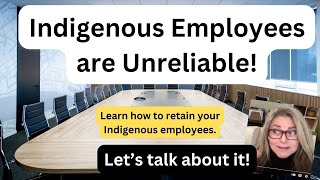
Sandi L Boucher argues that racism and hostile workplaces drive Indigenous employees away. Employers can either fix the culture or give job candidates a 10-item checklist about punctuality, racism, diversity, and mentor access so they know what they're walking into.
Chapters
I have heard it so many times. Employers insist they don't want to hire Indigenous employees because they're not reliable. They don't stick around, they're not worth the investment. There's a reason for that. And continuing to simply blame Indigenous peoples hasn't been working so far. Chances are real good it's not going to work into the future. But what if I could tell you a way that would work? I can actually show you or tell you about two ways that would fix the problem. Let's talk about it. Hi everybody. My name is Andy Boucher. I'm Red Thunderbolt, woman of the Loon clan. A proud member of Seine River First Nation in Treaty 3 Territory in Northern Ontario. And I have dedicated my life, my time, my energy, my passion to Indigenous Canadian reconciliation. Because for far too long non Indigenous Canadians have been making the exact same mistake. Underestimating the value and potential of Indigenous people people's. And as long as you keep doing that, then you're going to keep getting the same results. If nothing changes, nothing changes. Now I can tell you for a fact that one of the main reason Indigenous employees do not stick around, it's because you are expecting them to work in a war zone. Often, especially in the resource industry, natural resources, mining, forestry, people in the trucking industry. The anti Indigenous racism is ridiculous. It is horrific. And they are not getting hazard pay. They are getting the exact same pay as all of those people, all the other people. But they have to endure. And if you don't think that's a big deal, then you've never had anyone racist towards you. And I'm talking on an ongoing basis. The jokes that aren't funny, the ostracizing being left out of discussions. So as I promised in the opening, there's two ways to fix this. The first way is a lot harder than the second. I don't think the first is going to happen. I'm hoping the second will. If you are interested in saving money and honestly keeping those employees that you spent the money to advertise and to interview and hire, you put in the time and effort to train them, why would you not want to fix this? Maybe because it's easier to keep blaming us, but that's not going to save you any money. So let's talk about this. The first way to fix it is to create safe spaces. Now what I mean by that is you got to get on top of the racism in your workspace. You got to cut out the jokes. You have to make it a place where being of a different Culture is not going to make you a target. Like I said, option number one, not easy. I don't know of an employer that is willing to do that. Instead you hear boys will be boys and well, you got to toughen up to work here. No, because what you're expecting of your indigenous employees is so much more than you're expecting of the employees that and you think we're the problem. That doesn't even make sense. So like I said, chances of option number one being implemented, probably not going to happen. There is only one other way to get past this. It's either option A or option B, option A, create the safe space, put it in so that those kind of comments are not allowed, that there are reprimands and that you will fire someone if they behave and use that language and tell those jokes, Chances are slim. Or indigenous people, contrary to the stereotype, we are not thin skinned because we have to do that, endure that garbage in so many different places. So. And it's not new to us at all. I just had to block someone off my social media. Who, what kind of individual do you have to be to go out of your way to see a post by an indigenous speaker who is excited to be back on social media and you're going to take the time to type just nice, short and not sweet. There are no mass graves. You gotta be some kind of ugly to do that. So if that's the culture that you have in your workspace that you think those kind of comments are no big deal, then the only thing you can do to stop, stop losing money, stop, start saving money, is to warn your indigenous employees. And what I mean by that is it's why we value honesty and transparency so much. If you tell me, and I've had co workers do this and colleagues do this, we have to go meet with so and so. This person has some really horrific opinions of indigenous people. But we're only there for five minutes. I just need to get him to sign this paper. Please don't say anything. Thank you for the heads up. Now I'm not going to blow up your business deal, but I can protect myself. So if you want indigenous people to stick around so you're not wasting money, you have to arm them. You have to give them the information they need to thrive in that work environment so that they're not caught off guard, you're not going to suggest it's heaven, but you're going to give them an idea of what they need to prepare for. So because it's the caught off Guard that is sending them out to find another job out of your space. Hang on, I need to get my document here. Okay, what I have done for you is come up with 10 different things I need you to share with your potential new indigenous employee at the stage of job offer. So you've done the interview. You want to hire this person before they accept the job. You share this information with them and then they are accepting the job with full knowledge. It's not half truths. It's not everything that we fear when we work with mainstream. They need this information. So I'm going to list this off for you and please take notes or watch this video and feel free to share with every employer you can think of. First and foremost, this one is a cross cultural difference. If you don't know about Indian time, you can go back and watch my short that I just did a week ago. The first one is, how important is it to be on time each day? What will be the impression if the new employee, if they're not on time? What will happen if they're not on time? So you see how that's all tied together. Don't just say it's essential to be on time. I mean, you could, but better answer would be it's essential to be on time because not just because the boss likes it that way, but because we have to get this product done by this time to make the shipment. Blah, blah, blah. Give the information so they can see you're not just trying to control them because that's insulting and that plays into Canadian history. Explain to them why they're intelligent people. They're going to understand it. Explain to them this is a different culture. Remember cross cultural humility training here. What would be the impression of them if they show up late all the time? Well, people are going to think you're lazy, People are going to think you're a liability, that they're going to get hurt because you're not pulling the weight or they're going to have to work harder. Nobody wants people to think that of them. So tell them that. What will happen if you're late twice? You're going to get fired. Now they know what they're dealing with. If they choose not to listen, then feel free to fire them. But don't assume they don't care. They're there because they want the paycheck too. If you keep assuming the worst of us, there's already a problem. Okay, number two, how strong is the reconciliation knowledge of this organization? Meaning, has the people at this place taken any Training. How much do they know about indigenous people and the challenges we faced? So have you had any kind of training? If the answer is no, tell the new employee that they know nothing about indigenous people or the challenges. Okay, thanks for the heads up. They're going to ask stupid questions or say stupid things that aren't true. I can now prepare for that. See what I mean? Coping mechanisms. If you're not going to fix the environment, then give us the coping skills, the knowledge we need to be able to cope with it. Okay? Number three, is this a. Now a total honesty here, right? You want to arm this employee so they can be successful and it doesn't cost you more money to try to go find someone else. Is this a positive or negative work environment? Will the new employee hear encouragement or complaints? What's the going to be more common? Be honest. Oh, these guys, tradesmen, they are always complaining. I hope that's okay. I hope it's not going to affect you negatively. I just wanted to give you a heads up. Okay? It's just truth number four. Is this a diverse environment or a segregated one? Will the new employee be ostracized or embraced? Are they going to take him or her on as one of the teams or be excluded because they're new, indigenous or both? Next, let's get down to the real information here. How racist is this work environment? Will color of skin or cultural stereotypes play against them? I have had people pretend to do an Indian war cry. You know, the. Like they do in Bugs Bunny. Like yes, I'm showing my age with that reference, but you know what I mean. Or, or referring to a woman as Pocahontas. Right? Same garbage. Is that going to happen? Let them know so they can prepare. Number six, are there other employees of the same culture as the new employee? Employee presently working at this company? Will the new employee be working with them or have access to them? Are there other indigenous people? Are we going to be on the same, same shift? Are we in the same department or in the same office? Will we be able to interact? Will the new employee be able to get tips from them on how to survive and how to fit in? If they're the only ones, they need to know that before the first coffee break. They need to know that before they start their first day. That's the reality. Number seven, why did the last three people get fired? Showed up late, had an attitude, got in a fight, whatever the case may be, why did the last three people get fired? Give them a heads up so they know that not allowed. 8 what traits are the bosses looking for above all else? Different offices, different companies, different work environments, different traits. What are the traits your bosses or their bosses are going to be looking for? Number nine, super important. If the new employee is struggling, who can they speak to before it becomes an issue? Is there someone they can talk to and not hr? Because we know HR is on the side of the company, so who could they talk to? Preferably another indigenous employee. Again, if they're the only ones, who can they talk to? And last but not least, number 10. Is there someone the new employee can check in with to see how they're doing? You know, just a little heads up at the end of the week or after a couple of days, what do you think? Is there someone else on the team, a mentor you can hook them up with? Does anything like that exist? I hope you can see that if you go, is this comfortable? No. But guess what? If you don't tell them this stuff, then why are you surprised they quit? Would you not want to get out of there if you didn't see all of this coming? You're going to quickly get to the stage where the paycheck isn't worth it. Not worth my emotional and mental health. So if you want indigenous people working there, which, by the way, if you get past all this, indigenous employees are known as the most loyal group of people out there. When we find someplace that works for us, we stick to it. So it is worth it. You can either create the safe space so we don't have to worry about this, or give us the information we need so we can protect ourselves. I hope that made sense. I think it made total, complete sense. But I'm wondering what you think, and if you're not sure, send it to your friends who are supervisors, managers or bosses. Ask them, because if you really want employees and what you've been doing so far doesn't work, isn't it time to change it? I would think so. Until next time. I love you. Take care. Bye. Bye.
More from Sandi

How I Handle "The Four Uglies!" (Alcohol, Diabetes, Healing & Cheap Seat Comments)


All the Stuff We Don't Talk About with NO SHAME! (WMT Podcast w Antoinette Godin)


When Authors Chat ... (Radio Interview for the Launch of "Copper Stone - Glimpse of Blood Memory)



MORE PROOF of Indigenous/Non-Indigenous Relationships that Work! (Walking My Talk w Millie Gormely)
