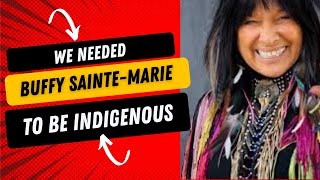
Sandi L Boucher reflects on the fallout after reports that Buffy Sainte-Marie may have falsely claimed Indigenous identity. For many Indigenous people, Buffy's presence on Sesame Street and in award recognition filled a void of positive representation. Boucher describes the emotional harm of that perceived betrayal and calls for compassion as people process the news.
Chapters
So last week, I did two videos concerning Buffy Saint Marie. They were part of the Path podcast, my podcast, and those blew up. It's probably why you're watching this video, because you found my channel. Maybe you decided to subscribe. Maybe you found this video randomly. But there's one other thing I really wanted to highlight or point out about Buffy Saint Marie as she relates to indigenous people. As this situation relates to indigenous people. Indigenous people like me. Let's talk about it. Hi, everybody. My name is Sandy Boucher. I'm Red Thunderbolt, woman of the Loon clan, a proud member of Seine River first nation in Treaty 3 territory in Northern Ontario. And as I mentioned in the opening, I just wanted to touch base on Buffy Saint Marie one more time. We. By now you've seen the news. You maybe you've watched the Fifth Estate episode, really highlighting, in my opinion, that she is a Pretendian. Now, I'm going to talk about this in another video, but a Pretendian is not any form of an indigenous person. And there are many forms of indigenous people status, non status, 60s, Scoop, assimilated, traditional. I mean, we could go on and on, which is why it's another video. A Pretendian is someone who has no indigenous heritage, no bloodline, and is pretending to be indigenous. It's usually for fame or acceptance or money or accolades or whatever the case may be. And Buffy definitely fits into that category. She definitely received the accolades. That's a large part of. What were the roots of this pretending existence? I mean, with a floundering career, was that the decision she made? We may never know. I can't read her mind. But I did mention in my first video that I'm 59 years old. I was born in 1964, and I remember her on Sesame street. And I remember how much I loved her on Sesame Street. I'm sorry. Something's stabbing me in the eye and it hurts. Anyways, I loved her on Sesame Street. I loved an indigenous woman on Sesame street because that opened the doors of possibility for me. And that's what I wanted to talk about today. Just helping people realize that for so many indigenous people, we needed Buffy to be indigenous. We needed to believe she was. And. And that's why this is so absolutely devastating, because you're taking out to believe that Buffy is now a Pretendian, or always has been, a pretending. But to understand and believe that now is to take out a foundational piece of many indigenous people. Because, you see, we are raised marginalized and oppressed. We hear the judgments, we hear the condemnations. We're taught shame and guilt for just having darker skin, for being Indigenous to see her on Sesame street or on stage, whatever, getting those awards. We needed her to be loved as an Indigenous person. We needed her to be admired as an Indigenous person. We needed her to be accepted as an Indigenous person so that we could believe that we would be, too. Because loved and accepted and admired is not anything we expect being raised Indigenous in Canada. And if you're not raised Indigenous, you're just going to have to take my word on that. That's internalized oppression, and that's what it feels like. And I know because I've been in business for 15 years, and I've had to battle those ghosts every step of the way. When people tell me how great I am at my job, it. And it's so much more than impostor syndrome. Internalized oppression crushes people. But when you see one of our own making it. If you're not engaged in lateral violence and tearing them back down, if you could actually be excited for them, it's probably because you're also excited for you in your future and your possibilities now. Hearing about Buffy devastated me. I think that's kind of obvious. In my first video, I am crying. But at the end, you saw my resilience and my perseverance come out because I made the comment that I thought she was a strong Indigenous woman, and she isn't. But I am. And I believe that even though it was a massive shock and took me out of my knees, I believe I was able to recover from it, maybe easier than other Indigenous people, because I am a strong Anishinaabe. I did find my voice. I do stand on my own stages. I do hold the microphone. And I'm heard there's so many Indigenous people that can't say that. So many people either still daring. Some little part of them is still daring and hoping that one day we will just be accepted, or they've completely given it up. Because acquiescence and giving up is also part of oppression. So I just wanted to say that to help you understand why maybe there's so many Indigenous people that still believe, or need to believe, she's Indigenous. It's really. There's a good chance it's got not a lot to do with Buffy. It's their foundation, their final hope they're trying to hang on to. So if anything, if you give them. Could give them a little bit of compassion and not judgment, that would go a long way. This is a learning curve. This. This took a lot and for some people, it still is a lot. I hope that helped clarify things. I hope that made sense. Until tomorrow. I love you. Take care. Bye. Bye.