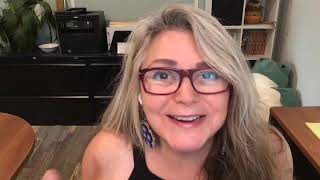
Sandi L Boucher reflects on grief, survival, and authenticity after an emotional reaction to an Oprah interview. She connects her loss of her father at 17 to a decade of domestic abuse, and asks people to see Indigenous women in stores as survivors who have overcome enormous obstacles.
Chapters
So I'm one of those people that a thought can pop into my head or I can be talking with a friend and I say something and my own words stop me in my tracks because in that moment when I wasn't thinking about what I was saying and I was just being me, I often blurt out absolute truth, truth that I need to hear. Does that ever happen to you? Let's talk about it. Foreign. Hello, everybody. It's Sandy Boucher here once again. I'm Red Thunderbolt, woman of the Loon clan, a proud member of Seine River first nation in Treaty 3 territory in Northern Ontario. And today I wanted to talk about, I guess, listening to your own spirit and your own authenticity. And I don't know if this ever happens to you. And, and if it does, I would love to hear from you, indigenous or non. Feel free to comment. But not often, but not rarely either. I will, you know, a friend will ask me something, or I'm just goofing around with a friend and I'll answer. And it's like, where did that come from? Because I answered with total honesty. And sometimes it's an answer I needed to hear. I'm sharing that because that's what happened to me. When I was watching TV a little while ago, I was actually watching it's the 2020 Weight Watchers. Oprah's doing interviews with all of these amazing people, and she happened to be the one I was watching. I watched a lot of them, I'll confess, but the one I was watching, that relates to this blog post. She was interviewing Michelle Obama, and I knew that was going to be epic, so I wanted to watch it. And she had standardized questions that she was going to ask. And this is where I didn't see it coming. Like, I mean, I'm sitting on the couch, totally chilling, petting the cat, watching tv. It was all good. And Oprah asked Michelle, if you could ask a question of a loved one who has passed on, who and what would it be? I didn't see the answer coming, but instantaneously, one, I knew I was going to be my dad. And anyone who follows my story knows when I was Daddy's little girl with that epic existence. But I lost my dad when I was only 17. And I'm going to try to tell you this without making myself cry, but I do not keep any. I'm not making any promises in that second. I knew, one, it was going to be my dad, and two, the question was, why did you have to leave so soon? I was safe when you were here. Why did you have to leave? I'm Anishinaabe Kwei in Canada. I am a 10 year domestic abuse survivor. I know what unsafe feels like. I know what scared feels like. I know what it's like to close your eyes and honestly think you're never going to open them again. But before that, while my dad was alive, I had this amazing existence being raised by soulmates that loved each other. We didn't have a dime to our names, but my dad worked hard and all of the essentials were taken care for and our house was bursting with love. To say I spent the next half hour bawling my eyes out was probably an understatement and I know there's no answer to that question. I know my dad didn't leave because he wanted to. I also know there's a really good chance even dad couldn't have stopped what was coming next. But in that moment, that's guttural moment, it reminded me how important safe spaces are. We need safe spaces. Anishinaabe Kwei needs safe spaces. Women need safe spaces. Children need safe spaces. And yes, of course men need safe spaces, but often we need safe spaces from them. That's a conversation we need to have. So I just wanted to remind people in this blog post, if you see Anishinaabe Kwei in a store, an indigenous young woman, you know, with her kids or not know what a battle it was for her just to get to the store. You have no idea the mountains she climbed to get there. Whether it's the racism she's enduring probably in the store, or God forbid, the violence and abuse she's walking away from to get to the store. So often what you're looking at is not a young mom. You're looking at a survivor. You're looking at a warrior. You're looking at someone who is overcoming incredible obstacles just to do what looks like day to day stuff. That was my existence. For years. I had such a joy and I don't know if anyone can relate with this. I'd love to hear if you do. Indigenous or non. For so many years, I took such a joy from being in the lineup in the grocery store and paying for my groceries because a certain individual told me I would starve and so would my kids if I ever left. And every single time my paycheck was big enough to feed my kids, it was a little win in my mind. A little, no, you were wrong. There are so many people out there in this country that are wrong about indigenous people. You got to start realizing what you're seeing. And there's a really good chance when you see an indigenous person, you're looking at a person that has climbed mountains just to stand in the coffee shop with you. It was a moment. There was a lot of tears, but it was so worth it. I hope that helped you. Until tomorrow. I love you. Take care. Bye. Bye.