Why Indigenous Are Leery of Mainstream Schools or Jobs
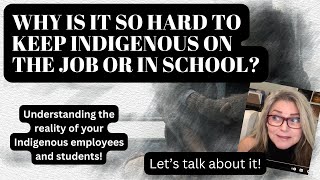
YouTube talk by Sandi L Boucher (Sandy Boucher), a member of Seine River First Nation, explaining why many Indigenous people are reluctant to engage with mainstream education and employment. Through personal storytelling and a series of empathic questions, she connects ongoing intergenerational trauma from residential schools, community-wide grief, poverty, housing and transportation shortages, and lack of local supports to barriers in starting jobs or attending school. She urges non-Indigenous employers to replace judgment with understanding, offers training/help to bridge gaps, and issues a call to action to change current recruitment and retention approaches.
Chapters
Many, many non Indigenous Canadians reach out to me on a regular basis because they find Indigenous engagement so challenging. They want to work with Indigenous peoples, they want to work with Indigenous communities, but they don't even know how to start. They don't know how to reach out. Do they email, do they call, do they show up? What would they say? They don't want to overstep, they don't want to be disrespectful, but they want to build this bridge and they don't know how and they're not sure they have the tools. That's what I wanted to talk to you about today. Because one of the main reasons Indigenous people are leery of working with mainstream is it tends to come with a lot of judgment. Those relationships can be incredibly challenging for us. So let's talk about it. Hi everyone, my name is Sandy Boucher. I'm Red Thunderbolt, woman of the Loon clan, a proud member of Seine River First Nation in Treaty 3 Territory in Northern Ontario. And today, from an Indigenous lens, what we're talking about is the back to back teaching. And I have shared this in so many videos. And imagine standing back to back with someone. Both of you could see so much of the room or area you're in, but you can't see all of it. And the part that you're absolutely blind to is what is obvious to the person you're standing back to back with. It's directly in front of them and vice versa. So what I wanted to do today is give you a little insight into what I see or we see the challenges you might see in a First Nation community. I want to take a shot at maybe eliminating some of the judgment and replacing it with understanding. And I'm going to do that with a series of questions. I'd be willing to bet questions you have never considered. And this time, as opposed to yesterday, I do want you to sit in your story as I ask these questions. Your experiences, your feelings, your emotions, maybe even your pain. You'll understand what I mean in a second. And no, not a handy dandy index card. Today I actually have a folded piece of paper. Once again, I emailed myself. Okay, so the first question is a big one. Let's just jump right in. Right. Would you consider starting a new job if you were grieving? And really good chance you're not just grieving the loss of one loved one, but several loved ones. And to make it even more challenging, every single person you know is also grieving and none of you know how to get past this. You're just weighted down in this pain. What would you do? Would you be open to starting a new job? My guess is probably no. Unless you're one of those people that want to deny your feelings and bury it down. And that's not healthy. Do not do that. That will actually manifest in physical ailments and your body desperately trying to get your attention. But I want to show you something. This is a cartoon that I used in seminar. Over the years. We have this little person. And he's little on purpose because he represents one of the first one of the children that would have been taken to the residential schools in the first generation. So no one in that community or family had gone before he was the first one. Chances are really good he was three or four years of age. That was the age my elders were taken. Now imagine, now remember. So before this, all of the experience he's had is love. Love from his parents, his grandparents, his aunt and uncles, everyone he knew in the community he's probably related to, or it's another family he definitely knows. But now he's in the schools and now he doesn't experience love. He experiences control. He's told that he's dirty because of the shade of his skin. He's told that he's a burden to the people that have to look after him, that he has to start behaving in a way that he's never even heard of before. They change his name, they change his clothes, they cut his hair. Hair. He's going to stay in these schools. He's going to go back for a short time during the summer, maybe a break at Christmas, but he's going to attend this school every single year until his 18th birthday. And then he's going to be released out into the world. And even if he didn't experience the worst of the worst, he didn't experience love. He experienced feeling separated and isolated from his family. Maybe even he felt abandoned by his family or resentful towards them for allowing these people to take them away. By the way, the parents couldn't stop it. They would have got arrested. So don't go there. No counseling, no support. And every single person in his community, his age or younger also has the same experience. And they all most. They don't want to talk about it because they're trying not to relive it. And they don't want to tell the people older than them because they don't want to upset their parents or grandparents letting them know what happened to them. And that man is now a grown adult. So eventually he's going to find a partner and have his own child. And the part that most people don't talk about is he's going to now watch his own child get taken to the same schools to have the same experience. Children mimic and repeat what they experienced as adults. They repeat what they experienced as children in some, depending on your location. In Canada, between five and seven generations of our families went to those schools. We're judged for not being good, loving parents. We're judged for not being in control when we're probably rebelling against the insane control that our families already known, always known. This is intergenerational trauma. It is what is happening in our first Nation communities. And thanks to addictions and, and that internalized oppression and lack of value that leads so many people to ending their own lives or the lives of someone else. There are so many first nation communities that are in a perpetual state of grieving. You can't even get over the grief or one loved one before you lose another. And these are the people that are judged for not being employed. So maybe we got to rethink that. Would you consider. Second question. Starting a new job with no savings, no money for transportation or clothes, not even enough money for a haircut to look presentable. Would you do it? But we're expected to. We're expected to go into a work environment totally foreign to us, working within a culture that's totally foreign to us and we don't even have the ability to look the part and maybe not stand out as much. And again, employers are surprised at the turnover and how often we just ghost. It is not because we love poverty. It is not because we are lazy. Maybe you're just asking us to climb a mountain we don't yet have the skills to climb. Would you? Now this one is a reality I have heard time and time again from younger adults or teenagers. Would you be able to go to work every single day if everyone in your household stays up all night and they get mad at you when that alarm clock goes off in the morning because you're now upsetting their sleep? There's no food in the house that got eaten and partied away and there's people laying all over the place. Would you be able to go up, get up every single day in that environment? There's no other place to live. This housing shortage. Would you be able to go to work every day on time because you're. Your boss is going to get upset if you're late and you're probably walking there because there's no transportation, by the way. Could you do that if you were an 8 or a 10 year old and it was school you were expected to attend on time, knowing there was no way you could get your homework done because there was no place you could have safely done it or quietly done it? Yeah. Would you be able this is going to sound very dramatic, but welcome to Canada. Would you be able to go away to school? You know, at the age of grade nine, grade 10, you live in a remote First Nation community, so you can't go to high school in your community. Would you be able to go away to school knowing three of your friends died for doing that? Three of them went away to school and for a variety of reasons never came home? What would you be feeling? Would you be excited about higher learning? Last but not least, a simple but very loaded question. Would you be able to believe in yourself and your abilities if no one in your immediate environment did? If the only person that dead did is some person in an office that gets paid to tell you you can succeed, that's the First Nation experience for many people. And by the way, maybe that's why I get so upset with the people who want to identify as Indigenous. Because just that notion that you would want this to be your reality proves you don't know what our reality is. You have no idea how hard our journey is, which is why it's so insulting when someone pretends they do. I guess pretending just became an even more valid word. So again, feel free to share this video, especially if you hear someone judging us. Judging us for trying to heal from a reality that was imposed on us by Canada. We didn't ask to be removed from our homelands and stuck in these compounds known as reserves and underfunded. We didn't ask for our kids to be taken away and we didn't ask to be taken away. And now we're judged for having not been able to figure out how to heal from it. And by the way, we are figuring it out gets better every single year. I'm just got a long way to go and judgment makes it worse. So you need employees. Indigenous people are known as some of the most loyal people you will ever meet. If you can build the foundation and build the bridge and hire that person and they find a way to succeed in your space, that person will stay with you for the rest of their career. Unless of course, you decide to abandon them. You need tips and tricks on how to attract and keep Indigenous employees. Reach out. I have information for you because what's happening up to now isn't working. And it's not a problem on our side of the feather. It's because the non indigenous in Canada haven't been offered the training they need. And I can help you change that. Until tomorrow. I love you. Take care. Bye bye.
More from Sandi

How I Handle "The Four Uglies!" (Alcohol, Diabetes, Healing & Cheap Seat Comments)


All the Stuff We Don't Talk About with NO SHAME! (WMT Podcast w Antoinette Godin)


When Authors Chat ... (Radio Interview for the Launch of "Copper Stone - Glimpse of Blood Memory)



MORE PROOF of Indigenous/Non-Indigenous Relationships that Work! (Walking My Talk w Millie Gormely)
