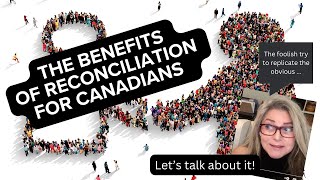
A short YouTube video by Sandi L Boucher arguing why non‑Indigenous Canadians should pursue reconciliation with Indigenous peoples. Boucher (Anishinaabe/Ojibwe) uses a three-image analogy (pre-contact functioning societies; transactional money-based relationships; a reconciled, reciprocal bridge) and lists Indigenous teachings—circle dialogue, humility, listening, connection to land/water, song and drum—that non‑Indigenous people can benefit from adopting.
Questions this video answers
Sandi L Boucher — Red Thunderbolt woman of the Loon clan; member of Seine River First Nation in Treaty 3 Territory in Northern Ontario.
Chapters
Hello again, you super duper double delicious person. I hope you had a fantastic weekend, a relaxing, peaceful weekend, or maybe a fun weekend with family and friends. Whatever the case was, I hope you got to recharge. And thank you so much for checking out my channel on this Monday morning. I hope you're subscribed. You're going to help me prove a point. If you don't understand that, watch my new channel video now. Today. Enough of that. Let's talk about today's content. A lot of non indigenous people are either wondering or out and out ask me why. Why should we reconcile? Well, today I thought I'd share with you the benefits for non indigenous Canadians to reconcile. I think we can figure out the benefits for indigenous people. But let's talk about this. Bonjour. Hi everybody. My name is Andy Boucher. I'm Red Thunderbolt, woman of the Loon clan, a proud member of Seine River First Nation in Treaty 3 Territory in Northern Ontario. And here I am in my office surrounded by loving frogs. We got to talk about reconciliation. Namely, why. Why should non indigenous people either care about reconciling with indigenous people? Or is it worth the effort? So I can tell you, from Anishinaabe Kwei standpoint, from an indigenous Ojibwe female standpoint, it most definitely is. But let me illustrate the point for you. So I want to share three images with you that I've used in seminar for years. It's going to help me make my point and then I'll expand on the last one. So the first one, here's the image. And this one just represents the fact that before contact. Before contact. I can do English. Before the settlers got here, before any explorers got here, we belonged to functioning societies, totally, completely different from the societies in Europe. We can acknowledge that. But what a lot of people, people don't realize, including some indigenous people, by the way, is the fact that we had totally functioning societies. Now, were they nirvana? Of course not. But we had governance systems, we had justice systems, we had education systems, we had health care, we had all the systems. Our societies were functioning. They just looked incredibly different. And when the settlers and explorers arrived, looking through their cultural lens, they didn't see systems that they recognized. So they assumed we didn't have them. And they set out, well, one, to move us out of the way so they could have the land and the resources. And two, if we were going to stick around and insist on not dying off, then they were going to assimilate us into mainstream culture, eliminate the indigenous cultures that exist from coast to coast and still do in modern day. So that brings up the second image. Now, unfortunately, this still describes way too many Indigenous non Indigenous relationships. Today. A bridge has been built between mainstream and Indigenous communities. But you notice the bridge is green. It's based on money. It's all about the money. We as Indigenous people hear things like, we want to partner with you, we want to work with you. If there wasn't resources at the end of that bridge, they wouldn't bother building the bridge. Let's get real here. And unfortunately, what that means is in this type of setup, Indigenous people are often still viewed as just in the way. Let's give them whatever they need so they can stand aside and we can get to the resources. Now that sounds devastating enough. But even more devastating is the arrow above the bridge. So this represents the flow of information. And in this model, the wisdom and the teachings of Indigenous peoples are still not being recognized. This is still that save the Indian mentality where mainstream believes they have to teach us how to do things, how to be prosperous, us, how to run our communities. It's insanity. But it doesn't have to be this way. And that doesn't mean that non Indigenous get excluded. Let's look at the third image. Now, to me, this is an image of reconciliation. You notice the bridge still exists. We're still working together. If we're going to sit side by side, I would hope we could talk and work together. But. But you notice the bridge is now half red, half white. Indigenous people are now empowered and healed enough to meet you in the middle of the bridge before you come into our communities. We're meeting you there and we're negotiating from positions of equal power. You need something, we need something. Let's talk it out. Let's come up with an agreement. And even more important, look at the arrow above the bridge. The now the information is flowing both ways and that's the focus of this video. Because as a non indigenous person, you may not realize the value and the power of indigenous teachings, Indigenous teachings that could help you. Now, of course I'm biased. I have my indigenous cultural lens. But most people that I know, at least in my little circle, agree that the environment would not be in the state it is if more people had listened to the indigenous peoples that are all over Mother Earth. You don't understand. Well, some non indigenous now do, but there are many that still do not understand. They minimize the power of sitting under a tree and taking the time to breathe and to contemplate or sitting next to the water. And watching it flow past you, allowing it to take your problems away from you, you are missing the wisdom of the trees and the water. And yes, I have a handy dandy index card with me. Many non indigenous people do not understand the power of sitting in a circle. And by the way, one of the main aspect of sitting in a circle is that we are all at the same level. For all of those people out there in some kind of career where they're feeling unappreciated, invisible, whatever the case may be, the circle eliminates that. No one sits higher or lower. No one is more important. That is the teaching of the circle. And one thing that I have totally noticed in my work with non indigenous and I have to remember that when I do a cross cultural seminar working with non indigenous people that so many are raised to, to sell yourself, to have that ego, to show up at the meeting, you better have the answer. This is not a judgment. This is the conditions of the environment you were raised in. But so many were not taught the power of humility, the power of sitting and listening and not debating, not asking questions, but trusting that if you contemplate it, the answers to your questions will come to you. It's how you build wisdom, it's how you build confidence. And our elders know that. But so many non Indigenous have never received that teaching. They don't understand the connection of heart to drum, the connection of song to drum to heart. These are valuable teachings that we use to empower ourselves every single day. That non indigenous Canadians are missing out on when they assume we have nothing to offer, when they get stuck in image too. I wrote a little sentence here that says the foolish try to replicate the obvious. They smudge they drum, never realizing they are missing so much. They are missing the unspoken that which is only experienced when you walk with us. So why should we reconcile? For all of those reasons and so much more. I'm so glad you're here. Do not forget to subscribe because here you're going to learn some lessons. And if you're non indigenous, you might just really need those teachings. Until tomorrow. I love you. Take care. Bye bye.