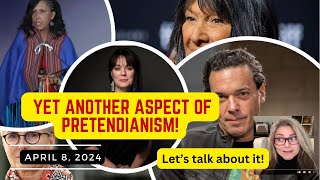
Sandi L. Boucher (Red Thunderbolt, woman of the loon clan; member of Seine River First Nation in Treaty 3 Territory, Northern Ontario) explains the harm caused by "pretendians"—people who falsely present themselves as Indigenous. She defines a pretendian as someone presenting as Indigenous without proof, argues Indigenous identity is by bloodline (not learnable or acquirable by marriage), explains how well-liked non-Indigenous teachers can appropriate and occupy scarce Indigenous spaces (funding, jobs, recognition), and urges Indigenous communities to call out pretendians to protect authentic representation.
Questions this video answers
Red Thunderbolt, woman of the loon clan.
Seine River First Nation in Treaty 3 Territory in Northern Ontario.
Up until 1985; the change occurred in 1985.
Chapters
Hello, here we are again. And believe it or not, we're discussing pretendions again. This conversation refuses to die. What we're discussing today is yet another aspect that I just realized in the last week. And to be fair, I'm not sure it's a bad thing that the conversation hasn't died, because I think each and every one of us, as we go through these conversations, we're learning more about what a pretendion is and why it's so harmful. So let's talk about it. Hi, everybody. My name is Sandy Boucher. I'm Red Thunderbolt, woman of the loon clan, a proud member of Seine River First Nation in Treaty 3 Territory in Northern Ontario. And today we are once again talking about pretend Ians. So if you haven't seen my other videos or this is the first video you're watching on pretend Ians, a pretendian is a pretend Indian. So someone who is portraying themselves as being indigenous, and I just saw a quote or a definition this morning that said someone who's presenting themselves as indigenous without being able to or wanting to prove it. I liked that because so many people, you should. I don't believe I have to prove it. Why? Why not? Like I do. Every. Every indigenous person I know who has had the luxury or the opportunity to learn any of their traditional teachings introduces themselves, as I did, by their indigenous name, by their nation, their. Their. Their individual nation, their treaty area, whatever the case may be. So that's what a pretendian is. And I want to be crystal clear here. Yes. Handy dandy index card. Of course I have a handy dandy index card. You are either indigenous or not, Period. You either have that bloodline or not. And I am not talking about one puzzle piece out of 52 pieces that make up your lineage. If one of your ancestors was part indigenous, then your cultural identity is made up of the influences of all the other cultures. Indigenous is a tiny part. But if your bloodline is indigenous, whether you've been exposed to the teachings or not, whether you were Ra in community or not, whether you were removed from your family or not, you are indigenous. So you are either indigenous or you're not. Even though these kind of conversations are making that really fuzzy, it really comes down to that. You cannot learn how to become indigenous. You are indigenous and can learn your teachings and your culture. But a non indigenous person, I mean, so many non indigenous people, and that's kind of what actually led to the creation of this video. So many non indigenous people are working in community, are in close relationship with indigenous people, and they pick up all of these teachings. Not a bad thing. Again, every indigenous knowledge keeper that I know, if you've had the opportunity to learn the teachings and you want to use it in your personal life or with your family, I have yet to find someone that has a problem with that. But more often than not, and I wish this wasn't the case, at some point, ego takes over the mainstream mindset, that worldview takes over and they become or they present themselves as teachers. It's the telephone game. You know, you whisper the sentence in one person's ear and it goes around the circle and by the time it comes back it doesn't sound anything like the original sentence. That's what happens when indigenous teachings are sifted through the colonial phrasing and mindset. An example, and we're going to ignore my cats of someone of another culture learning the teachings. Being a student doesn't qualify you to be a teacher. Said this a hundred times. So you cannot learn or become indigenous. Now the next one, you cannot marry and become indigenous. Even though does it still happen? I hope it doesn't still happen. Up until 1985, if you are a non indigenous female and you married an indigenous man, you got a status card that means legally you're indigenous. That doesn't make you a teacher of indigenous culture. It doesn't change your bloodline. You notice I said Indigenous by bloodline, not by government classification. And you know why that's so important? Because part of decolonizing, getting rid of the negative effects on indigenous people that Canada imposed is insisting that Canada no longer defines who we are or who is or isn't indigenous. We side so you cannot marry and become indigenous, even if it's legally, you wouldn't have the world in view. You can't morph into being indigenous. Right. And we've seen these people that they start out non indigenous and all of a sudden they start wearing beadwork and maybe a fringe jacket shows up at some point and suddenly they tan darker than they used to and suddenly they're using phrasing. They've and all of their friends are going, wtf? Yeah. But here's the aspect I wanted to center on today that makes this pretendium thing so traumatic for so many people and not just indigenous. It has been my experience. Now, I don't know about the pretendions that were featured in the thumbnail for this video. I just picked some of the most popular pretendions in Canada. But pretend Ians are so often incredibly well liked. They come across as very humble, very Beautiful people sharing their knowledge, indigenous knowledge with their followers. Everyone just loves them. Which is, and I, I'm not trying to be cynical here but I think that's on purpose because that's a really good smokescreen. That is because when we say pretend everyone goes, but they're such a nice person and they super helped me. And, and you can't say that, that you can be two things, you can be both at the same time. You can be an incredibly nice person who has crossed the line into being a pretend. So in the case of my ex husband who has no indigenous lineage as told to me by his parents, well liked, incredibly well liked, popular, huge and still has many, many people who believe he's indigenous, I can't change their minds. I can tell you the truth if you don't want to believe it. So and remember that a person is a pretendian because there's a benefit to it. There's job, there's funding, there's recognition as a knowledge keeper. So this well liked person is enjoying all of the perks and eating up, taking up incredibly rare indigenous space. There are so few indigenous specific positions, there is such limited indigenous funding that this person is taking up that space and eliminating the possibility for someone who is actually qualified to be in that space. The other thing that's happening is because of the effects of colonialism and oppression and internalized oppression, there are many indigenous, real indigenous people who carried the teachings who would not be comfortable in these academic type positions nor would the academic entity remember pretending is actually non indigenous. So of course they fit in because it's a non indigenous entity. So it is a lot harder to work with a true indigenous person with that worldview because it's a cross cultural relationship. All of this to say just because someone's an incredibly nice person and been supportive of you as they shared indigenous teachings. If they're not indigenous, you're not getting indigenous teachings, you're getting a non indigenous interpretation of indigenous teachings and that's cultural appropriation and that person is a pretendian. I just wanted to be crystal clear here. Now as I said in that other video, indigenous we need to teach people how to treat us. Which means in this case when the desperate for teachings and understanding uncomfortable non indigenous want to follow these pretendions, we need to call that out and they're not going to be happy. They're going to tell us how much they love this person. We have to do it anyways because if we don't then someone else is still speaking for us. And that is one of the root causes of how we got here. Another culture deciding they know what we need, they know who we are. And now they even know what we would say. I don't think so. I hope that made sense. I know it sounds or starting to feel like I'm. I'm not going to use that phrase. Beating dead log. How's that? But like I said, this just came up in the discussion last week of an incredibly well liked person who everyone knows is non indigenous, but they really appreciate his indigenous teachings. Hard pass. Until tomorrow. I have a great week of videos for you. I'm Sandy Boucher and I'll talk to you soon. I love you. Take care. Bye. Bye.