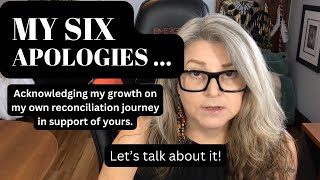
This is a personal monologue by Sandi L. Boucher (Red Thunderbolt, Loon clan, Seine River First Nation) reflecting on reconciliation through the lens of personal apologies. She describes her work as a reconciliation consultant (supporting both non‑Indigenous Canadians and First Nation communities), then lists six specific apologies—toward teachers, her children, well‑to‑do white people she judged, early seminar audiences, former partners, and to Creator for time wasted—while urging self‑reflection and improved understanding across groups.
Chapters
So I have a random and weird question for you today. How often do you think about apologizing to like people in your past? I don't know if it's an age thing. The older you get, the more you think about the things you would do differently if you could do them over. It was definitely where my mind went. And if you're not familiar with my work as a reconciliation consultant, I work on what I refer to as both sides of the feather. So on one side I'm working with non Indigenous Canadians, helping them up their Indigenous engagement, helping them to understand the challenges of working with Indigenous people, helping them retain their Indigenous employees. And on the other side, I work in First Nation communities, helping with the healing, helping, helping them to understand what oppression does to a human being, that what they're seeing in their community is not because we're less than, it's just a healing journey. And of course, I help them with the paths to overcome oppression. So I believe self care is self respect. And I believe Indigenous people, if you get caught up in the BS and the stereotypes, we're taught that we're somehow less than and have to prove our worth. But if you can get to that place where you realize you were born with value, you just have to start treating yourself as someone of value. And the older I get, the better I get at that. I realize I have value now and I realize when someone else can see it, that's that their vision problem, not my value problem. But I was thinking about apologies, and there's some I need to make, in all honesty. So let's talk about it. Hi, everyone. My name is Sandy Boucher. I'm Red Thunderbolt, woman of the Loon clan, a proud member of Seine River first nation in Treaty 3 territory in Northern Ontario. And as I mentioned in the opening, there are some apologies I need to make. I actually have six of them that came to mind relatively easily, which means they're probably apologies I need to make. So the first one, and I would love to hear if you are a marginalized person, so you're Indigenous, you're black Indigenous, person of color, your female, if any of these resonate with you, because I think some of them might. So the first apology, I wrote them down on my handy dandy index cards. I apologize to the teachers. I ignored the ones who believed in me and my intelligence before I did. There were. I was one of those really annoying straight A students. Ask my brother about that one. I loved school. I loved learning. I loved every A I got and wanted more and. But I knew I was good at school. I didn't believe my teachers thought I was going to become a lawyer. I was very interested in the law and. But I did not believe that was possible for me. In fact, I believed it was impossible to such a great extent. Are you ready for this? This is embarrassing to admit now. I could see myself as a secretary. I could see myself as an office administrator. Not that I'm downgrading those careers. So I trained to be a legal assistant so that I could at least be in that environment. Can you say internalized oppression? Can you say building barriers before someone else can? Like it's sad. So to all those teachers, so many of them not here anymore, who believed in me and all of my potential before I could even fathom the thought. I'm sorry. Next, I apologize to my kids who are now beautiful adults. My daughter has an amazing family of her own. I apologize to my kids. Well, a million things I should probably apologize for, but today I'm focusing on the fact. I don't know about you, but I am an absolute horror when I'm exhausted. I have zero coping skills. I'm short tempered. I am not. I would not in my present day. I wouldn't inflict that on anyone. I'm apologizing to my children right now because I spent way too much of their younger years exhausted and they didn't get the best of me. They got the short tempered me, they got the impatient me. And they deserved the best of me. And that is not who I was. That is me being completely and totally honest. So to my kids I say I'm sorry. Next number three. Oh. Oh. Honesty is the game here. My values, authenticity and bravery. So this is as real as it gets. I'm. I'm just going to read you what I wrote here. I apologize to all those well to do white people I judged or the ones that I assumed stuff about. You weren't all racist. Some of you were, some of you were just unaware of what's going on or ignorant of the reality. And some of you I should have become friends with. But as I always joke around in seminar, we have as many stereotypes about non indigenous people as you do about us. And as a younger person, I believed them because I didn't know anyone who could show me they were wrong. And, and no one was teaching me, no one talked about that. The schools I was in are for the well to do white people. So yeah, I have my stereotypes and I honestly could not do the work I do if I hadn't unpacked that baloney when I learned that non indigenous white people need safe spaces to discuss things just as much as we do. That they need safe space spaces, period. That they're not always just comfortable like I thought. That's when my career changed. So to all of those white people that I misjudged, probably on site, if I even waited till I met you, I'm sorry. Next. Okay. I've joked around about this one for a lot of years. I've joked around because after 15 years, I am good at what I do. People enjoy my seminars and workshops. After 15 years, I better be good at what I do. And I've long joked around that the people I did the seminar for in the first year, I probably owe them a free seminar. So number four is I apologize to all the people I did a seminar for before. I found not only my voice, but the strength behind it. You deserved the best of me and I just wasn't my best yet. So to them, I apologize. Because if there's one thing this career has taught me now, when I stand in my values and I stand in my truth and I believe what I say and I dare to say the truth, that is when I reach people. The more me I became, the more successful I became. And to those people, I was still stereotypical indigenous. Worried about how people would react, worried about the strength of the backlash. I don't worry about that anymore. Now I know I'm needed because I don't attack. I'm not into shame or guilt. But there's many non indigenous businesses out there that may go under if they don't figure out how to work with indigenous people. Because we are a growing population. We also a loyal population. There is not a business out there that wouldn't benefit from learning how to work with us in a more effective, respectful, understanding way. So if you need help. Okay, number five. Okay. I've definitely said this one too. And it's in line with number four. Different, different target market. I apologize to every ex husband and or boy boyfriend I had before 2009, I didn't know who I was yet or how to be me. So I'm sorry because you never got to meet me. Truth is, I was so busy trying to be who I thought my partner would want me to be that they rarely saw a glimpse of who I am. So for that, I'm sorry. And last but not least, straight from the heart to Creator, I am sorry for wasting so much time. I'll do better from now on. But then Creator knows that the reality is I am no longer, in my own way. I am no longer attacking or judging. I have all the time in the world for the people who ask humble questions and I have zero time for the people that want to judge me. If you don't understand something, that doesn't make you less than and I'd happily help you to understand if it involves indigenous peoples. But if you're going to hang on to the stereotypes, then maybe you got some work to do first. Or we could do a session on that. I have a bingo card of inappropriate terms. It's not what is that, political correctness. It's identifying statements that never should have been used. And we're finally speaking up and saying, don't say that. I hope this helped you. I hope, if anything else, whether you're indigenous or not, Canadian or not, I hope this got you thinking. Maybe, just maybe, there's a few people or groups of people that you owe an apology too. Just a thought. Until tomorrow. I love you. Take care. Bye. Bye.