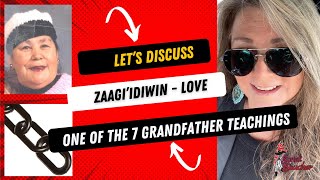
A single-speaker YouTube monologue by Sandi L Boucher (Red Thunderbolt, Loon clan, Seine River First Nation, Treaty 3) reflecting on the Seven Grandfather Teachings and focusing on the first teaching — Zaagi'idiwin (love). Boucher discusses her lost ability to speak Anishinaabemowin due to colonial-era residential schools and the intergenerational impact of language loss, describes how elders and mentorship restored cultural teachings in her life (names three elders: Nana Elsie Quandaments, Josephine Mand, Marjorie), and explains the practical meaning of "lead with love" through storytelling (care for children and possessions; love as unconditional and healing). She also briefly references sources (Seven Generations Educational Institute) and closes with encouragement and personal testimony (survivor of domestic abuse who emphasizes loving oneself).
Chapters
Now, I did a poll in my community a little while ago and asked what kind of things you'd be interested in. And because I had mentioned the seven grandfather teachings in a previous video that definitely came out as something of interest, I started getting tons of emails saying, please, please talk about the seven grandfather teachings. So I decided once a week I can share one of the seven grandfather teachings with you. And today I got to look at my handy dandy index card to make sure I pronounce this right. Unfortunately, in my family, the language was one of the things we're lost. And in little tiny ways I try to recover it. So today we're going to talk about Zegadouin. Probably mispronounced that, but let's talk about it. Hi everybody. My name is Sandy Boucher. I'm Red Thunderbolt, woman of the Loon clan, a proud member of Seine River First Nation in Treaty 3 Territory in Northern Ontario. And as I mentioned in the opening today, I wanted to speak to one of the seven grandfather teachings. So first off, I did want to touch on the fact that I kind of struggled over pronouncing the word, the fact that I do not have, I do not speak Anishinaabemo and I do not have my language. And that is a hundred and ten percent due to colonialism, as in the residential school era. I remember so vividly chasing my mom through the house. And when we were children, no one said aboriginal or indigenous. I'm old enough. Like I was born in 1960, before Get Real, everyone said Indian or Native. And I can remember chasing like literally little hellions chasing my mom through the house, asking her with pure enthusiasm, how do you say this in Indian? Whatever it was, whether it was a doll, whether it was a tree branch, whatever it is. And eventually we would corner her somewhere, get her in a room she couldn't get out of. And I always remember the sheer panic that would come over her face and sometimes she would give in and sometimes she would tell us the word. And other times she would just say, I'm not allowed to teach you this. And because she was now sounded angry, we would let her pass and let it be. I was an adult well into adulthood before I understood that reaction, that imagine not being able to pass on to your own children your language because the government has insisted and you've watched the devastation that happens for people that try to that, that brainwashing and that fear was that deep. So I don't have my language. And I used to feel a lot of shame. Funny, she felt shame for having her language. I felt shame for not having it. And I just don't play that game anymore. It's not my fault I don't have my language. In the same way that the sixties scoop and the kids that were adopted out, it is not their fault. The adults now, it's not their fault they don't know their culture and their teachings or know their language. We were denied that thanks to good old Canada. But I have been lucky. I started working when I was like 20, and for 98% of my career, I have worked in indigenous communities, in indigenous agencies, with indigenous peoples. So I've had access to the most amazing elders. And I've had my elders to help guide my development in the way that traditionally that would have happened if you didn't realize that it's one of the chains that were broken by the residential school era. So traditionally, what would happen, a young girl of maybe 5, 6, one would have an older sister of like 12, 14 that would guide her and teach her how to get dressed, how to take care of whatever she has to take care of. But that 12, 14 year old would have a 20 year old to look up to for guidance and mentorship. And that young mom in the 20s would have an older mom in her mid-30s to look up to and 30. We were never alone. We always had someone to look up to. And I had my mom. And then when my mom passed, I actually had other amazing elders. I had three amazing elders that appeared to me over the years and their names are actually on my feather tattoo now so that they're always with me. Nana Elsie Quandaments, who we just passed away earlier this year, was help me understand who I am and what I knew in my blood memory long before I knew the ceremonies. I danced jingle because of her. And if you want to know what that is, Google Jingle dress. And I had Josephine Mand, who's. You can see the bottom of her picture behind me. She taught me how to be indigenous and in business or how to be indigenous and a leader, how to honor our teachings and use them to lead, not to abandon them. And then Marjorie is my. And Josephine's gone now too, but Marjorie is still here. And she is such an amazing soul and such a bright light and an example of a caring, loving heart even after a challenging, challenging journey. So I've been able to recreate that teaching line. And yes, I spend a lot of time mentoring those that come next and paying forward what I was given, which is in line with our teachings as well. So it was through those elders that I first learned of the Seven Grandfather Teachings. And what I said in another video, this is a very loose metaphor, so please don't crucify me. But in the same way that Christians value and follow the 10 commandments, we have the seven grandfather teachings. And trying to live the seven grandfather teachings is not easy. Trying to live every single day, every conversation with humility and bravery and respect. Right? Like those are the kind of expectations that come with practicing the Seven Grandfather Teachings. And today I decided to start with Zagaduan. Zagadoin. I think that's how it is. It's love. Now, if now I received all my information from the Seven Generations Educational Institute website. It's based in Treaty 3, which is where I am from. But what I wanted to share with you about this one in particular, the love teaching. And I think we can all comprehend what it's like to live with love. But the problem, in the same way I'd be willing to get with the or willing to bet with the Ten Commandments, if you've heard the Seven Grandfather Teachings for a lot of years like I have, people tend to take them for granted. They become cute little pictures that are on office walls, but that's it. They're mention in your policies, but we don't talk about. Again, we know the definition, but do we know the practice? And one of the other amazing benefits of my career is I'm often a speaker at some conference somewhere in Canada and they bring their elders in. So I get to hear from elders from all different treaty areas and nations. And it is always worth the extent, experience. And I happen to be. Where was I? I was in Winnipeg and the elder was from Treaty 1, which is not my treaty area. And I had heard lead with love, start with love a hundred times before. Again, getting complacent, just taking it in stride. But that was what he wanted to focus on. That is what he wanted the audience to hear. And he said so you know, you have to, you have to start with love. You got to lead with love. And I'll admit. And I was kind of like, yep, heard that one before. Cocky, right? So disrespectful. That was terrible of me. But he said like, do you understand what that means? He said, so I'll give you an example. Beautiful style of the storytelling. Love, love, love it. Always on point, by the way, not going off on the tangent. Our stories are always on point. And he explained, like, he asked how many of us were parents and we put up our hands and he said, Would there be a difference between, if you had to go away for like a month, would there be a difference between leaving your child with someone who will take care of them but that's it, or someone who will take care of them, who loves them? Is there a difference? Of course there's a difference. Of course we want them with someone who's going to love them. It's like, okay, let's take the next step. Do you have something in your home, some possession, your favorite coat, your favorite whatever. If you love it, do you take care of it more? Of course. If you don't care about it, you don't care about it. But if you love it. Absolutely. Absolutely. That's when he paused and said, that's why we say lead with love. Because you walk differently when you love mother Earth and you speak differently when you love the people you meet. And I'm not talking a sexual type intimate love. I say I love you at the end of every video and it's genuine. Even if I've never met you. I love the potential of you. I love that creator made you. There's a reason for that. I don't know what it is. I don't need to know what it is. But I bet it's really exciting for you to figure that out. And I, if you do, I would love to hear you hear it. And I hope our paths cross so I can hear that from you. You don't earn. Love is not earned. That's another that comes from a place of pain, right? Loving is how you end the pain, not by stopping the loving. And yes, I can say that from the lens of a 10 year domestic abuse survivor. He got my past, he doesn't get my present and future. I'm not going to stop being a lovey, loving, happy human being because he tried to stop me. Didn't work then. Maybe it worked for a time, but I healed and I'm back. Don't give those people in the past your future, not even your present. Do your healing, you deserve it because you should lead with love. And the easiest way to do that, not easy, but a really good place to start is loving who you are. And that's got nothing to do with perfection. That's got nothing to do with beauty standards. I'd be willing to bet you are flipping amazing. And if you don't know why you're amazing, I gotta quit hitting my microphone here. If you don't know why you're amazing, go ask your best friend. And once they stop giggling and making silly jokes, tell them you're serious and they'll tell you why. They love having you in their life. So. And if you don't have enough of those people, well, then you need to go out and find them. Like we talked about yesterday. Don't sit around waiting for people to find you. Your path, your life journey. You gotta paddle your canoe. Otherwise the current can take you into the rocks. How about no? How about portage around that crap? You can do this. So the first of the grandfather teachings is Zegatoin love. I hope you enjoyed that. Can't wait to hear what you think of it. I'll see you tomorrow. I love you. Take care. Bye. Bye. It.