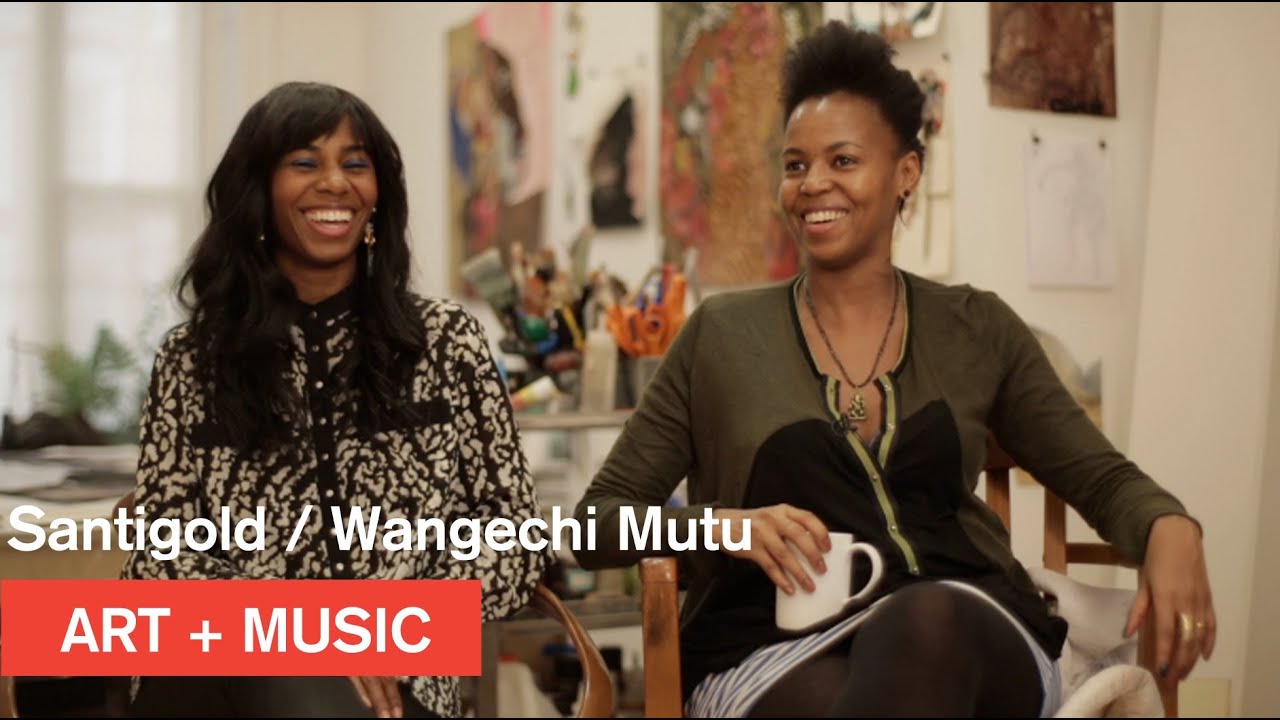
Visual artist Wangechi Mutu and musician Santigold discuss their collaboration on Mutu's first animation, The End of Eating Everything, where Santigold voices a creature that literally eats everything. They explore the film as a critique of consumption and greed, with Santigold describing culture as a pendulum swung too far toward materialism, heading toward explosive renewal.
Chapters
I'm Wageshi Motu. I'm here with Santigold, this amazing artist who worked with me on The End of Eating Everything, my first animation. And it's about an amazing moment in history and time that we're actually living. This character that she plays eats everything. I chose Santigold because I felt she was the perfect balance between someone who understands art, can act— I could tell she could act from her own work, from her videos— and she has a great sense of humor. I don't know how that comes through in so many amazing ways, and I could see that she would embody this creature.
I always call my approach to creating collage, you know, like I make collage music. All my ideas, my influences are pretty much like a collage. I take bits and pieces of everything, put it together, and so it just was It was so perfect that when I looked at Wageshi's work, it was like, you know, the same basis.
The world that it had made. The collage was colliding.
Yeah. Yes. And so, I mean, it just made perfect sense. And she's like, "It's a beautiful Black woman as well." I was just excited, you know?
I was just like, "This is great." Sometimes when you collaborate, you want to control what's happening, but the best part is when someone brings a little extra, more than you actually anticipated. And she did that. And I was like, "Who are you?" Talking about consumption is also talking about a state of mind. And really, how much do we need and how much should we be sharing versus taking? And it's something I've thought about for a long time, but I guess you just sort of find the right way to say things at the right moment. It's not a sort of— I'm not sort of riding on the crest of anything that I've seen. It's just that I found the right medium and I trusted that someone else could help me make this piece of work what it needs to be and that it needed to be in motion and it needed a strong protagonist. All of that came together and that notion of sharing when you're talking about things that have to do with not sharing and being greedy and all that, it all just worked out really, really wonderfully.
Hip-hop especially, it's just like all name-dropping, "I got this, I got this." 'You know, this brand and this brand and I'm rich.' It's so materialistic, but it's so empty. And when you have art that's this empty, when art is supposed to be something that is kind of keeping us grounded and renewing us culturally, it just lets you know how far the pendulum is on the wrong side. And what I think is interesting about your piece is how Literally, it's what happens. It's how the pendulum turns. It's when you're so far gone that there's nowhere else to go but sort of an implosion. And, you know, that's what's happened to her in this piece. And I think that that is exactly where we are in culture and in art and music, where there's— I mean, we're so far on the wrong side, there's really no more room. And I think we're at this place where it's going to be sort of like an explosive renewal. Right.
Thank you, Santee, for saying that. My God. I love her. She's great.