SuGo Alternative Cash Flow Fund
This is a transcript of a webinar by Sarah Sullivan presenting the Sugo Alternative Cash Flow Fund. The fund is a private, qualified-client-only (net worth requirement) pooled vehicle focused on steady cash flow from alternative real-estate-related assets (multifamily, ATMs, storage) with a target seven-year hold. Key features: tiered preferred returns (11–13% typically, with recent increases noted), quarterly distributions after two full quarters of ownership, a $50M total offering cap and $100k minimum, IRA/401(k)-eligible, and fund rebalancing as new assets are acquired; tax depreciation is passed through to investors. The transcript includes detailed investor Q&A and operational logistics for subscribing.
Questions this video answers
September 2021.
Net worth of $2.2 million or more.
Total offering $50,000,000; minimum investment $100,000.
Tier examples stated: $100,000 → 11% preferred; $250,000 → 12% preferred (speaker said this was updated to 14% the prior week); $500,000 → 13% preferred.
Target hold time seven years; distributions paid quarterly (start after two full quarters of ownership; preferred returns accrue from acquisition date).
Chapters
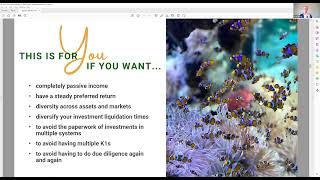
All right, welcome, everybody. In this presentation, we're going to be talking about the Sugo Alternative Cash Flow Fund. And I call it the Alternative Cash Flow Fund because it's all about cash flow, which we're going to go through. And. And I guess, Angie, next time, next time, you'll know it'll be perfect. So the Sugo Alternative Cash Flow Fund, it's all about cash flow, and it's all about alternative assets, which we're going to be talking about the assets that are in this fund, but they are considered alternative assets. I do want to start by making sure everyone knows that all are welcome to be on this event. However, in the Cash flow fund, it is only open to qualified clients, and that's defined as a net worth of 2.2 million or more. So although I'd like to have the fund open to everyone, the California fund manager rules is that we can only have funds for qualified clients. So in the future, if I'm in Florida, I can open up one as a 506B, but for now, it's qualified clients. Okay, So a lot of people say, okay, normally on the front of a fund package, there's like a picture of if it's a crypto fund, you put crypto. If it's real estate, you put real estate, you put a turtle. Why'd you put a turtle? And it was actually very intentional, because when I invest in all the calls, I talked to four investors this morning, and they said, why? Where would you invest your money? And I said, I invest my money in apartment buildings because I want a feeling of calmness around my money. If you guys haven't heard this notion of what's the energy of your money? It's like, how do you feel about your money? Are you excited about it? Are you calm about it? Are you nervous about it? And so I want to feel calm about my money, and I want my investors to feel calm about their money. So you won't be 5xing your money in the next 2 years with this investment. This is for the portion of your portfolio that you want to be calm and predictable, the base investments in your portfolio. So I had a turtle on the front because a turtle is peaceful and calm. If you've ever swam with sea turtles, they're like the calmest thing in the water, and they're able to go and do what they want, and they're just. They're very peaceful. And I want to bring that same calm, peaceful feeling to investors with this fund. That is my goal. Okay, so general disclaimer There's a lot of information in here. Bethany. My SEC attorney says it has to be in every pitch deck. So basically it's saying that this is not the offering. Once you get into the investment portal, there's the private placement memorandum. This is subscription documents, which you should all read thoroughly before signing them. And also saying this business plan is a plan, it's not a guarantee of anything. Just like any investment, past performance is not indicative of future performance. It doesn't guarantee future performance. So invest at your own risk is basically the summary for this one. Okay, so project at a high level. The name of the fund is the Sugo Alternative Cash Flow Fund. One and it has a one in front of it because we may have a two, a three and a four. We'll see. Depends on what these economic cycles do. Right. So the strategy is that we're holding it for seven years and we're holding different cash flowing real estate investments. And the primary geographic areas are Texas, north and South Carolina emerging markets in the sun belt or steady growth markets in the Sun Belt. And that will be a mixture of ATMs and multifamily. So on the ATMs we're going to talk about it as we get into it. I am not the general manager but for all the other assets in the fund, I will be the general partner on the investment. And why did I create this? So I now have 14 apartment apartment buildings and I have a lot of investors who are invested in like 10 of those. And they were saying, we did a survey last year and we said, what do you want? How can we serve you better? What more value can we add to you? And I had a bunch of investors respond that. They said, hey, we've done due diligence on you, we've done due diligence on your partners, we've done due diligence on how you do due diligence. We know you're going to choose good markets, we know you're going to choose good properties. So we just keep investing in every single one in order to be diversified on the project level and the market level. And they said, but that's annoying because then I have 10k1s every year and I have to keep track of them all. And they said, can you just create one fund that can be diversified in different projects? And, and can we have something that has a stronger cash flow? And so I created it. I'm a big fan. If you guys give me feedback, I take it into account very, very seriously. I take it into account. So if a Lot of people ask for the same thing. I create it. You know, a lot of people ask for, hey, we need someone to talk about tax strategy. I have someone come talk to you guys about tax strategy with these type of investments. A lot of people said, hey, we want to be able to 1031 exchange into a syndication. So I figured out how to help people do that, you know, so whatever you ask for, I try to deliver that value if it's in the realm of what I can do. So that was the point of this fund, was to give diversity and risk mitigation to investors, to increase that feeling of calmness, to increase that feeling of safety and security and low risk with the investment, and also to increase the cash flow. So we're going to go over the returns on a later slide. But this is focused on a preferred return cash flow. It's not focused on appreciation or capital gains. And you just have one, one portal, one investment. And it gets diversified to be one K1. So this project, this fund can have 100 investors and the target hold time is seven years. I'm going to pause here and go into this a little more because a lot of people ask, hey, is this, you know, is this a liquid investment? Can we trade in and out of a fund? And no, you cannot accept during capital events. So, you know, a common question is, what's the difference between this private fund that you have, Sarah, and a REIT? Or REITs are public and so you can go in and out of them. They have different, you know, sometimes you give a 30 day, sometimes a 90 day warning of pulling out your money. That is not the way this fund will work. This fund will own apartment buildings and it won't be liquid. However, investors can choose to have principal returned if there's a liquidity event. So you can see the asset focus is multifamily storage units and ATMs on the lower right hand corner. So one of the investments we have is already being sold. And so if this happens in year two through seven, that we're still within our first year, it just sold really quickly. So investors don't have this choice but say one of the apartment buildings we hold is sold in year three. Now we'll go to investors and say, we have a capital event. Would you like some of your principal returned or would you like us to reinvest that in this fund for you and carry it out for the next seven years? So investors will have a choice to have principal returned or reinvested at a liquidity event, but only at that Time. Otherwise, consider your money in the fund producing the cash flow for you and you'll be able to exit at year seven. Like I said, our focus is Sun Belt, so Texas, the Carolinas, Alabama, Georgia. So the next one we're looking to put in is in Texas and the one after that is probably going to be in Georgia. And I will reiterate again that the multifamily projects that are in this fund, I am the general partner on those. I am one of the managers with my partners. The ATMs that are in here are not managed by myself. They are a fund. So this whole project is considered a fund of funds. I see that you raised your hand, Ryan. If you want to put something in the chat or Q and A, be happy to to answer it. So how do the returns work? This is the preferred return table. So for those of you I want to make a difference, these are not projected returns. This is preferred return. So what that means? Preferred return means investors get this number before the general partners get any money. And so, and there is a catch up, which means that if for two quarters, you know, something happens with one of the assets, they burn down while it's getting rebuilt and we're collecting insurance premiums, maybe the cash flow does not come through for investors. However, there will be a catch up. So does it mean if it doesn't have cash flow for two quarters that investors lose out on that? It just means they temporarily don't receive it. And there will be a catch up as soon as possible. Okay. And definitely catch up before any of the managers receive any payout. So there are three tiers, class A1, A2 and A3 for this fund. And these are the different levels. But it doesn't mean these are the only amounts you don't have to invest 100 or 250 or 500. We have someone in here for 316,000. We have someone in here for 193,000. So whatever amount you want, you can put in. But once you reach that next mark, so once you reach the 250,000 mark, then it bumps you up 1% on your preferred return. And once you invest 500k or more, it bumps you up to 13% cash flow on your preferred return. Now it's paid out quarterly. And so I'll take the example of 250k at 12% because that's our most common investor. So what that means is every quarter you get 3% of 250k. So to make sure it's really clear, but it's not perceived as 12% each quarter is 12% each year, paid out each quarter. So each quarter will be 3% ROI on your original investment. So your annual cash flow is expected to be 30,000 on an investment of 250k. So 30 divided by 4 is whatever you get paid every quarter. So a lot of you have been investing with me in individual projects over the last two years, but then also a lot of you are new. And so this actually needs to be updated from 12 to 14 as of last week. So I just didn't update it yet. We just acquired two more, but our total assets under management is over 200 million right now. And so we have a lot of experience in the apartment space and we have a great track record. And so collectively, our apartments have been performing at or above the projected returns over these 14 investments. And if you want a full track record, the full track record is in the investor portal in the documents section. It has every single one of our assets, the projected and actual returns. So you know when people are like all the calls this morning I had with people, they were saying, I wonder if I should invest in the fund or direct into syndications. Because it's kind of like it's the same asset class, but just the returns are structured a little different. So a fund is for you if you want completely passive income. So you're not even choosing the different apartment buildings you're not looking at. Hey, Sarah, you have eight apartment buildings this year. I'm trying to decide how much to allocate to each one, when your next one might be. Your money is not sitting idle like maybe you have 500 to invest today. Well, if you want to diversify that, you have to hold it in cash and wait. Okay, that's losing money while your money is sitting in cash. Or you can invest it all in the fund. And what happens is each time we acquire a new asset, the fund is rebalanced so that all the previous investors are diversified with all the future investments as well. So that's called fund rebalancing. So each time we get new investors, each time we get a new property into the fund, we rebalance it so that all investors are diversified across all the assets that the fund owns. Okay, so it creates a completely passive diversified situation for you. This is also for you if you prefer steady returns. So if you go into individual projects, the return schedules are all different. There's a lot of back end gain, less on the front end. And so if really living off of a consistent cash flow is important to you or to Have a baseline in your portfolio of consistent, steady cash flow, then this fund would be really great for you. If you want to automatically be diversified across assets, across markets, across, you know, different liquidation times, then this investment would be really good for you. This fund would be good for you. If you hate doing paperwork and you hate choosing, you know, doing your due diligence on each project, then this is also a way for you to be diversified. With one investment, you get 1k, 1. One set of due diligence. So make sure you do really great due diligence on me. Most of you have been to my webinars where I talk about how I do, how I choose a market, how I choose a property. And if you have not, and you don't know me that well, I do a presentation. I'm doing it tomorrow at 8am PST where I talk about my due diligence in depth on how I pick my properties that I'm acquiring. And so that's a great piece of your due diligence. So, you know, okay, how does Sarah think? What. How involved is she in choosing these apartments? So anyway, most of you have already done that due diligence. And so this is a way to do one diversified investment. The fund is not for you if you want to maximize your capital gains at exit. So if you're making this investment with your IRA or 401k, which is possible, and you're investing it for 20 years from now, I would suggest you go into something that would maximize your capital gains. If you don't have to pay tax on your capital gains because of the retirement account it's in, and you're not using this money now like you don't care about cash flow because it's something you're going to use in 20 years from now, I would suggest finding an investment that maximizes capital gains on the back end versus something that cash flows. You'll multiply your money for later, faster. You know, this is more for someone who wants to use the cash flow today. Cash flow is important to them. If you want to have control over exactly which assets you hold, this fund would not be good for you. Because although I am presenting the next acquisition and the past acquisitions, once you're in the fund, you'll be notified when we make future acquisitions, but you won't be able to choose them right. And so some people are like, yeah, I don't care. And some people love choosing exactly what projects they're in. So I would say go direct into syndications if that is you. And if you love doing due diligence, which I don't know if you're on here, Sheila. Sheila's like, I do love doing due diligence. I'm going to see if her name is on here. Are you here, Sheila? Nope. No Sheila. Okay, well, she said, I love doing due diligence. Like, okay, well, this wouldn't be very fun because you do due diligence once and then you miss out. So if you love, you know, picking apart each property, then going direct into syndications would be for you, and this one wouldn't be as exciting for you. So, you know, also, let's dig in some more because a lot of you on this call might have this question, what is better for me, a direct investment into a syndication or going into this cash flow fund? So I broke it down on a table because everyone I talked to asks these same questions. So hopefully this table helps. So if you want diversified assets with one investment, do the cash flow fund. If you want a diversified sponsorship team with one investment, Suga Alternative Cash Flow Fund. So my projects, I have different co sponsors and then the ATM is also a different sponsor. So even though I'm the common thread, the other people involved are diversified. If you want to be diversified across markets with one investment, then the Cash flow fund is great. Let's talk about tax benefits. So this is unique to the cash flow fund. This is not common in a lot of funds. So in a syndication, when we buy the apartment building, we pass through the depreciation and loss to the investors. So basically the fund is an LP investor in the syndication. So that depreciation and loss gets passed through to the fund and then gets passed through to investors. So you have the same tax benefits whether you go direct or through the fund. They're the same. There's no difference. So that's really unique to this fund. A lot of fund managers will capture the depreciation for themselves and investors don't receive that. But I don't need all that depreciation. I guess I can bank it for later, but I think it's best that we all share in that. So if you are a 20% owner in the fund, you get 20% of the depreciation and loss for the fund that year. And so your tax benefits will be the biggest in the year you make your first investment. So some people made their first investment in 2021. So on their K1s, which I see some of you in here who are investors from last year, and we don't have our K1s out yet. It'll be another month or two. But you have the depreciation, most appreciation and loss in that first year. Now, if you make a second investment, which I know some of you are doing, where you're adding to your investment, so you maybe did 250k in 2021 and you're going to add 250k in 2022. You'll get a chunk of bonus depreciation for 2022 as well. And now you're at the 500k mark and so you'll go up to the 13% return. If you are investing for strong appreciation on the back end and you don't care about cash FL this is money for later or it's for your children or it's for a future event, I would suggest you go to a direct investment and not to this cash flow fund that'll support your investment needs better. If you're okay having your investments in multiple systems, multiple paperwork, then direct investments, when you diversify will be for you again, if you like doing due diligence and you really like having control over each and every asset you're invested in, then I would say go to direct investments and don't go into a fund because you'll see today what's already in the fund, what's going into it next. But you don't know what's going in in the future and the fund is rebalanced into those. However, if you're here today and you know me and you see what we've been putting in, what we're going to put in in the future is the same thing. So if you like what's already in there, you'll like what's coming in the future. But yes, I see two questions. I'm going to peek at those. Okay, good question, Greg. Is this fund open to self directed IRA funds? Yes, yes, yes. Umesh. Email rachelugocapital.com and ask her. She can help get you set up. So Greg. Yes, good question. You can invest with your IRA, you can invest with your solo 401k, same as this indication, pretty much any entity. You just need to have a ein number or a Social Security number and be a qualified client and you can invest in this. Okay, so I said the categories of assets, but really you want to know a bit more about them, Right? And so this one is an example. This is incorrect. It's not 24 unit, it's 224 unit apartment building. So it's a purchase price of 24 million. So it needs some money. Right. And so the fund will come in and supply a portion of money to purchase this. So it might supply 1 million, it might supply 10 million. And so it helps the management team make this purchase in addition to other investors. So the fund is a partial owner in apartment buildings like this. And we always choose value add. We always are going to choose something that's a three to five year hold. And Sugo Capital will always be a co sponsor. My attorney said make sure you put maybe in there for legal reasons, but I will always be a co sponsor. I'll always be a co manager for these, for the apartment buildings. And so the sponsors that I work with, the co managers, they and I have a track record of over 35, 35 now with the new projects. Percent annualized return at exit. And so what that does is we have the ATMs that are high cash flow and no returns on the back end and then the apartment buildings that are low cash flow, high return on the back end. And so they balance out to create that, that calm, stable return for the investors. Okay, example ATM acquisition. So we have done three ATM investment with the fund and this is a sticking point for a lot of people, right? I see a question in the Q and A. It may be about this. Yes, Steve, this is for qualified clients only, which means a net worth of 2.2 million or more. So a lot of people when they say, hmm, you have ATMs in here, who uses cash anymore? I mean we go to buy something at the store, right? You just go bleep. You just send your friend money, bleep. What is this cash thing? Well, contrary to what we all might believe, cash currency is actually been increasing in use over the years. So this is the volume of currency in circulation, the number of notes in circulation. This is from the Federal Reserve website. And so you can see it is increasing each year it has doubled. The number of notes in circulation has doubled in the last 20 years. I think that's crazy because I've reduced my use of cash. However, lots of parts of the United States still work as a cash basis. And this is, this is proof. These are the notes that are in circulation today. So I want to read out the facts because this is, a lot of people give me this feedback like, why do you have ATM in there? That doesn't feel safe to me. So this is from the Federal Reserve website. So fact number one, there are more US Dollars in existence today than ever before in all of human history. Fact number two, the unbanked, underbanked car carriers, low income folks Immigrant workers are one of the fastest growing groups in the US So a lot of you on the call are not in those groups. You're not in those circles. So it seems like a foreign concept to you. However, a large population of the United States is currency based in their finance financial situation. Okay? Yep. So while many folks believe the use of cash is in decline, the opposite is true within the demographic that we serve. And smart investors are providing a service to this group. So the more cash machines are out there, the easier it is for this demographic to function and do their business. So I think it's really cool because these provide heavy cash flow up front, and then the syndications provide the capital gains, capital gains, which for you creates a steady cash flow. So the current assets that we have in the fund, we have three fund opportunities, and they're three fund investments, and they're paying back into the fund monthly. Everything has been going as expected. So we made those first investments September of 2021. So if anyone on here is wondering, hey, when did the fund start? It started in September of 2021. We've invested in three ATM funds and they're all paying out monthly the exact amount that they should. And we've invested in two multifamily properties, and they are all performing as expected. One of them, Prosper Fairways, is actually exiting next month. And so since it hasn't been in ownership property one year, what happens is the capital gains and the principal that was invested in Prosper will be reinvested into the fund for you. So it'll be reinvested, but it'll support the cash flow that you're going to get over the next couple quarters. Now, the reason I'm doing this webinar today is that we have identified the next asset that the fund will hold. The apartment complex is called Waco901, and it's in Waco, Texas. Surprise. Not a very creative name. We're going to change the name to Sunset Point once we own it, but for now it's called Waco901 in Waco, Texas. We're going to do a webinar on it on Thursday if you want to go direct into that investment. The Waco, Texas market is incredible. It's fantastic. We're in an investment there right now that was sturdy all through the pandemic. It's a really growing market. So I will be on the sponsorship side with Multifamily Capital Partners glp, which is Lisa Parish and Sugo Capital. So if you guys have been with us for a While we've now done seven or eight projects together, and so this will be our ninth. So we have a strong track record together. We have a strong track record of exceeding returns and on shorter timelines, which is good for you if you're in the fund because it means that it brings security. If we exit something and roll it back in, it's really going to beef up that fund and make it more secure for you guys. So that is why we're looking to do another round of raising into the fund. The fund will be an LP investor into Waco901. Okay, so here's some more information that my attorney would like me to share with you. I'm going to check the chat. Okay, perfect. I see those questions and I'm going to save them till the end, you guys, because I think I'll answer some of them and then I'll jump over and go into your questions. Okay, so the fund manager is Sugo Capital LLC, which is me. The total offering is 50 million. And so all that means is once we get to 50 million, we close this fund, we open a second one. Minimum investment is $100,000, and there are three tiers as shown above. So 100,000 is 11% preferred return, 250k is 12% preferred return, and half a million is 13% preferred return. And it is open to IRA and 401k funds. And the first 100 qualified clients will be able to participate. And once we hit that number, we'll close this fund and open the next one. Overview. You can read this on your own. It's basically repeating what I just said, but my attorney wanted me to make sure it was written out. So investor distributions, I'll hit on this. This is a common question, is when do distributions start? So distributions are paid out quarterly and they start six months after the acquisition of the first investment. So if you put in money today and what we acquire, we close the sale on May 31. I'm looking at the calendar over there, which is when it should should close. So say we close on May 31st. That's when your returns start accumulating. Your preferred returns started accumulating when we make that purchase, when the investment closes. So not based on the day that you put in your money, which is why, you know, two months ago, some of you asked, hey, can I put money into the fund? No, because it would have just sat there. You wouldn't have been accumulating returns. I didn't have a place for it. So now I'm saying, okay, it's go time. We're ready. We have the next asset. So your preferred returns begin accumulating on the day that we, we purchase this next asset. Now that's when they start accumulating. But when do you get your first payment? So it'll be the first two quarters afterwards. So if there's something that happened like we made a purchase in November and so exactly six months after November is again in the middle of a cross quarter. So the payments don't start in the middle of the quarter but they'll start at the end of the next solid quarter. But it'll be prorated. So I hope that makes sense. So if you, if your investment is made in the middle of a quarter, you're going to be, it's going to be rounded up basically. So you wait two full quarters and then your first distribution will be after the first two full quarters. However, your return begins when we close on that property. And so it'll be prorated. If you made an investment in the middle of a, in the middle of a quarter, you'll still start accumulating then and we'll do a catch up or a prorate. Okay, so I explained this already. I do want to point out, so I am the asset manager, I am the fund manager for the Sugo Capital Fund. However, we do have a succession plan in place. So for all of the properties I co manage with another sponsor. However for the fund I don't have another co manager for the fund. If I become unable to manage the fund for one reason or another, then Ryan Woolley of Multifamily Capital Partners will take over management of this fund. That's important for you to know on any of your investments what happens if the fund manager is not available. So those of you who know my business partner Ryan Woolley, he would take over. He has Multifamily Capital partners. Okay, so timeline how to join this fund. If, if this sounds like it's a good match for you with your investment. So you would go to investwithsarah.com and that's the investor portal. So you would register and, and put in all your information there. And you would enter your commitment amount by the 20th, which is this Friday and then sign your subscription documents by the following Friday and submit your funds, wire your funds. So if you guys are using your IRA or your 401k, I would sign your docs today and get them over to your custodian. Some custodians take three days, some take three weeks. And so you want to start that communication process with Them today, they will basically audit the subscription documents if they need to co sign with you. And so, you know, everyone has a different process. So please, please make sure you sync with them on the timeline of their process so you can get in. And if you, if, if the timeline doesn't fit for the 27th with your custodian, talk to me. Let's figure out how we can make it work for you. Okay? And then after you wire the funds, if you are already an investor in the fund, that's all you have to do. If you're a new investor, we are going to send I should have had this on here, a third party called Verify Investor. And they basically verify that you're an accredited investor. So in the subscription documents, you'll self certify, you'll say, yes, I'm accredited, yes, I'm a qualified client. I have a net worth of 2.2 million or more. And then we'll send you a link to a third party who will verify that you're an accredited investor. They ask you to upload some documents. There's no cost to you. We pay the cost of that. And then at the back end, they give you a certificate that says you're an accredited investor. That's for you to keep. You can use that with other investments. And they also send a copy to me so I can put it in your investor profile so that I'm compliant with the sec. Okay. And then in the portal, you make sure that your, your bank details are correct and your payouts begin are paid out quarterly and electronically. We do not send checks. So if you want to use an IRA or 401k that requires checks that would not work in this situation. We can receive a check, but we will send all distributions electronically. So I hope that answers the question, Ava, when does this capital raise close? On the 27th. We do have a little bit of flexibility. So if you guys, if you guys need to have some flexibility, let me know. Ava, good question. Okay, if you're already an investor in the fund, do you need to complete subscription documents again? So I'm going to check, but I believe the answer is yes, because you'll have a new date. So the money that you have in there already has a preferred return from that date. And then this is basically a second investment. So it needs to start from the new date. But let me check. My mom did a second investment and I had her sign the documents again. But let me check, Let me check just in case if you don't have to, because I know it Was, it's a long, what is it, like 70 pages or something? So not fun. So I'll check on that. So next steps, go to investwithsarah.com and once you register, you'll see the Suga Alternative Cash Flow Fund in there. So right in the middle where it has that blue oval that says sign subscription documents or enter an investment amount. So if you've already entered an investment amount, you've done step one and step two is click on that and you can begin signing your subscription documents. So first you would fill out some information in the portal and then it'll say, okay, one moment, we're preparing your documents. It'll pop you out to DocuSign and you can sign the documents, you can review the documents there. And once you sign, it'll pop you back into this investor portal and show you the wire instructions. Okay. So you should be able to do it all in one sitting. However, if you want to print it out and review the documents. Once you're in here, if you see the screen in the lower right hand corner where it says documents, you can download a PDF of all the subscription documents. This is a 70 page PDF. You can have your CPA review it, you can have your attorney review it, you can have your custodian review it, you can have your spouse review it, whoever you want to review it. I would suggest doing that. Download it, have anyone review it, and then when you're ready, jump back into this portal and begin the subscription process. So right here I will pause and go back over to the question. Okay. Do you allow investing with llc? Yes. So any entity. I'm just gonna turn that off and bring the questions up over here. So any entity can invest. So as long as you have an EIN number for your LLC or a Social Security number for yourself, you can use that to invest. So people use their nonprofits, they invest with their nonprofit, they invest with their businesses, they invest with their retirement accounts. Trust. Any. Any entity can invest. Yes. Christine, good question. If an investor contributes 100k now, will there be future opportunities to invest additional funds in order to achieve the next tier of return? Yes. So you simply add on. So your preferred return will be 11% for now. And then when you make that second investment, then starting at that point, your whole 250k will now be at the 12%. Greg, does it have to be in the same fund? Can you clarify what you mean, Greg? So I. If you mean can you have some in syndications and some in the fund? No, it would have to be all in this same fund in this. The same entity. The cash flow fund. Is that what you were asking? Greg? Let me know if that answered your question. But you can use different things. So we have someone who. They put in 100k in the name of their own name using their Social Security number, and then they used 150,000 from their IRA. So combined, even though it's two accounts, it's the same person. So combined, they have 250k. So both of their accounts will get 12%. What will your involvement in the deal be? Post closing. Oh, so post closing. Yes, Corey. So we have weekly meetings with the property management company. We have a business plan for the properties. So if. If it's a multifamily property, then I'm on the GP side, so I have ongoing sponsor responsibilities. If it's the ATM fund, I have no involvement. That is a fund. It's passive for the. For our fund. You're welcome, Corey. All right, Greg, you indicated you have multiple funds fund. One that may open and close at different times. Okay. Yeah. So thank you. I understand. So fund. It would have to be in the same fund. Yep. It'd have to all be in the same fund. So if in December you want to invest in another one of our funds, fund number two, those would be considered separate entities. And. And I wouldn't be able to kind of commingle those investments. Yeah. So the close date for Columbia is 6:17. Can I invest then? Or is it 527? A final deadline, Ava? Let's see. Because it may be too late. Because the asset we're buying in Waco, Texas, it'll probably close before 6:17. So let's be. Let's be in sync over the next week while I see how the closing deadline is coming for the next property. Yeah, because even if we close Columbia on 617 and you get your return proceeds from that, it probably won't be a couple days later. So looking at the calendar, that's a Friday. Say that the funds hit your bank account on the 21st. It might be too late. We're scheduled right now to close Waco on June 10th. So it might be a little too late. But let me see. Let's. Let's talk. Okay. Sean, how much above the 13% has the fund currently been generating? The fund is currently producing 13%, Sean. So it's right at what it should be. And yeah, no room for error. No room for error at this point. But it's, you know, it. It fluctuates. So every time we do a Raise, we rebalance. And so right now only the, there's no cash flow from the multi family buildings right now. And it's cash flowing at exactly 13 because of the balance. So the room for error is, I'm assuming that the apartment buildings do no cash flow. So 100 of the cash flow is being supported by the monthly payments from the ATM fund. And so then when the multifamily properties do start performing, then that's when it'll perform above that number. So I hope that helps. Yeah, let's see. Accredited certification is good for 60 days. It actually depends on how you are certified. So if you're certified for income, you have a certain time frame and if you're certified for net worth, it's a different time frame. And so yeah, I forget what they, they are and how long that they're good form. Let's see. And if you're already an investor, you don't need to redo the accredited investor process. If the government does away with cash, which they are trying to do, what happens with the ATMs, then I don't think they're going to go away with cash during the term of this cash flow fund. That would be, that would be like. I would never think that was possible in the next seven years. However, am I opening a fund two years from now with the same strategy? That's not my plan because there is one day that will go away from cash, but I don't think that's in the next seven years. All right, Juliana, are the apartments and real estate investments in Texas only or all over the nation? All over the nation. So it's Sun Belt, so we have South Carolina, we have Alabama, Georgia, Texas, Indianapolis. So nothing west of Texas though. Nothing west of Texas, only stuff east and south. Lance, is the funded DST that allows 1031 exchange from other real estate? No, but Lance, we do have 1031 exchange options if you want to go direct into our syndications. We do have a structure set up to allow that. So Lance, if you'd like to do that, and I asked this question a bit ago, you're still here. Yep. Okay, I see you're still here, Lance, so shoot me an email if you do. If you are working on an exchange, we have options for you, so let me know if you'd like to hear those options. Helen, does the fund start paying after Q1? No, you start getting distributions. There's two full quarters of ownership, and then the fund starts paying out distributions. However, your preferred return does start accumulating with the first Acquisition that we make with your funds. Okay, I think some of these are. Repeat that. I already answered yes, Corey, that structure is a. Is a tick. Is a tenancy in common. When do I anticipate the next raise? I don't know. It's. I don't have something in the pipeline that would support the cash flow fund because. Was it. Was it Corey who asked about the 13%? No, that was Sean, because I only put apartment buildings in the fund. That cash flow starting in month six to nine at a rate that will support my fund model. And so it's getting harder and harder to find those. And so that's why I'm really excited about this property in Waco, because I've been looking for something since December that would support the fund model. And it's like, finally found one. Everything else has a lower cash flow and it doesn't cash flow for the first year, which are great investments, but not for the fund. So as far as. When am I going to do the next capital call into the fund? I don't have something lined up yet, so I would hope over the summer. But it depends on what happens in the economic environment. You know, with the rising interest rates, it's harder to make. Make stuff cash flow in the beginning. So I'm not sure when the next raise will be for that one. Okay, let's see. What other questions do you guys have? Okay, here we go. In the Q A, accredited investors only. Yep. Can 403B funds be used? Linda, I'm not sure what a 403B is. Can you send me an email and I'll look it up? I believe so. As long as that account. If it's some sort of retirement account, it depends on if that account allows you to. But if it has a ein number, I think it can be used from our perspective, but you have to check with. With. I don't know. It sounds like a retirement account. So if there's a custodian or a. And whoever's hosting that, ask them if they can invest in this. And if they want to have a conversation directly with me, I'd be happy to do that. Paige, how do you become an accredited investor, and what are the guidelines? So an accredited investor means you have a net worth of 1.1 million or more, not including your home residence, or you make $200,000 per year, or you and your spouse together make $300,000 or more per year. And so the way that you get accredited is there's a third party who will ask for this information. And you simply upload documents like your W2, those sort of things. Alternatively, we have people who their CPAs sign a form certifying that you meet one of the two criteria. So there's a couple ways. But for the fund, you do need to be a qualified client, which means your net worth is 2.2 million or more. And how often do I have these investment opportunities? So for the fund, like I said, I don't know when I'll next do the raise into the fund. It may be another six, nine months. It may be next month, probably not next month. I don't have the next asset identified. So it'll be as soon as I find an asset that will support the fund model, then I will do another raise announcement and raise into it. Now, how often do I have individual syndication deals? You can probably. They'll probably be about five more from me this year. So I hope that opens answers that question. All right, anyone else have a question? All right, well, with that we can wrap it up. Unless anyone going once, going twice. Does anyone have additional questions? What other information? You're welcome, Angie. You're welcome, Lawrence. What other information would you guys like to know about this fund? Is there anything that I didn't answer? You know, like additional information that would help you make a decision? Can you let me know in the chat? I'm very interested to know. Okay, good point. Back end, will it be certain? So on the back end, there's no capital gains for investors. It's flat cash flow throughout the duration. On the back end, you get your principal returned. And so the way that it's balanced, the principal return will come from the syndications. Right. Which will be passed back to investors. And then the capital gains on that, it just needs to be 35% for the hold in order to cover the money that went to the ATM funds that doesn't get the principal return. So normally you should get at least 10% per year in appreciation. It only needs to be instead of 50, 60 or 70%, it only needs to be 30, 35% in order to have all the principal return to the investors. So nothing is certain. It's an investment. So the stock market is not certain. Crypto is not certain. No investment is ever certain. However, I think it's very likely that the way that I balanced it, that the there will be principal return on the back end. Great question, Vera. What is the major risk with this fund, in your opinion, that investors should consider? So I was asked that earlier today, and I think the biggest risk is actually that it Won't be as diverse as I would like. So I'd love to put five more investments in there this year. I will do five more apartment buildings this year, but a lot of them won't support the fund model. So I think the risk is that it'll be slow to diversify. So maybe we'll do one or two more apartments this year with the fundamentals and then maybe we have to hold and wait till next year until things change in the economic environment before we find more projects to add. To add to the fund. Maybe not. But I think that's the biggest risk. So right now it's diversified across five assets. So this will be number six. And you know, I'd love it to be 1012, but maybe it stays at six and, and maybe next year we're able to add two or three. So I think that is a risk and there's a risk. You know, they are a partners. There are. Okay, I'm reading some of the questions. Oh, another risk is another risk. So I mean there are apartment buildings and maybe we'll find a good storage unit to put in it. Those are physical assets that provide the cash flow. So if there is something like one of them burns down, we've had that in apartment buildings where a building, one of five buildings burns down. Now we have insurance and we have rent loss protection and all that. However, there's going to be a delay. There's going to be maybe six or nine months while we rebuild, while we try to get the insurance payout and all that kind of stuff. So in that time that asset will not produce a cash flow. And so that's a risk. That's a risk if you were individually invested into that. And that's one of the points of this fund is, you know, if you're an investor with me and that was the only investment you made, your cash flow is on pause now. We're selling it right now. It's under contract. Investors are going to get their annualized return at exit. However, they didn't get their cash flow in the meantime, there's a catch up because of the waterfall. And so that'll be the same with the fund is there'll be a catch up in the waterfall. But there is a risk since they are physical assets that if there is some disaster where they burn down, there might be a pause in cash flow. However, there will be a catch up for sure. And. Fred, good question. So I'm going to say this one out loud. At first when I read it, I was kind of confused. But I think this is interesting and I appreciate it, Fred. So Fred asked, what if we get our 11 to 13% but you don't get enough to want to stay in? Well, I can't get out legally and once the assets are deployed, I have a third party fund admin who is doing like the back end accounting stuff. So once the funds are, are deployed into the assets, I own the assets directly as well. So the fund is an LP in an apartment building and I am a GP on that apartment building. So even if the fund had zero cash flow for me, I still get cash flow from the apartment building and the funds help me own the apartment building. And so that's why I'm not so concerned with, you know, how I'm. My goal with the fund is not, I'm not making a living on the fund, I'm making a living on the apartment buildings that the fund buys. So I thank you for your concern though. I do appreciate that. Good question, Corey. What are the fees associated with the fund? And I did not cover this already, so thank you for bringing it up. Because there are no fees, so I forget to mention them. So oftentimes a fund has a 2% asset management fee or some sort of, you know, fee like this and I don't have an asset management fee for this. So because, you know, similar to Fred's question, because I own the apartment buildings directly and the fund helps me buy those, I'm paid by the apartment building. I have a portion of cash flow from the apartment building. So I do not have the 2% asset management fee. I just get if there's any capital gains still in the pot at the end of seven years, then that's what I get. So I expect that I'll get zero cash flow over the seven years. And then on the back end, once again, there's all the catch ups and all the principal return that there'll be a pot on the back end that, that I'll be able to take advantage of and roll into something good. Now I do want to say a caveat. If I'm hit by a bus today on the way to go pick up my kids from the school and ryan Woolley from MFCP takes over, then there is in the, in the PPM you'll see a 2% asset management fee that will go to my successor if that has to happen. Okay, so when you see that in the PPM and you go, oh, Sarah said no asset management fee, read it carefully because it does say it's not for me, it's for if someone needs to replace me. You know, if I die and I have a successor, they, they need to get paid for taking over. So there's a 2% asset management fee that would be enacted at, at that point in time. Steve, is there a fund like this for non accredited investors? Not an equity fund, but if you want to shoot me an email, Steve, I can introduce you to someone who has a debt fund. It has lower returns but it is debt which is more similar position to equity but with lower returns and no tax benefit. So it's not quite the same but it is a fund for non accredited. So shoot me an email and I'll do an introduction for, for you. Okay. So I appreciate those of you who really asked the good questions because I'm sure everyone else was thinking them or once I answered them I bet people went oh yeah, I had that question. So thank you, I appreciate it Brian. Okay, good, let's, let's dig into this. Brian says if I invest 100k, what is projected total return after payout? All right, so I'm going to open up my phone and do some math because it would be 11 times 7, just 77,000. There we go. Doing math on my calculator. So you would get 11% per year on your 100k. So that's 11,000 times 7 years. So it would be 77,000 in cash flow over the 7 years plus your 100k returned on the back end. So it would be a total of 177,000. So I hope that answers the question. Brian. You're welcome, Johanna. Anyone else have questions? All right, so you can go ahead and visit. You're welcome Lawrence. Investwithsarah.com and if you are going through the process and you have any questions, just reach out to us. Did anyone try to go in and do the subscription paperwork and have any questions about the process? So not so much about the whether you want to invest or not, but have any of you made a decision to invest and then you went into the portal and it was a little bit hard to follow or something didn't work as you thought it should. Can you let me know if that's a sticking point? Okay. Seems like no. So Once you're in investwithsarah.com right in the center it says begin, make a, make a commitment. And once you click that, it'll take you through the subscription paperwork. If you get. You're welcome, William. If you have any questions along the way, just ask and we'll get it worked out for you. You should be able to do it all in one sitting, like I said. And I do suggest, if you want to have anyone review the ppm, the subscription paperwork, that you download it from the document section and then share that download. Because Once you're in DocuSign, it's kind of hard to read it and you're not able to share it. So that way you can review it outside of that time. All right, if that's a wrap, then I will say thank you to everyone. Thanks for participating. Reach out with any questions that you have, and otherwise go to investwithsarah.com and begin the paperwork. And we've got about two weeks to go. You're welcome. Debbie got about two weeks to go. And we'll fund that next investment. All right. You're very welcome. Goodbye, everyone.
More from Sarah

Multifamily Real Estate Investment Webinar: The Park at Ashford - Full Presentation & Q&A
Who Are You Investing With? Mastering Due Diligence for People, Markets, and Properties
Who Are You Investing With? Mastering Due Diligence for People, Markets, and Properties