The Multiplier Effect: Fund Your Investments with Life Insurance
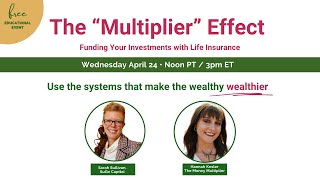
Webinar (YouTube) by The Money Multiplier (Hannah, hosted by Sarah Sullivan) teaching the "infinite banking" concept: use a participating whole life (cash-value) life insurance policy as an internal bank — fund the policy, borrow against its cash value to invest externally, pay policy loan interest, and keep both policy growth (tax-advantaged) and investment returns. Core numeric example: deposit $125,000 year‑1 (comprised of a large initial deposit plus premium), take a $100,000 policy loan to invest that earns 30% annualized, pay 5% loan interest, and repeat annual premium contributions ($12,000 early years, later smaller premiums) to illustrate year-by-year cash growth and long-term (15-year) outcomes. The presenter emphasizes tax-advantaged growth, death benefit, creditor protection in many states, and intergenerational wealth retention. Slides, replay, and contact info (Hannah and Brent at themoneymultiplier.com) are provided for follow-up.
Questions this video answers
$125,000
$100,000
30% annualized
5% simple annual interest
$12,000 per year
Chapters
Really what I want you to pay attention to is this bottom left hand chart right here. This chart. And I know you see a boatload of numbers, but I'm going to keep it super easy. The only two columns I want you to look at is this annual premium and this cash growth year by year column. So annual premium and cash growth year by year. So let's just take it year by year. Let's look at year one. Year one, you put $125,000 into this policy, you put in 125 and immediately. What's my definition of immediately? Within 30 days, I have 114 and some change that I can use from this policy. 114. So let's look to see what's happening. Year one, year one, I put in 113,000 as my dump in and 12,000 of premium. Now for my analyticals on the call, I'm not going to get deep into the engineering behind the policy. So again, go to my podcast show for some resources or maybe I'll take some questions and answers after this. But if you add up the 113 plus the 12, this is what gets us to 125,000 that we're depositing into the policy the first year. So I put in 125,000 and then what I'm going to do is I'm going to take out $100,000 to go make this investment with Sugo Capital. Now, this investment, this is going to give me a 30% return annualized, and I'm going to get paid out monthly. So if I go here and I take out this $100,000 loan from my policy, I'm going to go and give it to my investment. Now, reminder, you took out only 100,000. You still have 14 and some change that you can use inside of the policy, cash value that's available, and you can use that money for whatever you want. So let's just see what happens over the course of these 12 months. So my capital that's deployed in the investment is 100,000, and if I earn 30%, that's $30,000 that I earned for the year. But I really didn't earn $30,000 because, reminder, I took a loan from my policy to go and buy this investment. The insurance company charges me 5% simple annual interest to use their money. So 5% of 100,000 is $5,000. So what I'm going to do is I'm going to take my gains of the 30,000 and of that I'm going to subtract 5% and I'm going to go and pay my loan interest to the insurance company. So my net profits for year one is 25,000. So I have 25,000 end of year one, month 12, plus my 14,000 that's left over in the policy as cash available for a total of 39,000. In some change is my overall growth that year. Year one following. I'm going to keep going because it's going to make more sense as I keep going. What I could do is I could say, sarah, you know, I think I'm done with this. That 30% was great. Give me my a hundred thousand dollars back and she could do it. Then at the end of it all, you'd have 139,000 as liquid cash. So you can go do whatever you want with. But me and my investor mindset, I like cash flow. And if something's working out, I'm going to keep giving that individual that money over and over again because money's made in the motion of it. Money doesn't just get made with sitting somewhere rotten and compounding you, your four 1Ks, IRA people, right? Isn't it just crazy and ridiculous what we're taught to do with money? You would never go out and go purchase a house and then wait until your age 59 and a half to go move into that house, would you? So why on earth are we leaving money inside of these qualified accounts where we cannot touch that money until age 59 and a half just to avoid the 10% pay penalty and then we're kicking the can down the street on the taxes we got to pay on that money. Sorry, I went off on a little tangent. That wasn't a part of my script, but you get where I'm coming from. So this investment went Great. I got 30% interest year one. I want to do it again. So year two rolls around. Year two, what I'm going to do is I'm going to put money inside of my policy again. But in year two, I'm going to only put in $12,000. Now, Hannah, that's stupid. Why would I put $12,000 into this whole life policy? That's a payment, right? No. Reminder, these are your deposits. Here's the correlation I want you to make. The policy is nothing more than just your glorified savings account. This is just your savings account is the policy. It's nothing more than that. And what I want you to do is I want you to pay yourself first. I know you've all heard that before, but do you actually do it. No. Are you worth $1,000 a month or 12,000 a year to pay yourself first and save up that money? I hope the answer is yes. I teach my folks that we should be saving at least 10% of our income. And the money that we're saving, the. That's the dollars that should start flowing through the policy. So what we're going to do in year two is we're going to put $12,000 into that policy. So year two, right here, I put in my 12,000, and in year two, my cash grows by 13,000 in some change. Now, I'm not a math genius, but I know if I put 12 bucks into something and I immediately get out $13, that's 100% plus return on my money just that year. I'd be doing that all day long if it was me. So I put in my 12, and my cash grows by 13,000 and some change. And that's just what's happening in the policy alone. Not talking about what you're doing with the money outside the policy and your investments that you're into. Oh, and on top of that, is that taxable growth or tax free growth? That's tax free growth. So year two, I put in my $12,000 and I have outstanding my $100,000 of my loan principal. That's what I'm going to go put into this investment again. Leftover, remaining inside of my policy that I can use for whatever I want after I fund my 100 grand investment is 28,000 and some change. So let's see what happens over the course of year two. At the end of year two, month 24, okay, I have 100,000 that's deployed out in the investment. I make 30% on it. 30 grand. But remember, I really didn't make 30 grand. I got to take into consideration the 5% interest that the insurance companies charge me. So I take the gains, my 30,000, minus the 5,000 for another 25,000 as my net profits for year two. So overall, year one plus year two, I have a total of 50,000 that I gained over the course of those 24 months. So I have my 50 plus the 28 that's in my policy for a total of $78,000 is my true cash increase by year two. If I wanted to, I could take out the investment money, that principle of the 100,000, and I'd have a total of 178 back inside of my pockets that I could do XYZ with. But I like this. Let's go another Year I like this. I like earning my 30%. It's easy. It cash flows. It's mailbox money. Let's do it again. Year three, I put in another $12,000 into my policy. 12,000 goes in in year three and immediately my cash grows by 13,9 more than last year. Do you remember why? Is because we have uninterrupted compounding interest that's happening inside the policy. I don't want to sound cheesy on y', all, but have you heard of the gentleman named Albert Einstein? Albert Einstein says compound interest is the eighth wonder of the world. Those who understand it earn it and those who don't pay it. What do you think we've been doing all these years? Paying out that interest to the government, others, banking institutions. Now that I understand this stuff and what the elite and wealthy are doing, I'm just going to play the game right along there with them. So year three, I put in my 12 and my cash grows by 13,9. So year three, I put in my 12, I still have my 100,000 that's invested with the Steady Eddy Forex fund. So leftover Beginning of year three, I got 42,000 as cash value in the policy that I could use for whatever I want. Oh, but get this, y', all, I didn't even talk about this. You know what else you have? You have a 1.6 million dollar death benefit. God forbid that I go out and I get hit by a bus. In that third year, you know what? My family receives 1.6 million of tax free lump sum money that gets paid out to them. But I digress. We're not even going to talk about that. So at the end of year three, month 36, what happened? I have 100,000 that's deployed into that investment and I made another 30%. So 30% of 100,000 is 30 grand. But again, I didn't really make 30,000 because I got to take into consideration the loan interest that I paid to the insurance company. So 30 minus the 5, I got another 25,000 as my net profits year three. So over the course of these 36 months, I've earned 75,000 from this investment. I have my 75 plus the 42 for a total of $117,000 is my true gross or net gross, I should say, in the policy at by the end of year three, if I wanted to, I could cash out. Say, Sarah, this has been fun. I think I'm ready to go. And then you would have a total of 217,000. I think you're getting it now. So let's fast forward, let's go to year 15, because I'm telling you right now, this concept, the infinite banking concept, and becoming your own banker, this is not a get rich quick kind of deal. This is not for somebody who's going to start this concept and then stop it after five years. I'm telling you right now, no, this is a financial change that you are making in your financial life. And we're doing this for your entire whole life. Ooh, I just got a little punny there, didn't I? So year 15, I'm putting in 6,000 into that policy. Wait, Hannah, I thought I was only. I thought I was doing 12,000 a year. Why am I only doing 6,000 a year now? I'm not going to talk about that right now. But just FYI, as the policy gets aged and seasoned and matured, that premium is going to drop later on down the road. So by year 15, we're only paying 500amonth or 6,000 a year inside of this policy. Well, look right here. Year 15, you put in $6,000 inside of that policy. Your cash value grew by 20,000 and some change, y'. All. That's over a third 300% return on your money just in year 15 alone. That's tax free money that's growing for you and your family. And that's only what's happening inside of the policy, not talking about what you're doing outside of the policy with it. So you put in your 6,000 as your premium deposit into the policy. You still have that 100,000 loaned out to the forex trading fund, and you still have 257,000 as cash that's available in the policy. They can use for whatever you want. Maybe we got to pay taxes. I know y' all got to pay taxes. We just had april 15th not too long ago. Or maybe you like to take vacations. Or maybe you want to enroll the. The boys and girls into Boy Scouts and girl Scouts, want them to do extracurricular activities like soccer and piano lessons. I mean, crap costs money, right? So I can go and use this257 for whatever I want for myself in my life. So let's see what happened at the end of year 15. I have my 100,000 that's invested, and I earned another 30% interest, so I got another 30,000. But I really didn't get 30,000 because I got to pay that 5% interest to the insurance company. Something to note on this. I'm not A CPA or tax professional. So go talk to your tax guys. But if this loan is used for a business expense, can't that interest be counted as a tax deduction? Ooh, that just got really cool, did it not? Go talk to your CPA. I do not give financial advice. So this 5% that I paid to the insurance company, I earned 30,000. But I gotta pay my 5% interest. $5,000. So my total net profits by the end of year 15 is another 25,000. So over the course of these 15 years, we've accumulated 375 as our growth from the investment. Plus I got my 257 that's sitting as cash value in the policy for a total of $632,000 as my true liquid cash that I can go and use for whatever I please. Let's say at the end of it, I say, Sarah, I think I'm done. I think I'm good now. I've been doing this for 15 years. Maybe I want to retire. I just want to cash out. I want to retire. I want to go move to remote island and just live my life living out on the grid, right? So let's see what happened over the course of these 15 years. What did we really do is our true total net injection into the policy. And you can see right here, do you see where it says cumulative cash injection? Well, in year 15 we put in a total of $257,000 into this. And you have 732 that's sitting here as cash that's liquid that you can do whatever you want with it. We're not, we don't got to pay the taxes on it. I don't have to go and pay that money back to the policy if I choose not to. And I'll talk about more details on that here in a second. But I put in a total of 257,000 into this policy is my true net injection. And I'm sitting here with $732,000,000 as cash that I could use for whatever I want. This is what I'm talking about. That banking is a process. It's not a product. Banking is a process and how we're using the money within our own family banking system. It's the and asset. Because y', all, I'm not going to take my money and say, hey, I'm going to go and do this forex trading fund or go put my money into the policy. No, it's the and asset. I'm to run my money through the policy first and then I'm going to go and invest the money because now I'm double dipping on the dollar. I'm making money in two places always and forever inside of my policy. And I'm making money over here in the investment deal that I'm doing. So now just real quick, let's see what happened if I just use cash for this. If I just went and I withdrew the money from my checking or savings account and I just went and paid cash for this. And I just want to pay attention to year 15 right here. Year 15. So, and this is pretty easy math, right? If I put in $100,000 into an investment and I earn 30% or $30,000 every single year. So 30,000 times 15 is $450,000. Do you agree on my math there? 30,000 times 15 is $450000. So I've earned 450,000 from my pot or excuse me, from this investment that I'm doing. And I'm making an apples to apples analysis here because I got to take into consideration my cash injections that I'm putting into my savings or checking account over these 15. So 450,000 plus my net injection of 257 gets me to 707, $707,000 if I just went and I paid cash for this investment. So okay, it's sitting there inside of my savings account. I have 707, which is cool, it's still liquid money to me. But I got to get a 1099 on that money. That's going to be taxable growth inside of that savings account. I also don't have a death benefit, you know, because it's not an if we die, it's a when we die pass or graduate. I like to use the word graduate, but you can use whatever word you want to use. It's not an if, it's a win. There's no death benefit here, so my family's not going to get that paid out. And would you rather have this 707 or the 732 plus your death benefit plus it's protected? I didn't even talk about that a lot. You go out, you get that lawsuit against you. You bet your butt they're going to come after the 707 that's sitting inside of your bank account or your savings account at the local bank. They cannot touch this money that's sitting inside of your policy. So which one do you want again? It's the and asset. It's not the either or. So I'M just going to fast forward because we got, I got more examples in Sarah, Cynthia, you guys have these presentation slides where folks can go in and really dissect the numbers because there's different studies here. You know, Sarah's got her other apartment cash flow. It's the same thing. It's just that 10% and not 30%. But the process of using the policy is exactly the same, along with paying cash for it. And then also she's got her equity growth investment. And that's another thing of how you can use the policy versus just paying cash for it and the differences there. So, y', all, I'm not reinventing the wheel. You guys have heard of the gentleman, Robert Kiyosaki, right? He is the, he's really famous for his book Rich Dad, Poor Dad. But he also has this other book called Second Chance. And in that book, Second Chance, Robert Kiyosaki talks about this concept. I bet y' all have read it, but you read right through it and didn't think a second thing of it because it's never been explained to you this way. Or how about Tony Robbins, Money Master the game, chapter 5.4 of that book, Tony Robbins talks about this concept, but again, it's never been laid out to you in this manner. Or I'm not going to even shout out Larry Steinhaus, he's got a book called money hacks. Chapter 13 in that book talks about this concept. And I think this is a brilliant title. I honestly love it. He says, because everything you think you know about money is wrong. And I kind of agree with him. I love it, Larry. So, y', all, you're probably thinking, well, hey, you know, I hear what you're saying, Hannah, but. And this stuff is really, really powerful. But why haven't I heard about this before? Well, here's some real life examples. Here's an article that was posted on November 16, 2016. And I remember this because actually dad and I were over in Denver, Colorado, and we're going to get up on stage and teach on this concept. And this article came up and it said, cash value life insurance makes Harboro college football's top paid coach, y'. All. The University of Michigan is using this stuff. How about Disneyland? Walt Disney wanted to start Disneyland, but after failing in the pursuits of traditional means of financing, meaning that Walt walked into a bank and he and that he told the bank teller, hey, Mr. Banker, I got this brilliant idea. It's called Mickey Mouse and Donald Duck, will you give me a loan? They laughed in his face. And said no. So you know what Walt had to do? He had to provide his own means of financing. And a large portion of this came from collaterally borrowing money from his cash value life insurance. Who knows if Walt didn't even have those policies, if this, if Disneyland would even be here. What about Ray Kroc with McDonald's? Ray Kroc partnered with McDonald's brothers and opened their first McDonald's in 1955. Croc did not take salary for the first eight years. And to help with cash flow, he borrowed from his two cash value life insurance policies to cover for the salaries of the key employees and then to also fund for the advertising campaign that we know of as Ronald McDonald. And speaking of, I haven't seen Ronald McDonald around recently. I don't know what he's up to. So if you see him, tell him I said hi. But I know I showed this just for investments because that's the purpose of really what Sarah and I were coming here to show y' all today. But it's anything in everything. I mean, I'm calling y' all right now for my condo over here in Daytona Beach, Florida that I just been purchased back in January using my policy cash values. Me at 24 years old trying to go down to the bank and say, hey banker, give me a loan for a million dollars. I want this condo. They would have freaking laughed in my face, don't you think? How about this? The pampered chef. Using $3,000 she borrowed from her life insurance policy, Doris Christopher started the Pampered Chef in her suburban Chicago home. The company had grown into a 700 million dollar operation that then was acquired by Warren Buffett for $1.5 billion billion with the B. I mean, how impressive is that story? Now everything that I've told you has been fact up to this point. Now this is just my opinion. Now, now that you know this, everybody should be doing it. Because if you don't, you're stealing from yourself, your spouse, your children, and future generations to come because you're letting the money leave the family. With this concept, we're able to keep the money in the family and not have others suck it out of US government, others banks. Right? So I know you guys know the name Warren Buffett. And here's what Warren Buffett said. If poor people would just start doing what rich people do, they wouldn't be poor anymore. How much freaking sense does that make y'?
All?
I'm not gonna reinvent the wheel. I really don't know when Warren Buffett Said this, but I remember my dad bringing it around the kitchen table back in 2008. But oh my gosh, all I'm gonna do is just mimic and imitate what the elite and the wealthy are doing. If you really think about elite families that are out here in America, the Rothschilds, the Morgan's, the Stanley's, the Barclays, I mean, all of them understood money and they understood how to keep it within the family and they talk about money. If you got nothing else from this call right now, let me just tell you one thing. Y' all need to start bringing money around the kitchen table and you need to start bringing it around the family and start talking about money. Because I know money can be such a taboo subject to folks, but you really need to start talking about it and everybody being on the same page. We all don't gotta agree with everything that we're doing out there, but we need to understand money and how it works because it's just a tool, it's just a resource to be able to take back our time and financial freedom. So only one or two things is going to happen to us, where they're going to live or we're going to die. I like to say graduate, but if we live, are we better off with or without this concept? Hopefully I showed you with. And if we die, pass or graduate, our beneficiaries better off with the without this concept. Because y', all, there's a death benefit on the policy whether you like it or not. And how about policies are exempt from judgments and liens in most states. I told you I was going to tell you this quick little story. You know O.J. simpson. O.J. simpson was found not guilty in the criminal trial, but he was found guilty in the civil trial for the Goldman family for killing the Goldman boy. Do you think the Goldman family ever got any money? No, because where was OJ's money inside of his life insurance policies? How about the internal values of the policy grow tax free so the government's completely out of our hair because here's what I want to do. I want to pay tax on my money one time, one time only, at the lowest rate possible, and then get that money to a tax free environment where now it's growing tax free for us, totally opposite to what we've been taught by putting money into qualified accounts. And how about loans never have to be paid back on my example that I showed you, I never showed you paying back that $100,000 loan that we've taken out. We just simply only paid the annual loan interest, which I encourage you to do. Do you even have to pay the loan interest? No, but I encourage you to do, because if you don't pay the loan interest, they're just going to deduct it from future cash values anyways. But the principles of the loans never have to be paid back. Like when I call up to the insurance company, I mean, crap, I'm sitting here right now. I just got a check in the mail from one of my life insurance policies, and I'm going to go put that to work in an investment for me. But when I call up to the insurance company and I say, hey, I want to take out this loan, they never ask me what I'm using the money for, when I'm going to pay it back, or how I'm going to pay it back, because they just don't care. They know that at the end of it all, I'm guaranteed to graduate. So at that time of my passing, any outstanding loans would just get subtracted from my death benefit alone is nothing more than a prepayment of my death benefit. And I'm just using my death benefit money today. Now, this might not be the only reason we're doing this, but maybe one of the reasons why we want to do this.
I want to be a billionaire so freaking bad. Buy all of the things I never had.
All right, hey, just reminder, y' all, send me an email. Hannah, @themoneymultiplier.com I'll send you a copy of this ebook. You can also even reach out to my father directly if you want. His email is just Brent B R e n t Brent themoneymultiplier.com he can send you a copy of this ebook. And I mean, if this is just something that you want to talk about, you have my contact info right there on the screen. That's my cell phone number. I only got one phone number. And you can scan the QR code. It will take you back through the entire presentation. Because like I mentioned, I did something a little different here for this webinar today. So I would recommend going back and re watching the entire presentation so you can scan the QR code. You can see it right there at the bottom. The money multiplier.com forward slash presentation. And then you got my calendar, you got the team's calendar right there on the screen as well. But I think I'm done. I appreciate everybody's time and hopefully we learn something new today.
That was awesome, Hannah. Thank you. Awesome energy, awesome examples. Yeah. Do you have a Few more minutes. I was trying to man the chat and Q A and all that, and there was one that kept coming up that was not something I could answer.
I'm here. Yeah.
People were asking about age. Like, what is the. I'm 68. Am I too old? I'm 58. Am I too old? Is there a certain age where it's like, yeah, this is not really the best strategy for you?
No, no, good question. And I did. I wanted to touch on that too, because. So, no, age does not matter when we're talking about this concept. Age only affects our death benefits. And here's what I mean by that. I'm just gonna, I'm just gonna share a quick little example. I'll even say this. I'm gonna, I'm gonna say this comment too. My oldest client, he's 79 years old. He got approved for his policy and he's using this concept within himself in his life. So if I have this $20 bill here, all right, I have $20 bill in my pocket. And let's say that I have three individuals, age 20, 40 and 60. I have this $20 bill and I walk into the grocery store, who's going to be able to buy the most amount of groceries with their $20? All of them, right? Doesn't matter how good you look, how bad you smell, color of your skin, the language that you speak. I mean, the same $20 is going same amount of groceries. But if I walk across the street to the life insurance store, that life insurance store, If I have $20, age 20, 40 and 60, all in the same equal health, who's going to be able to buy the most amount of death benefit with the $20? The younger one. That just makes sense. So age only affects the death benefit. It does not affect the cash that's inside of that policy. And I'll just even exp one more because some people are probably thinking, well, Hannah, yeah, okay, I could probably do this. And I know I can do it on my age. Let's just say I'm 60 years old, but I have some health concerns. I got pre existing conditions and different things like that. Well, what you can do, because actually my brother, he's my older brother, I think he's what, like 38 now? I don't know. Don't tell him I forgot his age. But he actually had. He was on dialysis for a long, long time. No insurance company will touch him right now because of that medical history. So if you have some medical concerns going on, what my brother does is he goes and he puts policies on people he has an invested interest in. So he has one on my sister in law, my niece, my nephew, his children. He owns the policies, he's able to control it, use the policy. And it's just that death benefit is on that other individual. So if you have health concerns. I know, I get that question a lot too.
Yeah, that was in there a lot. So thanks for addressing that one. I see a bunch of people saying, hey, you know there is an example with a high cash on cash return. We didn't really dig into some other syndication, real estate type examples. The, the presentation, I believe you said Hannah, that you would. The, the slides are shareable. So you guys, when we send out everyone's asking, is there a recording? Yes, there's a recording. So we'll send out the recording with a link to this and then we will also send a link to the slides. So the slides that Hannah skipped over that kind of went into depth. You can take her example when she went through Steady Eddie and how she showed like where to look and what each column and everything meant. And then you can look at the other two examples and see how the math worked out for those. And a lot of people are asking wait, how can I find those? So on our website, sugocapital.com backslash open. That's where we have whatever current opportunities we have. And so it's, they're just examples that Hannah was showing. They're not like, oh, you can go invest in that today. But you can always go to their very typical examples of what we offer though. So you can always go to sugocapital.com backslash open and Cynthia, let's make sure to put that link in the replay email as well so people can keep an eye. And like I, I see Brent answering some questions about hey, we design policies that are based on people's goals. And so I think that's great and that's the same thing with our investments is you know, maybe the 30 cash flow is not ideal for you. Maybe the equity building real estate investment is right for you. So we do have a range and it's a pretty big range of what we offer. And, and so you can keep an eye on that. And then also I have your email now, so you're going to get emails from me about the future offerings.
Hey Sarah, can I just say one thing because actually I am a little embarrassed to admit this. I know I get hung up a lot and like just giving out the content and the education and when I get Done. Even speaking live, people are like, hannah, this is so cool. Who do I go to to get one of these policies? And I'm over here, R.A. like, me. Pick me. So just so y' all are aware and clear, so. So at the Money Multiplier, this is all that we do. We're 100% the infinite banking concept. We help our folks obtain the policy, designing it properly for their needs, their goals of what's going on. And then even after that policy goes active, that's where my mapping and the implementation team step in. But that'll make more sense when you see that foundational presentation of what I'm talking about, the mapping team. But just so people are aware, this is what we do over here at the Money Multiplier.
And I'll add to that. You know, Hannah was saying that Brent or father spoke in February at an event. And so we had a lot of Sugo Capital clients and investors who went and, you know, did a consultation and are choosing to move forward. And they had really, really good things to say. You guys can see in the webinar chat, it has been blowing up with great things to say about Hannah, Brent and their extended team. So, you know, we don't invite people back to speak to our community who we hear bad things about. You know, everyone's like, why did you have that person on? We talk to them and like, you know, any negative feedback we get, we don't work with that speaker again or that company again. But we heard great things from our folks, so that's why we invited the Money Multiplier back. So I want to make that really clear to all you guys who came from the, the Sugo invitation list, that your peers had really good experiences with them.
That was good to hear, too, Sarah, because normally what I say, I don't want to hear all the good feedback. I want to hear all the negative crap that we got to fix. So tell me the negative.
I don't have any negative for you, but if I do get some, I'll let you know.
Thank you. Thanks for the time today. And I, I, I'm sorry I went just a little bit over, but you're absolutely right. I know. I, I do have the charts for those other investments, too. I just hopefully I went through that one, so you can kind of see the gist of. All right, these are the columns. This is why and where we're looking. And then it's the same thing. It's just a different investment. Right? We're just plugging in the different investment with A different return.
Exactly. Exactly. Well, I think it would be great to go ahead and wrap, and you guys know that we're going to send the replay and all the ways to get in touch with us, so we couldn't possibly answer. I think in the chat I saw there were, like, 87 chats that I had it. I was like, well, I'm not even going to try to answer all those questions, but you have our contact. You can get in touch with Hannah, you can get in touch with me on the replay email that comes out. It'll have our contact information on it as well. And so we encourage you to continue to work with us, to continue to learn. And. And I will say I'm really impressed with the audience today. You guys were so interactive and also really interactive in a way that you were helping each other. So people would ask, like, oh, how would you do? You know, Iowa, how would you do this? And other people were answering, and people are asking about, what's an accredited investor? And other people were answering. So that's such a huge help when you guys do that for each other. And I encourage you when you're on other events to do that as well. It makes it a richer experience for everyone involved. Hannah, thank you so much. That was awesome. I appreciate that you plugged in our stuff and into your examples, and it was great to see, like, here's how the numbers actually work for everybody.
Yep. No, and I appreciate the opportunity. And we'll. We'll. We'll coordinate, too. I'm always here to help and serve you and whatever you need in the community. And just so you know, my father and I, we're looking into some of the stuff that you're doing as well. So we're going to be talking on a personal level.
Oh, awesome. Cool. Well, happy to help. Cool.
Thanks, everybody.
More from Sarah




Multifamily Real Estate Investment Webinar: The Park at Ashford - Full Presentation & Q&A

Who Are You Investing With? Mastering Due Diligence for People, Markets, and Properties

Who Are You Investing With? Mastering Due Diligence for People, Markets, and Properties