The Proven Webinar Framework That Actually Converts (Medicare, Retirement, Life Insurance, Estate)
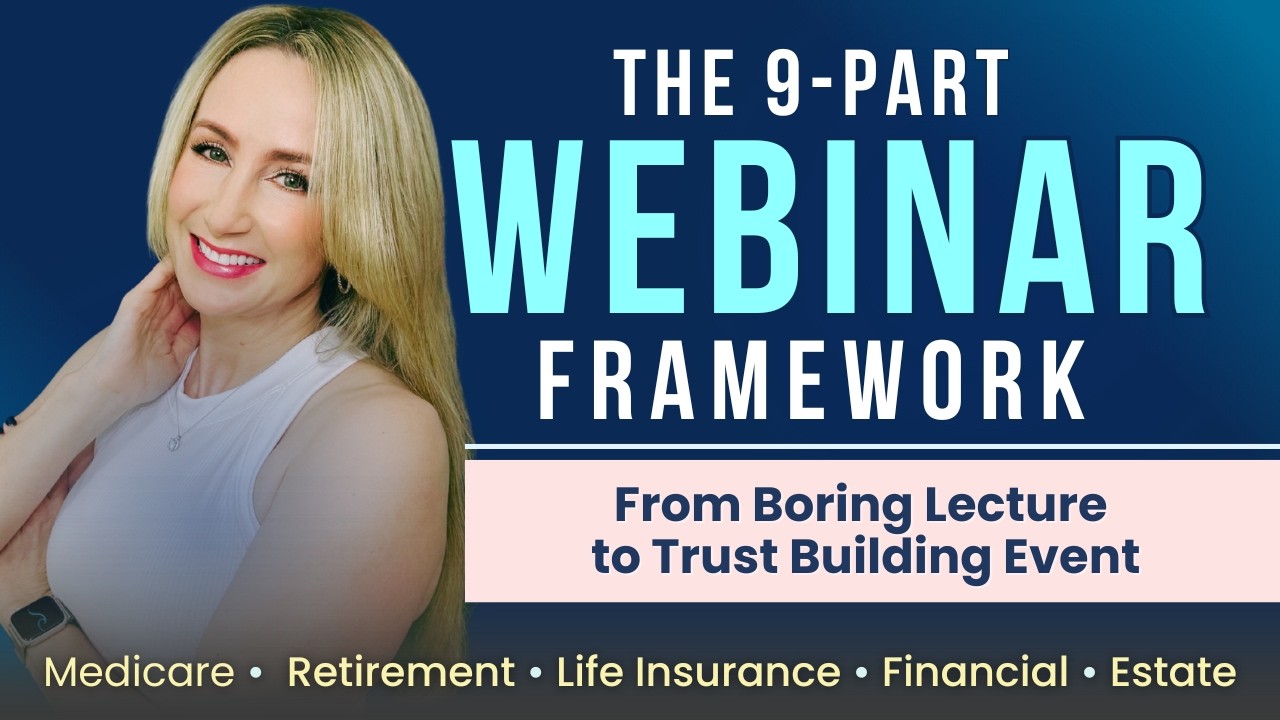
In this video Shauna Thoresen, founder of Social Waves Media, presents a detailed 9‑part framework designed to turn educational webinars for licensed professionals (Medicare agents, insurance agents, estate planning attorneys, financial advisors, real‑estate pros, etc.) into high‑converting sales machines. She begins by exposing the unethical lead‑vendor ecosystem and stresses the importance of owning one’s own marketing data. She then walks through each element of the webinar: 1) Hook – a compelling opening that promises a concrete benefit; 2) Intro – a brief, audience‑focused credibility statement; 3) Tension – a reminder of the stakes and pain if the information isn’t applied; 4) Value – concise, mindset‑shifting education that avoids information overload; 5) Transition – a bridge that presents the audience with clear options; 6) Pitch – a clear description of the service offering, using price anchoring; 7) Testimonials – social proof to reinforce credibility; 8) FAQ – pre‑emptive answers to common objections; 9) Closing – a strong, specific call‑to‑action with next‑step instructions. Throughout she provides industry‑specific script examples, slide‑design tips, and a downloadable guide. The overarching message is that the topic may be “boring,” but the delivery, structure, and ownership of the funnel determine conversion, and applying this framework can generate seven‑figure revenue.
Chapters
If you're a licensed professional that is offering educational webinars or seminars, or you're considering adding that to your marketing plan in the future, this is for you. You see, many licensed professionals lose 80 to 90% of their webinar attendees before they even get to share how to book services with them, and they have no idea why. In this video, I'm going to be breaking down my 9-part webinar framework where I'm going to share with you how you can transform those boring presentations into compelling experiences where individuals walk away viewing you as an advisor and actually book appointments or services with you. Now, if you're hosting a Medicare 101 seminar, an estate planning workshop, a financial planning webinar, or even a seminar about real estate or any other educational webinar, and you're wondering why people aren't converting, or you want to know how to get those conversions from the very beginning, I'm going to share with you exactly how to execute this 9-part framework. Now, not only have I consulted with many different licensed professionals and helped them increase conversions in their webinars. I myself apply this 9-part framework to my own webinar that's converted over 7 figures in revenue, and I'm gonna break that exactly down with you right now. In case we haven't met yet, my name is Shauna. I am the founder of Social Waves Media, and I've been specializing in lead generation and optimizing the customer journey since 2016. And as I have started working closely with insurance agents and other licensed licensed professionals, there is one thing that has become abundantly clear to me, and that is how unethical this space is. And I'm talking about how unethical it is for you, the agent, or you, the licensed professional. There are so many different slimy lead vendor companies out there. There are so many marketers that overpromise and underdeliver. There are so many of these done-for-you systems where we'll set up a whole system for you. It's a personal brand funnel, or it's a webinar funnel, or whatever it is, where if you end up walking away from that company, you don't actually own any of the data or even understand how that system worked. And I am on a mission to give the power back to you because I truly believe that when you own your marketing, you own your growth. Webinars or seminars can be one of the most impactful elements in your overall marketing plan. When executed properly, you are able to very quickly build trust. You're able to very quickly move prospects into becoming clients, and it can be one of the highest revenue contributors that you have whenever you look at your overall marketing efforts, but they must be executed properly. And the stakes are a lot higher whenever it comes to a webinar. There's a lot more time, money, and energy that you have to actually put into that versus something like just sending out a piece of direct mail or just sending out an email campaign. And the reality is the stakes aren't just high for you as a professional, they're high for the attendee. They are risking that they are not wasting their time by going to spend it with you talking about a topic that, let's be honest, is probably not the most exciting topic. Now, I hate to break it to you, you probably already realize this, but the reality is when we're talking about in the licensed professional space, the topics are not the most exciting thing ever, right? Not many people wake up on a Saturday morning and are like, I'm so excited to go talk about if I need a will or if I need a trust. They're not excited about talking about long-term care or retirement planning or learning all the different parts of Medicare. But while the topic is boring, the pain that they feel is real. The benefit that you provide is real. These people want to know that they're making the right decision. They want to feel supported. They want to feel secure. So the reality is the pain that you are solving and the benefit that you're providing is extremely real. But when you structure your webinar or a seminar like a boring educational lecture, you teach them to tune out and it doesn't actually establish that relationship. But the good news is there is a 9-part webinar framework that I am going to share with you. So let's jump right in. Let's dive into the 9 essential elements of a webinar that converts. Now, the very first 4 happen pretty closely next to each other. So let's kind of look at them all together. So we've got part 1, the hook, part 2, intro, part 3, tension, And part 4 is value. Now you probably didn't even notice this, but I actually executed all 3 of those steps in this video right here, right? So I started my video with the hook. The hook is the opening line and it's the first words that come out of your mouth and the first words that you have to say and the message that you have to deliver to people that have attended is way more critical than most professionals even realize. Most of these webinars, whether it's estate planning or it's Medicaid planning or it's long-term care or annuities or Medicare, most of them start like this. Hi everyone. All right, we're going to go ahead and we're going to get started. I'm very happy that everyone is here today. We're going to talk about some really important and some exciting things. We're really excited that you're here. So we're probably, we're going to get started right now. And yeah, here we go. No. The very first words that you say need to grab their attention and need to reassure them that they are not wasting their time showing up on a Saturday or a Wednesday or whatever it is to hang out with you. We've already established that the topics for many of these presentations are boring, right? No one's wanting to like raise their hand and buy a ticket to go talk about these things, especially whenever it is their own time that they could be spending with their family or just doing something that's more fun. But the pain that they're feeling is real. The benefit you are providing is real. They want to be taken care of. They want to trust you. They are hoping that they are attending this and it is not a waste of their time, and that you are going to be someone that they are going to be able to trust. They're going to understand enough to make a really smart decision, and they're going to be able to move on with their life, right? So the very first lines that come out of your mouth— I'm so excited that everyone's here. No one's believing that. No, Start off by leading with what is important to them. Let them know what they're going to be walking away with. So for example, in this video, I started it by telling you exactly what was going to be in it so you can make a decision of if this was going to be a waste of your time or not. Let's look at some real examples whenever it comes to your industry. So let's talk about— so Medicare agents, you could start it off by saying, by the end of the next 45 minutes, you'll know the 3 Medicare enrollment mistakes that cost retirees an average of $2,847 per year and exactly Exactly how to avoid them. An estate planning attorney. Today, I'm going to show you the one estate planning gap that causes 67% of families to pay 40% more in taxes than they should, and it's completely preventable. If you're a financial advisor and we're talking specifically about annuities, in this session, you are going to discover why 73% of retirees run out of money by age 78 and the 3 strategies that guarantee your income lasts as long as you do. Okay. And by the way, If you are interested in the actual examples that I share, I have a very robust guide for you that breaks all of this down. It is very robust. I have the link in the description, so all you have to do is request it and I'll send it over to you. It's gonna have all of these examples, so you definitely wanna grab that. The very first words that come out of your mouth make the largest impact. When I am running my own webinar for Meta ads and I'm teaching insurance agents about Meta ads, and then I'm going to be offering them my program where they can learn from me how to break free from lead vendors, I start that off every single time by saying, I am so excited that you're here because today we are going to be focusing on Meta ads and you're going to walk away from here understanding why some work, some don't. You're going to see real examples and so on. I lead with that benefit from the very beginning, right? So thinking about what you have to say in the hook is super important. I want to pause really quickly and say, if you're enjoying this and you want to learn more about webinars, let me know in the comments. I have more future videos planned, and I want to make sure that you're interested in learning the entire webinar funnel, uh, how to create a pre-webinar email sequence, what to send after, even a landing page that converts, and then how to actually get traffic and eyeballs on your landing page so that way you can get more webinar registrants. So if that's something that you're interested in learning, or you have another specific question, Put it in the comments. I read every single one. Right after the hook, you roll into part two, the intro. And one of the biggest mistakes that I see agents or other licensed professionals make is they make the intro all about themselves. And I know what you're thinking. Well, it's my intro. Isn't it about me? Yeah, but the entire purpose of the intro—it's not to roll off your credentials or talk about your company, or we're so proud to have served this many people in this. This area and licensed in this many states for this many years and work with— no, that's, that's not going to actually do what the actual purpose is. The purpose is for you to establish yourself and show that you are qualified by making it about what you can do for them. So that is the biggest secret, is realizing your intro isn't about you, it's actually about them. So in doing that, you want to show them that you actually care about them. You want to show that you're trustworthy. And you want to show them that you are on a mission to help them either one, get rid of that yucky pain point, or 2, actually get the benefit that they are seeking from showing up to the actual webinar. They want to see how you've served other clients or some of the results that you've had. So here's kind of a guideline. Keep your intro under 2 minutes, right? No one wants to hear about you and all of the accomplishments that you've had. So you can have this happen very quickly by simply having a slide up that maybe shows some of the credentials and stuff, and then you can introduce yourself. So in this specific video, the way that I introduce myself, and I do in a lot of my videos, is I very briefly tell you that I've been in this industry since 2016. Okay, that automatically lets you know, okay, she, she might know what she's talking about. Oftentimes, um, I'll flash different videos of me speaking at different conferences or working with agents. You're like, okay, I see she's actually done some things. And then I tell you what my mission is. I tell you that my mission is for the marketing to go back in your hands. And that's either going to make you be like, yeah, I'm interested in learning more from this girl. Or you're like, nope, that's not for me. I'm not interested in it. So whenever you're actually sharing your intro, you wanna make sure that it is about how you're going to actually take care of the people. So here's a couple of examples that I have for intro. So a life insurance agent. I'm Sarah, and for the past 12 years, I've specialized in helping families protect their legacy without overpaying in coverage. Last year alone, my client saved an average of $1,800 annually While increasing their protection by 35%. And you could even say, I absolutely love working with my clients and it makes my heart so extremely happy. Okay, a real estate professional. I'm Mike, a real estate investor and broker here in whatever city. My mission is simple, to help people build wealth through real estate without typical barriers. I've helped over 200 families purchase their first investment property using strategies that require little to no money down, and I'm going to share that with you today. If you're a benefits broker, I'm Jennifer and I work exclusively with business owners who want to offer competitive benefits without breaking the bank. In the past 3 years, I've helped 85 companies reduce their benefit costs by an average of 22% while improving employee satisfaction scores. And then continue on. When I am doing my webinar, and I like to always give you like these examples and then ones that are kind of meta examples for you because you experience them with me. And typically whenever I am hosting a webinar for my insurance agents, I will start off by sharing a little bit about myself and I will either have a flash of all of the different industry leaders that I've been on their YouTube channels or spoken at their conferences show up, or I'll even have an intro before I actually start speaking at the webinar that shows that credibility. So I don't have to list things like I've been and done this since 2016. I've managed millions of dollars of ad spend. I've worked across numerous different industries. Now, when I first got into this, I actually did used to do that. I'd be like, I worked across numerous different industries such as long-term care, and I would list them. And after I was going back and looking at my webinar and kind of like the way that the attention span seemed to be, the chat interaction, or even the drop-off, I'm like, no, the intro always needs to be about you guys, the attendees. And the same thing happens whenever it comes to your webinar. Part 3 is tension, and this is one that a lot of— in all industries kind of roll over as they just kind of instantly try to move from the, my name is Shauna and I've been a Medicare agent for this long, and today we're going to talk about Medicare 101. So Part A is— and then they just like roll right into it. The tension is building the reminder of what is at stake. It's reminding them of the pain that they're experiencing or the thing that could happen if they don't get this information, um, or the benefit that you're about to bring whenever you talk about it. So this is not about bringing up fear or being like overly dramatic, but it is about helping them understand why they are there. And it's supposed to help their little ears perk up and want to hear the content that you have to say. Now, I myself in my own, Meta ads webinar that I have, I have an insurance agent that's a trainer at an IMO come in and he very briefly shares like the pain point that he had of of buying from lead vendors, how terrible they were, and then how after working with me and applying what I was going to share, it changed everything. And so that kind of is just a little bit reminder. In this video, I talked about how the stakes are higher whenever it comes to a webinar. So that way, it'd be like, look, this is actually. Important information because the reality is if you don't apply what I'm teaching to you, you could waste your time, your energy, and your money on a webinar that doesn't convert. So let's look at some examples here. And by the way, like I said, this guide is available for download. The link is down in the description. And if you hear me say any statistics or any numbers, I got those from either my friend Chatty G or from my friend Claude. Um, so don't necessarily, uh, they're saying that they're accurate, but of course you wanna make sure that you're saying numbers that are correct. Okay? So for attention, for a Medicare agent right now, so many people on Medicare are on the wrong plan and they don't even know it. They're either overpaying thousands per year or they're underinsured and they're just one health event away from a massive out-of-pocket cost. The enrollment window is only 7 weeks long, and most people don't realize the mistake until it's too late to change plans. An estate planning attorney. Without proper estate planning, your family could lose 40 to 50% of your wealth to taxes and legal fees. I've seen families be forced to sell family businesses or homes just to pay the estate tax bill. The worst part? These losses are all completely preventable with the right planning, but only if they act before they're too late. And today we're going to— we roll into value. If you're a tax planning professional, the average small business owner overpays in taxes by $7,000 to $15,000 every year simply because they don't know the deductions that they qualify for. This money is something that could be reinvested in your business save for retirement, or use to hire employees. Every year that passes without proper tax strategy, and it is money that you'll never get back. So it's reminding them of the stakes. Now, I just talked for quite a while about 3 events in your webinar that are literally going to be— the hook is going to be about a minute, your intro is going to be about 2 minutes, the tension is probably going to be about 45 seconds, and then we roll into the value. But those pieces are so extremely critical because they are the very first impression. They are what is going to actually either capture attention or lose attention. So it is worth actually spending some time, some energy of actually planning out what those pieces are going to be before you roll into part 4. And that brings us to part 4, the actual value. Now I have a slide for us to break this down because what it is, it's the educational content where you deliver on your promise and create mindset shifts. Shifts. This is where you teach, but not in the way most people think. How to execute: focus on bigger concepts and aha moments rather than drowning them in details. Your goal isn't to make them an expert, it's to shift their way of thinking. Common mistakes: information overload, using industry jargon, being too technical, using slides with too many words just like this one. Did you already scan the page and read this? Did you stop listening to me and did you zone That is my question of this slide. This right here is one of the biggest mistakes that I see so many agents and professionals make in their webinars is they jam their slides with not only too much information, but then they read the information word for word. And what makes this even worse is those that host these webinars that you don't even see their face. They just put slides up and read it to you in a monotone voice. Let me tell you, nothing says I am wasting my time right now than sitting through something like that. And the moment that I put the slides up, if you're actually watching this video and not just listening, or you heard me reading it, I'm gonna guess that your attention kind of started going all over the place. So we don't want to do that whenever it comes to the value that you're actually providing. Now, when you're actually teaching the contents and the educational content, The people don't want to know all of the ins and outs of every single little part because annuities, IUL, even life insurance, even Medicare, these are all very complex topics. They don't want to know them all, right? I can't teach you Meta ads in 45 minutes and you probably know when you come to my webinar, I'm not going to teach you that. But what I am going to give you is the 3 very big steps. I call them the 3 keys to a high converting ad campaign and you're going to walk away understanding those concepts. And more than anything, you're gonna walk away having the confidence that— or you're not, but if you end up actually wanting to work with me or be a part of my future videos, you walk away from that going, okay, I have the confidence that this person, that Shauna, can actually teach me these concepts because she explained it to me in a way that I was able to understand. I liked her teaching style. I liked her character. I liked her personality. Hopefully. And that is often what's going to make the decision for an agent to enroll in my course. It's not that I give them as much information and dump it on them all at once. And on top of that, when you have these complex topics that you're talking about, you have a Q&A at the end. We haven't gotten there yet, but you should have a Q&A at the end where if you've sparked something that they have a more specific question, you're going to give them the opportunity to ask. So don't overcrowd your entire value part with things that are too detail-oriented, too much jargon that are confusing, and don't overpack your slides with all of the words that you're actually going to say. So let's talk about a couple of other examples. So IUL, annuities, those types of approaches. So first you talk about kind of like most people think retirement planning is just about saving enough money, but there's actually 3 critical components: accumulation, protection, and distribution. Today I am focusing on distribution because you can save $1 million and still run out of money if you withdraw it wrong. So let me show you the 3 distribution strategies that ensure your money lasts as long as you. Now obviously the webinar, you need to fulfill what the promise is, so you probably would have in the title of that webinar something like, um, the 3 distribution strategies that ensure your money lasts A long-term care specialist, you can talk about how Medicare doesn't actually pay for long-term care, and then you say the actual cost could be $108,000. There are 3 ways to fund this: self-insured, traditional LTC insurance, or a hybrid policy. Let me break this down so that they all make sense. If you're an estate planning attorney, you can share, today I'm going to show you how the 3-tier asset protection strategy that wealthy families used to preserve wealth across generations. And then you would have that listed in 3 different ways and you would organize your content so that they understand exactly where you're at in the presentation. So with me, I have the 3 keys to a high-converting ad campaign, and then I am going to start with one. They're going to see a slide with what that actual one is. We're going to dive into it and then we're always going to come back to that slide so they can see exactly where we're at in the presentation. And where all of the information that I have to share fits in. Now here's a little side note. When you are sharing the education, the biggest thing that you want to focus on is shifting their mindset, right? Whatever the barrier is of their mindset, you want to be able to shift that over. So for me, when I'm teaching agents, I want to shift their mindset into showing them lead vendors— it's actually not complicated. They are taking advantage of you. They are generating Medicare For $3 to $7, and they're selling them to you for $25 to like $35 to like sometimes even $40 if it's T65. So I wanna like show you, you can do this. Let me show you how simple it is, and I want you to be able to trust that I can actually teach you how to do that. So whatever it is that you are trying to take them from being right here, maybe they think that they have enough life insurance coverage because it's through their career, their job, but they showed up because they wanna make sure. Maybe they think that they have enough money in their 401, but you want to open their eyes to what the realities could be and help them make sense of if they should be looking at other plans. For people that are in Medicare, you want to shift their mindset and start planting that seed. Like, guys, this is not— a lot of people think that if they're in a plan, it's going to pay for long-term care, but it's actually not. And this is what it can cost families, and here's how we protect our assets, and here's all of the other options that you have. So pick a framework, focus on kind of the mindset, and keep it really nice and concise where the slides that you have are just contributing to the actual presentation that you are giving. This brings us to part 5, the transition. And this is where we are transitioning from the actual educational content that we just taught into actually pitching your service or how they can work with you. And this is kind of a little thing that gets missed a lot. It's literally the bridge where we go from— we just talked about all this mindset stuff, all of the educational stuff, we shared with you something that was important, and now we need to just gently take them over to where we're gonna actually present how to work with us. And in order to do that, you need to truly let them see what their options are so that way they can make the decision of if the option that they want to choose is to move forward talking to Now, an example in my webinar Meta Ads, I always showcase some real results that my course has generated from agents that have been executing the strategies inside of it. I say here, here are some actual results, and then I say if you want results that look like this, the reality is you have three choices. One, you can learn on your own, and I talk about kind of like the the issues with that. You don't know what's outdated. You don't know what's relevant for insurance. It's always changing and so on. 2, you could hire someone. I talk about what the cost is to hire someone that knows what they're doing, and I'm not talking about those that use the exact same generic ads for every single agent, doesn't have any branding, doesn't do anything for your business in the long run. I'm talking about an actual ads manager that knows what they're doing, and that's going to be about $2,000 to $2,500 a month starting. So that means that's a $30,000 overhead. Or 3, you could spend a little bit of time And money to learn from someone. And then I transition into what it looks like to work with me. So you can apply that exact same thing into your offering. So let's look at 2 examples right now. Um, let's look at one for Medicare. So you have 3 choices ahead of you. First, you can try to navigate this on your own. You can research all the plans, you can compare costs, and you can hope you're making the right decision. Second, you can do nothing and you can stay on your current plan. Or you could say, second, You could choose to work with, um, 1-800, uh, Medicare-type agent, but the problem with that is blah blah blah blah blah. How much are they going to actually care about you? Or 3, you could work with someone who does this every single day and can guide you on the right plan for your specific situation and is available to answer your questions. Then we flow into what it looks like to work with you, what their next steps would be. Okay, if you're a financial advisor, here's where you're at right You can continue managing your retirement strategy alone, and you can hope that your 401 is enough. Or you can put this off and deal with it later, but every year that you wait costs you loss in growth and tax savings. Or you could work with someone who specializes in retirement income planning and has helped hundreds of people retire confidently. If you want to work with me, it is, and then we move into the pitch. So it's literally like that little tugboat that just kind of brings them over to the other side. It doesn't last very long, but it's still a very impactful element. And now we are at part 6, the pitch, where you actually share exactly what your services are, what it looks like working with you, and what the next step is of them moving forward. Now, one thing I highly recommend whenever it comes to the pitch, no matter what it is that you're offering, is for you to utilize what's called a price Price anchor, right? So it is an anchor of them seeing a larger number first before you actually break down what the actual package is that it looks like working with you. Now, obviously, if it's Medicare and it's free to work with you, then you actually could show something of like, here's the cost of not being on the right plan. Highlight the fact that you really, really personally care that all of your clients are on the right plan, so you're going to be able to save them And of course, working with them costs nothing to them. Uh, but whenever it comes to something like estate planning, you could say something like, the average family pays $47,000 in unnecessary estate taxes and legal fees when someone passes without planning. Okay? So the potential cost, $47,000. Our complete estate planning package is $3,500, which includes trust creation, drafting the plan, blah, blah, blah, and all of the things that it's included. So So showing them that number of $47,000 before you actually show them, and we're being honest here, right? This is not— anyone that works with me knows I'm all about we need to have honesty and integrity in everything that we're doing. So we are opening their eyes to the reality of what the cost could be. If we're talking about long-term care, you could say how much the average long-term care is, which I think is $108,000 right now in today's world, and what the actual long-term care insurance insurance plan is. So having them see that price anchor can make a really big difference in them making the decision to move forward with you. That brings us to part 7, and this is something I don't want you to leave out of your webinar. I guess I don't want you to leave any of these parts out of your webinar, but this is something that is extremely impactful, and that is testimonials. That is showing some sort of social proof that you are actually the person that is going to be able to help them. Now, it could be actually talking numbers of showing some images or showing a video of someone saying how much it saved their family because they worked with you. But it could also just be about your character, that they enjoyed working with you, that you actually answered their questions, that you really are someone, um, that seems to care. When you're presenting testimonials, it gives them the opportunity to see themselves in whatever story or sentence or person that you're actually showing to them on the screen. Now, I personally like to share testimonials, and you can either have it be a short video— like in my webinar, I typically run it into a short little video of some industry leaders talking about, uh, the impact that I've made, what they've learned from me, or just, uh, the results they've seen their agents get from working through my course. But it could also just be some images that you have up, like here's a couple of clients that we've worked with. It's up behind you if it's a seminar, it's the screen if you're actually doing a webinar, and it's just some even little sentences of maybe how you actually help them or you supported them. And then I like to leave like kind of a screen up that has some testimonial quotes as I roll into part 8, which is the frequently asked question section. Now I do see a lot of people that are very scared to open the floor to having any type of actual live Q&A. This is truly your opportunity where people get to kind of see like how you are whenever you're not like all buttoned up and you're actually having conversations with them. So I feel it's extremely important to build trust, to be open to answering any and all questions. And if you don't get any questions, like let's say you have a tiny little show up, it's only 3 people or 5 people, but they're still there. And at the end, then you could say, well, here's a couple of questions that I get asked all of the time. And how about 3 ready to go. Um, they might branch off into more conversations, they might not, but at least have those ready to go of what the most commonly asked questions are. So that way that section is still there and they get to kind of see you in a more conversational tone and not quite so rehearsed. And that brings us to part 9, the closing remarks that you have to say. Now, what you need to do whenever you are closing out your webinar is give them very clear next steps. This is when you are truly emphasizing your CTA or your call to action, what you actually want them to do. So here's a couple of examples. Okay, so a Medicare agent could say, here's what's happening next. I have 12 consultation spots available this week. Click the link you see on the screen to schedule your free Medicare review. We'll spend 30 minutes going through your current coverage, medication, and doctors to find the best plan The enrollment deadline is December 7th. That's only 3 weeks away. After that date, you're locked into your plan your entire year. So I cannot wait to talk to you. Okay? If you're an estate planning attorney, if you're ready to protect your family assets, here's your next step. Click the link and schedule a complimentary estate planning review. We have 5 spots that are open this week. We are going to analyze your current situation and show you the exact gaps that exist and how we can help you. and so on. So this is where you give them very specific steps. You need to either give them a link, you need to have someone that is in there trying to actively schedule them, try to get them to take the action while they're actually there investing their time and energy on focusing on what you were talking about versus just waiting until afterwards or saying, just reach out, here's our phone number, here's how to call. Get them to actually take an action that moves them forward on the actual journey to becoming a client. And there you have it, the 9 essential elements of a high-converting webinar. Now, as a reminder, if you want that guide that breaks everything down with examples, that link is in the description. But the biggest takeaway is it's not you, it's not the topic that you're talking about, it's the way that you're presenting the topic. Even though the actual topic, Medicare 101, might not be the most exciting thing. What is important to the people that are attending is solving their pain point and you being able to showcase the benefit that you bring from working with them. Now, let me know in the comments if you are interested in more videos like these and what your biggest takeaway is. And never forget, you are capable, you are able, and you are worthy of achieving anything that you want in this life. Just take the next step and go get it. I'll see you in the next video. Bye.
More from Shauna

Medicare Ads: How Do I Target Seniors If We Can Not Target Age in Meta Special Ad?→ AEP Question 7



How do I increase the quality of my Insurance or Medicare lead?→ AEP Question 5




Insurance Ads: Can I upload a purchased email list so I can target age, income, zip code, etc?



How This Medicare Agent Went From Zero to Generating His Own Exclusive Leads for $6.26