A Transracial Adoptee's Insights On Peace & Identity
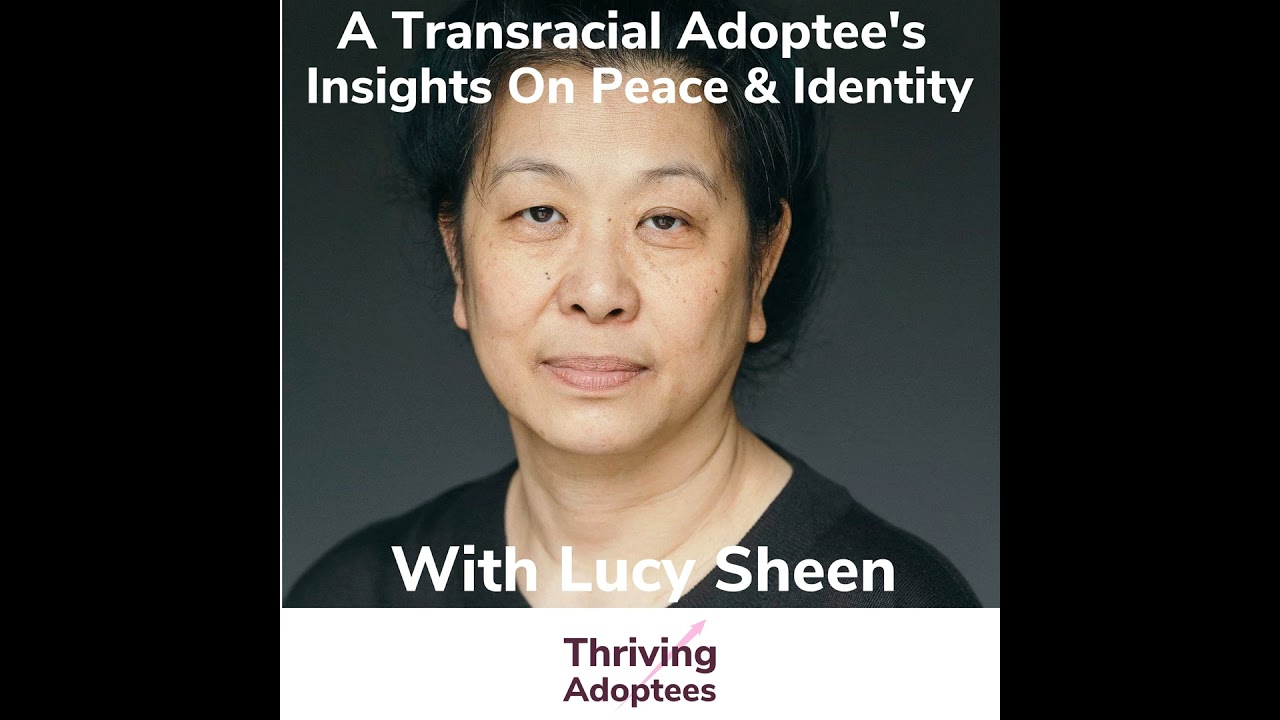
In this episode of the Thriving Adoptees Podcast, host Simon Benn interviews Lucy Sheen, a transracial adoptee who is also a classically trained actor, writer, and filmmaker. Lucy recounts her upbringing as a Chinese‑heritage child raised by white parents in post‑war England, describing how she first sensed being different, how visual difference compounded that feeling, and how societal treatment added another layer of otherness. She introduces the metaphor of "no man's land" to illustrate the cultural liminality she inhabited—caught between a white British environment and an Asian heritage she could not fully access. Over decades, Lucy moved from a childhood of confusion and yearning for a missing backstory to a later‑life acceptance of a composite identity, which she likens to a heterozygote, embracing both cultural halves without privileging one over the other. The conversation explores how peace and healing for transracial adoptees are less about uncovering lost histories and more about perceptual shifts—insight, patience, and allowing struggle—rather than active pursuit of answers. Lucy also reflects on broader cultural attitudes toward not‑knowing, the importance of mental‑health awareness for adult adoptees, and the idea that peace is an internal, "seeing" process rather than a concrete achievement.
Chapters
Hello everybody, welcome to another episode of the Thriving Adoptees Podcast. So today have we got a treat for you. Welcome to the show, Lucy Sheen.
Hi, thank you very much for having me.
Yeah, so Lucy is a transracial adoptee, um, and she is also— interesting combination— she's a classically trained actor, writer, and filmmaker. Um, but we're going to be kind of zeroing in on the, uh, the transracial adoptee part of how she sees herself. And this is— I was saying to Lucy before we hit record, I'm really looking forward to this because her take on this is really, really deep, very, very considered, incredibly articulate, incredibly bright. And I'm feeling that I'm going to be stretched by this conversation, and I like that. I like being stretched. But if, if I occasionally— there's occasionally a bit of radio silence, right? It's just me because I'm, I'm stretching, because as a white guy adopted by white parents, I don't have lived experience of this. And that's essentially what we're going to be exploring today. So I— because I don't have the lived experience, it's going to, it's going to stretch me to grow, to take in, to take in the sort of stuff that Lucy's going to going to be talking about. So really looking forward to it. Um, as I was talking to, um, another transracial adoptee yesterday, and it seemed to me there's, there's 3— there's kind of 3 stages. Um, there's the fact— so what, what makes— I have what I share in common Um, and I think what we all share in common, all as adoptees, uh, is that we feel different. So I felt different, but I was a white guy with white, white parents, so I didn't look different. Okay. And, and, and, uh, uh, so there's that, that the, the, the, the looking different thing kind of, uh, to use a word that you mentioned before we started recording, Lucy, it compounds the difference. So the, the looking different is the logical compounding. It compounds the feeling of difference. So it's more evidence that we are different. And, and then, and, and then that is further compounded if we're in a mainly white, um, uh, white society, white part of, uh, part of the world, that other people treat us differently. So that I see 3, 3 bits here that compound: feeling different, looking different, and as I learned from the transracial adoptee last night, um, being treated differently.
Mm-hmm.
And, and that would seem to me to compound the complexity and the difference-ness and what people call othering these days. I think that's the word. Does that make sense to you?
Oh, absolutely, yes. I mean, I think obviously there will be similarities, huge similarities between other transracial adoptees, but each one of us, our narrative, our story is very are unique. So I can't speak for other transracial adoptees. This is just what I've experienced, what I've lived. And initially, I mean, I grew up in a very white part of England, conservative with a small c, as it was then in the late '50s, early '60s. So this country was a very different place in terms of its relationship to people of colour, its understanding, you know, sort of they were majoritarily from sort of the islands, some South Asians, very few East Asians. Well, You didn't see them as— there were, but you didn't see them out and about as you do now. And I remember going to Chinatown for the first time, and that was completely full of, as you would expect, people of East Asian heritage, predominantly from sort of Hong Kong. Whereas now you walk through, it's a tourist place, you know, you have a variety and diversity which is amazing. So I grew up and as, you know, sort of a very young child, I didn't see, initially see anything wrong or anything untoward in the makeup of where I was growing up. And it was only through the reactions of other people from the immediate community that even as a young child, it was like, oh, this is a bit odd, you know. But as you know, children are children, they're very resilient, you know, you don't— you do not question things in the same way as adults do, unfortunately. And I suppose it was only kind of round about 4 or 5 that I began to realize that the way that I was being treated was very different. I think for the first, you know, sort of up until about 3, 4, there's a cuteness angle that gets you through that, and any differences or or things that are not the same as the majority. There's a cute— if you're cute, you can, particularly with babies, you can get away with it. And it's the aww factor that wears off. And when it wears off, it becomes— can become something else. And I became aware that Visually, although I couldn't put it into words, the family that I was part of was very different to every other family that kind of like surrounded me. I was different in the way that— not so much that I thought I was different, that came later, but the way that people treated me.
Mm-hmm.
was different, and I wasn't quite sure why that was. And it's hard to put one's finger on it as to when that became a sort of a real sort of emotional and sort of cerebral recognition that there was something that was different or not the same as everybody else down the street. I suppose for me it manifested itself more in the fact that I began to find solace, short-lived as it was, in films, you know, the Sunday matinees on BBC and occasionally, well, quite often seeing films with people in them that looked like me. It's great, you know, yay, marvellous. Only to realise not, not long after that those people that looked like me, the Marlon Brandos, the Katharine Hepburns, were not exactly like me. They weren't me at all. They were pretending to be me. which was very strange. And then obviously coming across the more extreme versions of that, like Breakfast at Tiffany's and Mickey Rooney, and the other side of that made me aware that how I physically looked and how people treated people who looked like me was not, in some senses, not very nice, and it was uncomfortable. Um, but it wasn't something that you talked about, and to a certain extent, in some senses, adoption across the the board, whatever type of adoption that is, it's something that we as a society, we don't really like talking about. We don't really like talking about the nitty-gritty of that. And obviously, you know, sort of being, sort of growing up in the world that it was, still quite close to, you know, sort of the post-war years, as it were, and that children should be seen and not heard philosophy was still very much around. So you just, you know, it wasn't talked about. So there were all of these sort of weird things that were going on I wasn't quite sure of, plus the reactions of people towards me, whereas I saw myself as, well, like any other You know, I didn't see what the difference was. I think that creates a, I suppose, an internal chaos or an internal unresolved dialogue that I think for me came sharply into focus when I hit my teens. That point when you are beginning to sort of, beginning to sort of form as a rounded, unique, and hopefully independent individual, and how you relate to your community, your immediate community, which is your family. And where you sit in that hierarchy, you know, sort of, for me, I was like a square peg in a round hole because I didn't sit in that. I didn't look like the people who raised me. I had no connection other than a couple of pieces of paper. to the heritage that those people who raised me had, to their roots, to their ancestors. For me, I had nothing. I had basically a few cursory words that, you know, sort of when I did pick up the courage to actually ask my adoptive parents, you know, some tentative questions, I was told that I was abandoned because I wasn't wanted. And that's all there was to know about that. I later discovered that that was completely untrue and that there was quite an awful lot known about my circumstances. But because it's a taboo subject, or, and still was, you know, you didn't ask. And there was within me that yearning to want to know, well, I look different, so what? Is there anything that is within me that connects me more to communities and people that actually physically look like me? And then for me, you have the double whammy. You have the wider society that doesn't particularly want people that look like me because they consider— they considered me to be foreign, to be a threat, to be somebody that shouldn't be here? And then you turn to your heritage community, and there was an equal suspicion, not from everybody, but from many, because I don't speak Mandarin or Cantonese, of who on earth are you? What are you? You're not like, you know, people of your age, you're not like the kids that we know. You know, and also that lack of being able to communicate. So you kind of end up, or I ended up, in what I call sort of, you know, the no man's land, the cultural no man's land, literally between 2 very distinct cultures, of which I have, to a certain extent, a foot in both camps. So you are Culturally disenfranchised, you are linguistically disenfranchised, and there is kind of nowhere for you to turn to because you, you do not have that anchor point that everybody— that most people have, the anchor points of knowing where your parents were born, where you were born. Odd things like knowing your medical history. Transracial adoptees don't have that. We don't have that. I have no actual history, concrete history, factual history behind me before I was walked into the orphanage in Hong Kong. I don't exist as a person. Until somebody wrote something down about me in a book, in a registry in Hong Kong, basically to say this babe was abandoned, found here, and we think she's approximately this age.
Wow, wow. Are you, um, you're no man's— I'm a— I love a metaphor, um, so you're no man's land uh, metaphor sums it up, um, chillingly. And, and it is chilling, actually. I am getting a chill as I, as I think about that. I am having— I'm feeling a chill over, over my, um, over my body about, uh, how lonely and dangerous It is to be in no man's land, you know. And do you still feel you're there?
Yes and no. It's a place that I am comfortable with now. I am I am what I am, you know, and I think accepting the spaces, the gaps, I think is a huge kind of stumbling block for many transracial adoptees. Because by accepting that, to a certain extent, you're— the incompleteness of one's existence in some senses becomes a reality. And it's also an acceptance of certain things that one may never actually get to understand or to know. And that can be quite hard, and I understand why, you know, some people never truly sort of come to terms with that. I'm happy in myself now. It's taken me over half a century to actually get there, but I'm happy in myself in that I know who I am. There are parts of me that I don't know who I am in relation to other people, as other individuals might, but that's part and parcel of me. So I don't see it— I don't see it as a bleak place anymore.
No.
It is a place that Through circumstances, call it what you want, relinquishment, abandonment, you know, fate. That's where I ended up being, and I've made a home of it, and I am comfortable with that. Um, and that didn't happen overnight.
No.
You know.
No. Um, it— the, the thing that came to my mind as I said that was, and I'm pursuing your no man's land metaphor, right? And we're smiling at this. So no man's land is this, you know, I think of All Quiet on the Western Front, right? So it's just been remade, hasn't it?
Yeah, absolutely.
So it's, it's, it's, it was a book by a German author, um, and, and, um, no man's land is the place between the, between the, uh, the English and, uh, and the Germans in the, in the World War I, um, no man's land when there's a war going on is pretty dangerous, but no man's land when in times of peace is an okay— is a peaceful place to be. We're not in danger. And it strikes, it strikes me that if we've, if, if we've found peace, uh, with being in no man's land, um, then we're, we're okay with not being okay.
Yes.
We have— we often— and I think you were alluding to this— it's more like something that we've seen rather than something that we've done, right? So the attitude, you know, that— sorry, the thing that— the word that comes to my mind in this sense is, you know, like We can— when I go to bed at night, right, sometimes there's a sigh and a relief and a snuggling in and a gratefulness that comes kind of over me and a bit of peace that comes over me at the end of a hectic day, right? And I am grateful in that moment. I'm not writing a gratitude journal. I'm not writing a gratitude journal. It's nothing that I have done. I haven't thought, I really need to be grateful. It's I have seen something's come to me, peace has come to me, or gratitude has come to me, rather than it being something that I've gone out and, and, and sought. And it seemed to me that, you know, this was a a realization that you've come to rather than something that you've done?
Yeah, I think so. I mean, I think to explain it, I, I— there was a very short period in my life when I call it my yellow period, literally, because everything had to be about East Asia, about China. If it wasn't, then it wasn't worth you know, sort of me considering. And it's the extreme, isn't it? You know, sort of my lust for, or desire, or desperation if you want, to try and find out something more about that missing part, and whether I can find a connection with it, and actively trying to make that happen. Which was never going to happen, you know, just as bad as not doing anything about it, for want of a better term. So it is that— I mean, being cliché, it is that ability, and I suppose it does, a lot of it does come from experience of actually being able to let things go. let things go, to actually be in the truest sense Zen about certain things. And that, you know, sort of chasing after things in the hope that you can affect some fundamental aspects of your own being, which in the back of my mind I knew wasn't true. is a fool's errand, but I think it is a process that many transracial adoptees, you have to go through. It may not be chasing after all things cultural to try and get a hook on that. It may be something else for another transracial adoptee. For me, that's what it was. And coming to the realization that I am this composite, this bringing together of nature and nurture, of being brought up in the West to all intents and purposes with the privilege of being brought up in a white society, but not ever being able to take advantage of those privileges because of the colour of my skin. And on the other side of over 5,000 years of culture, of art, of philosophy, of innovation, that is part of me. And also where I sit now, I think there will be other— I'm sure many transracial adoptees who will disagree with me— I owe enormously to my birth parents. I have inherited from them the traits of me being bloody-minded, of being interested in various things, of perhaps seeing things in the way that I do, and that connects me as much to my sort of cultural heritage as the way that I was, the advantages I had being brought up in the 5th wealthiest nation in the West of here. So I am an amalgamation, a true heterozygote, if you like, of those 2 cultures, and I walk that line in between. You know, I cannot help but do anything other than that.
Yeah, I'm gonna have to look at that word heterozygote because that doesn't— the composite one was the one that that made the most sense to me is, you know, it's that going back to how it, you know, how you talked about it, how other people— I'm gonna hopefully this, I'm just simplifying, right? Not fitting in, not fitting in in a way, not being welcomed.
Yeah.
You know, in a white community, not being welcome in a white community, not being welcome in an Asian community. You talked about that, no Mandarin, no Cantonese. So that's you in no man's land.
Mm-hmm.
The composite Lucy has a foot in both camps and isn't looking to the, um, East Asian— you know, you were looking for the, the, um, you're looking for yourself in the, in your yellow period, the East Asian camp. And now happiness is being a composite, an amalgam, amalgamation, and, uh, a realizing a realization that you're straddling, you've got a foot in both camps, is that how you would put it?
Yes, I would, yeah. I mean, I am made through, as it were, to a certain extent, British colonialism. I am made through the fact that, you know, sort of my birth parents are of East Asian heritage, and the result is me, you know. And I think talking about sort of— it was only when you were talking about my sort of analogy of the no man's land, I think there is very often for people of colour, a war that goes on inside you about identity, especially if you are, I think, and I believe this, if you are blessed with more than one identity, heritage, or however you wish to coin that. Which should take precedence? Which is the most dominant? You know, which do you lean into more? Which are you more comfortable with? And I suppose for me, and it's just me, I have come to the conclusion that neither one is dominant because I am— I would not be who I am doing what I do. I would not be speaking to you if, for me, I had not come to the place where I accept I am both of those things, and I can call upon those attributes in whatever proportions I need to at any time, you know, and I am happy with that. There are people in the wider society who are not so happy with that, but that is their problem. not mine.
Yeah, because I was— I, I, I really picked up on the word blessed there, right? So, you know, I've been, I've been painting all these, um, um, or projecting all this stuff, you know. I've been painting this lonely existence in no man's land, uh, as, as along the journey. So lonely in no I guess there's 3 stages there. Happy at home, lonely in no man's land, and then happy with a foot in each camp. That's probably the 3rd bit, the 3rd stage. And then the 4th stage is blessed. Blessed to have a foot in both camps. I really wasn't expecting the word blessed to come up with, which is probably why I underlined it. So now it's almost like, well, Lucy's got a superpower in the fact that she can choose which part of her heritage she brings to the fore— brings forth to achieve what you want to achieve in the world.
I mean, it's not, you know, I am, I think I am a combination of those things, and, you know, you can't have one without the other. So, you know, it's 2 halves of the, you know, or 2 sides of the single coin. you have to have both. It's like light and dark, you can't have one without the other.
Yeah.
And there is a symbiotic kind of relationship, and how those parts of me intertwine and reconcile themselves to each other. I'm not quite sure how that happens, but it It does. You know, it's— so from that, yes, it's— I don't know why I use the word blessed, but, you know, sort of, I'm lucky. There are some people who don't have the kind of like the challenges or the component parts, the multitude of component parts that transracial adoptees have, and still find it difficult to centre or find who it is that they are within their own sort of framework. So, you know, sort of, it is a complex issue, isn't it? I mean, all of these sort of, we're told, man-made expressions, you know, sort of about identity. If they are man-made, we still put so much store They mean so much to us, both individually and collectively. You know, it is important to, as somebody said to me, to find your own tribe. And people do. You find, like water, you find your own level eventually. And you find the people that you can create a family with or create communities with that are supportive. So, you know, sort of, and it's very often sort of told to me that, you know, sort of identity is overrated. Well, for people who don't have problems seeing themselves and identifying themselves in their own communities, of course it's not. if you know where your history is, if you know where you came from, then of course it's no big deal. But if you don't have it, it is a big deal. It's something that you long for, that history, you know, sort of even connecting in a way to sort of my heritage being of East Asian heritage, you are putting your finger on a thread, a red thread that goes back over 5,000 years. And that is an extraordinary feeling, even though you may feel slightly displaced from that. There is a part of you that is actually associated with that, you are connected to that by dint of your DNA, by dint of the way that you look. That is a very powerful thing. And as transracial adoptees, you know, sort of, you don't have that with the people that you think that you should, with your parents, with relatives. You have none of that. You don't know. There is an absence of that root structure for you emotionally, personally, physically, historically. So you are very much, I suppose, like a cuckoo. You know, you're growing up in somebody else's nest. Um, and finding your own way, finding your own sort of, uh, roots, it can be difficult. Yeah.
One of the— I— one of the ideas I'm playing around with at the moment is that, um, healing— and I guess in, in, in— sorry, healing is a seeing thing, right? It's something that we see. And in the context of this conversation we've been having, that peace too is a— it feels like a seeing thing rather than a doing thing. It's something that we get through insight rather than doing. Does that make any sense to you?
I think it does, yes. I mean, in this context, yes, I think it is. It's not— I think something that you, personally speaking, I think it's something that you have to allow. And I think very often particularly, you know, sort of through my formative years, there was a noise, a worry that drowns out your ability to stop chasing for things that are— not that I would say they're unobtainable, but that are unnecessary because so much weight is given to knowing where you come from, having all of those, in some senses, minutiae, that you're chasing after things that you don't necessarily need to have, but because everybody else has them and because they are the things that point you out as being different, as being outside of that normative framework, I think you, you try to chase them. Which in some senses, as a transnational adoptee, and the very nature of that being, means that what you're chasing for is nigh on impossible. Therefore, you are, you know, it is almost the practical, you know, sort of application of, you know, sort of insanity, doing the same thing over and over again and hoping you'll get a different outcome, which you won't. So I think it's, I think a lot of it does come from experience and hopefully a little bit of wisdom. And also age, to a certain extent, does perhaps in my case made me more comfortable with me. You know, and from that point of view, yes, I was lucky. It made I I was able to sit fully into myself and relax and be comfortable with that. Whereas, you know, growing up, I was distinctly uncomfortable about a lot of things because I was constantly being reminded that I wasn't the same as everybody else. And I think it's very easy to To go down those blind alleys, to go down, you know, the rabbit holes, chasing things that actually aren't that important. It's because society's put on those— the importance of those things that you should know exactly A, B, C, and D. But actually, you don't have to know. All of that. the ABCs and Ds. It just means that, you know, sort of your path, your tapestry is slightly different, and why shouldn't it be?
Yeah, so you've found peace without ever finding the story, the full backstory, right?
Yes, because I've I've reconciled with the fact that I will probably— now I'm going to be proved wrong, aren't I? I'm suddenly going to get some kind of like ping on the DNA thing— that I will never know, that I will never meet any close relatives, now more because of time. I will very, very— it's very unlikely that I will ever meet my birth parents if they are still alive. And I think there's a point at which, as regrettable and as sad as it is, you have to— well, one has to basically let it go.
Yeah, you know, I mean, our, our culture— I mean, listen, I'm talking about our culture, I'm talking about Western culture here, um, I guess, and not— I'm not talking about anything to do with the multi-culture. I'm saying, but our culture isn't really happy with not knowing. Not know, you know, like politicians, you know, uh, what, um, when politicians are interviewed by the media they will go to great pains to avoid saying that they don't know. That, you know, the, the, the, the, um, the interviewer, the, um, the political commentator, the hack, the journalist is trying, always trying to get them on the back foot, always. And, but if they say that they don't know, then the, the, that, that, that journalist is going to be all over them. like a rash. The idea of, of not knowing, you know, at peace with not knowing, doesn't sit very well with, um, the culture here in, in the West. Well, you're going to find out, you know, the idea. Um, and, you know, that, that, um, when we've got this curiosity in our heads as adoptees, so we don't know. Well, so therefore, if I can answer all my questions, then I'm going to get to peace. That, that's— Uh, that is a big narrative in the adoption community. But what you're saying is it's not for you, it's about you reconciled without the resolution.
Yeah, and I would have to say, I mean, and obviously, you know, each adoptee is different, I think there is a false hope Is that the right way of putting that? That particularly for adoptees, of entering into a reunion or finding more about the missing past links will somehow possibly resolve any current challenges or previous traumas that they— that one might have gone through. And that's not necessarily the case, unfortunately. Sometimes, you know, sort of when you get answers to the past that you didn't know you have, you end up with more questions. One can end up with more questions and not very many answers. So it, you know, sort of, it's a difficult one because— Deciding to kind of try and chase after things that, you know, that have been buried for whatever reason or that are lost is another journey, another level on your current sort of existence. And it can be quite— that in and of itself can be quite traumatic, especially if you're— If one is hoping to find answers in inverted commas, because very often you don't, unfortunately. It's, it's such a strange thing. And I was talking to another transracial adoptee the other day about I view that sort of transracial adoptees grow into, very often grow into more of their challenges as they get older, and it should be the other way around. You should, you know, sort of be free of, you know, sort of these trials and tribulations. But as you grow older, the life markers that signify you know, significant things like, I don't know, leaving home for the first time, setting up with a partner for the first time, having— buying a home, having children, getting married. All these things point back and are a constant reminder that you don't have the links toward— to all of the other things. all of those other things that happen to your mother and your relatives. You don't have— your link is the only one that you're aware of, unlike other people who go, you know, they can compare their marriages or whatever with their grandparents or their uncles and their aunts. You don't, as a transracial adoptee, you don't have that. And that can be quite, um, that can be very upsetting. Um, so some of the problems that transracial adoptees face come to them quite late on in life, and if you have not— this is from my point of view only— if you have not been able to settle within yourself and reconcile yourself to who you are as opposed to what other people would like you to be or think you are. It can be very unsettling. I have no answer as to how one does that. I, like I said, I've just been very fortunate in how I've been able to come to that. There is no magic bullet. There are no internet or ebook classes that I can run on that, you know. I'm sure somebody somewhere has tried that, but it doesn't work like that, unfortunately.
So as My own stuff I would describe would actually mirror your journey, but with obviously different destinations on the point, on the start. So you, we start off at home, we start off at home, um, then we go on a, on a journey the human journey, or that— what do they call it— the hero's 2 journeys in the film world, right? We go on the journey and then eventually we come back to where we started.
Hmm.
So we started off at peace, then there were a load of trials and tribulations, false starts, and then we've we've come home. And home has been— is that place of peace. So we've gone from peace to war, and then we found peace again. And that's how it seems to be to me. And there is the, the, the only, um, the, the silver bullet is, is insights.
Hmm.
The silver is when we have a shift in our perspective, when we have an aha moment. And, you know, I, I, I'm working on this in terms of my book at the moment. You know, first off, you have kind of a, a glimpse of something Then you have a theory emerges, um, uh, a theory emerges in your head. Then you get it, then it becomes stronger and, and you get it in your, your heart. You have a shift in the way that you feel about things. And then you have a— or one has an embodied understanding. So insights grow in grow in stature, they grow in scale, and they become fully, fully embodied, um, experience— being a fully embodied experience. And, and that seems to me that the only thing that helps us get back home, get from war to peace, is the insight. And then, so the next question that always comes to My mind, as I'm thinking as if I was a listener, um, would be, well, how do I do that, Simon? And, and, and the, the answer is you are already doing it, listener. As in, you are listening to 2 adoptees talking about the insights they've had, they've had that have helped them to more peace. And I'll talk about myself in a, in, uh, in the sense that that peace is not, um, that, that is peace with the tough stuff.
Hmm.
That's peace with the, with the insecurities. What, what we're looking for is, uh, that the world, the world has told me that a com— a complete cessation of feelings of insecurity is where I'll find peace. But I, I don't see that in the human experience. I don't, I don't see any, any, any humans going through life not having some tough stuff going on, but being at peace, being reconciled with the fact that insecurities sometimes come up, that I feel insecure.
Oh yes. Absolutely, you can't, you know, it's, it is a bit like the difference between allowing a chrysalid to struggle to break free and to emerge as an amazing colourful butterfly. If you help that chrysalis and you cut it open and you allow it to break out, which was once done, maybe at school, it loses all of that colourful beauty, comes out brown.
Right.
There has to be struggle, there has to be conflict, and conflict doesn't necessarily have to be a negative thing. It can be a positive thing. It depends how you— how that is used within you and how you engage with all the other bits that are going on around you, you know. We have to have light and dark. We have to be able to sometimes hit those sort of unpleasant rocky depths in order to appreciate and in order to understand and appreciate more the high points. You know, you have to have that diversity. You have to have that light and shade. You know, I think, and obviously, you know, sort of similar with experience, one uses both the positive and the negative experiences to inform how you react, how you engage, how you move forward from the present point that you are, how you evolve. Without, you know, sort of without having that difference, without having that, you know, sort of up and down, it's— you would— you wouldn't kind of like learn. You'd be plateaued. You wouldn't change. And I think it's, you know, sort of it's the having the confidence and the courage and hopefully the support to be able to go through those moments where you are angry about things, where you are upset about things, where you are happy about things, where you embrace your feelings about your journey, about your circumstances, and don't shy away from them. And as, as you've said, learn that it's okay not to be okay. It's okay to say no, as equally as it's okay to say yes. You know, one can only do what you can do at any given stage, and I think very often, you know, sort of we try to force things and Sometimes that doesn't work out, and it's not good because I think there is a— particularly now, you know, sort of we are very greedy. We want things to happen quickly because we get our emails quickly, we can phone people, we can get all of this, you know, we can do it now, now, now. And that's not how kind of like— certain things happen. It doesn't. Life isn't— doesn't happen like that. And we are part of that, that big, you know, sort of eternally rolling ball, you know, and not everything happens in the way that we would like it or when we would like it. It's just the way that it is. And I think we We have to understand that there are certain things that will happen. We will have certain reactions, and it's okay to be surprised by those. It's okay to feel the way that you do. It's okay to run up against a brick wall or into a cul-de-sac, and that's okay. stamping our feet or getting sort of really angry or upset about it sometimes isn't the best thing, although sometimes it is a release, you know.
Yeah.
So I guess, yes, you know, sort of, and the other good thing about, one of the good things about now is that, you know, sort of talking about mental health and well-being and looking after oneself is becoming more of a thing that is acceptable, you know, and I think that's really important, particularly for adult adoptees.
Yeah.
I think it's really important because that has— that plays a huge part. We put so much— I think we put so much pressure upon ourselves as well as the pressure of societal norms that I think you can lose sight of what is important, which is you.
Yeah, a funny image of me stamping my foot and saying, I must have an insight now, into my own shooting. How conducive— that's a good word, isn't it? I don't use that word very often. How conducive is patience to insight? And yeah, not very, right? Impatience and insight are not that—
They seem at odds, but I think they are complementary, aren't they? And I think, you know, so it's one, one of the things I would say with, with time perhaps comes a little more patience.
Um, sounds like a great place to, um, bring it in. Um, so I'll put links to your socials on there, on there, on the, on the show notes if you want to check those out. find out more about what Lucy's up to in the world. It's been a great conversation. And yeah, and, and I'm— before we started this, the conversation, I was concerned— well, not— I really wanted to focus in on the individual, um, rather than— because Thriving Adoptees is, is about shifts in us as the individual rather than the the external, because I'm not— I don't see the role of the podcast as to do the external advocacy stuff, because I think, you know, peace is an inside job. And that's what most of us are looking for. I didn't realize we would have as much to talk about on that internal stuff as we did. So I'm I'm delighted that you shared such eloquence. And yeah, I loved that, and especially that no man's land. If you can— at peace in no man's land with a foot in both camps, I think it's a beautiful, peaceful place to To, to see ourselves. Yeah, beautiful. Thanks a lot, listeners. We'll speak to you very soon.
More from Simon







Weathering Storms With Joanne Morales, Jennifer Hartwig and Rebecca Dominguez


