Beyond What's Possible With Karyn Kunst
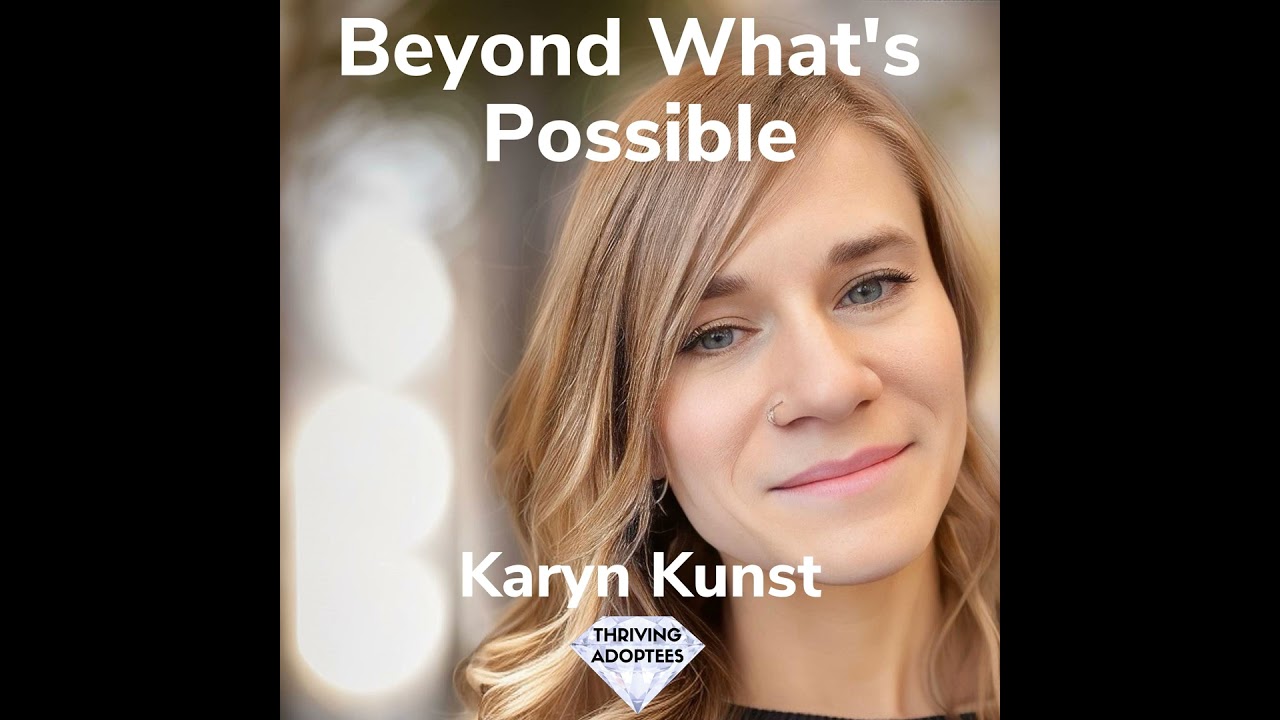
In this episode of the Thriving Adoptees podcast, host Simon Benn interviews Karen Kudst, an adoptee, author, and speaker. The conversation explores what it means to "thrive" beyond mere happiness, emphasizing continuous growth that often requires stepping outside comfort zones. Karen shares her personal adoption reunion journey, describing the anxiety, faith, and decisive moments that led her to seek out her birth family, the realities versus expectations of those reunions, and the ongoing impact of that experience on her identity and work. The dialogue delves into themes of healing versus growing, the role of gratitude (both internal and external), the challenges of introversion in public speaking and promotion, and the importance of embracing uncertainty and faith rather than seeking step‑by‑step how‑to answers. Throughout, both speakers reflect on the value of difficult experiences, the transformative power of gratitude, and the idea that meaning emerges from navigating discomfort and uncertainty.
Chapters
Hello everybody, welcome to another episode of the Thriving Doctors podcast. Today I'm delighted to be joined— I'm spluttering over my words. How many times have I said that? 600 times, right? Um, today I'm delighted to be joined by Karen, Karen Kudst. Looking forward to our conversation today, Karen.
Yeah, and I'm, I'm so grateful to be here. Thank you for having me on, on your show. That's great.
You're very welcome. Pleasure's all mine. Uh, I've said to Karen, it's been a a busy day, uh, releasing the 600th episode of Thriving Adoptees and recording 3 in one afternoon, which is, I think, a first. I don't know if I've ever done 3 anyway, but we've had, we've had an aunt by adoption, um, who is also an adoption attorney. We've had an adoptive mum, and today, and now with Karen, we've got a, a fellow adoptee. So all different perspectives. from 3 different people, very different people, different roles. So from your perspective then, Karen, what do you— what comes to your mind when you hear the name of the podcast, when somebody says Thriving Adoptees to you?
It makes me think that we're happy and feeling fulfilled and reaching our, um, potential and going beyond that potential and doing, doing really well in, in, in life.
Yeah, yeah, yeah. I had a bit of a realization last week in terms of, like, you say happy, right? Um, in terms of The feelings of thriving.
Right.
It was almost like, what, I've done 598 episodes and really never thought that it's about how we feel rather than about what we achieve or, or what we do or how we overcome trauma or how we move from surviving to thriving or all these kind of doing things. Rather than feeling things.
Right. Yeah. Yeah. For me, for me, it's a lot about how, how I feel. And it's interesting because in the release of my most recent book, I've come across a lot of opportunities and they've been opportunities that really take me outside of my, my comfort zone. So I find myself being, um, Kind of scared and anxious a lot in those opportunities. But the interesting thing is, is that when I go through that and I do those opportunities, they are actually ones that are growing me and they are taking me to maybe the next level in my life. And I'm becoming an even better person than I was before. So for me, thriving also is a lot of like growing. And in that growing, sometimes there's a level of being uncomfortable when we're taking— taken outside of our comfort zone.
Yeah.
So I find thriving really interesting because it's a lot of really good feelings of being happy and fulfilled, but it's also like, Always growing, which isn't a static thing. Yeah.
As, as you were saying that, the metaphor that came to my mind was growing pains.
Yeah. Yeah, that's right. I think, and I think to reach our potential or maybe surpass like the, um, limiting beliefs, 'cause I know like I know where I'm headed is ultimately meant for me, but there is a part of me that has some limiting beliefs. So when I'm able to like be brave enough to go past that, then I'm really thriving. Like then I'm really, I'm growing and becoming even more than maybe what I thought I could be. And to me, that's like, that's not just like surviving or being content. That's thriving. That's— yeah.
And I guess there's a difference between— so the growing pains happen while physically they— that happens while in the process of the growth. But you're also talking about, I think, a little bit of anxiety before the growth as well as pain in it. Do you see what I mean?
Yeah, well, it's, it's the stepping outside of, of the comfort zone with, with opportunities. Like, like even this, like speaking, that would be something that typically before I would be like, no, I'm, I'm shy, or there's, there's other people out there that, that would do a better job than me. But I know that I want to, and then I push myself to do it, and then I do it, and I do, I do good at it, and I'm like, oh hey, You know, I, I can do that and it, it opens up my world to, to more things.
Yeah.
Yeah.
And I guess sometimes, you know, writing has been a, a retreat for us or a safe place for us when we were a kid, right? Um, I'm not talking about myself here. I, I, I, I— this wasn't me, but I, I've heard a lot of— I've interviewed a lot of adoptees that have written their memoirs, right? And other people from the adoption Constellation who have written, and some have explained, described to me that writing was a way of getting out of themselves. It was, you know, processing tricky feelings or an escape place or, you know, something that they could do in a solitary space. It was a retreat for them. And I also think, but then to promote what you've written, you've got to get out and in front of people, and that's not always easy if you've kind of considered yourself an introvert.
Yeah, absolutely.
Did you consider yourself an introvert?
Oh, yeah. I still am an introvert. I'm an introvert that I feel like I have a calling to do this. And I'm just— I would never want to turn away opportunities. So I'm pushing myself to do whatever comes my way. And that is growing me because I feel like it's meant for me. But in the same hand, it's uncomfortable. But that's not necessarily bad. Like, I sometimes— I think that sometimes our fears hold us back a little bit, and if we can push through that, we can surpass what we believe for ourselves sometimes.
Yeah, so you're talking about complexity in a world where we don't really We don't want complexity. We want— not we, like the culture doesn't want complexity. It wants black or white, or, you know, it doesn't want gray.
Um, and that's what I think is interesting about thriving. Like, there's an element there of like, for, for me anyways, it's not necessarily being comfortable. It's expanding and growing. And in that, there is a level of being uncomfortable.
Yeah. So there was a time on the podcast, maybe last year, maybe the year before, where we kind of— we narrowed down— I narrowed down. So I've been going down the kind of the thriving path, and I thought, okay, well, and then I've done loads of, loads of interviews with adoptees, and I thought, okay, right, what everybody wants is healing. So let's shift from thriving to healing as a focus and see, see where that goes. And some people didn't like the word healing. Some adoptees didn't like the word healing. And when I asked them what they preferred instead, Often they would say growing.
Ah, okay. Yeah, that's cool.
Um, and these are all just jumping off points for the conversation. It doesn't, it doesn't really matter. I don't know. I mean, it doesn't really matter where we start from. It's kind of—
Yeah, and I think that goes hand in hand. Like, if you're growing Then I think you probably are in a way healing. It's interesting because when I went through my adoption reunion journey, like before I did that, I remember telling myself like, I know I have to do this, but I don't know how I'm gonna do it. 'Cause I was so scared to take that step. And when I wrote my newest book, I figured my adoption reunion journey was pretty settled and done, and that, that's why I wrote the book. And then in putting the book out into the world, I've gotten a lot of positive opportunities come my way, but they get me to step outside my comfort zone. And I find myself asking that same question, like, I know I need to, but I don't know how. And how, in the end, it's just, you know, being brave despite being scared. And faith plays into it too, that I don't know that I don't have to do it alone.
Yeah.
So, yeah, so in there, there's healing and growing all at the same time. And I find that before any of that happens, there's an element of being scared of the unknown or being a little bit uncomfortable and pushing through it.
Yeah, I think that the how-to question— I don't ask how very often on this podcast, right? Because when I listen to podcasts tackling deep stuff. Deep. Like, how always seems to be reductionist to me. It's like, I don't know how. Like, you know, it's, it's more about faith than it is about logic, to kind of reflect some of the, some of the things that have been landing as I listen to you, right?
Mm-hmm.
And, and I try to think of analogies like I do. I mean, like, you know, like last week, last week, listeners, Karen had a bit of a sore throat. So instead of doing that, instead of doing the podcast, we had a look at this Thrive framework that I have distilled from the listening.
Mm-hmm.
And so she kind of knows that I like a metaphor. Uh, because Thrive is full of— the Thrive program is, is full of metaphors. When I think of how-tos, I, I think of chemistry experiments as a kid, right?
Right.
So you've, you, you've got to— there's— you've got to do an experiment, right? So you start off with your list of ingredients— not ingredients, your equipment list, right? So you've got a Bunsen burner, you've got a fireproof thing and the base, the whatever it is, then you've got your test tubes and you've got your different chemicals, right? So you've got your equipment list, and then you've got your procedure, right? So did they teach chemistry the same in Canada? Because it's Canada, you're not in the States, you're in Canada.
Yeah.
Did they teach it the same way? You did an equipment list and a procedure, right?
Yeah, sounds familiar.
Yeah, so I didn't— it was like when I think of how-tos, I think you're right, you do step 1 and then you do step 2 and you do step 3, and we're kind of brought up to think that's how life works, right? Right, so I'll go to school, I'll do well at school, I go to university, I get a job, I'll buy me— like, we, we tend to think of life in these how-to and these steps and these processes, but it's, it's just, it, it's not about— the tricky stuff isn't about the logic. It isn't about— there is no how-tos.
That's right. And, and sometimes that can be pretty scary, um, especially when you feel like you don't know how to take the next step. Like when the next step feels kind of feels really, really difficult for you or almost impossible. Like, I don't like to say that word, but something that you feel like It's really, really difficult. Then you ask yourself, well, like, how am I gonna do this? And there really— I mean, there was never really any answer besides just, you know, having faith, relying on that, and having the bravery to walk through that.
Yeah.
Yeah.
Is the— I mean, are you talking about faith in yourself? Are you talking about faith in God, faith in some higher power? Are you, you know, what, what are you talking about?
Faith in God. I, uh, in, in those moments where I felt like maybe I wasn't strong enough, um, that's, that's where I went. And that's when I walked through those moments where I felt like I couldn't do it alone or I wasn't strong enough, I could rely on, on that. And that gave me that little extra bit where I could know that it was going to be okay.
Yeah.
Yeah.
So when you mentioned reunion a couple of times and One of the things that you said, it seemed to me that you— there was, um, there was an imperative behind that. It was like, it was a— it was not a should I, should I not. It was like, I've got to do this. Is that—
Yeah, yeah, that's correct. I personally, for myself, as I got older, I, I knew inside myself that I had to I had to answer those questions to move forward in my life without them holding me back.
Yeah.
And that's what I wanted. No matter how scary it was for me, I knew I had to do that to become the person that I wanted to become.
There was no option.
There was no option. I was terrified. And like I said, I had no idea how I was gonna— the hard part for me was initiating it. I did not know how I was gonna be brave enough to initiate it.
You, you mean to start the process?
Yes.
Yeah, not so the what do I do first rather than what happens when I meet my biological family.
Yeah, no, it was, it was the first step. And it was, I didn't want to hurt my adoptive family.
Yeah.
And I, and it wasn't anything that they, they had done. It was all internal, internal struggles. And I think that I, there was a part of me that felt like if I brought this out into the open, That I would be displaced in a way, like that, that maybe I wouldn't— what if I lost my family? Or what if I didn't know where I were or felt where I belonged? Or like, I would— it was the unknown that was like really scary to walk into and to start.
Yeah, can I just take us a step back?
Um, sure.
What was there a moment when you realized that you had, had to, uh, had to search? Or was it— do you remember a distinctive moment that you thought, I have to search? Or was it more something that, you know, it had— you'd been thinking about it for a long time and, and you— and, and there's no specific point at which it became a no-brainer?
Um, I remember one night, I don't think it was triggered by anything. I, I just, I was ready. And then I prayed on it, and the next day I— what I prayed for was an opportunity to arise where it would initiate the process, because I was having a hard time Feeling comfortable initiating. Oh, okay.
Yeah, yeah.
Yeah, so I prayed on it, and by no stretch the next day an opportunity arose where that was brought up. And my, my mom had asked me at that time, she's like, are you interested in, in answering some of these questions and finding out about your birth family? And I said, yeah. And then she gave me a letter that had come from my birth mother that was given to them when they felt that I was ready. And it was that letter, because it was a very positive letter where my birth mother had said, like, that she would like to meet me one day. That letter, in that moment, I knew that I had to search. And it was on. I was like, I got to do this now. And I feel like it should— like, I wish I had done it I felt like I wish I had done it sooner, but the time— the timing was right because that's when it happened. But like, there was an urgency when I got that letter.
And how old were you then, Karen?
I would have been around 21 or 22.
Yeah.
Okay. Yeah.
And not because I'm a gentleman, aren't supposed to ask, right, how old a lady is anyway.
Oh yeah, no, I don't mind at all. I'm turning 40 this year. Okay.
Right. But just for the sake of perspective on that.
Absolutely. So yeah, I was 22 when I went on the reunion journey, and I'm 40 now, and had— I've just written my second book. And I wrote it because I felt like that whole reunion process and all of that was really settled in my life. And I could write on it from a very settled perspective on it. At almost 40. Yeah. Okay.
So, um, I guess we— I've got to ask you a little bit more about the reunion itself. So, sure. Yeah. Um, so how did it go?
It went really good. Every— everyone was really welcoming. So I, I met my, um, Oh, I could talk about this for a long time. The whole trying to, trying to find them was like trying to find a needle in a haystack. Um, that was really interesting. I had went through the, um, the government program where they, if they had the information from the birth parents, that they would try to do the reuniting process. Um, but the information they had was outdated. So then I took on searching myself and I was just And my mom, my adoptive mom, just for sense of, for people to know who was helping me, but she helped me get all the phone numbers too. And I would just ring people up and be like, this is who I'm looking for. And then eventually I got my biological aunt on the phone and she was like, oh, that's, that's my sister. And she hooked us up on the phone. And I think it was, it wasn't long after that that I flew out there. To meet my biological mom and my— I met my half-brother and aunts and uncles and cousins. And then shortly after that, I met my biological father who lived in the same city that I did.
Yeah.
And yeah, they were all really welcoming. There of course was a lot of hurdles in a sense, like it wasn't Easy. They were based—they were like strangers. So I mean, I had to get to know all these brand new people, and it's a little different than meeting strangers because there's obviously a lot of feelings attached to these people from both sides. So it's a really unique situation. It took a long time for things to kind of. settle out to know where, like, everyone was gonna fit in my life and how I was going to feel with all these new relationships. And I had a lot of expectations on what those relationships would look like. And I think that was the, that was the biggest hurdle, was coming to terms with the expectations that I had created. my whole life, and then what the reality was and how that was different, and how their lives were different than my life, some of the choices on how they live their life. And there was a lot of differences. So there was a lot of things to work through that it was quite difficult in times. But in the sense of, um, I mean, everyone was really welcoming, so that, that was a positive.
Yeah, positive. And can you give us an example of how the expectations, um, weren't met? What was different? What was different to your expectation?
My— I've done a lot of reflection on this, and my expectations that I had, um, specifically from my birth mother were a reflection of some of the best qualities that I had and the qualities of my parents. So it was all really good stuff. I had made this image of this person that I thought was a lot like me, but like stronger and wiser and All these really kind of— I mean, it's not fair to put those expectations on somebody, and it's pretty unobtainable. Like, I had really high expectations. So there was a clash there— not a clash, but I had to come to terms with the fact that my expectations Um, weren't realistic and that it's better to accept people for who they are and not expect certain things from them. Like, yeah.
Yeah, you've been quite polite about this, Karen.
Yeah, you think so? Yeah.
Um, yeah, I, I, and, uh, very self-aware about it.
Yeah, yeah, yeah. I've done a lot of reflecting on it for sure. Yeah, yeah.
Because I, I kind of— listeners, I kind of know the punchline to this one. So, right, yes, I, I know. But, but the, the, the, the punchline, it, it, it is a, is a great one, and, and it, it is a— it's a, it's a happy not an ending, but it's a happy stage in, in, in the, in the process. But I get the sense that there was a bit of tough stuff before that.
Oh yeah, there were— there was a lot of— there was a lot of tough moments for me. Um, I had to do a lot of reflecting and a lot of, um, like soul-searching and just kind of protecting myself from being hurt, but in, in a way, I was the one that had set myself up for that hurt too. So like, there was a point where—
Yeah, sorry.
Yeah, I had to take a step back at one point to really like reflect on what was, what was important and where, where where I belong and where I fit in everybody's lives. And that maybe my— so my presence in my adoptive family was always like joyful, and they made me feel so loved. And stepping into my biological, like meeting them and stuff, I kind of expected the exact same kind of position. And of course, that's not going to happen because they're not my adoptive family. They're like, right? So my expectations were skewed, but it just took time.
Yeah.
To settle with that. Yeah.
So the self-reflection piece was about the realizations that you'd been— your expectations had been off-kilter.
Yeah, but it's interesting because those expectations and who I had thought that I was looking for Um, I, I should— I just get to the punchline right now?
Yeah.
Because that, that, that very clear image of what I thought I was looking for through all the hurdles and stuff in my life, not just, not just in my adoption reunion, because there was other, other things in my life too that were very difficult and, and caused me to grow as a person. But that image and expectations of who, who I was searching for ended up being the woman that I had become through everything, which is so interesting to me because I can, I can reflect back when I was younger and thinking about going on the adoption reunion journey and knowing that I had to. To become the woman that I wanted to become. And I didn't know who she was, but I ended up becoming who I thought I was searching for. But I had deflected it onto other people. So I don't know if it's like I became that person because I had envisioned it and that's what I became. It was like a guiding force, or if somehow I knew that this was the journey I had to go on to, to be this person that I was always meant, meant to be. But I found that person. Yeah.
Because a lot of people talk about visioning, don't they? You know, people talk about— like, I remember, you know, having a coach People would say things like, you know, having having a coach that was going like a business coach, but then you'd get into sort of you you'd get some of them would get you into kind of bigger than your business, right? So like be not just that part of your life. So and people start throwing around quotes like from people like Gandhi saying. be the change that you want to see in the world. And, and horizons kind of expanded. And, and you, you, you see those pictures of— it's like the, the Russian dolls, but you're growing into the bigger.
Yeah, it's so interesting because, like, I— because I, I'm adopted I personally had a reason to envision, and that was my avenue, was I was adopted and I was always envisioning what my biological origins, what these people would be like. And they were a reflection of my amazing parents and how they loved me. And so all these really good qualities. I don't— so I had this reason to envision these things when I— would I have envisioned it before? Like, if I wasn't adopted, I don't know if I would have envisioned what my future self would look, would look like. Or so it's kind of cool to think about it in that way, that like I spent a lot of time envisioning, um, this person or this image.
Thinking, thinking into Thinking it into being. Some people would say that, but, but you weren't thinking into being for yourself.
No, but it ended up being, being what happened, which is interesting. Yeah. Yeah.
There's a, there's a, there's a mystery around it though, isn't there? You can't reduce it. You can't— like, trying to reduce it to, oh, how did you do that, Cameron, would be— you know, that's why I don't ask the how question very often, because—
Yeah.
I— when I hear it, I just think, um, that's the wrong question. You can't explain it. Uh, for some reason, I want to share a little story about that. Um, when it— because it really brought it home for me. Like, we, in terms of the mystery, it's not about logic, you know?
Right, yeah, absolutely.
It's not about logic. So it's not about, you know, understanding how brain chemistry works and the different parts of the brain. And, you know, when people reduce to talk about adoption and trauma and stuff like that, and you say, well, that's not what it's about, you know? Like, it's not.
Right.
It's not about— So I was listening to a— it's a really popular podcast, it's called The High Performance Podcast, and it's run by 2 guys, 2 British guys. One's a sports commentator and one's a sports psychologist, coachy kind of guy, right? They were interviewing— the guy's name's just gone out of my head. He's a South African rugby captain and he was the first Black South African rugby captain to lead them, South Africa, to the World Cup. And I'm really annoyed that I can't remember the guy's name. I'm gonna forgive you. So the guy was talking about character And he was talking and he'd put his heart and soul and a lot of time and effort and like walking 5 miles or running 5 miles to his training every day. It was a big commitment and a big— I guess a leap of faith for him, you know, like that he was doing this, right?
Yeah.
And he was talking about character and who he was and his story and how he got on with his teammates and other stuff like this, right? So it's all really big picture and then the sports shrink said, So, so something like, so how would you describe your leadership strategies? Some word like this. And the guy just said, it's just who I am.
Right.
And the sports shrink guy was taken aback for a second and then went on to— but the penny didn't drop for the guy that he was— he was— the guy was being really reductionist.
Right.
And, and this, the, the— this captain who had led the team to Sun was being— was talking about big expansive things and, and, and going, and going to identity. So if I put it in, put the, uh, put it in a sentence, the question— the guy asking the questions was talking about strategies and the captain was talking about identity. They weren't even in the same— they weren't even the same ballpark.
Yeah, absolutely.
They weren't in the same ballpark. But the penny didn't drop for the guy that he was playing in the wrong ballpark.
Okay, yeah.
You know, and so whenever, you know, the how-tos and it's just, it's the bigger stuff is way bigger than how-tos.
Yeah, yeah.
And that's not to reduce it.
That's right. And I, like, I guess that's the important thing of why I bring that up when I'm— when I find myself asking how, is that it's okay to feel like you don't know how. Like, sometimes we don't know how we're going to do something, but we can still do it. We can still walk through it. We can still be brave enough to try or rely on faith to to get something through something when we don't know how we're gonna do it.
Yeah.
Yeah.
And, and as you, you were talking, I was— I picked up my phone and I was about to Google the name of this rugby captain, right?
Yeah, yeah.
And I'm falling into my own trap. It doesn't matter what the guy's called.
That's true.
You know, it's about the idea, not about the specifics of what his name is, other than being slightly embarrassing for me that I can't think.
I'm sure it'll come to you right after the podcast.
It will. It'll be at the back of my head. As soon as I hit the stop button, it will pop into my head. But we're talking about size, and, you know, I came up with that Russian doll analogy about— and you talked about growth. And so I think that's what, um, I think that's what prompted somewhere that, that the, the Russian dolls, you know, the stacks, the stacks of dolls where they— so you're becoming a, a, a bigger, a bigger doll.
Yeah, absolutely. And like, we're not putting it—
we're not talking about your physical height. Or you're, you know, or putting on a few extra pounds or anything like that. Obviously, we're not talking about that. Yeah. Yeah. That's it. That's just nuts. Right. Okay. I don't know why I started talking about that, but growth, right? Growth is capability.
Yeah. That's, that's, I feel like that's thriving. Like when a, when a plant thrives, the plant is growing more than what its potential is maybe seen as, or what you think it's gonna do, but it's thriving, it's doing better, it's growing more. And that's how I see myself. Like, I feel like I'm thriving and I feel fulfilled and I'm growing and I'm trying to make good out of my life. And there's a lot of moments where I'm, uncomfortable, um, because I'm stepping outside my comfort zone. So yeah, yeah, yeah. So it is growth.
Yeah. And we don't normally talk about this stuff, sort of stuff, do we?
No, not very often, because I think, I think like you said, in today's world, comfort is, um, kind of prioritized. Every— but like being comfortable and And peaceful and everything is just like easy, easygoing. But I feel like, like, yes, that's nice. We need that to thrive as well. But to really thrive, I think growing is a part of it and becoming better. And that can be uncomfortable.
I, I remember some point at, at some point in my business, old business, I thought I, I only actually learned from the bad stuff. I only learned in the hard times.
A lot of the lessons, like the really big lessons, come from the hard times. And I, I think that's why they're so hard, is because it, it is a lesson. If it, if it was easy, would we be learning? Like there wouldn't be something there to learn if it was easy. We would already know it. So the difficult times are showing us something that we have yet to learn in, in some, some instances.
Yeah.
And I'm— and in that sense, I am extremely grateful for the difficult times that I went through because they've, they've shaped the person that I am today, made me more compassionate. Um, I Like, in many, many ways have made me a better person. And a lot of that comes from reflecting on the difficult times too and like seeing what I can take from it.
Yeah, you've mentioned that a couple of times that you wrote the— took you a while. Well, you didn't say this, but you said you've finished the second book, or you said something like that. Didn't— you did the reflection, you did the reflection before you read the— wrote the book, essentially.
Yeah, I was, I was, I was settled. Like, my adoption journey was really settled when I wrote my, my second, like, my newest book. Um, but it's interesting because, I mean, the adoption journey is influencing me again in a different way. I'm still growing from it because of the opportunities that are now coming from, from my book. So I'm learning from it in a different way. But I'm still growing, still growing from it for sure.
Yeah.
Yeah.
What growth do you see ahead?
It's like, it's all personal growth, just really doing things that I'm scared of, becoming more of an extrovert, like going from an introvert to being more comfortable Talking in front of people, talking about complex, like this stuff is, it's complex to talk about. So like it, I, and I'm, I would, I wouldn't have said that I was really good on my feet talking about complex things. Like I'm good at writing and writing, there's a sense of being able to think about things before you put them down and reflect on them. Whereas speaking, it's, it's just there. So So that in a way takes me out of my comfort zone when I'm having to do that. But I appreciate doing it. I just, I had a radio interview not too long ago, and I was terrified, terrified to do it. So outside of my comfort zone. But after it was done, it is one of the coolest moments of my life. Like, it is a treasure in my life. So. The amount of fear I had is equal to the amount of how much I appreciate the experience of actually doing it. And I could have very easily been like, nope, I'm uncomfortable doing it. I'm scared to do it. I don't have the skill to do it and not have done it. But I'm grateful that I did. And faith really played into that because I felt like I didn't know how I was going to do it. But I did. I did. Yeah.
Have you, have you mentioned meaning in the last 50 minutes, or, or I, am I just imagining that? Because I haven't, I haven't written down on me, on me, on me.
Meaning?
Yeah. Did you mention, did you mention meaning, or am I just imagining it?
Oh, I might have. I am not sure. Yeah.
Does— I mean, do you see meaning and growth? Uh, you've said faith a couple of times, you talked about growth. Does, does meaning play into this for you?
Like what it all means to me?
Like, um, well, so for me A meaning thing that happened for for me last Friday. I was doing a training, and I was talking about the fact that I'd read The Primal Wound, and it had taken first my first reaction to reading The Primal Wound was relief. Then that then after the relief, this kind of this explains things, and then. After that phase ended, there was a, a phase where I thought, I'm, I'm stuck with it, I'm stuck with this primal wound. And then there was a realization that I wasn't stuck with the primal wound.
Right.
And so I can, I can see the, the meaning I can be, I can be grateful for the setback.
Oh yeah.
Because without the setback, it wouldn't have. I wouldn't be doing the podcast. I wouldn't, I wouldn't, I wouldn't have been doing absolutely.
Yeah.
I so it kind of bring it brings meaning to to pardon my French the shit right? It brings meaning to the shit.
Yeah, absolutely. And for me, definitely my— the meaning for me is the person that I've become because of all the hard things and where I'm at in my life. Like, I wouldn't change anything because I am fulfilled and feel like I'm thriving. And I appreciate the person that I've become and It was like a workout for my soul, like just always working on myself and becoming stronger from it. So there's definitely, I can take a lot of meaning and be grateful for the hurdles and the difficulties that I've been faced with in my life, 'cause they've made me a better person. And I think, Yeah, it's— I don't know. I was going to say I think it's a choice, but I don't know. I don't know if it's as easy as that. But it took a lot of reflection and wanting to see the good in difficult times.
It feels like a realization rather than a choice to me.
Yeah, yeah. It's like a perspective. On things. I— it's— that's a tricky one. Yeah.
Yeah. I— we've been talking about similar sort of thing this afternoon on a previous interview. I think perspectives come to us. I don't think we make them happen.
Right. Yeah. And I guess I'm grateful for how I've always been able to see things in a constructive way for myself, like to always be able to naturally find gratitude.
Yeah. Gratitude is a funny thing, isn't it? In the adoptive community.
It is. Yeah, that's right.
I always did, whenever I get anywhere, get near it. Sorry if you've heard this before, listen. Um, I think about forced gratitude versus spontaneous gratitude, right? So gratitude from without, um, and gratitude from within.
Right, absolutely.
And I've never had that. I, I, I've I've never been subject to external gratitude. As in, what I mean by that, my parents have never said to me, you know, the idea is freaking laughable, um, well, you should be grateful that we adopted you. That, that, do you know what I mean? But yeah, but some adoptees have had that, right? Whether it's been as directly spoken like that, you know, in, in that, in those, um, short words, um, or it's been more of an unmentioned belief or an unmentioned expectation.
Yeah, I really like what you said about gratitude from within. Like, the gratitude comes from a place where the growth happened, or there's been some sort of like shift, and that's, that's where the gratitude Like grows from. It's not something that's put onto you.
It's like happiness. It's an inside job.
Yeah, that's right. I totally agree. I think so too.
Yeah. I heard something last week that just stopped me dead in my tracks. And It, it was— I think it's 5 words. Yeah. Happiness comes from our being.
Oh yeah, nice. Yeah, I like that.
Or gratitude comes from our being as well, to, to tweak it slightly. Right. Being told to be grateful, you know, like being told to be anything When has that ever worked?
No, it doesn't. And yeah, and I feel like that same with like, sometimes I'm asked like what advice I can give. And I'm just like, I remember when I was given advice for like my adoption reunion journey and stuff. And although it was very wise and correct looking back, it didn't ever like quell the, The need for me to have to go on my journey and figure it out on my own. Like, the words from somebody else never filled that place where I had to learn that for myself, even though they might be accurate. I had to figure that out for myself. So, yeah, being told to be something.
Doesn't always, or told to do something, told to be something, told to feel something.
Yeah, that's right. Because like one of the things was like don't have expectations or be prepared.
Okay, I'll work on that.
Yeah, exactly.
All right, thanks for the tip. Right, yeah, that's great. I'm just going to put them all to one side. I've been thinking, I've been having these expectations for the last 20 years, but now you've said that. That makes it pretty, you know.
Yeah, I don't, I don't need to have them anymore.
Yeah, I don't. All right, I'll just get rid of them. Thank you. Hey presto, they're gone.
Yeah, so that would be like gratitude.
Yeah, that would be like bullshit. Yeah, we can't just— yeah, we can't change. We can't, we can't make that change happen.
Yeah, that's right.
So is there anything that you'd like to share that I've not asked you about, Karen?
Um, just that like when we're talking about thriving, um, I had a lot of support and love from my adoptive family. They're my family, but again, I just say adoptive family so that everyone knows who I'm referring to. But that support really built a foundation where even though I was scared and had my own things to kind of overcome so that I could thrive, I always knew that I— That I was going to be okay because of that foundation that they had given me and that I have to always be really— I'm very aware and grateful for that portion and how it's helped me to thrive and not let any of my fears hold me back or any of the questions that I needed answered hold me back. They've always helped me and supported me in doing that stuff. So I feel like that was a very big contributing factor to me thriving today as well. Yeah.
Yeah. It's, um, I think what poor parenting Is, um, I think what sometimes we do is, as we as adoptees, right, we— I've got this feeling that we blame a lot of stuff that's— we blame relinquishment for a lot of stuff that is actually poor parenting.
Right, okay.
For poor adoptive parenting. To make it clear.
Right. Yeah, right.
I think, and we'll never know, right? How—
Yeah, yeah, that's right. Yeah.
And I'm regretting even saying this, actually, but, you know, where's the science?
Yeah, and it's tricky. And I just like, and I feel very grateful that like I had that really good foundation. And because it could have very easily been that I let my fears hold me back. And it could have been, it could have been a very different story for me where I, I didn't go on that journey and I didn't, I didn't push myself and I didn't become the person that, that I am today. And I'm very grateful for every part of that journey from, from my, my family and then the hurdles and struggles, and it's all contributed to me thriving today. So. Yeah, that's cool.
That's cool. Thanks, Karen. Thanks, listeners.
Oh yeah, thank you. Thank you, Simon.
More from Simon







Weathering Storms With Joanne Morales, Jennifer Hartwig and Rebecca Dominguez


