Comfortable In Our Own Skin AJ Bialo
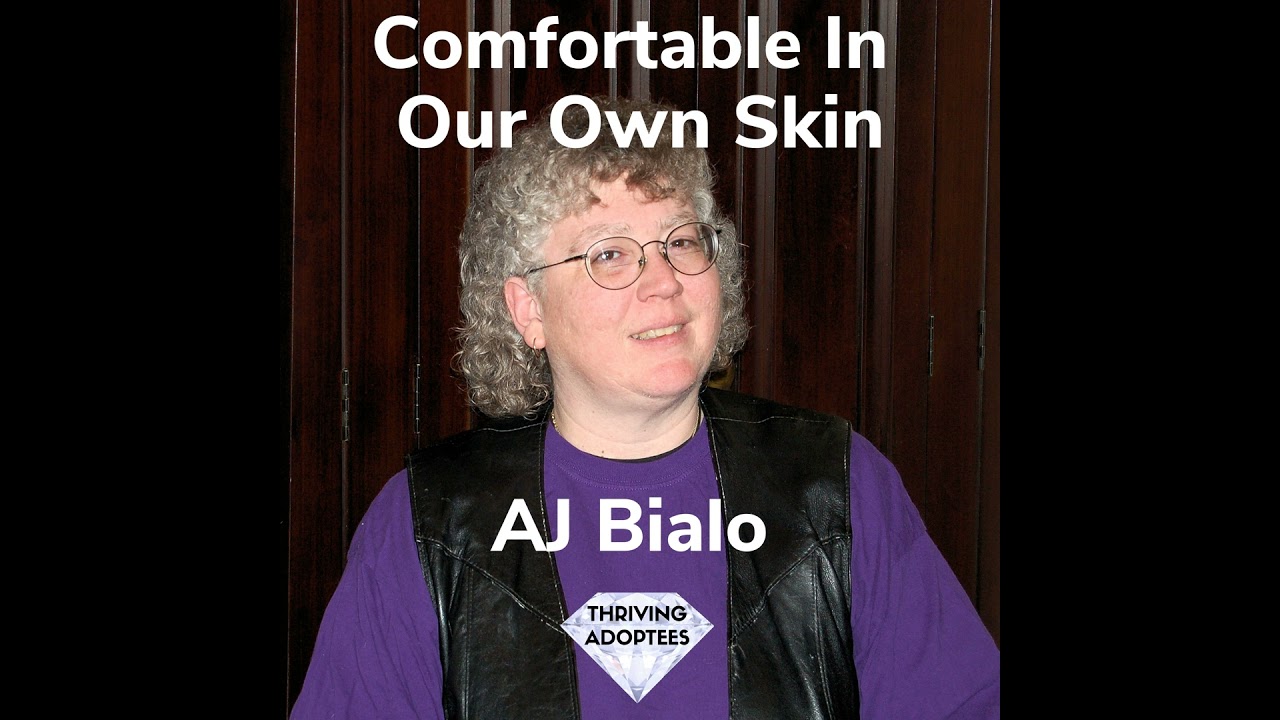
In this episode of the Thriving Adoptees Podcast, host (Speaker A) interviews AJ Bialo, an adoptee who is also a poet, short‑story writer, and novelist. The conversation opens with AJ reading two of his poems—“Alone in a Crowd” and “Wishing I Could Disappear”—both stark portrayals of adoption‑related trauma, secrecy, and the feeling of perpetual otherness. AJ recounts his early life: a birth in Syracuse, a biological mother forced to relinquish him under duress, a step‑father who prevented her from keeping the child, and sealed adoption records that left him without a clear origin. He describes an oppressive adoptive mother who suppressed his creative outlets, leading him to burn his diaries and cease writing until a college professor forced him back into journaling, which eventually sparked his poetry. Therapy reinforced writing as a vital outlet. AJ reflects on the pain of both relinquishment and being raised by a “nutter” adoptive mother, noting the constant comparison to biological cousins and the feeling of never fitting in. A pivotal “aha” moment occurred at his adoptive mother’s wake, where others praised her love for him despite his memory of never hearing those affirmations, prompting a deep identity crisis and a drive to reclaim his narrative. He discusses estrangement from his biological family after the wake, a failed attempt to reconnect, and the lingering impact of his father’s death in 2015. The interview explores AJ’s ongoing struggle with the desire to “disappear,” rooted in depression, bullying, and feeling trapped by family obligations. He explains his decision to change his name to AJ Filo (honoring his biological grandfather and adoptive family) and his rejection of his legal name, Susan, which he associates with a tomboy identity. He describes his gradual self‑acceptance, focusing on writing, carpentry, and a small circle of genuine friends, and his reduced need to please others. AJ also shares how a 2022 car accident and concussion disrupted his internal rhyming voice, forcing him to rely on a rhyming dictionary and highlighting the fragility of his creative process. He mentions involvement in an adoption‑focused writing forum where adoptees share poetry for mutual support. Finally, he touches on future creative ideas, including a potential poem about reclamation, and provides personal details such as his birth date aligning with the Chinese Year of the Hare and the “COVID” of his book being his birthday. Overall, the episode weaves together personal narrative, poetic expression, and reflections on trauma, identity reclamation, and healing within the adoptee experience.
Chapters
Hello everybody, welcome to another episode of the Thriving Adoptees Podcast. Today I'm delighted to be joined by AJ, AJ Bylam, a fellow adoptee and a creative force, a poet as well. Looking forward to our chat today.
Yeah, and as am I.
Cool, cool. So you're a poet, you're a, a writer?
I am, yeah.
And you're gonna—
I have written short stories.
You've written short stories as well? Yeah.
Um, so, and novels.
And novels.
I'm a prolific writer.
Yeah, brilliant, brilliant. So we thought, um, we'd start perhaps with one of your poems, and, uh, that, that leads— that's about adoption, and we'll kind of see where the conversation goes from there.
Right, okay, sounds good. Um, this This poem is from my current newly released book. It's called A Moment in Time. And the poem is called Alone in a Crowd. Hidden long before I was born, physically removed and to secrecy sworn. Quickly sent far away from home, safely confined and unable to roam. Staying until the deed was done, returning home. The only one. A chaotic beginning concealed with a shroud. Abandoned by family, alone in a crowd. Left in a crib of metal and chrome until they can find a suitable home. Left alone with life changers, given away to perfect strangers. Strangers who quickly change my name to make legal their parental claim. With new records, I am disavowed. With new family, alone in a crowd. Although they call themselves my kin, I never feel like I fit in. We did not look anything alike, always feeling— take that back. Knowing since I was a tyke, we did not look anything alike, always feeling Out of joint, I always seem to disappoint. I never seem to make them proud, leaving me feeling alone in the crowd. Waiting until I'm fully grown, I look for answers to the unknown. A piece of my past I try to embrace, looking to find a familiar face. But original records will not be revealed, for all records are permanently sealed. Access to records is never allowed, ensuring I remain alone in the crowd. From one family I am rejected, from the other I am disconnected, always feeling like an eternal child, my true identity still unreconciled, feeling I live in isolation. I ponder my own annihilation. Living life under a big dark cloud, always feeling alone in the crowd.
Wow. You've got like a— it's a shiver going right down my back listening to all of that. It's so powerful. And thank you. It's so— yeah. It's painful. It's really—
It's heavy. The book is heavy. It's got a lot of heavy adoption moments.
Yeah. It's really like the, the, the angst and, you know, it sounds a bit like solitary confinement, right?
It was, you know, the more I've thought about, you know, my mother was good at putting me in a box. And any outlet I tried to find, you know, for myself, she always shut down. I used to write when I was a child. Not— I never wrote poetry as a child. I wrote short stories. And I think it was not so much about the stories, but the characters in the stories I was interested in, because I was an only child and there were no children or friends around where we lived. So I was basically by myself a lot, and so I had to amuse myself. So I read a lot of books, and I started writing my own stories. And my mother never got the idea of privacy. Everything that I ever wrote—diary stories, whatever—she would find and criticize how childish it was, how you know unbelievable it was. Well, I was a child. I was writing child stories. I was interested in the people. my imaginary friends, you know, and no matter where I would hide them, she would find them. And so at some point I gave up, and I took my diaries and my notebooks that I wrote in, and a box of matches, and I went to the park where I used to like to hang out, and I burned them all. And I didn't write again. Until college, when I was forced to by a professor for a course I was taking. We had to write a journal, and that just terrified me—that somebody else was going to read what I was going to write for a grade. You know, and it was in my major, so I there was no way out of this. So I had to write a journal that he was going to read and grade, and it was. It was the most terrifying thing I ever did, but it was the best thing that ever happened because it got me writing again.
Yeah.
And it got me into— well, poetry. I don't know where poetry came from because poetry just seems to come from somewhere else. You know, it's like things just— the brain just works in the poetry mode like all the time, and sometimes it comes out as a poem and sometimes it's just Oh, remember to do this, you know, today or whatever. So, yeah, so that's where, yeah, a lot of the— my, uh, when I did therapy for quite some time, and, um, my therapist was very happy that I was a writer because she saw that I was getting everything that I needed to talk about that I couldn't put to words to speak, I could put to words. To write down. So it was like my therapy to, yeah, come out of my box that I got put in.
Yeah. Freed. Yeah. Just you captured the— you captured both the relinquishment stuff and the Adoptive mum stuff. You it's we have a lot of people on the show who have had somebody called my own adoption benign the other day, and and I I don't know quite what what does but it seemed like. Okay, or, or good? What does benign mean? Like, it's not, not harmful? What does it— what does it mean?
Didn't cause any harm, it shouldn't be a big deal, move on with your life. That's what everybody who's not adopted says. Yeah. Oh, you had a wonderful family, what are you bitching about? You know?
Yeah, actually it was another adoptee.
Oh wow.
Yeah, um, she— I think she meant an okay. I think she meant an okay experience. Now, I've heard the benign, you know, the only, the only context in which I've heard benign recently is in cancer. Like, so it's cancer, but it's benign rather than life-threatening or so benign.
That's a good thing.
Yeah, it's a good thing. But so my adoptive life was a cakewalk compared to yours. And I— but I do think that the poetry captures both the pain of relinquishment and the pain of being raised by— what did I call her last time? A nutter, didn't I?
I think you called her a nutter, yes.
I called her a nutter. You know, like—
And you were being nice at that.
Yeah. So it's, it's the pain. And like, so I think for— we can look at these 2 things, you know, the relinquishment thing and the, um, uh, the, the pain of being raised by a nutter separately, but it all comes— it, it's all contained within one person.
Yeah. And you've really have to look— I mean, there's always that pain of the relinquishment, you know, for both my, my biological mother, you know, who was forced to by her stepfather, who also turned out to be my father. Um, he, he told her, you know, he's not going to let her bring her bastard child home, even though it was His child too. Nobody knew that. I just found this out doing DNA a few years ago. Wow! So it's you know how she was treated and how you know the whole picture of you know yeah she was treated badly. She was actually sent to the home for unwed mothers here in Syracuse. Which is where I was born. I asked her when I met her if she ever held me and she said no because if she did she would never have gone through with it. She said, but she heard me crying from the nursery at the top of my lungs.
Yeah.
With the whole pain of That separation, and then being forced to live with someone who really didn't. She wanted her own child. She wanted someone who looked like her. You know, someone because all of my cousins, you know, the female cousins were all. Like to dress up. They like to go out, and you know, one was a cheerleader. I always got compared to one cousin who was always smart, getting good grades, and we went to the same school. We were 1 year and 4 days apart in age, and I was always compared to her. I don't know if she ever knew that, but you know, it was always, why can't you be more like this person? And so it was always not only growing up being told how worthless I was by my mother growing up, but, you know, also being compared to other cousins in the family. Why can't you be more like them? So she wanted someone, she wanted a child of her own. And I just put this in a— just finished off a short story And the idea of— she wanted her own child, not somebody else's hand-me-down, because she always taught— she grew up in the Depression, and she always got— she was the youngest girl of 6, and so she always got the hand-me-downs. So she wanted a child of her own, not somebody else's. But she took me anyway, because they told her that I would be this malleable little baby who she could you know, make into anything, which didn't happen, obviously.
So you talked about before we started recording, you talked about a big aha moment at your, your mother's, your adopted mother's wake.
Wake. Yeah. It was everybody who was coming in. My mother was well known. in, in town from work, and she had a very big family. And so everybody was coming, and as the line— procession is coming by, they're all, how wonderful she was and how much she loved me and how much she was proud of me and what I had been doing, you know, and all the things that I've done. And, um, she— And I just looked at these people like Who were we talking about? Are we talking about the same person? Because you know, she never once, ever in my memory, ever said I love you or I'm proud of you. The words I would have killed for growing up, you know, never got said. But yet all these people are telling me what you know she was so happy to have me and and you know. It was just, what do I do with this? It's like she got the last laugh. She threw this at me, you know. She had this outward persona of the perfect mother, and I got, um, mother dearest, you know. In fact, I used to call her that sometimes when she would piss me off, I would call her Mommy Dearest, you know, from Joan Crawford. And she didn't quite like that, but, you know, I told her to get over it. There's a lot of things I didn't like she did either. So it's been taking me a while. I've been writing quite a bit since then. And she died in 2007.
Wow.
So it's been since then that I've had this awakening moment. I, I, you can call it my defogging since it wasn't from adoption. It was more of, who am I? Who were you? And how do I reconcile what happened for the whole 45 years before this happened? You know, so I've been sort of writing poems and a lot of short stories. I tried working on another novel, but it seems like the short stories, I can cover more things over time than one large story would tell. But yeah, I mean, it really Brings it home for me, I think.
Yeah.
And I'm not— I've, since that time, since, well, since my father died, I've not heard a word one from any of my cousins except for one who called around Christmas time one year to see if I was still alive because her sister sent me a Christmas card and it came back. She wanted to know if I moved. I said, no, haven't moved, still the same place, 25 years now. You know, and I've heard from nobody since. So I'm assuming I'm just alone in this little journey of mine with me and my spouse and our critters, fuzzy critters.
So tell me more about the awakening moment. What did you wake up to?
Well, it was the whole of My whole experience of who she was, our whole relationship. Because I had always hoped—I wondered why you know we had this relation so intense relationship of love and hate—and I thought at first I didn't think I would cry when she died, and I did unbelievably, and it was. Not so much grieving her, but grieving the loss of what might have been when she was alive. We still had the ability to, you know, have a relationship, come together, work these things out, but that never happened. And so I really did a lot of searching as more as to who I was, because I sort of let her define who I was because I was stuck and didn't know. I mean, yeah, even if I, I left home, I was still stuck with her because there was always things that she would— I mean, in the other poem it will tell you. One of the things is, you know, I moved out as soon as I could, but one thing was I learned is you can never move far away enough. Because there's always, we need this, we need that, come here, take care of it for us. And it didn't matter where I moved, it always came. Um, I think it was— I, I had to find my way. Yes, I was free, but I didn't know how to move on. It had been this whole life of being here, and now I'm outside of it, but I don't know in what direction to go and what to do now. So I had to learn all over again to stop playing the voices, her voice in my head of you can't do this or you can't do that or you're not good enough for this or not good enough for that, and had to just If I wrote it down enough, I would believe it. And that's the process I'd just been going through. And that was also the last time I saw my biological family. My birth sister had a brain tumor, and I was basically taking care of my adopted parents. Literally. And, um, she had, you know, our mother and aunts and uncles and anybody who would be there for her. And my parents just had me. So when I— she wanted all this attention from me, I said, I've got to take care of them, like it or not. And she's like, not my problem, hung up on me. I've never heard from them again. And, um, She, uh, I haven't heard from any of them ever again. They came to the, to the wake because I called my birth mother today. She was actually the first person I called to tell her that my adopted mother died because her mother died not a few years before that, and I was there for her. I was hoping she would be there for me, and they came and After that, they just like poof disappeared and moved to another state. So I sent her a birthday card one year, and it came back undeliverable, forwarding address expired.
Weird.
So so yeah, well, that was them. So I took the little yellow sticker and wrote— put the card with the sticker inside a bigger envelope, wrote the address that was on the sticker, sent it in, sent it off in the post. And I'm assuming she got it because it didn't come back a second time. So.
Yeah. So would you like us to— we'd like to read the second poem.
Sure. The second poem is called Wishing I Could Disappear. You can imagine where this is gonna go.
Yeah.
From the time that I was born, the loss of family I would mourn. For night— for night after the cord was cut, The door to mother was quickly shut. Unable to express that I would not comply, all I could do was lay there and cry, crying for the mother who would never appear, wishing I could disappear. While adopted parents try to make me their own, there are some family that do not condone. Pay closer attention to your bastard child. Who with the neighbor kids is running wild. Make sure she is quiet as a mouse while you are living in my house. Family opinions that I overhear, wishing I could disappear. Never fitting in at school, often met with ridicule. Enduring bullies week after week, called names like retard and freak. Daily recess is met with dread. Playing dodgeball, they aim for my head while other children snicker and jeer, wishing I could disappear. Coming home as a latchkey kid, for a few hours I felt safely hid. Making myself a little snack in the silence, I can sit safely back. After a bit of TV time, I prepare food for suppertime. To the standard recipe I must adhere, wishing I could disappear. But life is seldom great at home amongst those whom I share no chromosome, reminded often I'm not much like them, differences they often verbally condemn. If you ever bring our family shame, I will send you back from whence you came. To my own mother, I cannot endure, wishing I could disappear. Coming late to the dating game, my own shyness I overcame. Finally, I had fallen in love with someone I set high above. Family you thought knew you the best turned their backs in their protest. Coming out to say I'm queer, wishing I could disappear. Never let there be any doubt. As soon as I could, I did move out. What I learned, to my dismay, is I could never move far enough away. Anything they needed to fix or install, I was expected to be at their beck and call. Over my life, they still domineer, wishing I could disappear. Trying to make life on my own, keeping my nose to the grindstone, finding something I love to do. Something I can grow into. But often I am interrupted at work, often enough to start to irk. They need more help, that is clear, wishing I could disappear. As they continue into old age, from the world they disengage. Alzheimer's slowly destroys the mind, leaving a frail old body behind. The other has a leaky heart who refused to fix it from the start. To take care of them, I gave up my career, wishing I could disappear. Having done what I had to do, I must now start my life anew. But even though they did depart, I have no idea where to start. I know my life must go on. But what that means seems will be gone. Wondering where I can go from here, wishing I could disappear.
There was a line about high above. What, what was that?
High above.
High above. About 2/3 of the way.
High above. Oh, I had, um, someone I had finally fallen in love, um, with someone that I held high above, high regard. Yeah, yeah. And then family Yeah, I was not too happy with that.
But you're still with that person?
I— well, no. Well, she was my first. I don't know if you remember your first, but you know, you kind of fall hard for the first. And we were together on and off and on and off for about 3 years, and she just told me I was just a little too needy because I had never felt that kind of love from anybody before. And so the person I'm with now, we've been together for 19 years and married for 12. So, yeah, can't imagine living my life with anybody else. So don't care what family thinks anymore.
So how long did you write the poem Wanting to Disappear? How long ago was that?
Oh, probably about, I don't know, 5 years ago, maybe. Yeah, 5, 4 or 5 years ago. Yeah, it's hard to because I, I write them all in a written— of course, all written on the typewriter, and then I have a journal which I write them and date them all in. But I would guess, yeah, about 4 or 5 years ago. It's one of the newer ones I've done.
And, and was that, was, was that where you were then, or was that a summarization of where you'd been before?
I think it's a summary of where I was before. Yeah. Um, yeah, my father— let's see, my father died in 2015, so yeah, it would probably been just after he died, probably when I wrote it. And because, you know, now they're gone and I still don't know where to go and what to do. And, you know, I've— I just felt stuck. So.
So where are you now? Do you still want to disappear?
Sometimes. Sometimes people, you know, never felt the need to just want to run away.
Yeah.
Not the same as wanting to disappear, because that is just wanting to just like not exist, disappear. That's what that disappear is about. But there are sometimes when I just want to, you know, like take off. You know, people want things, and they always call when they want things, not to just check up, say hi. But you know, it's like sometimes I just want to go somewhere where nobody knows my name, start life all over again. Not as much as I used to, but still.
Yeah. Um, because there was— you, you chose your name, right?
I did. AJ Filo. I chose that name. Um, as soon as my aunt, who I'm taking care of, who's 98, dies, I'm going to legally change it to that because right now everything is tied in with her as far as doctors and and legal papers and all of that, power of attorney. And it would just be so much at her age of 98 to just change it all. She'd probably die before I changed it all. So I'll just wait a little bit longer. And AJ Bylow is the name that I chose. I dedicated the book to both of my maternal grandfathers. My biological Maternal grandfather was Armand Joseph, hence AJ, and my adopted mother's last name was Bilobreski, which many of us younger generation shortened to Bilo. And that is the name I just in some ways in the dedication it's like without the two of them. I wouldn't be here without my— without Armand. I probably wouldn't exist because things would have played out differently had he lived and taken care of his family. My— the stepfather would never have shown up and things wouldn't have happened.
Yeah.
And then the way I was raised, of course, came from the way my mother was raised. I don't think anybody was all that warm in either family. You know, they all drank. Um, my adopted grandfather during Prohibition used to make his own gin, um, and distribute it amongst the neighborhood, from what I Heard. Um, so, you know, it, it's a combination of who I am. Never liked my legal name, um, and I don't see going back to my adopted name. That's something that's in the past that isn't really a part of me anymore.
But you taking the— you taking some power back though. With your name, is that?
I have in that respect, yeah. I, I've decided this is who I am and I'm comfortable with me finally, and it's a name I'm comfortable with. Um, I, I cringe when people call me by my legal name. Yeah. Um, I've never liked my first— my, my mother named me Susan. I've always hated that name, especially because everybody calls me Sue. And there was, you know, I was always the tomboy, so it was the Boy Named Sue song. I don't know if you've heard of that one.
Yeah.
I'm sure you have. Yeah. So yeah, this is who I am. And this is— I don't want to go, you know, my adopted parents took enough from me. I don't want to go into my afterlife with their name. Or their attachment. I want to be able to put that aside and just be me, both sides.
So you're comfortable with your name when you're comfortable with you?
I am pretty much, for the most part, I'm, I'm comfortable with me and the process that, you know, of how I'm going about it, how, what I'm becoming, who I'm becoming. I think I am. Yeah, it took a long time to get there. Now that I'm 60, I'm finally getting there. But better late than never, I guess. Yeah.
So with the— you talked about aha moments— with the aha moments in the along the steps of becoming comfortable with you?
Hmm.
What were the— were there some epiphanies, some aha moments that went off? Or what did the— what did the, um— because you described me in a very painful trip, they— and, and the pose, it was But a very, you know, set up a very bleak picture out. And yet somehow, as you say, better late than never, you've found a place of comfort with yourself. What was it that led to that?
I think it was mostly I don't care at this point anymore what other people Think of me. Probably why I haven't seen my family in a decade. But you know, this is who I am. Either you like me or you don't. Either we're friends or we're not. If we're not, move along, and I will move my way. You move your way. And you know, I've got things I want to do. If you don't like my direction, then go your own direction. You know, I've just become that. I'm tired of trying to be the people pleaser that we adoptees always seem to be forced to be, you know. I'm done pleasing other people. I'm finally just content with being who I am, writing, and I also like I do a lot of carpentry, so I'm happy with who I am and what I do. And you know, I'm better. I'm a better person for having a small group of friends who will basically stick by me through thick and thin, and me with them, than to have the fake friends by the dozens who you know are only there because they want something or. So it took me a long time to not to do that. And I guess maybe in some way I still do. I try not to with my aunt as much. And I've so much as told her, because I've told her, you're not my mother. You know, I'm here because I'm the only family you got left. Be nice to me. So, you know, Yeah, I don't know. That's just— is she your— that was sort of my— it took a lot.
Is she your mother's sister?
My father's sister.
Father's sister. Yeah.
She's the only one left of all the aunts and uncles. Yeah, I've— I'm surprised because on my father's side of the family, everybody died young from heart disease. My father had heart disease, but he lived to be 89. And she's 98, and nobody's lived— she outlived all of the generation before, the great-aunts and uncles. The oldest was like 92, so I don't know where she got the longevity gene from. Um, but yeah, so I'm just— once she's gone, I mean, that's it. I would totally be free, you know, because right now we can't really go far. And do much because we have to take care of things with her. She's right now in a nursing home, but I still have to make decisions for her about her, all of her, you know, doctors and everything. So I'm still feeling a little stuck there, but not as much as I used to, obviously. Um, yeah, I don't wish to disappear as much as I used to. Which is a good thing. But it's just that whole reclamation process. It was slow but it's a worthwhile process. It's just a process of looking at yourself and figuring out what parts of you you like, which parts you don't, what you want to— who you want to be when you grow up.
Yeah.
Yeah, I guess so. Yeah. So where do you want to go from here?
Yeah, assuming you want to grow up, of course.
Why bother now? I want to go back. I want to be a child again, you know, watch cartoons on Saturday morning.
Yeah, I, I I think the adoptee community needs such a poignant creative person spelling this out in the way, with the poignancy that you do.
Most of my poems, I try to Break them up with. I'm not a very light writer when it comes to you know poetry. Stories can be a little different, but this is poetry is really my main focus of getting out what I need to get out, and just. I've shared a lot of the poems that I've written in one of the adoption forums I'm in, and mostly because it helps all of us. We have a folder. We don't, you know, support people just coming in being a writer and promoting it, but it's like we all write on some level and share, and we all discuss how that has impacted us going forward. And it's a It's a great forum to be a part of. Yeah. To be just with other adoptees, period. No other experiences. Yeah.
Will you ever write a poem about the Reclamation?
So I don't know. Maybe someday. It's a possibility. Um, I've written a lot of things. That has not been one of them, but I— yeah, I suppose I, I could see myself writing that in, in a future. Yeah, gotta find the rhyming words first.
Yeah, I, I'm a long way behind you. I think I've written I've written 2 poems and I've written probably 2 or 3 variations of the first poem. Once I've got the metaphor, I'm away and I don't make them rhyme. I don't try and make them rhyme, which gives me a bit of freedom. Yeah, but I'm Mine is dark to light. You know, I'm looking—
Okay. Mine's just dark.
Yeah. That's why I'm asking if you're ever going to write something about your Reclamation.
Yeah. I've tried to be light, but it just doesn't— yeah, it just hasn't yet come. I mean, like I said, poetry, I write in rhyme because that's what I hear in my head. I mean, it's like a sing-song thing that goes on in my mind, you know, playing with words. And as they rhyme. And 3 and a half years ago, I was in a car accident and had a concussion. And I never realized what it was like to not have that. I mean, I just took that little thing for granted. It just keeps moving along, you know, even with my day. Now I see little things and I make up little 2-line things or 4-line things in rhyming. And all of a sudden, after the accident, It wasn't there anymore, and that scared me. It took almost a year to be able to start hearing that in my head again, for the concussion to subside enough to get back in that flow. But that's been sort of slow. Even now, I mean, I'm not usually one to rely. I have a rhyming dictionary to help out from time to time, and for the most part I don't use it. But there have been times when I start losing words since the accident and the concussion. I lose words. It's like I know what I want to say, and I can think about it. One of the other languages I use is sign language, and I remember the sign for it, but I can't think of the English word for it. You know. And so I have to try and work, find my workarounds with that. And, um, that's been kind of scary that, that, that would just disappear like that in my head. So I'm glad it's coming back more and more.
Brilliant.
But I was able to write more stories then.
Is there anything else you'd like to share that I've not asked you about, Asia?
Um, I don't think so. You don't— there's so much. I mean, in the little time we have left, I don't know if you want to start another round. Is there anything else you want to ask me about anything?
Yeah, um, I just, I love the fact that you've found some comfort.
I have. I'm glad I have. Yeah. I'm glad I have people that I can just be myself, and that's okay. So maybe someday that poem will come, that lighter poem will come. I think I've written 2 lighter poems, and they're both cat poems.
Brilliant.
Because I've— we've always had cats. So, you know, I had to throw a couple of those in. But I don't write much that's very light. I had picked out a different poem other than the first one I read. I had 2 others that I had thought of, and they're much deeper than what I, I read. One of them is called The Black Hole Blues, and that is about depression and what it's like to be in that bottom of the black hole and not be able to find your way out. Um, I think I've suffered from depression ever since I was a kid, just never recognized it as that. you know, until we get older and have labels for these things. Um, but yeah, it took me a while. I even— there was another one I had thought of, and I thought, no.
Okay.
Mostly because in writing, I sort of liked the word woe begone, and I used it in this Wishing I Could Disappear, and I didn't realize when the first poem that I picked, I also used it in that poem. I'm going, yeah, no, we can't use it twice. That's not a very common word. So we picked something else along the way. But yeah, the only thing would be the COVID of the book is actually my birthday.
Wow.
This is— I didn't buy any new copies yet. This was the Uh, the author proof that I got from Amazon, not for resale, they put it on there. So yeah, I had to go through and redo things, but the whole clock was built on the old 13-month calendar of 28 days. And amazingly enough, I was born in the Chinese Year of the Hare, in the old Month of the Hare. On the 8th day at 10:36 in the morning. So this is like my birthday on the COVID I thought it would be a moment in time.
We'll put a link in, in the show notes.
Okay, that'd be great. Um, and I need to send you the picture and, um, yeah.
Thanks a lot, AJ.
Thank you.
Thank you, listeners.
I really enjoyed myself. Thank you.
Good on you. I enjoyed myself too.
More from Simon







Weathering Storms With Joanne Morales, Jennifer Hartwig and Rebecca Dominguez


