More Than Good Enough With Ann Haralambie
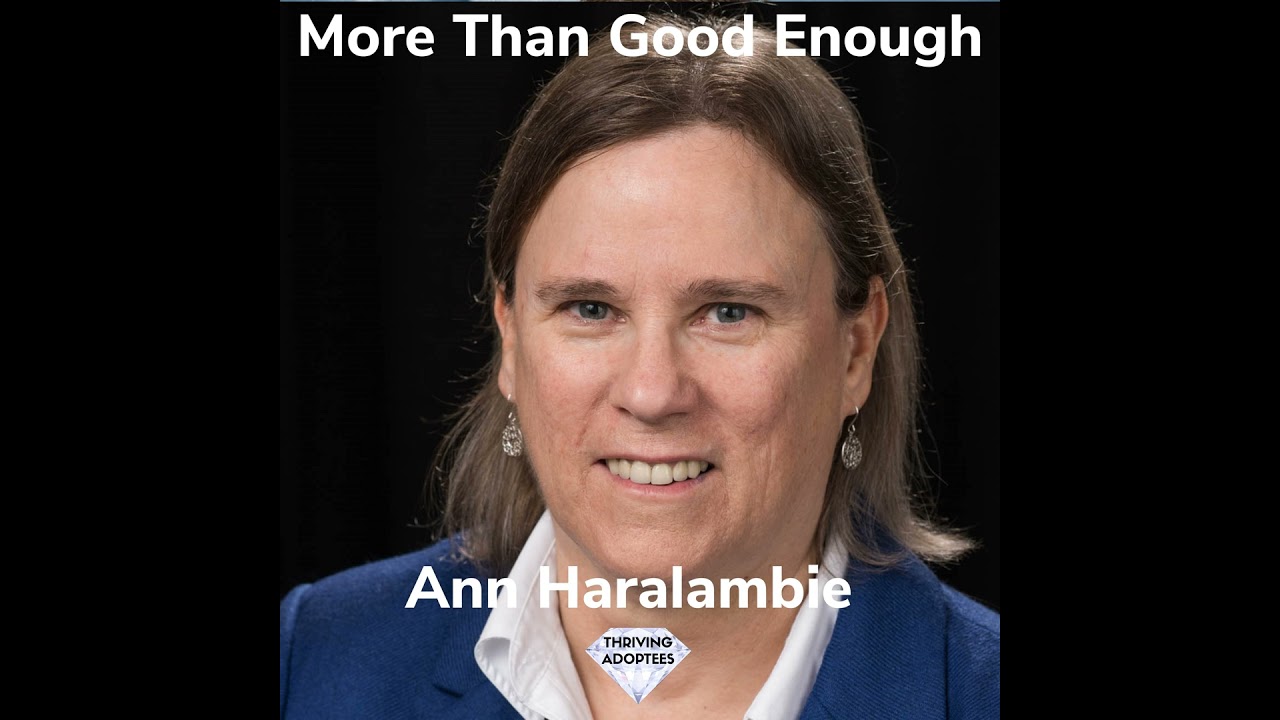
Anne Haralambie, an adoptee and child-custody lawyer, describes reading Nancy Verrier's The Primal Wound and realizing that separation from her birth mother was trauma, not her fault. She discusses sealed records, the burden adoptees carry to protect both families, and how understanding trauma at psychological and spiritual levels allowed her to extend grace to herself and reshape her legal practice.
Chapters
Hello everybody, welcome to another episode of the Thriving Adoptees Podcast. So today I'm delighted to be joined by Anne, Anne Haralambi. Welcome to the show, I'm looking forward to our, uh, our discussion today.
Very happy to be here, Simon.
So, uh, Anne, another fellow adoptee, uh, Anne was born back in, uh, '51, and, uh, we had a conversation a month or so ago and And in that, um, Anne said that she, um, she, she never— you— that you'd never felt that you'd had trauma, right? You'd, you'd felt pain, but you, but you didn't feel wounded. So can you expand a little bit on that?
Yeah, I mean, my first memory in life was being told I was adopted, and I, I don't remember what my mother said to me. I remember the place. I remember some kind of understanding that there was another mother I had that I was never going to see. I cried. She cried. I was about 2 and a half. And the pain of that and why I didn't have a, you know, why I wasn't with another mother was something that really was something that ran through my entire life. I mean, sometimes it was right on the surface, sometimes it wasn't. It was always there. Cried many tears in secret because I didn't want my parents or anybody else to know, uh, the pain I was feeling. But interestingly enough, even though I'm a child custody and child abuse lawyer and have been for 46 years and dealt with child abuse and trauma and the psychology of trauma, I never really attached that term to what I had been feeling. And so I internalized a lot of the pain was my fault. I was too weak, or I wasn't grateful enough, or why wasn't I good enough, you know, to have my parents keep me. Because my adoptive parents thought that my birth parents were married Catholics, which turned out they weren't. But that raised a lot of questions to me. Why does the child of a married Catholic couple end up being adopted? So somehow, even in my, you know, childhood, you know, fantasies, trying to fill in the blanks of information I didn't have, I imagined all kinds of tragedies happening that would explain it. But somehow, as children usually do, I internalized that as somehow being my fault, or I was somehow, you know, to blame for the situation. But I didn't identify it as trauma until, oddly enough, many, many years later. I was reading Nancy Verrier's book, The Primal Wound. I read it, you know, 20 or more years after it was published. So even though I was pretty conversant with adoptee literature, I hadn't read that one. And I was floating on my lake in some kind of inflatable reading the book. And when I realized that the separation from my birth mother, even though I was not badly treated by anybody along the way, was trauma. And so it literally was an aha moment for me. I think I even uttered the words, oh my God, sitting there on the lake. This explains everything. And by the way, It's not my fault. I'm not to blame. It's not that I'm weak. It's not that I have some kind of flaw in my character. There was a trauma that I experienced. And with that understanding, I was able to start to extend myself the kind of grace and compassion that I extended to my child clients who were abused in much more obvious ways. And if somebody was scalded or had broken bones or things like that, it was easy for me to understand that that was trauma. And I actually had studied a fair amount about trauma in my role as, as a child welfare lawyer. But to think that trauma could occur when there wasn't something horrendous and visible that was seen, you know, I wasn't raped, I wasn't physically abused, I wasn't— you know, in a war zone. I didn't have something, some circumstance that everybody would realize, oh yes, this could cause trauma in this child, and this could explain a lot of why she is who she is. And I started— it took me a while, and I think I'm still in the process of, of understanding the depth of that. But at least I started. to let myself off the hook a little bit and to give some more grace to everybody else involved. Yeah, society just didn't understand that there was any trauma involved in infant adoption, period. Yeah.
So, um, you've mentioned the word grace a couple of times, and you've said this explains everything. Was, was this a, was this a relief for you? How would you How would you sum up the emotional reaction to that?
It was definitely a relief. I mean, it didn't take away all the pain, and it certainly didn't take away my anger at the whole sealed records. You know, why can't I have my own birth certificate? This is not somebody else's record. It is my record. And all, you know, I had a lot of anger, still have a lot of anger about that kind of thing. But it let me off the hook to the extent that I didn't see myself as so inherently flawed or unworthy as I had. And Bruce Perry, who's a, you know, major expert in trauma and dealt with the kids in the Branch Division David Koresh Waco fiasco and was looking at the cortisol levels in their brain and even at rest were elevated from the trauma they had been through. Well, Bruce Perry and Oprah Winfrey wrote a book called— I think this is the title of it— What Happened to You? And they posed A very profound question that we use whenever we're dealing with damaged people or situations where somebody, you know, we would think in our mind, what's wrong with you? You know, there's something wrong with you. And they said it should be framed differently. The question should not be, what's wrong with you? But, what happened to you? And that's the same kind of thing. The question to be asked that I think dovetails very nicely with, with the whole concept of the primal wound. Something happened to me, and it happened at a stage in my development where I had no words or context to be able to do anything with it. And what we know about memory and child development is, and I don't know if this is getting too geeky for you, but— No, no, no. What we know is in order to have memories, you first have to have encoded the memory and then stored it so it's available later for retrieval. And there are a lot of reasons why people, you know, even adults, may not correctly encode or store their memories. But for an infant, you do not have words or context, so it is impossible to even encode that to end up as a memory that you can later cognitively retrieve and talk about. Now, I think I do not necessarily have a whole lot of robust statistics, but I think people also— I mean, I know I encode memories for smells and sights. And, you know, if I'm pumping my own gas, which I always do, the smell of the gasoline fumes brings me back to my childhood in New Hampshire summers of taking the boat, you know, to the dock at the store that had the gas can and my father filling it. And so that takes me back. to New Hampshire. If I smell manure, horse manure, takes me back to riding. So I know that those kinds of non-cognitive, you know, things can get in your memory and you can, you can retrieve them. But when people talk to adoptees very dismissively, and I think they probably do it less now than they did back in the '50s and '60s and '70s, They talk about, well, you know, that's just mere curiosity. To which I say, the hell it is. You know, it's not mere curiosity. People have tried to come up with words, the void, the, you know, but we didn't have the words. And Nancy Verrier explained why we don't have the words, because we didn't encode the trauma. In a way that included words or context. We weren't able to have somebody explain to us, you know, the minute we were taken from our mothers, maybe never to have any contact again, what happened. And when somebody later— for me at age 2 and a half— when somebody tried to give me words and a context, which I was able to encode and store and later retrieve in very fragmented ways. There was some other mother out there somewhere, and I couldn't be with her. That was, that was all that developmentally at 2 and a half I was able to get out of it. But at least I was able to get that. But I still hadn't labeled it as trauma. And when I later found out that my mother, like virtually every other birth mother of that era, was an unwed teenager— she was a junior in college, you know, she'd had a long-term relationship with my father, but for a lot of reasons he wasn't, you know, appropriate to marry, and they had broken up. a few months before she realized she was pregnant. You know, she was a good Catholic girl. You're not supposed to have sex before marriage and all of that. You know, so when I understood, okay, that makes total sense. And boy, don't I wish I had been told that much earlier in my life before I grieved over causing my mother's death in childbirth or having a fire in the apartment from which my birth father would have rescued me but didn't have time to go back and get my mother. And so again, I was, you know, the cause. But for me, he could have rescued my mother. And all of these things that were very, very painful to me and that I cried about and processed all of these emotions about scenarios that were totally untrue and had nothing to do with me. Excuse me. And if I had been told early on what the true story was, I think I could have said, okay, that was the right decision. I didn't want to be raised as a love child in the '50s, and it was not okay to raise a, a quote illegitimate child, which of course was the label they put on the child, not on the, the adults who were responsible for doing the deed, um, it would have been a lot easier. And, you know, I, I still probably at an early age wouldn't have understood that that was trauma. I think I would have understood more the trauma on my mother's side. And even growing up, I had— where I was placing my compassion and grace was on my birth mother. And You know, you didn't think about a birth father until much later. It was all about babies and their mothers.
Yeah.
And of course, I didn't understand again the intrauterine connection and the hearing the heartbeat and your mother moving around and, you know, all of the other sort of magical things that happen between a mother and, and her unborn child. Yeah.
So can I take you back to the, um, you said that this reading the primal wound, there was a relief and it took you off, took you off the hook. What, what do you mean by that? What do you mean by taking you off the hook?
It, it meant that something had happened to me that was outside of me, that was a circumstance That affected parts of me deep enough, you know, in my brain that I couldn't control it at the time. Just like a child who gets a broken bone, the bone can heal, but you still broke your bone, and you still know that your mother's boyfriend swinging you around by your arm is the one who did it. So I could say more that now I have to learn to deal with this in a different way that does not make me less than, does not make me damaged goods, unworthy, as, as in a character flaw. It's my fault. It means that something physiologically happened to me that altered certain things about my thoughts and my feelings on basically a biological level. And being a very cognitive person, you know, I've always lived in that part of my brain that talks and writes and, you know, figures things out. But seeing that those things happened in a different part of my brain, I had to, I had to, um, say, okay, then the part of my brain that I live in, in my relationships with people, in my, in my, you know, legal business, that isn't what's going to, um, correct the issue. I have to deal, deal with it on a more psychological and even a spiritual basis. And Verrier, and I can't remember whether she says it in The Primal Wound or the sequel Coming Home to Self, but somewhere she talks about the connection between the birth mother and the child in utero is also a psychological and even a spiritual connection. And there's a scripture that says, you know, and the of course, the right-to-life people, this is, you know, one of their big scriptures that, you know, while you were yet in your mother's womb, I, meaning God, knew you. And so there was a sense that there was a spiritual connection in me having to do with my having been conceived and born. And I totally believe, just as a spiritual matter, that no life comes into being without the breath of God or God's, you know, okay. And maybe we can make the best of it in a bad situation. But I think that God knows, you know, there's another scripture that says, before you were born, I knew you. So I realized that I could start to deal with this really more on a spiritual level. and a psychological level and get it out of my cognitive intellectual, you know, well, of course this was my mother's appropriate choice. And, you know, of course I, I am happy having been raised in a good home where nobody abused me. And as a child abuse lawyer, you really get a sense of gratitude. I mean, I told my father once— it's a bizarre moment— I had written a book on child sexual abuse and I was at a legal conference talking about it. And, you know, I said to my dad, thank you for not molesting me. Well, you know, he was a pediatrician and he was not a pedophile. And, you know, he never crossed any lines. It's kind of a bizarre thing to say. But as someone who dealt with it with other kids and seeing, you know, the tremendous trauma and aftereffects of that trauma, You know, I was, I was thinking about the positive things and the trauma that I didn't have, while at the same time starting to understand that I would need to deal with myself in a trauma-informed way.
Yeah. So if I was to sum it up, um, you've said, uh, you, you, you had, you had this question Why wasn't I good enough?
Yes.
And, and then, uh, essentially reading The Primal Wound and realizing that this was about trauma, that, that kind of blew, blew that question out of the water, the why wasn't I good enough question. Because some— your, your innate quality Uh, you saw your innate quality. You saw that this was, uh, that this was something to do with— or this was all about trauma and nothing about the— it— your inherent quality as a person.
Right. And I knew that cognitively, um, but getting that into your emotional self Um, you know, and which, which isn't to say there aren't still hooks that, that go back to why am I not good enough for XYZ? I mean, my husband left me, divorced me. Why wasn't I good enough, you know, to stay married?
This is a— so there's a really big point here, I think. Um, one point or two. The, the first one, you're talking about, um, the depth, the, the depth of an understanding, right? So we can get stuff in our heads, in our hearts, or in our bones. So you're talking about the depth, depth of that.
Yes.
That's one thing. So for, for us to be aware of, um, uh, is, uh, getting stuff cognitively in there, getting stuff emotionally in our heart, or getting our stuff as like, uh, what I think people call this as a, um, what do they call this, an embodied understanding. And embodied, it's, it's, it's all of you. It, it's—
Yes.
It's not just a vague theory. It's not just a, um, a thought that happens to you once. So that, that's one thing, that there's this depth of understanding. And as, as a society, I don't think we talk a lot about that. We think of knowing stuff like knowing our times tables from school, or, you know, knowing that 2+ 2= 4. Knowledge is often portrayed as a 1 or a 0 thing. It's like, especially in this digital age, it's either yes or no. It's not about depth. Right. And so that's one thing that you're drawing our attention to. And the other thing that you're drawing our attention to, which I think is even bigger, is just because we get this stuff, uh, we, we understand our quality at a cellular level, our inherent quality, um, doesn't mean that the odd thought doesn't come up, right?
Absolutely.
So what this is, the reason I'm laboring this, or reinforcing it really, is because it's something that I've struggled with. And if I've struggled with it, then the likelihood is that other people have struggled with it. You've seen it. You said, well, just because I've had this, it doesn't— I've had this very deep embodied understanding of my own inherent quality. It doesn't mean that I never have the I'm not good enough thought. Because our brains will latch onto the fact and they'll say, right, because they're going back to that, they're going back to that place of understanding is a yes or a no. And then there's frustration. You think, well, we think we've learned the lesson and these random thoughts are coming back up again, especially something like a divorce. it's totally understandable. And, you know, we have, we have moved on. And rather than this frustration of us having to go— the fact that we've gone all back to the start again, that's not the truth, right?
Right. But, you know, and I think it's probably, you know, there's— it was so deeply ingrained that I think it's going to bubble up for the rest of my life. And it's a matter of— and that's where I think grace comes in and the importance of giving myself grace as well as giving grace to, you know, everybody else that was involved other than the agency and the laws that set up a system that, um, is only on the surface for the interests of the child. I mean, my whole career has been to try and serve The best interests of the child, and you know it was a phrase. If you look at adoption, you know the the stereotypical at least older version of adoption with the unwed mother relinquishing or surrendering her child to the married couple, and the mother is told you have to think about the best interests of the child. You're a single woman. You have no money. You're gonna bring shame on the family. You know, you have to place this child for the child's best interest. The child will be raised by people with more money, with people who are married, who are more stable, will have a better life. And on the flip side of that, the adoptive parents are screened, or again, were. in a different situation now where most U.S. adoptions are out of children in foster care, or people who get infants basically, you know, do international adoptions, which has its own other problems that I don't want to get into. But, you know, the adoptive parents are screened to see if they are good enough to raise somebody else's child. And, you know, would they be in the best interests of the child? you know, to, to take this child and adopt this child. But at some point, the actual child and the actual child's best interests are subverted to, you can't be disloyal to your adoptive parents. And I know you know this because any of us who have talked to hundreds of adoptees, at some point or another, a large proportion of them are told things Um, like, how could you do this to your adoptive parents? You ought to get down on your hands and knees and thank God that they took you in and treated you as if you were their very own. Which, of course, you know, how you can never repay the debt of their charity and beneficence.
Yeah.
And the aha moment I had regarding that was when I had represented um, some adoptive parents in private adoptions. I've never been willing to place a child. I, I will not do it and have never done it. But if somebody's already had the child, um, identified for them, either through friends or relatives or their pastor or their doctor or whatever, and it was already a done deal, then I would represent them, um, in doing it. And when I would go to the hospital with them Because this was now in the '70s and '80s where, you know, adoptive parents actually got the child fairly soon after birth in many cases. And I saw, hey, these people are getting something out of this. These people really wanted a child. This is like the answer to their prayers. And I don't know why it never occurred to me until I was a lawyer on the side of the adoptive parents that I realized this isn't, you know, the charity of scraping some kid out of the sewer and raising them as if they were your own. These were people who really wanted this child and loved the child and did consider the child to be their own. And then the other half of it, when we start to search, And again, it's not as much of a problem now. It's still somewhat of a problem, but I mean, I started searching back when adoption search was very brand new. Florence Fisher and Betty Jean Lifton and Annette Barron, all of those people. That's when I kind of entered, when they were doing things. And, you know, people would say—
Hmm.
How can you do this to your birth mother? I'm sure she now is married and has her own children and a husband, has made a life for her. Basically that this slut, you know, who made this horrible mistake has now reformed, and you showing up, you are now going to ruin her life. And so that was a burden that adoptees carried with respect to um, their birth mother to not ruin her life. So you were either going to be, you know, a disloyal ingrate to your adoptive parents and/or, you know, ruin your birth mother's life. So of course, if you're a decent person, you're, you know, your brain is telling you, well then, my, quote, need to know, or my desire to heal from my trauma, or even my desire which I expressed, you know, at the time I started searching. I want to let my mother know I turned out okay. I was treated well. She made the right decision, and take that burden from her of guilt and wondering, you know, why she had made the right decision or what had happened to— I mean, I never— took drugs, not tried a marijuana joint, nothing. I was, you know, the unicorn of my generation in that regard. I didn't have sex till I got married. I tried to live a very straight and narrow life. And yet birth mothers that I talked to and represent, have represented, you know, were worried, oh my gosh, you know, coming of age in the '60s and '70s. You know, did my kid get into drugs and promiscuity and die of an overdose or have a horrible life or whatever? And there's so much healing that could happen for everybody that was stopped by putting this burden on the adopted child that— and at least now we're calling them adoptees, but that's fairly recent. Didn't matter how old you were, you were an adopted child.
Yeah.
Um, but now all of that burden was on us to not make everybody else feel bad. And the heck with, you know, the fact that we were traumatized, that we could use healing, that we could bring healing. And I got healing even though my mother died 2 years before I found and never told anybody. And I was the big shame. And also, she was traumatized, according to my uncle. And while I had some good conversations with my birth father, also a lawyer, um, he ultimately decided he did not want to acknowledge me. And so I didn't have, you know, the happy reunion with my birth parents. Although I have some cousins and other, and other people that I'm in relationship with, some very important. But it, it brought some level of healing to me in a way that, again, I can't really express very well. I tried in my book to express it, but I don't think I necessarily was that great with getting the depth of what it really means to be able to give myself grace. and to give other adoptees grace, whether they have the wonderful reunions, whether they are angry and think adoption is just child trafficking and should, you know, should be wiped off the face of the earth and everything in between. But I think grace— and for me, that's a spiritual thing that, that I can offer myself and others only because God offered grace to me. Um, but I think that, you know, that has helped me. You know, the, the title of your, your podcast and, and your website is Thriving Adoptees, and I think I'm finally thriving in my sitting in my adoption more than I did, and hope that other people can get to that point. But in that acceptance and grace, still be fierce advocates for changing a system that imposes and continues to impose pain and frustration on all of us. Didn't mean to be so preachy.
Yeah, I think it is that thing about hard— it being hard to put healing into words. That's that. And it is. And I'm into spiritual stuff, but not like religious stuff. So, you know, I believe— so we use the— I use the word consciousness rather than spirit.
Oh, God.
Um, you know, I, from the, from my view outside looking in and hearing what you've gone to saying, that one of the key moments was the, um, the, the, uh, the demise of the why I wasn't, you know, I'm not good enough belief. That, yes, that, that, that's That, um, that, that's what stands out to me.
But it still doesn't take away the, why do I have to suffer these things? I mean, I felt that with my, um, uh, with my divorce, and then when my daughter died unexpectedly at 41. My only child. She has one child. So that, until I found my birth family, that was the sum total of my genetic family was my daughter and then my grandson. And I'm thinking, gee, you know, I have one child. Why does this stuff, you know, happen to me? And it, you know, there's, there are no answers to those kinds of questions and, and having to learn, you know, that, that I have a pretty pruned-down genetic, genetic tree. But what You know, how to deal with that and how to hope that in her lifetime I gave her grace. And I, I am a person of faith, so I do believe that there is a heaven and an afterlife and that, you know, the Bible says that all things will be revealed. And I am hoping that I'll get to meet my birth mother in the hereafter and, and reunite with my adoptive parents and, you know, my daughter and all of the people that I've loved who have gone before me. But, you know, I have to keep pulling myself back and realizing, you know, that stuff happens. We don't all have easy lives. Some of us, our lives are very easy in some ways. I never had to worry about you know, the threat on the other side of the bedroom door. I didn't have to worry about being abused or not having enough food, or, you know, not getting an education or being able to support myself. But, you know, there are still, there are still wounds and lacks and traumas that happened. I mean, the death of a child is a trauma, obviously. But learning how to deal with one trauma, I think, maybe helps in dealing with another trauma.
Yeah. How do you think— how does that look to you? How do you think that familiarity with one trauma helps you deal with another?
You know, one thing that I started saying to myself Probably starting, you know, back with my divorce in 1973, uh, when I hadn't even— you know, I, I started law school a couple years after that. But, you know, I started saying, okay, Lord, I look at examples in the Bible. I look at Job, who my God had everything taken from him. I look at you know, the 3 Hebrew children put in the fire, and the Lord brought them out of the fire. I looked at Lazarus, who died and was raised from the dead. I looked at people who, like Jesus, who was crucified and, and suffered all of that pain. So I started saying, okay, Lord, if you can— just as Jesus said, Lord, if this cup passes away from can pass away from me on the cross. But if not, thy will be done, basically. And so I started thinking, particularly when I was a lawyer, okay, Lord, if I have to go through this— I've gone through 2 major clinical depressions in my life, one related to my divorce— if I have to go through this, at least on the other side of it, let me have learned something. that I can help somebody else with. Let me have some degree of compassion that I can offer to other people, understanding from someone who's been in the crucible that can make it better. Just like I was hoping with my birth mother. Something bad happened to her. She got pregnant when she didn't want to and when it wasn't convenient. But let me have made something good out of that. Let me somehow have been, you know, a counterbalance to the shame and the pain. And so that's how I have approached other things, including my daughter's death, including my divorce. And I think it's made me a better lawyer handling clients who come through a divorce. You know, I don't trivialize the pain of that. Dealing with clients who have had or are in the middle of a major clinical depression. I know what that's like. I know what it's like to be able to function as a lawyer and come home and go into my bed and cry and not want to wake up the next morning, so if I can give my pain or my trauma some purpose, I think I will have done the best I can do.
Yeah, well, I think you're doing that. I think you're doing that right now with what you're sharing.
And it's really— it's a lot of why I decided to write a memoir, because— and, and why I waited really 14 years after I found, and a year after my birth father died. to do it because I wanted to, to have some insights. Yes, I wanted to write a good and interesting story that has a lot of twists and turns and whatever, but I wanted to have some insights that could maybe help somebody else, somebody else in the triad, um, some other adoptee feel they're not alone, that many, many of us have gone through exactly the same kinds of things. And we each find a little piece of insight. And if we share that insight with somebody else, then maybe that can help them.
Yeah.
And maybe we can look back and, you know, the real concept in terms of vocabulary of giving myself and other people grace really came through the writing of the book. I hadn't thought of it You know, putting that word to it. Um, even though I think that I was trying to do that anyway. But for me, being a verbal person, having the word makes it, you know, makes it easier and makes it more the ability to, to have an aha moment. Like the word trauma was in, for me, in reading The Primal Wound.
Yeah. My, um, my own experience with reading The Primal Wound was similar in the, uh, in the first instance to yours, and almost identical. You know, you said, this explains everything, right? That's what I thought. That's what I felt, um, when I Uh, when I read it, you know, so much so that I, I tracked my Amazon history. Um, I do remember reading it in pretty much in one sitting, the first book, and I looked at my Amazon history, uh, uh, and I bought the second book probably 2 weeks afterwards.
Me too.
Yeah, I, I found the second book Um, just, well, impossible really. I mean, you, you talked about, you've talked about the kind of like the spiritual connections. You talked about, you know, psychological side and the emotional side. For me, the, for me, all the profound stuff happens at a spiritual level, right?
Yes.
And, and that's what she kind of— what she was explaining in the first book. But the second book is, is all psychological. And, and it's— I guess it's like that. It's like a, you know, the, um, But it's like the musicians say, you know, we have— you've got, got the— you've got the whole of your life, you've had the whole of your life to write your first album, and then you've got 6 months to find your second album, and, and, and it's the difficult second album. And, and, and that's the thing I found with, with the second— with the second book.
Um, I read it as a lawyer. I read it the way that I read other psychological books about abuse and other professional books about abuse. And then also was applying the things there. But I think in a lot of ways she was trying to aim that towards the mental health community and towards professionals working with adoptees as much as— I mean, she of course was not an adoptee. She was an adoptive mother trying as a, as a therapist. I think she had a master's degree in psychology to help understand what her adopted daughter was going through.
Yeah.
And so I think she was writing that a lot for the adoptee and the adoptive parent to understand that. And then I think in Coming Home to Self, I think a lot of it was— and I haven't read it in a while, so from my memory, I kind of— the snapshot I take away from it, it was much more aimed, or at least I read it more with wearing my hat as a professional dealing with abuse and trauma.
Yeah.
At least as much, if not quite a bit more, than dealing with it as the traumatized child. Yeah.
Um, do you, do you think— have you heard this phrase? It's one that I haven't— I've used quite a lot on the podcast, but not so much recently. This, this idea that we are, um, spiritual beings having a human experience.
Absolutely.
Yeah. Um, do you think that— that this is really a loaded question because, um, we're just— we're just debating it, right? Do you think that that spiritual being can be wounded?
I do think so. I do think— I mean, and, and I, I have expressed things, for example, discrimination. Let's take discrimination against Black people, discrimination against LGBTQ— I'm not sure all the letters— people, or discrimination against any people, especially if it is for who they are. I mean, God made a Black person. God made an Asian person. You know, God made all of us, and I feel a spiritual wound and have always expressed it that way when I see people discriminating against it. And it deeply affects me. I mean, brings me to tears to see discrimination. And, you know, of course, in the United States, and, you know, the last 6 years, we've seen more of it than than at a lot of, you know, times. But even as a young child, I— when I saw people being discriminated on the basis of race, I mean, it enraged me, but it wounded some part of my spirit. You know, John Donne, years and years, centuries ago, you know, wrote For Whom the Bell Tolls, and, and he says, seek not to know for whom the bell tolls, it tolls for thee. Because he talks about we're all part of, you know, this human race. We're all part of this body. The, the Christian church would call it the body of Christ for some of us. But, but we are all, you know, made by God, and a wound to one wounds, I think, the spiritual body. And it— those kinds of things offend me on a different level than on an intellectual or even an emotional level. And I, I think that— and I talk about my spirit being wounded. So I absolutely think that's a thing.
Yeah. So, um, looking at, looking at some, looking at some stuff around the— that this consciousness, this consciousness space Um, if we were to, and if we were to look at something around consciousness, around, uh, there's something, I mean, something called non-duality, where we talk about the, the, uh, about the, uh, awareness as being, uh, aware of, you know. So it's the difference between what we are aware of, right? We're aware, we're aware of our trauma, but that's the, that's the content of our consciousness rather than consciousness itself. Um, or looking at another, perhaps an easier to understand metaphor than that, is, uh, the, the, the screen. You know, this— We're looking at But each— we're looking at each other, pictures of each other on the screen. But if we're watching a television, when you're watching a television program, right, the, uh, the television, uh, screen is untouched by the, the, the drama that, that appears on it, you know. So I'm thinking about a trauma, like a car crash, or a— you talked about Waco earlier on, like a shooting. So the screen isn't damaged by the movie. The screen doesn't laugh at the rom-com. The screen doesn't cry at the, you know, watch when Roots comes on, right? So Alex Haley's Roots, that, that, um, terrible stuff that happened to, uh, uh, to—
And that was a spiritual wound for—
Well, yeah, I guess it's, it's how we, it's how we define the word spirit and, and, um, and, and consciousness. But I, I, I see spirit as actually unwoundable. Um, what That's kind of my, my take on it. And I guess we're just— that's what we're really talking about, is our personal, our personal take.
I think it's— I think it is not ever able to be lethally wounded because I think, I think the spirit will always persist. And I think that the spirit You know, that, that the spirit is a separate, a separate thing that, that is eternal and unkillable to that extent. But I think it can still, it can still suffer wounds.
Yeah, interesting.
And I think the wound, I think the wounds can be healed. But in the moment, I think it can It can feel the wound. Not every wound leaves a scar.
Indeed. Um, I, I came— I'm playing with this, uh, I'm playing with my communication and my messaging on this because clearly I'm not there yet, right? Um, I came up with this idea of, uh, of a spiritual stab vest. Okay, so the idea here is it's a, it's a metaphor. So the primal wound is a metaphor, right? It's a diagnosis, it's a metaphor. Um, uh, and, uh, you know, I have felt wounded, but have, have I been wounded? So this idea of the spiritual stub vest I came up with, so that, you know, I'm in the wrong part of town. Um, I have, uh, I've taken a side street, uh, that's dimly lit, but there is one light. As I'm walking down the, down the side street, I see a glint. I see the glint, and then I realize that there's a mugger there, you know, with a hoodie on, so dark, you know, dressed in dark clothes. And in a flash, he's on me, right? And he shoves the knife at me, he jabs the knife at me. I feel the pain, right? It hits me so hard, I'm almost— I'm winded, right? And I feel him going through my pockets. He, he takes the wallet off me. He runs away. I reach, I, I reach down inside my jacket because I can still feel this pain, and I'm, and I'm looking. I think I'm gonna feel some blood, right? But I, I can't feel any blood. And then, uh, when I stumble in front of the light, I can't see any blood on my hand. because I've had this spiritual stab vest on, right? So the idea is that, that the, the spiritual stab vest means that I have felt wounded, I have felt cut by this 6-inch Bowie knife that this, this, this mugger had, but I haven't been wounded. And that's the closest that I've kind of got so far to describe the difference between feeling wounded and being wounded. Um, and, uh, and, and that's why I believe that we, um, we are unwoundable. That came to me as an aha moment. And in the same way as we were discussing early on, that it's hard to describe healing, it's hard to describe That, that thing, that moment of truth I had when I, when I realized that I, I have felt wounded, but I haven't actually been wounded.
Yeah, I think it's maybe for me the difference between being killed and being hurt.
Okay. Yeah.
I, I don't, I don't think that deep down, whatever it is we're talking about can be killed. Yeah, but I think it, I think it can be hurt, but then it, you know, can bounce back, it can heal, it can flourish. Yeah. Here's to flourishing.
Here's to flourishing. Right, we're gonna have to do another podcast in a while, in a couple of months, because we have, I think we've got to the gist of the, the really interesting bit there for me. That's the way to do it. Yeah, that would be great. Um, I hope you have, uh, got something from this, listeners. If you're still listening now, then you probably have, I guess. Um, uh, it's been, uh, it's been great, great for me. Um, I hope you've enjoyed it too, Anne. And, uh, well, you must have done because you just volunteered to come back on again. Um, and, uh, we'll, we'll pick up that conversation on another Um, on another time. Thanks a lot, listeners, and thank you, Anne.
Thank you.
More from Simon







Weathering Storms With Joanne Morales, Jennifer Hartwig and Rebecca Dominguez


