Startup Lifecycle Explained: Everything You Need to Know ! Webinar
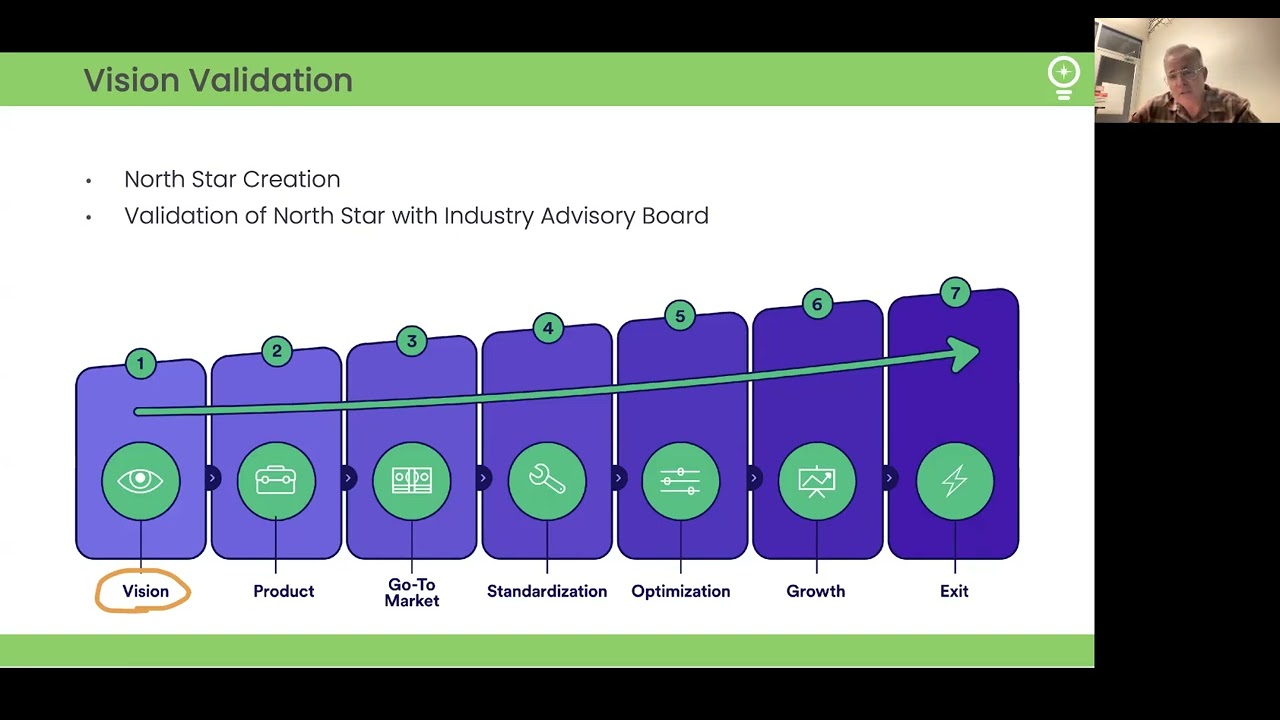
Marty Bickford of Boss Startup Science outlines seven stages of startup growth: Vision, Product, Go-to-Market, Standardization, Optimization, Growth, and Exit. Each phase has specific milestones and metrics. Timing matters: moving too fast wastes runway, while a clear exit strategy from the start guides every decision.
Chapters
Great. Hello, this is Marty Bickford from Boss Startup Science, and what we wanted to do today was give a little bit of background on the startup lifecycle. So it's not something we invented. This is something that most startups go through. So we did want to share some really important aspects of each phase of that lifecycle. So we're gonna jump into that, but this is what it looks like. And if you've been at a startup, you understand these phases, right? So you start out with vision. What are you gonna do? Then you build your product. You go to market. Go-to-market, we'll define that for you. This is a testing of go-to-market strategies. Then you standardize your processes, you optimize, and then you're ready for growth. So each of these is critical to the success of the next phase. There are important milestones. that you have to achieve to legitimately leave one of these stages. And that's where we think the education and going over this is really important to founders. So these are the 7 stages or phases. And what's important is that the life cycle itself reflects that journey from value creation to value capture. So we're building something that we, that we know creates value. It will create and capture, it'll capture that value when we're done and we're ready to really have an engine that is selling, servicing, and continuing to innovate. But we really, you know, later when we're capturing value, we're really focused on growth. What's really important is that as founders, that we do things at the right time. Right? We don't want to get ahead of ourselves. We have an orderly process, and not doing things before we should can lead to a reduction in runway, which is, we know, the lifeblood of our startups. And also, it can make you feel like you've validated certain things that you haven't, and that's a common mistake whenever we get into trying to prove product-market fit. Right. Each of these lifecycle stages we want— or phases— we want to demonstrate our progress, demonstrate our traction, and that builds stakeholder confidence, including the investors that we are probably going to need at some point to continue down that lifecycle. And we want to reevaluate that at each phase in the lifecycle. We also want to, along the way, make sure that this validation and traction, along with other KPIs, are being captured the right way so that we can make really proactive, data-driven decisions. Obviously an important thing we all want to do. So why should we have a lifecycle? Well, knowing where you are, knowing where you're going, And what's the next step to get there, right? You can call it a map, a GPS, whatever you want, but ultimately you need to know what's the right thing to do right now and what you have to do next. You know that based on where you're going, right? And that'll tell you what the next objective is. And you'll notice that one of the phases that we have in the lifecycle is exit. And there's a lot of talk about, you know, should a startup be pitching their— what they want to exit for and all that stuff. We're not talking about what you talk to investors about. What we do think is really important is that you have an exit strategy, that you understand your personal goals, why you're doing this business, what that looks like for you at the end. Right. So it always makes sense. Big project, small project, startup, corporate project, whatever it is, you start with the end in mind. And when we embark on probably one of the hardest and sometimes longest projects in our careers, a startup, not starting with the end in mind does not make any sense. So we encourage that from day one. Timing and objectives. So most startups will get into the growth phase and sometimes exit. In a 3 to 5 year period. So we know that that's typical and never true of any specific startup. So we're not trying to say this is an absolute, but when you look at the data, this is typically what people are doing. Objectives. Each of these phases has very specific metrics or tangible outputs that get you to the next phase. There's always gonna be some gray area where you're still sort of in product or you're in go-to-market, you're testing your strategies and you're starting to standardize at the same time. We're not saying that's a problem, that's normal. Nothing in the startup space is clean, but it is important to know what those objectives are and what lies in front of you. So, and another big, big piece is obviously runway. So we believe that Each end of each of these phases, as you start to approach the next one, you need to make sure that you are funded to get through that next phase. Each phase comes with new challenges and obviously validation points that help you achieve that runway, those, those pieces of investment that is necessary to move on. So let's just jump right into these different lifecycle phases. So The mindset for vision is very clean, right? What's your big idea? And is this an idea worth pursuing? That's what we're trying to figure out, right? So how do we do that? Well, the first thing that we need to do is create a North Star. A North Star is extremely important, not just for startups, but for any business. You need to know what you're all about. What is the makeup of your company? What will the makeup of your products be? Who are your customers? Who's your ideal customer? And understanding that, we all know, is extremely important. We define the North Star deeper. We believe that you should have all of your user stories and your marketing personas, and marketing personas include How you're going to reach them, and also how you're going to service them. Right? So can you win customers through the channels that are available at a profitable rate? Right? We're not saying you're doing that yet. You haven't even built your product yet. Right? But you need to have a clear plan that this is something that you can do, and that you're the right company to build this product, and that there's a market need. So you're going to do your market sizing. You're going to do your market dynamics. All of the information about your customers. You're really gonna build out a really strong plan to understand how you can start and will the customers be there. The other thing that's included in that North Star is an exit strategy. So what is— why are you doing this in the first place? Most of us do startups for a very plain reason, and that is to make our lives, the lives of our families and our communities better. All right, so exit strategy matters because you have to plan for a good exit if you want one. Timing, life, there's lots of stuff. Market conditions can get in the way of a well-priced exit if you wait too long, and you can obviously undercut yourself if you sell too early. So understanding that as a part of the North Star is really important. Once you've defined your North Star, You know, instead of having a pitch deck where you go run around asking for money, which we want you to do with that is validate that North Star with what we call an industry advisory board. All right, so the North Star, I already talked about these things, right? Market sizing, market dynamics, what the product is and why it's being built, what the company is and why it exists. who those ideal customer profiles are, who the marketing personas are, what are the user stories, and what is your exit strategy. The other key component right at the top is your ecosystem, and that's something that you build in your vision phase. This is every company, every product in the industry that you play in. You need to make a list, understand their relationships. Are they potential partners? Are they competitors? Are they a potential acquirer at the end of the day? Understanding the ecosystem is the same as understanding the market. Who are you up against? What is the opportunity? And it will define a lot of your strategy. So that ecosystem piece is really important. And here at Boss Startup Science, we have a whole course on how to build an ecosystem. We also wanna focus on the industry advisory board. So this is a group that as a founder, you go collect of industry experts. People who know about the problem that you're trying to solve are in that market and will be able to review your North Star and give you feedback. You know, maybe the customers aren't going to buy the way that you want or your price points are off. Maybe you can't really reach them the way that you think, but the industry advisory board says is a, you know, is a way to reach those potential customers. So that board should give you some confidence that not only will your company fill a need that's real, right? Is this thing even worth building? It'll also give you a really good idea if what you're building is investable. You know, so can you attract investors into this problem with you, which is potentially going to be important? Some of us are able to bootstrap and that's fantastic, but if we can't, we're gonna need resources along the way. So that North Star combined with the industry experts, that advisory board, are gonna tell you those things. And once you have validation, right, then we're ready to start building. But if you start building before you have the green light from folks in the industry, you run the risk of wasting a lot of money and a lot of your precious time building products that customers ultimately won't be interested in. So that validation is really the most important point coming out of the vision phase. You've built your North Star, you know where you're headed, where you're going, you know how you're gonna get there, and you've gotten feedback and validation from the industry to say yes. Those folks are hopefully gonna stick with you. They may become potential customers of yours. They may become potential investors of yours, and we would advise that you have a mix of folks in your industry that play those different roles. They will benefit you along the way, and talking to them early is important, not only for the validation but also for the stickiness of having those folks stay with you along the journey. All right, so we've got the green light from our industry advisory board. Now we're going to roll up our sleeves and start writing some code. So in the product phase is very simple. We're going to allocate all of our funds to building prototypes and an MVP. We're not worried yet about, you know, our marketing channels. What we really want to do is validate that we can build what we think we can build and test the value with that, with not only that industry advisory board but with other folks. It's that value creation that we're after. So the potential customer has to understand that value and be willing to pay for it, right? So that's the goal of the product phase is we want to build our prototype, validate that, and then build our MVP and validate that. So let's talk about the MVP, right? You can't build an MVP without a prototype. You need to prove to yourself that you can actually build what is in your, in your head. And then we build the MVP. All right, so what we're trying to do is create value. Value is relative to price. So we need to start understanding if our price points that we can charge are fit— are a fit for the value that's gonna be delivered to our customer, right? This is a part of the MVP process because your MVP is built directly to that, right? We don't build the features and whiz-bang stuff that, you know, are the nice-to-haves with our core customer, our ideal customer. Are they willing to pay for this value? And our MVP allows that to be tested. So the other thing we gotta do is test our marketing message to the ICP, which is why it's important to have customers early, not paying customers, but customers, potential customers that will engage with you on that value. And the other thing we have to do is test the messaging. So if we present our solution to your problem in a certain way, does that attract you to this product? Does that make you wanna try it, right? That messaging is just as much a part of the product as the code, right? So we like to build things and then maybe go away and see how we can sell it. These things go together, right? Now we're not gonna allocate a bunch of funds to testing marketing channels yet. We're gonna allocate our funds to engineering. But if we come out with an MVP and we don't have an understanding of the messaging that goes along with it, that's a fail. So what we wanna validate against is that MVP with what we call a user advisory board, right? This is absolutely a mix of your paying customers and your users. Now those two aren't always the same, right? Which is why We need to call out that it needs to be a mix, right? 'Cause you need to prove the value, but you also need to make sure that people are going to use it, that they like the value that's being created. So the same way that you had an industry advisory board there to validate your North Star and your plans, and a lot of these people might be the same, right? You can reuse some of these folks. The user advisory board is there to validate that the technology, the product that you're building, Is a solve for the problem that you set out to solve, right? That, that— so that you're actually building the right solution. And you're only doing it in a minimal way, right? You didn't give them everything they want, but you gave them what they need to create the value at the right price point, right? Will they buy it when you're done? And in this process, you should find your first customers. through that user advisory board. I'll tell you, there's no better sales process than asking someone who has the problem you're trying to solve to be engaged early in the building of that product. Okay, the other thing is this is really where we start to understand product-market fit. So the questions that we have to ask— answer, sorry— in this phase are, Does my messaging actually attract potential customers? It's not okay for us to build products that we have to spend a ton of money on to get people to adopt, right? It's the messaging that should resonate with them because it's describing the problem that they can align to and it attracts them in. You want your customers coming to you because the message that you have is doing that for you. The next thing is, can you get that message out to the potential customers? How do you reach them? Who, you know, you know who you're selling to because you defined your ideal customer profile. Can you reach them? Right? And you have to, and then not only that, but can you retain them? So can you win them because they're attracted to your solution? Are there channels that you can go through to get to those folks? And once you win them, can you hold onto them? Is the value strong enough against the price point to make them wanna stay? These are things we need to start testing as we roll out our MVP. MVPs are not just about features. It's about our ability to win and retain customers As well as features. There's some more questions that you need to start thinking about as we start to progress down the lifecycle, and that is, what type of org is required to win and retain those customers? So it's not just the messaging and the channels, but as I scale this company, as I go from 1 to 100 customers, what does my org need to look like? And can I build an org that creates profit, right? Or do I have to build an org that requires way too much service to retain the customer and therefore I can't see profitability down the road, right? So we need to start thinking about our service and our marketing and our sales as well as our features and our MVP. And finally, before you move out of product, right, you need to make sure that you have funding for the next phase. Because the next phase costs money too, right? So we'd spent a bunch of money on engineering. Now we're going to look at how do we actually start to test some of those go-to-market strategies. So we have our vision, we built our product. Now we're going to start going into the go-to-market phase. And like I said, some of these slightly overlap. That's okay, right? That's normal. So the goal of the go-to-market phase is to find those scalable marketing and sales strategies, right? What we really want is I might have a great salesperson that can go win me, you know, 20 customers. Can I add 2 salespeople, right? Will that triple my amount of revenue that I'm doing in my wins in the customer area? Can I afford the marketing that's required and the sales process price, or, you know, the cost of sales, right? There are cycle times associated to the sales process. So can I afford that? If I have a product-led sales approach and marketing approach, then the answer is probably yes, but that's not an easy thing to achieve. So I probably am going to end up, especially if I'm in B2B, with cycle times, pulling those prospects through different stages. And the go-to-market phase is where you start to define that. One of the key objectives to move past the go-to-market, and this is really where you feel in between coming out of product and leaving the go-to-market phase, that's where a lot of startups go to die. This is where people don't find product-market fit. And product-market fit, like I said, is not just about a good product that someone will use. It's about our ability to get to break-even with all of the operations that are required to sell, market, and service that product. So what we're really doing here is testing. We're testing our ability to grow an org. We're testing our ability to reach and win customers. So from marketing and sales perspective, I just wanna emphasize this is not the growth phase. Growth is where we have a well-oiled machine and we go to an investor and say, look, if you give me $1 million, I'm gonna turn that into 5. I'm not, I don't need to build a whole bunch of new products. I'm ready to rock, right? I know I can reach these customers. I know who they are. I simply don't have the resources to go out and win all the customers. That's not where we're at yet. We want to validate, uh, that we have achieved, uh, the objectives necessary to move to the next phase first, right? So we're testing our channels. What works best? Print advertising, ads, direct outreach to the potential customer, Partnerships, right? How am I gonna put my messaging out in front of those prospects and what will lead them through a measured process into becoming a prospect and then a potential customer? So we're testing our channels, our ability to create reach, and we're testing our sales strategies. And our sales strategies are not just how slick can you be on the phone. Right, this is about what validates them moving from one stage to another to be able to create reasonable forecasts and understand cycle times. How long does it take your customer to get through legal? How long does it take to get them from reading your blogs to wanting to have a call? Right, these are all measurable, measurable stages that we can put in our CRM and create forecasts with. So we're testing our marketing, we're testing our sales, and we're testing our pricing models because ultimately, right, we're looking to deliver value that exceeds the price that our customers are paying. We also start tracking our KPIs, and our KPIs are around these things that we want to prove, right? And there's a whole list of KPIs that once we start winning and trying winning customers retaining customers and trying to reach customers, our KPIs really start to light up and you start to see what works and what doesn't. We're gonna have lots of KPIs, but some of the ones that are important are cycle time, right? From the point you reach out to a potential prospect, how long does it take you to get cash in the bank? That's really important. If it's 2 weeks, that's a lot different than 6 months, right? Those are funding gaps that we may have to make up. So we need to understand these. We're not trying to adjust them yet. We're just trying to understand them. Our win rates, our sales strategies, our stages, sorry, our CAC to LTV ratio. In other words, how much does it cost me to acquire a new customer versus how much money I think I'm gonna get out of that customer over the lifetime of my relationship with them? Yeah. And obviously, can I retain these customers? It's very common, especially if you're in B2B, for people to use strategies like freemium models or short-term contracts that turn into long-term contracts. So you'll naturally be using some of these that will give you good early data about retention, right? We need to measure The dollar cost and the percentage. And then the final big piece of the go-to-market is really about breakeven, right? When is it possible? We're not saying you have to be there yet. Lots of great companies that weren't to breakeven once they went public. But can we see it, right? Can we prove to our potential investors, to ourselves, right? We're our biggest investor anyway with our time and our own resources. But can we prove to ourselves and to our stakeholders that we will hit a break-even? And if we decide to hit a break-even, when will that happen? Right? You may decide not to break even and to continue to pour money into other things because you know that you have more growth ahead of you, right? Not saying you have to be— you have to break even, but the point is, Once you have built your product, validated your channels, validated the fact that you can retain and win customers at a reasonable rate, breakeven has to be on the table, right? That's for your own good and for the confidence of new potential investors. So breakeven is really important. Even if we decide to not break even, right? Knowing when and if it's possible are critical questions that will be answered in this phase. All right, so just to review, right, we're through vision, we're through product, go-to-market. Now we're gonna move into standardization. So standardization, is a phase in the life cycle. It's not a big one, but it's important. So we've done all of this testing. We've started to build our operations. Now what's really important is that we standardize our company, right? This is a huge factor in reducing risk that pops up once we move into growth, right? We're still preparing for growth. So although it may not be a huge time suck, may only take you 3 to 6 months to standardize, if you don't do it, you can't optimize. And if you can't optimize, then you're not gonna grow with the same potential that you could, and ultimately you're reducing your value on exit. So best practices is what we create during our standardization process. Right, we codify all of the functions in every functional area, so sales, marketing, finance, HR, customer success, engineering. We want to understand how we hire new people, how we onboard them, how engineering communicates with product marketing, and how product marketing translates things over to marketing, right? and how sales hands off customers to service. These are really important things that cause disruption in a company if you do not standardize them once you're ready to grow. So you standardize first. At this point, all of your KPIs are turned on. You're able to measure the effectiveness of your onboarding process for new hires and for new customers. You're able to start measuring the effectiveness of retention and what leads to retention, right? So extremely important because we're starting to gather data on our own operation, how effective it is, and how efficient it is. Before this stage, we're really focused on effectiveness. Can we do things that work? But once we hit standardization and move through optimization, we start to look at efficiency. We start to build our value capture as opposed to creation, right? So we're building something that will create value. As we move to capture that value, we need to standardize our processes. This is where a lot of automation can come into play, and you can spend time increasing profit and reducing burn, right? And that burn will only grow, and as the org grows, it becomes harder to standardize. 'Cause you have more stakeholders. So do this at this stage, at this phase in the lifecycle. All right. Once we have standardized everything, we have measurements, we know how long everything takes, we know how effective things are and how efficient they are. Now we look to optimize. Another word for this is kaizen or kaizen. And we're really using those KPIs, that data-driven approach, to make our decisions. Where are we losing the most money? Can we reduce headcount or not hire in certain areas? Can we cut cycle times down from a 3-month sales process to a 2-month sales process, right? How do we make ourselves more efficient without losing effectiveness? This is critical. So we wanna reduce waste and in turn that creates profit. And we want our highest profit margins available before we start throwing gasoline on the fire and start growing because things typically finish how they start. And once you get into the growth phase, things start to move a lot faster. So our best practices are adjusted for high growth. We have knowledge, we have proof, we have validation That once we start turning on our marketing channels backed up by a bunch of resource, that the volume coming in the front door of new customers is going to accelerate. And we have to be prepared for that acceleration. So we standardize and then we optimize. Once we're done optimizing and we think we've got all the juice out of that lemon that we can get, it's time to move into growth. So growth is really simple, right? Super complicated in terms of real life, but in terms of validation and, and what's in front of you, it looks pretty simple. So we're moving away from creating value and creating the machine that will create that value effectively and efficiently into letting the machine run and ramping up the speed. All right, we're starting to capture the market. This is where marketing and sales and service delivery are fully resourced. We're seeing our use of funds shift from engineering and innovation into maintenance in the engineering world and in use of funds into our growth areas like marketing and sales. Right, so we're shifting where the money goes because we know that we're ready and we validate ourselves in each step along the way. The other thing that's really good about this stage is we start to prepare for exit. Now, we started our preparation back in the North Star, and we continually update that North Star along the way. Within that North Star is exit strategy. So what do we wanna sell for and when? Probably most importantly, to whom, right? So as a part of that exit strategy, you will have defined your potential acquirers and you've started to research them. You started to develop partnerships with them. You're starting to create relationships, right? And you understand the value that you can bring to them. So that's in preparation to exit. And obviously the size of that exit is directly affected by the growth phase. So you felt you were ready to scale. Is it working out the way you thought, right? So understanding those metrics and those KPIs is really critical in terms of timing of moving from growth into exit. Exit is life-changing, right? Changes our personal lives, the lives of our family, the lives of our communities. It's the number one way that wealth is created in the world and why entrepreneurship booms whenever economies decline. It's wealth— it is wealth creation and life-changing for us founders. I'm not saying it's the only reason that we build our companies, but it is a major way that we impact our families. So like I said, we started this process with our North Star and vision. We've kept it updated and we've developed these relationships with potential acquirers. If you think you're gonna build a company and somebody is gonna come along and just pick you up, And that is not a good bet. The majority of acquisitions happen through long-term partnerships. And what I'm talking about is if you want a well-priced exit, right? We don't want fire sales, right? We want to build this on purpose. And just like anything else in life, if it's important, we plan for it and we work towards it. And this is true of an exit as well. And we're using that ideal acquisition profile. So we understand that our retention, that our customer base, that our technology, that our positioning is well aligned with that acquirer and that they understand who we are and why we're building. All right. So that's it. Those are the 7 phases. We have a lot more detail here at Boss Startup Science about what to do in each one of those things that I just skimmed over. But this is just an introduction to the different phases and what to expect along the journey. So appreciate your time, happy building, and we hope you continue to visit us at bossstartupsience.com. Have a good day.
More from Gregory

Startup Science Founders Academy Pathway Podcast | Ep 4/16 | You're Building for the Wrong Person

Run Your Business Like an Investor to Operate Better | Tyrus Shivers x Startup Science
Startup Science Founders Academy Pathway Podcast | Ep 3/16 | The Founder Mindset

Why Our 2024 Financials Don't Tell the Full Story | StartupScience.io Founder Q&A