The Broken Startup Ecosystem Killing 90% of Founders (Here's How to Fix It)

Gregory Shepard, who's exited 12 startups, spent five years and $500k researching why 90% of founders fail. He's building Startup Science, a platform that consolidates fragmented startup tools into one login for founders, investors, mentors, and support organizations. The business targets 2 million founders by 2026 through acquiring niche tools and charging everyone except founders.
Chapters
Thank you for showing interest in this community funding round. It's a really exciting opportunity that we're excited to share with you more about. So I'm a startup founder at heart, and I met Greg. He was the first person to ever fill out the Contact Us form on my website years ago, 4 or 5 years ago, and another company I was working on. And I saw him fill out the form and I thought, wow, what a perfect potential customer. I should reach out. And after years of reaching out, I didn't hear anything. Then we finally got on a call together, and in that 30-minute call, I thought, wow, I'm going to sell a customer and we'll make some revenue from this. And kind of the— instead of just making a customer, I made a friend. You know, Greg is a founder through and through, and he saw me and my journey as a startup founder. I was a little embarrassed. He got some tears in my eyes connecting with the hardships I was going through as a startup founder. And so that was my initial impression of Greg, is he's clearly extremely aware of what's going on in the startup industry, but also very aware of the personal experiences startup founders have and how challenging it is. And so I instantly connected with him and ever since then just wanted to keep building the startup ecosystem together. And so that's why we're here today to help you see the vision that Greg has from decades of experience in the startup ecosystem and to really connect. Obviously, you've seen our WeFunder pitch page on wefunder.com/startupscience in case you haven't yet, but That's where you can get a lot of the facts and information about this community funding round. But I'm going to turn the time over to Greg and let him roll through this beautiful pitch. So thank you everyone for attending. We really appreciate your time and take it away, Greg.
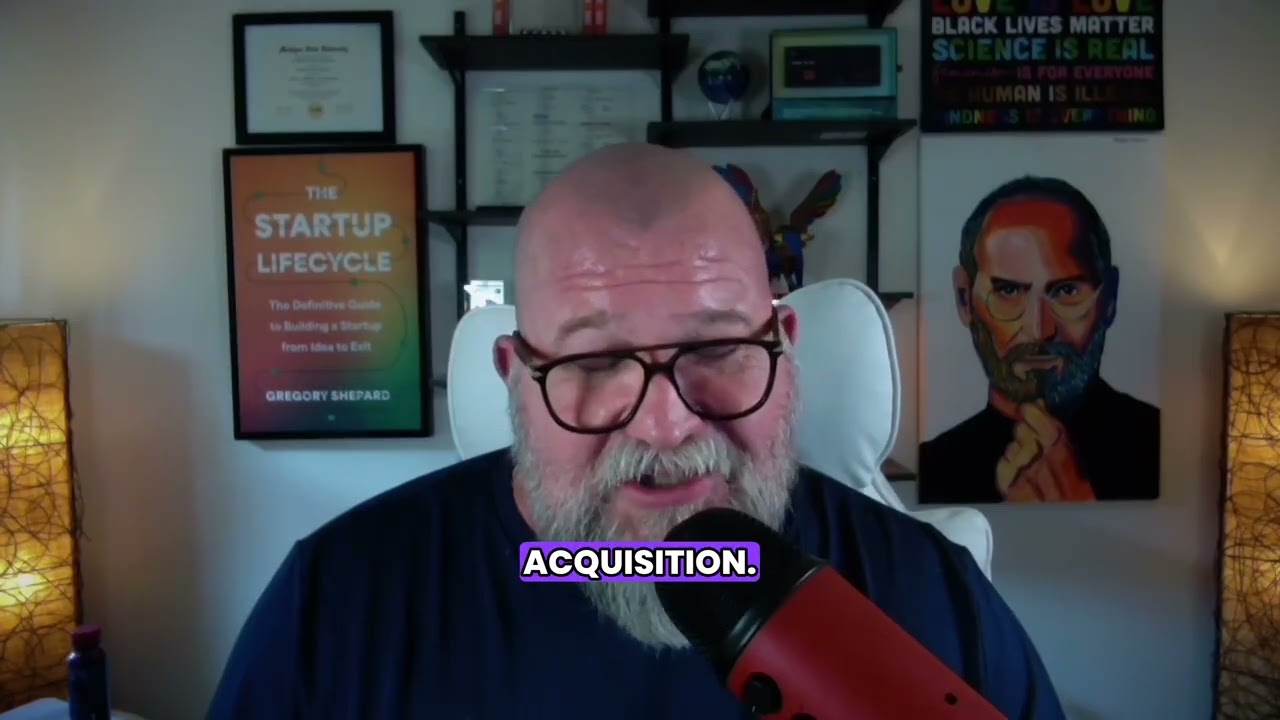
Thank you. So I am a serial entrepreneur, so I just, it's really a big deal for me that you're here because I'm trying to do something really special. So what I'm going to do is I'm going to start out by explaining to you a little bit about my background, and then I'm going to go into startup science and some of the research that I've done as well. I do have autism, so I do sometimes stutter. I will try not to, but we'll get through it together. My track record is 12 startups and 12 exits, which sounds totally crazy and It's, it, I didn't realize that it was so unusual until I started doing the research that I did. I just thought, you know, oh, this is, this is just me applying my systems and process thinking things. Those companies are all listed right here and they're also on my website, gregoryshepard.com, because a lot of people just don't believe that I have all done all these things. but I started 35 years ago, so I also started when I was a teenager. I also have 4 private equity awards for transactions between $250 million and $1 billion. And in fact, right behind me, you can see the trophies from those transactions. I also authored a book that was published by a division of Ben Bella, which is a division of a bigger publisher. That's called The Startup Lifecycle. I have 2 more books coming out, one this year and another one the following year and a year after that. There's a set of 5 books that go through the things that I researched when I was trying to understand why founders were failing. So those things include things like execution and funding and all of the different elements that you have if you're trying to start a business to try to offset the failure numbers that we see On an ongoing basis. I hosted the Forbes podcast with a lot of fancy guests, TEDx speaker. I do a lot of keynotes. I've written something like a few hundred articles on the startup ecosystem. I've been on a few hundred podcasts. I also co-founded the Fulbright Entrepreneurship Initiative, which is an initiative to buy Fulbright, the academic institution, to try to get founders to go from one country to another on a visa program for a temporary period of time and set up a business. So that kind of gives you some background on me and where I'm at with things. So the next thing is a disclaimer. I guess I should leave that up for a little bit. This is for all the investors that are on the call right now. This has a list of the different disclaimers that you have to be aware of according to the SEC. We went through quite a bit to get our SEC filing. I also started off poor. I'm from a foster and adopted family. I had a lot of medical conditions when I was a baby, died twice. I was in the hospital almost constantly until I was in my to 13, 14 years old. And I went from being poor, and when I say poor, we homesteaded. So we actually lived on the land in tents, took showers from a bag hanging from a tree, went to the bathroom in a bucket, et cetera. And I went from that to this, which is where I sold 2 companies to eBay Enterprise Marketing Solutions. The Ferrari I bought because I had a mentor of mine that said, one day you will have one. But honestly, I only kept it for 6 months because I just felt like it was too showy and now I drive a truck. The status quo is that 90% of founders fail. And this is an issue that's been an issue for 35 years and it's bothered me deeply because I can't think of another industry that would allow founders to fail over and over again at a rate of 9 out of 10. So I wanted to do something about it. Why do founders fail? Well, this conventional thinking says that 29% of them ran outta cash, 14% ignored customers, and you can see sort of the data here. But when you think about this, these are questions more than they are answers. This is sort of a top line. When I saw this, I was like, well, why did they run outta cash? Why were they ignoring customers? Why did they have business model issues, et cetera, et cetera? So I engaged in a 5-year research project starting in 2016. I invested half a million dollars in the research project. I had 5 people on the project to find out more about founder success and founder failure so that I could help other founders through the process. I also at the time was a chairman for a congressional candidate and I was trying to figure out if there was a way that I could use politics to move money down to startups because startups are the best path to equality. They solve the problems of the earth and everything that you're doing, the machine that you're on, the phone that you have, pretty much everything, including if you're driving a Ford, came from Henry Ford, who was one of the first entrepreneurs. So the methodology left me with 2,200 founder interviews, 4,867 accelerator interviews, 1,100 investors, and 100 global companies. And the root causes of failure had to do with not setting up the founder for success, fragmented ecosystem, this one right here, and bad advice were the biggest issues that happened in the research. So when you then roll back and you say, okay, let me look at the entire startup ecosystem. Let me look at what's involved here. And what you see is you see that you have what's called an ESO or an entrepreneur support organization. And that's like accelerators and incubators and universities and different programs that help early-stage founders. These are people that say, I have an idea, get through, create a pitch deck, and start talking to investors. Well, then you have the service providers. These are the people that are trying to sell things to the founders. At a discount. So they offer founders of new startups incentive programs to earn their business because they know once they get their business early on, they usually stay with them. And then you have the sponsors who are the same as the service providers. The sponsors pay money to sponsor a pitch competition, which is where founders get up and pitch for money in front of a bunch of investors, or They will sponsor different types of events like demo, they call 'em demo days, which is where the founders pitch each other and learn, or they'll sponsor any kind of an event or any kind of software or anything that they're doing for them. The majority of the ESOs have 3 paths of revenue. They get grants, they get money from founders, and they get money from these sponsors. And then you have mentors, and we talked about bad advice being one of the big things. So Mentors or advisors, these are the people that the accelerators rely on in order to help the founders through the process when they need somebody to talk to. So it, you add on investors and what you have there is you have, this is the whole ecosystem. There are 5 core players. You have investors, ESOs, service providers, founders, and mentors. So that gives you the overall ecosystem. So what I wanted to do was I wanted to create a platform because of the fragmentation issue that took all of these fragmented pieces and put it all into one place. So if you think about the past and you think about pretty much everything that you use from shopping carts, you have multiple different cards and you have all these different logins and trying to keep track of things. But most people use Amazon now. About 60% of people use Amazon because everything's one place. They don't have a bunch of logins. They can save things. They can do everything they want in one place. Apple does the same thing. Microsoft does the same thing. You could go around the clock. Most of the industries out there, these ecosystems, they end up with a platform of platforms. In the startup ecosystem, believe it or not, there isn't one. So I created the first one, which pulls together everything that the founder needs and any of these 5 individual parts of the ecosystem. Essentially, each one of them have their own platform, but it's all connected through a core. And that means that all of these people only have one login. So our north, our North Star is to get to profitability in 2026. I put over $1 million in this myself. And so I'm, you know, as an investor, I want to get to profitability by 2026. We're thinking that we're probably a few months away from that depending on growth. As you know, you put money into growth and you can sink back into not being profitable. And then you put, you stop putting money into growth, you become profitable. And there's a point at which these 2 lines start to overlap. So right now, that's our goal. We want to acquire competitors. Last year I acquired 3 companies. One of them was Jonathan's company, Startup Stack. We acquired a company named Sphere and a company named Startup Benefits EU. So these companies are ripe for acquisition. What they've done wrong is they haven't looked at the unit economics, the people that are buying the software that they have. Cost more to acquire than they can make from those companies because they don't have enough income. And the reason why they don't have enough income is because they don't have a holistic single-point platform like we do. So we can buy these companies like I've done last year to prove the case, incorporate them into our system real easily. We've proven this by doing it 3 times last year, And by doing this, grow the user count substantially, grow revenue, and grow the available tools and different product features that we have in the platform. The goal is to get to 2 million founders. The acquisition strategy is a big software company. So if you look at anything like GitHub or Amazon or Google or Microsoft, I mean, you name it, Dell, all those places have startup programs. And they are very aggressive about building startup programs. So some of them have accelerators, some have incubators, some have different types of programs, but they all have these programs and they're after the founders. The founders are very, very important to them because a founder is essentially a lead for anybody trying to sell anything because it's a brand new company. They need everything. So there's a lot of companies out there interested in acquiring A company that has 2 million ongoing founders. When we look at how we get the users, it's a cross-pollination strategy. So a mentor, typical mentor, work with 5 different accelerators and those 5 accelerators will have this mentor available. If you have a good mentor platform, then they bring the accelerators to you. If you have good service providers, then the founders come in to get those exclusive offers or incentive programs. Same thing with investors, and you could go around the clock. So by getting one of these markets, you automatically get the founders that come from the market. The thing that's very unique is that the accelerators and incubators, these ESOs, these entrepreneur support organizations, they use our software to power their program. Think of it like an operations tool. When they do that, one of the features is an application. The founders apply using the application and then they get inside of our platform. So by spending the money that we've spent to build the program management operational tools, we made a capital investment to get founders, not just to get founders for free, but to have the ESOs, the entrepreneur support organizations pay to actually give us founders because they're using the software. So we made that capital expenditure with that strategy in mind. Jonathan, it looks like there's 2 questions in the chat. Can you check those real quick and make sure if they— oh, here. As an investor or acquirer, what are the specific criteria that help you choose where to invest and where not to invest? So when you look at investment, There's always growth, margin, and retention. Like if you think about exiting a company or your valuation in general, they're called valuation drivers. Growth means that you can grow. Retention means you can keep the customers you grew from, and margin means you can do that profitably. So when we are looking at, if our investors are inside of our platform looking at deal flow, Later stage deal flow, it's growth margin and retention. Earlier stage, it's are they profitable and do they have the KPIs? Like, are they able to acquire customers? Are they able to hold on to customers? And are they able to do that profitably is growth margin retention. So those are the big numbers to answer that question. I hope that answered your question, Jeff. If it didn't, Go ahead and let me know. Don—
Greg, could you maybe tie that into, how does that tie into the growth strategy for Startup Science? Like what types of companies are we buying and how does that fit into getting to those user targets?
Oh, okay. Okay. Sorry. I think I misunderstood your question, Jeff. So I'll answer that question instead. If you think about what happens in ecosystems, I want you to imagine a still pond. And still ponds are usually stagnant and old, and somebody throws a rock in the still pond, it stirs everything up, and then there's rings that appear on the outside. So an industry that's ripe to do something like this is a still pond. I've done, this is my third time doing this. So you find these still ponds, it's really hard to find. I never thought I was going to find another one in my lifetime. And then you are the disruption. You throw the rock in the pond. When that happens, there's a bunch of little rings that appear on the outside of that. Those rings represent the opportunities. At first, the opportunities are close to where the rock hit the pond. They're bigger, but there's very few of them. So if you think about the emergence of the iPhone and then you think about all the apps that originally came out of that are early stage there when the rings are smaller. As the ring starts to grow, there are way more opportunities. They're not as big, but there's There's more and more and more of them. After a while, these things start to contract. Those opportunities that I was talking about are the fragmentation that you see in our industry. And then as that fragmentation starts to compress, it starts to go back down. This is when acquisitions happen, and this is when everything starts to crush down to where you get to something like an Amazon. Or anything like that, a major player in a certain market. So we are at the stage where we've had contraction in the startup ecosystem for a number of years. And we're starting to see, you know, this expansion that we had, we're starting to see this now contract, which is putting a lot of these smaller companies that only have one revenue model, meaning they only make money one way, they just can't survive. And those are the ones that I'm buying. So think of those as fire sales. Like you realize that it, it, you have to charge $500 in order to make money from a client, but the client can only afford $200. So now you're in trouble. There's a lot of those out there because those people hadn't done the same research I've done. So that should help you understand the difference between those spaces. I hope that answers your question, Jeff. Okay. Abby, did you have a question? Okay. And then Don up here is from Founders Pledge. Nice plug, Don. I love it. Nonprofit founders, mental health, anybody needs help. Don's in here plugging his business and not mad at you, Don. I would do the same thing. So let's go back to the deck here. So what you have is you have how we get users. Oh, there's a new— okay, there's a question here from Michael. Okay, so it's both actually. It's, we are both going out and acquiring companies. So if you go out into the space and you find some company that has a piece of software that you need, And they already have customers and they have revenue and they have users, but you can buy that for less than you could build it or acquire those users yourself. That's how I choose which ones we go after. So it has to fit something that we're looking for and it has to be able to pay itself off really quickly, you know, quickly being 3 to 6 months. And so that's how we choose that. These are, these, they can be primary tools that support the ecosystem. Sometimes they're internal things. They could be sources of data or stuff like that that we need. Like in the case of startupbenefits.eu, they had a global grant system that we wanted those global grants to offer to the founders. They also had 57,000 investors that were European investors, which we needed for the European market. So in that scenario, it was an acquisition for the tools and the data to support our platform, which supports the ecosystem. The rollup is also part of our own revenue model. So there are a lot of companies down there that have revenue, but they can't make money on that revenue, meaning their costs to maintain the revenue is more than the revenue itself. So what I do is I can buy those companies and incorporate them, but because our cost is spread out through multiple different revenue models, we can acquire these companies profitably. And all right, let's go ahead and move on here. My slide is frozen. I'm sorry. Okay, here we go. So how do we make money? Well, we make money from a lot of different places. The majority of the money comes from software subscriptions. So we charge monthly fees to founders. We charge it to ESOs, investors, mentors, providers, and partners. The providers don't pay monthly fees quite yet, but they will. They pay for advertising and sponsorship. Mentors pay monthly fees to use the platform. Investors pay monthly fees to get access to the deal flow, to the startups that they want to invest in. As I said, entrepreneur support organizations, they use the platform to run their organization. So they pay a monthly fee for that. And founders, you know, we have, we don't charge founders a subscription fee to get into the platform. It's absolutely free. We're committed to helping people that don't have any money and founders who are just getting started don't have any money. That's why they're starting a company or one of the reasons. So we don't charge them, but there are tools and other things inside of the platform that we have to charge for because we're getting charged for them. But we do get these things discounted because we bring a bunch of founders and as doing so, we get a volume discount. The advertising, as I said, and the sponsorships are providers and partners. Customer acquisition. This is just helping them get customers and us getting customers through acquisition. And then the revenue share, in some scenarios, we have some big partners like the Collegiate Entrepreneur Organization CEO, which is a university-wide student program that's a nonprofit. They don't really have any money, so we do a revenue share with them. The Canadian Startup Association, Fulbright. There's other ones that we have that are big, the Angel Capital Association, et cetera, where we don't charge them any money. We just go on a revenue share basis for those partnerships. Our traction. So we currently have all of these partners, some of the ones I just mentioned inside of here. We have these 3 acquisitions that we made last year. We've been featured all over the place and we've already raised $5.75 million from sophisticated investors. And these are investors that have invested in me previously and made money. So they have successfully exited with me, most of them, if not all of them. I can't see some of the logos, but they have invested in me and follow me and invest Further on, this is the product roadmap. So, you know, the first step is to do some modernization to the platform. When you build a monster platform like this thing is a really big, big platform. When you build a big platform like this, you roll out things as a pilot first, because what you don't want to do is build, spend a bunch of time building a piece of software and then show customers Ta-da! And then maybe they don't like what you built. So what you do instead is you, you build something basic, you roll it out to your customers, then you listen to your customers, you interview them, and you build what the majority of those customers want. This roadmap was based off of that over the past 5 years. So we have learned quite a bit and then built the roadmap according to the priorities, the needs, wants, and pain points of the customers that we have, those customers then being the same people that you see here down on this side here. So that's the roadmap. So why does this whole thing matter? I can tell you that the reason why I started this is that coming from no money and being neurodivergent and barely graduating from high school, Yet getting things like, I'm a Fulbright scholar, I've got an honorary degree, you know, you get all these things, you realize that entrepreneurship is a form of education and entrepreneurship is absolutely a path to get out from check-to-check living. And it also changes the world that we live in and everything on it. I mean, you know, people are coming up with solutions to the most fundamental problems that we see in the planet. I saw a founder the other day who was taking in greenhouse gases and producing plastic to make plastic bottles that biodegrade. So you don't have problems with plastic in the ocean. I mean, this is the kind of thing that these founders come up with. They are changing the world. Large corporates are not. They buy the startups and then they claim it as their own. But most of the stuff that you see out there comes from the startups. In addition to that, big companies lay people off. Startups hire people. When the startups get acquired by big companies, they lay people off. So who is hiring the majority of people? It's these startups. It's young companies. Who is moving us forward? It's the young companies. Who is offering everybody, regardless of race, religion, or political beliefs or anything, an opportunity? It's startups. That's why I'm doing this. And there is no category-defining product. There's no platform out there that does what we do. It just doesn't exist, although it should exist. So we are disrupting the space and breaking through to create something that should have been created a long time ago to help everybody else out. And this is my team. So we have me over here. Gary, who's been working with me for 10 years. Daniel, I think we're on 20 years together. Darryl, 10 years. Geraldo, a few years. Jonathan, a few years. This is, these are people that have done deals with me in the past, people that I like, trust, and respect that can actually execute moving forward. And that's the end of the presentation. So if there is any questions, I'm happy to answer any questions that anybody has.
Greg, I wanted to ask you about, um, with the product roadmap, if you could go in a bit more detail. I know there's a lot of information there and I think a lot of people would have questions. Would you mind pulling that slide back up? And I, I'd be interested. I know there's kind of different buckets of, and different phases that we're moving through. So I'd love to hear more. How are you thinking through the path that our product is going down and how does that fit into This broader strategy.
So when you think about it, you, what you see is you see, I want you to think about a, you're in the desert and you see a strip of trees growing in the desert. That's because there's water there. The trees, the plants, all the vegetation and the wildlife that grows around that waterway, that's the ecosystem. The founders are the water itself. So what we did is we started by building things for founders, and then we started building things for those people that work with the founders. So what you see in the product roadmap is you see early on some modifications to the way that the user interface actually operates and runs. So it's more intuitive and looks more enterprise and stuff like that. So we spent a lot of time Really talking to customers and founders to figure out what it needs to look like. And that's what you see there. Then what you see down here is the program management. These are the ESOs that are using our system to bring in the founders. We did that next because after that, we get their profile data. We use their profile data then to match them up with what they need at the right time. So They need financing. What kind of financing? Grants, loans, community funding. Do you need investors? What kind of investors? Family offices, individual investors, angel? Let's say that you need a piece of software for your business. Well, what kind of software? You need a mentor. Well, do you need a mentor that is somebody that specializes in marketing? Do you need somebody that specializes in product? Do you need somebody that's used to working with really young companies? that are still trying to develop who they are or later stage companies? Do you need people that specialize in sales and marketing to help you out with your CRM or setting up everything that you're using? So all of this stuff leads up to where you see content matching. And this is where we can take all of the data that we've acquired through this process and then immediately apply that to the founder so that the founder gets what they need at the right time. Without all the distractions. Jill has a question. If I invest through WeFunder, is there a liquidity event acquisition? My goal is an acquisition. I have done 12 acquisitions of my own from my own startups. And then I've also invested in, I think, 8 companies and sold 4 of those. Everything has been through acquisition. So every liquidity event, has been through acquisition. In fact, I haven't been involved in a company that I didn't sell. So I think that should answer your question. I hope that answers your question, Jill. If it doesn't, please just let me know.
Now, this is a longer one, Greg. So if you want to open the chat and read through Michael's comment, he's asking about how do we think about the future in terms of AI?
But yeah, this is very exciting. Okay. So what you What you see with AI is you see AI attacking industries that have simple business models. So, you know, what we saw in the stock market was the fact that you can now use AI, you can use Claude, OpenAI, whatever, and you can write code. And I agree that if somebody isn't using AI to help them build their business in the next 12 months, they probably won't be around. We use AI to help us write code and it's like 10 times faster than having an army of people. What that means is the cost of building a simple company is a lot less. You could have, you know, 3 people in a dorm room build something that used to take millions and millions of dollars to build. This is a multi-tenant, multiple-role user platform. Which means that our system has the ability to power independently thousands of individual ESOS, individual mentor platforms, individual marketplaces. So each one of these is its own platform, all pulled into a single system. That's not something that you can do with AI currently, and I don't expect that'll be something you can do for a long time, but You can use AI to help, but it won't build it. That's the difference. If you have a single tenant platform, meaning you only have one platform with one type of user and, you know, one system that everybody's logging into, that's something that AI can do pretty easily. But something like what we've built, I mean, believe me, if I could have used AI any more than I already do, I would have done it.
So.
I think that that's one side of it in terms of the moat, right? In terms of protecting us from the event of AI. Now, on the other side of AI, if you look at the history, robotics had attacked the blue-collar worker world, and now AI is attacking the white-collar worker world, mainly knowledge thinkers. So if you look at consultants, you look at lawyers, you look at accountants, a lot of these roles, you know, writers, all different types of writers, technical writers, medical writers, et cetera. It's definitely doing damage to that industry, to those industries. But what you also notice is those same people turning to AI to help them start companies. So what you're seeing is more new startups than ever before enabled by using AI to get their company off the ground. So It's actually a really, really beneficial thing. At first it stings a little and then it turns into exponential growth.
And then one other nuance to Michael's question, Greg, I really love what you said. And I can attest as just a team member at Startup Science, we're really pushing the limits on what we can do with AI, but not sloppily. I feel like we're doing so very tastefully, not trying to break too many things, but definitely it keeps our team lean and efficient. So part of Michael's question is digging into like the broader dynamic, like does the startup ecosystem consolidate under big companies like Claude or OpenAI, or does it actually fragment further because of like it becomes more hyper-fragmented? So how would you think through the, just the broader dynamic that AI is Like, is it, how is it changing the ecosystem within that pond framework?
I think that in the, you, the fragmentation that we have is the result of AI. Most people have just started to use AI or just became aware of AI, but it's been around for like 5, 6 years in terms of like a lot of people have been using it for 5, 6 years to write code. They used to call it no-code or learning systems, you know, and then they came out with large language models. It's been You know, this is, this has already been here for a long time. So the fragmentation that you're seeing is already because of AI. Will we see more of that? Absolutely. 100%. You will see people coming up. In fact, some of the companies I've acquired were built using AI and you see these things popping up, but that doesn't mean that they'll survive just because they're solving a problem quickly and easily with AI. Still doesn't mean it's going to help them survive because there are unit economics at play and hyper-competition because of other people using AI, just like the avatar I was talking about. I think that you will see further fragmentation and then more consolidation, and it'll sort of breathe a little bit. So normally you see this massive expansion and then this huge consolidation, you know, contraction, consolidation, sort of like a heartbeat. And you see this happen over the years. It's just, it's everywhere. But I think now what we're going to see is more like a little bit of pulsating. So a little bit of expansion because of AI, some contraction, some expansion, some contraction. So it's going to change the way mergers and acquisitions have operated in the past and the way that these ecosystems have contracted to some sort of major winner, like what we see with Amazon, Apple, Microsoft, Oracle, Salesforce, you could go on and on. So I think it is going to change it.
And I'll just read this next question. If a motivated founder uses PitchBook for resources to build a company, what are Startup Science's platform advantages versus PitchBook?
Yeah, so PitchBook is just data. So the only thing that PitchBook offers is raw data so they can tell you about companies and they give you just data. We have the same data. So we offer data. The difference is that Startup Science has an academy module for education so they can watch, listen, read, and experience anything that they want to learn from. It's got a resources area that has everything that they need to get immersed into the space. There's a knowledge base that's used to help them understand rules, regulations, policies, et cetera, et cetera. There's a capital module that has all kinds of funding options, grants, investors, all different types of investors that are inside of there. There's a tools module that has different tools that allow you to find your competition, your partners, your market sizing, et cetera. It's got an area for activities for people to have conversations. It's got a forum, a community, so people can interact with each other. So PitchBook is just a database of data, and even that is scraped. So there are 5 players like PitchBook. There's PitchBook, Crunchbase, DealRoom, Traction, and CBI. All 5 of them sell the same data because they all scrape. So they all send out bots to scrape, they pull the data back in, they put it in their system. So all they have is system, is data that could be found using AI. I think they're going to be impacted. But, you know, there's no original data. It's not originated in their platform. Our data is originated in our platform, meaning because we work with the startup, the assistance programs, the entrepreneur support organizations. Because we work with them and that's the beginning of the founder's journey, we have the origination of the data versus the data that those guys have is data that was discovered by a bot crawling something. And if a bot crawled something, it means everybody's already seen it. And because they're selling the data, everybody's already seen it. So those guys also charge like $3,500 a month for a program to get in there. You know, to get the data that you need. So it's also incredibly expensive. I think that we have everything they have, but they have none of what we have.
I'll read this next one. This is from Eloy. What would your rough horizon be for an exit here given your experience, and what multiples would you expect given the space and any other M&A comps?
So if you think about subscription software companies is between 5 and 10x multiples on revenue, top line revenue. So gross revenue, top line revenue is between 5 and 10x. Now you can get premiums if you have something special. If somebody comes to us and we have 2 million founders in our platform, we have 100,000 and we've gotten those rather quickly, just a few months. If you have 2 million founders in your platform, but those 2 million founders and the new founders are coming in because you're doing advertising, you don't really have an ecosystem business. You have a platform that you're paying for advertising to get in. Now, our play is completely different because we have hooks into all 5 elements of the ecosystem. So when you're looking at acquiring something like Startup Science, what you're acquiring is an ecosystem. Real ecosystem with lines of data, meaning founders and investments and things like that going back and forth. It's incredibly valuable and there's nothing like it out there. So at that point, you would expect a multiple between 5 and 10, which is standard multiples right now. Markets change this thing, but that's pretty standard. If you go in and look it up, that's what you're going to find. And then you have the opportunity to get these premiums, which is where they'll say, well, we'll give you an extra 5x because you have, you know, 20% of the whole startup ecosystem, which is my goal is to have enough of the startup ecosystem between 10 and 20%, 10% minimum that I could go to somebody and say, I have 10% of the global startup ecosystem. You know, there's a new startup every 10 seconds. So this is a monstrous hunk of business. Anybody and everybody that is looking for what startups create, making investments, the new products they come out with, meaning corporates, are all going to be interested in that business. So that kind of gives you my story in terms of the comps and in terms of the multiples, et cetera, et cetera. In terms of timeline, I typically like to sell things in 3 to 5 years. This one's already been 5 years because it's such a monster project. I'm looking to sell it by, in 3 years. So we'll see what I can do. It's a lot to do in 3 years. It might be 5 years, but I'm shooting for 3 years.
Well, this is awesome, Greg. If you'd follow us on our WeFunder page at wefunder.com/startupscience, that's where you can stay in the loop on our raise. So this last question from Michael is, when does the upcoming round close?
When does it close, Jonathan?
Yeah, so I know we're sprinting at the start, so we'd love to just close it because it's full. I believe we're keeping it open through April, but I know we'd love to fill out most of it this month. We've already raised About $300K in through the Reg CF with a lot more coming in this week. So I think that's the logistical answer.
So I do want to share this. This is my website. It's just gregoryshepard.com. You can see everything I've done here. You can see the businesses I've built down here and who bought them. You can see the stuff I've invested in, everything I've written. I mean, it's all here. Feel free to go to the website if you want to learn more about the CEO. This is my greatest achievement out of all of the things I've done. This is without question the greatest achievement that I will do and the greatest impact I will make on our little planet and all of us that live here and share it together. So I really appreciate your time and energy. I hope that you guys join more of these with more questions as you learn. And if you invest— oh, sorry, Jim asked why a Reg CF? That's a real— I'm so glad you asked that, actually. I'll tell you why. I want the startup ecosystem to be owned by Everybody, not just owned by accredited and sophisticated investors. If you are a startup, unless you go through one of these community funding platforms, you can't invest unless you already have money. So how are you supposed to make more money on investments if you are trying to invest in the stock market? That's when all the money's already been made. My major, major, major thing here is how can I make it so that everybody can participate in the fruits of the startup ecosystem and everybody help each other? So the reason why I'm doing a Reg CF is to raise money from everybody. We're raising money from our founders, from our customers, everybody that I talked about, we're raising money from all of them so that ecosystem can be owned by the people that run the ecosystem. and people that care like you folks that are inside of community funding. Thank you, Eli.
Please stay in the loop. This is a big campaign and like Greg said, it's not just about checking the box and getting cash in the bank. It really is a bigger mission. And just speaking as someone who's become Greg's friend and colleague, I can really speak to, you know, when you invest in a startup, you need to know the people that are involved. And Greg's a great guy and hopefully you've gotten a taste of that. And not just Greg, we've got a great team. We've got a lot of great people here that are building this together and it feels good to wake up every day and build something that matters. We really appreciate your time.
Thank you everybody. I hope you have a wonderful day. Thank you so much.
More from Gregory

Startup Science Founders Academy Pathway Podcast | Ep 4/16 | You're Building for the Wrong Person

Run Your Business Like an Investor to Operate Better | Tyrus Shivers x Startup Science
Startup Science Founders Academy Pathway Podcast | Ep 3/16 | The Founder Mindset

Why Our 2024 Financials Don't Tell the Full Story | StartupScience.io Founder Q&A