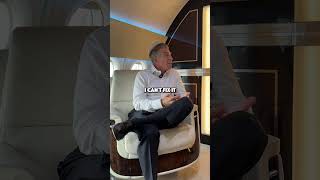
Iman Gadzhi buys a $30,000,000 private jet from The Jet Business

In this YouTube interview, Iman Gadzhi sits with Steve Varsano, founder of The Jet Business, to discuss the process of purchasing a $30 million private jet and the broader business model behind high‑end jet sales. Varsano walks Gadzhi through his flagship London showroom, which mimics a Wall Street trading floor, and explains how his team gathers market intelligence by calling every jet owner worldwide. He outlines the segmentation of the jet market (small, midsize, large, ultra‑long‑range, VIP), the importance of long‑term client relationships, and the role of branding and experiential showrooms in building memory and referrals. The conversation then shifts to jet selection criteria: budget ceiling, minimum seating, cabin configuration (2‑cabin vs 3‑cabin), aircraft age, range, and baggage capacity. Varsano compares specific models (Praetor 600, Challenger 650, Falcon 900 LX, G280) using a 1:1 scale video wall to illustrate cabin dimensions, aisle width, and operating costs. He details the financial structure of jet ownership, breaking down fixed versus variable costs, fuel burn, and the economics of chartering versus owning, including fractional ownership and jet cards. The interview also touches on financing constraints, loan‑to‑age ratios, and the impact of flight hours on cost‑effectiveness. Throughout, Varsano emphasizes reputation management, confidentiality, and the experiential nature of his sales process, while Gadzhi probes practical concerns such as relocation fees, range limitations, and the point at which jet ownership becomes financially sensible.
Chapters
Honestly, what would be the maximum, maximum budget that you would want to spend? $30 mil. Welcome to the jet business. Upon entering it, my favorite phrase is, "Time is money. Buy a jet." So, I mean, it is a little takeoff of— it really is the whole basis of owning an airplane. I'm always saying, you know, it's not about luxury, it's not about a bunch of guys going on a bachelor party. It's really about time machine and being a capital asset to a company. So this is just really let the message get across right from the beginning. So this is our trading floor. This is—
I was gonna say, when I walked in, it looks like a proper trading floor.
Yeah, so this is my version of a Wall Street trading floor, and each desk is always— looks like a cockpit. It comes from basically a Bombardier Global jet cockpit. It's done all with Bentley leather, you know, it's a nice soft called leather. It sort of gives that whole atmosphere of being in a trading floor. So here's where our sales and research team sits. What these guys do is basically call every single owner of every jet in the world, from what we call the super midsize up to the VIP airlines. So airplanes are usually broken up into small, mid, large, ultra-long-range, and VIP airliner. We don't really deal too much with the small midsize unless we actually get a mandate to do it, but so our main focus is the upper end of the market. And these guys are calling every single owner, so we always know exactly what's for sale, who's buying, who's selling. And in those calls, we're trying to find out, trying to build a relationship, a telephone relationship, obviously, of trying to get ahead of the curve. So you're trying to get that piece of information, you know, oh, we're going to be looking to buy in 6 months or a year, or we're going to sell in 3 months, or we're going to trade, or by the way, my guy in the other hangar, he's looking to buy or sell. So it's really trying to get as much information as you can. It's not call up, hey, you want to sell your jet? There's a whole process to to really trying to, you know, show some sincerity, how much information we can give them.
So that long-term view on sales, where did that come from?
You know, I just believe in referrals, repeat customers. You know, in our industry, it's so small. If you do one thing wrong, I mean, your reputation is trashed. And I just think that from having a relationship with some of the clients that we do, and we have some very big-name clients, they can trash you in 2 seconds, and that rumor goes through the high-net-worth world quickly. I just like having long-term relationships. And the thing is, if you come into the showroom, you're going to remember forever coming into the showroom. If you meet me and I didn't have the showroom, okay, maybe I might, you know, stand out for a week or 2 weeks. But in a year from now, if you're going to buy an airplane, you're going to say, what was that guy's name? But I was in that showroom. Hey, let's call that, you know, guy in the jet business. And it's really to try to build memory to last longer in the person's head so that they, when they do decide to do something, they come back. And it has happened. People came in the showroom and 5 years later they decide they're gonna do something, then they call us. How long into your career until you decided to open your own showroom? Yeah, so I started selling airplanes in 1980, and I first came out of Aviation University, so I got a bachelor's degree in aeronautical studies, and I got my commercial pilot's license and all that kind of stuff, but I never flew professionally. And then I got a job on Capitol Hill in Washington, D.C., representing all the airplane manufacturers, which was a great job. The ego was fantastic, but it paid shit money. So at nighttime, I got a job at a nightclub and met some guy who sold jets. And I said, wow, that sounds like a pretty cool thing. And after meeting him and talking to him, he said, that he showed me a bunch of his commission checks and it got me interested.
Like a Wolf of Wall Street kind of moment?
Yeah, exactly. It was. That guy actually was pretty close to Belfort, and I convinced him to actually introduce me to his boss. And I went to go to meet his boss and he, you know, he said, you don't have any sales experience. And so I volunteered to work for free to learn because I really thought it was a cool idea. And I got a job as a waiter at night to represent, you know, to pay my bills. And it took me 8 months before I sold my first plane, which is a whole other story. And, and that's where it actually got started. But that was a long time ago. And I left the industry and got into private equity, doing corporate takeovers and things like that, because the person that I sold a bunch of airplanes to was in that world. So he said, come work with me, and I left the airplane business. And when I decided to come back into the industry, it was like 15, 18 years later, and the whole demographics of where the airplanes were has changed. So it used to be 80% America, and it was easy to go see a client, but then When I decided to come back in, it was 50% in America, and the big growth was in Russia and China and India and Nigeria, all these places where you really— it's hard to get to, it's expensive to get to, and it took a lot of time to get there. So it wasn't practical. So I came up with an idea. How can I build a place to get my clients to come and see me? And that's where, after a lot of vodkas one night, I came up with a crazy idea to build a showroom and then figure out how to What do you put in it?
How long did it take? I want the trading room, I want the fuselage, I want this, I want that.
I played with it for about a year and a half. Devil on one shoulder and the angel on the other. Yeah, do it, do it. No, don't do it, you're an idiot. No, do it. And everybody I asked told me I was nuts to do it. And finally I just said, you know, I don't care, I'm getting older. I mean, I'm gonna either do it now or not do it. It was a year after the financial crisis in 2008, so it was really stupid. But I just thought I had to do something different. It's my USP. These guys do have. It just has to be something different. And so I created this whole idea, and I probably sketched it with this designer a year, I don't know, 15 times. The guy thought I was crazy. And then I decided one day, I said, you know what, I found the spot. It's actually— it was across where the Peninsula Hotel is. And I said, I found the spot, let's go right now. I'm just going for it. And at that moment, I just decided to throw all the eggs in one basket. And said, potluck, man, either I lose it all or I don't. So it was over a decade later. So back here, this is a club room. Sometimes, like right now, you know, we have a client in studio there, and so if we really want to, I have another video wall here that I could do another presentation on. However, this one I can't do the full floor plan of all the airplanes, so And I'll show you, I'll take you through the app on that wall because it's just much more effective. But we really take the people through a whole process. It becomes such an educational tool. It's one of these experiential journeys, if you want to call it that. It's amazing how, you know, we used to get, you know, these 35-year-old oligarchs that, you know, came in with ripped-up jeans and t-shirt and, "Steve, I got 5 minutes, you know, I've got somebody told me I should see what you have. What do you have? What do you have? What do you have?" You know, and that kind of thing. But once they sat down and started going through this video wall, It was like 2 hours and, you know, the guy's on their 4th espresso and I'm like, how do I get rid of this guy? It's just really engaging and if you're really interested in trying to buy an airplane, it's an unbelievable tool. So sometimes we'll bring some people in here. Actually, we have this little hidden door here. It's a secret door because sometimes if we have 2 people come in, we don't want one to see the other or one of my competitors comes in or We don't want people to see each other, confidentiality. And so we can usually have people coming in and out. Sometimes they have paparazzi following them or something, so we can get them out the store. Kind of atmosphere.
I know it's an ashtray there. Do you guys smoke in here?
You can do whatever you want in here. Amazing.
Cigar? Cigar and death shopping? Yeah, yeah, yeah. Listen, I can see why people come to you.
We got a full bar here. Wow.
Special.
Sometimes I'm here till midnight. And it's happened sometimes, I'm in a restaurant or a club here, and you know, midnight or something, I'm talking to somebody and they say, "Come on, let's go to the showroom." And literally we'll come in here at midnight or 2 o'clock in the morning, I've done it many times, and start doing a presentation on the video wall. It's crazy, you know, it's really— and you're not gonna do that for a regular office. I'll come to my office and sit at my desk, I'll show you on my laptop.
Yeah, 1-year-old HP, 2002 HP.
Take it to '95, a PowerPoint. So back here we have our graphic design and IT. So we really take care of all our own branding and things like that. So these guys sort of keep me honest with, you know, keeping brand quality up there and making sure all the IT and systems work and upgrading all the technology every time I come up with another crazy idea I want to add to the app.
Some really cool photos around here.
Did you pick them or did you— Yeah, yeah, most of them actually. For this painting, actually came off the living room of John F. Kennedy. This is Anthony Shriver, who is the nephew of John F. Kennedy, and he's a good friend of mine. So we were actually— they were doing a charity event in their backyard, a big tented area back there, but for some of the big sponsors, they had a little cocktail inside their house. So we went in the house, we're walking around having a drink, and I saw this picture on the wall. I said, wow, I love that painting. I said, you know, let me buy it. And he said, no, but that's not part of the charity auction. I said, yeah, but it's so beautiful. I mean, come on. No, it's, it's my mother's. I can't do it. No, no, come on. I mean, give me a price. I want to buy it. You can put the money into the charity. He said, okay. And so the first painting from the artist went to Eunice Shriver, which is JFK's sister. And then he wrote to Steve, you know, you're the best, Anthony Shriver. So it's, it's got a nice little history. It came off of John Kennedy's desk. My personal office. And sometimes we're doing video when I'm on the telephone. As of late, one day a week, we're doing our video in the some of our calls. Back here, some of my favorites. When I was in the White House in the Oval Office with Ronald Reagan, that was when I was like 20, 24 years old or so. Tony Robbins, one of my good friends and fantastic, fantastic guy and great client. Richard Branson, I used to be on the board of directors of Virgin Galactic. I was supposed to go up in the spaceship on the test flight before it blew up. And I sat on the board with them for 4 years. And so the family pictures and stuff like that. This is an Airbus 319, Airbus 320 actual cross-section of the aircraft. I didn't really build this thing in here, put it in the front window really to sell Airbuses or Boeings. The real reason was obviously as a marketing gimmick to catch the people's eyes in the window. But whenever people come to see me here, or anybody walks in off the street, they usually get put in here for a little while, let them just digest, get the feeling of sitting in, you know, the ultimate corporate jet. And so this is really the feel inside. On the windows, it's like you're flying with the moving clouds. And this usually, we have a separate dining room here. We have meetings in here. We have lunches or breakfasts here. This is absolutely the best table for a meal in London. You don't get any smell of the cars, you don't get the noise, and you get, you know, great view of the park.
Well, see, back then I didn't really have much of an interest in jets, but, uh, but yeah, even just that, even just 5 years ago, even if you don't have an interest in jets, I feel like when the time comes in your life that, uh, you know, it's something in the horizon, you just don't forget this place. Because especially if you live in London, you know, I lived in Knightsbridge, uh, my last place, so you're just You're driving down this road multiple times a week, so it's ingrained in your mind. So you guys have done very well.
Ground zero, really. I mean, really, between Belgravia and Knightsbridge Mayfair, anybody who's anybody that comes to London, they're always going to come through here. Even if they have to go work in the City or in Canary Wharf or something like that, they usually stay in one of these hotels around here. So that's the whole point. The rent here is obscene, but That's what I'm paying for. I'm trying to get that brand awareness and people to walk in off the street, and you'd be shocked how many people just walked in off the street and end up doing business with us. So it pays its way. Not that I want my landlord to hear that right now, but— Have a seat here and I will take you through this whole process. This is our video wall, which is a really engaging kind of educational tool. Basically, there are— besides going for a Boeing or an Airbus or an Embraer lineage, the largest airplanes that are made now for corporate airplanes is the Gulfstream 700, which is coming out in a couple months, and the Bombardier 7500. Passenger cabins are very, very close to each other, and this video wall is the exact width and length of that passenger cabin from that galley door, the kitchen door, where you walk into the passenger cabin, to the bathroom door in the back. So this is— and for what we do here is to make everybody see in a 1:1 scale how big one is to the other. These are the 148 models. What we do now is we have to figure out a sensible way to filter the airplanes out that don't meet your parameters. Honestly, what would be the maximum, maximum budget that you would want to spend?
$30 mil.
Out of 148 models, There's been 27 of them that are priced over $30 million. So we just got rid of those. So we're going to start filtering out those airplanes that don't meet your need. One section, two sections, or three sections. So normally, there's 4 or 5 or 6 people in a section. Yeah. All right. The question is, is do you want to have a sleeping area plus two other sections? Do you want to be able to just have a 4-seater, 8-seater, 12-seater? What do you think is—
It needs to be 8 minimum.
8 minimum.
So even like, for example, whenever we fly, even if it's just 3 of us, I'll still take an 8-seater.
It's just a little bit— okay, do you want something less than 5 years old? 10 years? 15? 20?
To be honest, I don't really care because I said for me, I think it just needs to be a new spec interior. And from what I understand, to refurbish an interior, I mean, jets kind of never really change the external appearance. I understand the performance changes. I don't think I'm— I'm not really one of those people that needs to get somewhere aggressively quick. Like, let's say, if for me, I won't feel the difference if it's a 2-hour-and-2 flight time compared to 2-hour-and-25-minute flight time. You know, I'm not on that precise of a schedule, so for me, it's mainly about getting there as comfortably as possible. It's feeling spacious inside. It doesn't need to necessarily be the fastest jet.
Would you take bank financing on the airplane? Correct, yeah. Okay. That's a key question because a bank, if they're going to loan money to you, okay, usually what they say is, term of the loan plus the age of the airplane should not exceed 20 years. So, meaning at the end of your loan, The airplane shouldn't be more than 20 years old.
Yeah.
And so that's a key question because really you can get an airplane 25 years old, it's going to be perfectly safe. The maintenance starts to get a little bit more expensive. Let's keep 15 years in here. So if you got a 5-year loan and 15 years also. So now we're down to 58. Okay. The next one is the maximum range. So the longest trip from A to B, where do you think that would be?
I'd say farthest realistically, I don't know.
Maybe Dubai to London. Okay.
Looking here, I think I've flown Falcons before. Challengers, flown many times.
Falcon? Huh? Go ahead.
Yeah, we haven't flown too many Gulfstreams, I don't think. I know Gulfstreams are amazing.
You really are looking for a 2-cabin airplane, not a 3-cabin airplane, right?
Yeah, definitely don't need a 3.
So I would say, based on— I'm going to give you a couple of choices and get rid of the 3-cabin airplanes.
Yeah.
Praetor 600, okay, is a great airplane. I'm going to show you the Challenger 650, which is the Bombardier product. Falcon 900 LX. I could put a G280. I'm going to look at these 4 airplanes. So from Dubai, this is the range that you can go nonstop. Okay, so anywhere in Europe, you can make it to South Africa, make it to Singapore. However, this is with no wind. This was the winds last week at 35,000 feet. Normally, we're going to put a 50-knot wind. And normally you could see that the winds around the world generally go from west to east. So even though they're not a straight line, okay, you have high pressure, low pressures, and things like that, but generally you can see how the winds are always going this way. So what this means is that you're going to be able to fly faster when you're going east, and you're not going to be able to go as far on range, or it's going to take you longer when you're going west. You can see that here you can make Singapore with all these airplanes. You can make Manila with these airplanes and you can easily make London. But if you were to start now in Singapore, you watch this, this is so you can see. If I go to Singapore, you are just barely. Matter of fact, if the winds get a little bit worse and get to 75 knots average, you're not going to make it back in that G280. One of the things people don't ever ask, which they absolutely should ask, is how much baggage can I put in my airplane? You can see that this number is the 6.4 cubic meters of luggage, and this is half. And I can tell you, this is a nightmare question. So this is 100% scale, okay? So I'm 6 foot, I'm 180. So you can see the blue one here is the freighter, the green is the Gulfstream, the yellow is the Falcon, and the Bombardier is the Challenger. And so if I wanted to take, let's say, the seats on the Gulfstream and compare it to the Challenger, that's the difference in the aisle width. It doesn't look like too big of a deal. See here, it's a little bit more. You're getting a little bit more aisle width, but really where you see the difference is when we look at the floor plan. This is 100% scale of the Gulfstream 550. That's the 3 sections I'm talking about. You got the kitchen door here, the galley door, and most airplanes, the front section has these 4 single seats. This is really the normal setup. Again, the normal setup on most airplanes is a conference table of 4 and a credenza. Sometimes you get 2 chairs here. Sometimes you get a couch. This is really a changeable spot. You can fly from London to Dubai. You can fly from London to New York. Let's say this airplane, you're going to fly it 350 hours a year and you're going to pay $4.50 a gallon. That airplane is going to cost about $3.6 million a year to run it.
Now there's a surplus for Europe.
What usually happens is everything is more expensive in Europe than it is in America. Everything except jet fuel. Everybody normally thinks, because they drive cars, you know, car fuel is so crazy pricier, it's double, triple than it is in America. But jet fuel is actually cheaper in Europe than it is in America. So now if you want to compare, now just to show you, okay, that's the Gulfstream 550. Now if I go to this Praetor 600, it's half the price.
Yeah.
Why? Because if we go back and look at these comparisons, the cabin is almost half, or 60%. The luggage is 75%. The range is 60%. You're not getting anything for free. But for you, really, if most of your trips are going between London and Dubai, or if you want to Dubai to Singapore, that circle, that radius, yeah, it's great. But if you're going to really start flying longer than that regularly, then you should get the 3-cabin airplane, which gives you more range.
I think the 550 is very impressive. It's crazy the difference in the cost per hour.
These 3 airplanes are all in the $24 million range, brand new.
I've never been in one in real life. I don't know if it's the roundedness of the seats or whatever, but this just seems like smaller.
If you're going to fly 9 people on here, it's, it's going to be 2 people. But 4 people, I guarantee you, on any— on the Challenger 3500, this airplane, a G280. You can go one step up, okay, which we're going to go here to this Challenger 650. So now you see here, that's the red one. It's that much bigger on the width, okay? It's the same height, but if you look at the seats, so you can see it's a big difference in aisle width. Huge, from here to here, okay?
So what is the benefit of a Creator 600 compared to a 550? Because it seems like the 550, obviously the running cost seems a lot more expensive, but apart from that, price-wise, let's say for example, what's the difference?
The 550 is a little skinnier in its width because you want to go to the next width up. It's the G500 or G650, which is much more money, another $250 million.
You know, why don't I buy a jet myself? And then why don't I charter it out in the meantime?
Well, that is a great question. When you have an airplane, the budget is broken up into two things. You got fixed cost and you have variable cost. Fixed cost is what you have to pay whether you fly 1 hour or 400 hours. Okay. It's the pilot salaries, it's insurance, it's the hangar. Every hour you fly it, you have fuel, landing fees, catering, pilots, hotels, Eurocontrol flight, all that kind of stuff. The variable cost per hour is $5,700. Okay, so every hour on top of paying this fixed cost is that. So if you're flying 400 hours a year, it costs you $4,000 an hour fixed cost. Yeah. Plus 50, so it's $9,500 an hour. But if you start flying more hours, then this is less per hour. It's cheaper to fly per hour the more you fly it. If you're able to charter this airplane for $12,000 an hour— dollars we're talking about— and every hour is costing you half that, that means you're making $6,000 an hour profit, not including fixed costs. If you can charter the airplane out for 200 hours, that's 200 times 6, you're making a profit of $1.2 million. That comes off of this, and now your fixed costs are only $400,000. So if you're flying now half the 200 hours in a year and you're renting it out for 200 hours, you get this to $400,000, and you're flying 200 hours a year, it's $2,000 an hour plus this. So now it's costing you $7,500 an hour.
Understood.
And the more you fly it, the cheaper it gets. Yeah. And all our numbers here are overly pessimistic and conservative. You know, we put a lot of cost here, which your actual cost is going to be less. As I always tell people, I'd rather you hate me today than in 6 months from now. So sometimes we lose business because they say, oh, the other guy said he could do it much cheaper. But we're trying to, you know, sort of under-promise and over-deliver.
That's very surprising. So only one-third of jet owners actually then charter it out.
Because the average airplane is flown about 420 hours a year, but the average user flies around 325 hours a year.
What is the hour mark in terms of flight time where you're like, it might make sense to consider buying a jet? And what's one where it just absolutely, no matter how much money you have, it's just stupid?
Yeah. If you fly under 150 hours a year, it just Doesn't make sense. Not financially. It's just, you know, go get a fractional. And that's the next best thing to owning an airplane. Let's say they, an airplane, usually on a fractional basis, they sell 800 hours a year. If you wanted to buy 100 hours a year, you will buy an eighth of that airplane. The airplane was $24 million. You pay $3 million and then you pay an hourly every hour you fly it and you pay a monthly management fee. It usually comes out to less than chartering, but you have to put the $3 million up front. But what's good about that is that you get consistent frequency. You know exactly, you know, if that's in a fleet of other airplanes, you bought an eighth of that airplane. You might not get that airplane, but they have 10 or 50 or 100 of those airplanes in their fleet. So one of those airplanes will come, and they're all done usually the same design. So if in 24 hours or 48 hours before, you can always call and say, I need a plane, it comes. Yeah. Okay.
So in an example like that where a lot of people are going to Monaco for the F1, as you said, with the fractional setup, surely if a few of the people involved want to go there, if the jet isn't available, they then have to get you a separate jet. To make up for it.
Yes. And it has to be better than the one you have. You can't get one less. There's limitations on, you know, Christmas, New Year's, on Thanksgiving in America, on any kind of special where they know the demand is so big. There's different limitations. And by the way, if you buy a fractional for a certain airplane, you have a demand for a certain flight to have more people or less people. They will give you a move up or move down ratio so that if, you know, instead of you using up 1 hour for every hour you use it. And you got the bigger airplane, you might use up 1.6 hours of your 100-hour allotment. So they have different airplanes in the fleet and they can adjust which airplane you need for that. You might need a smaller plane because you're going to go by yourself for a 1-hour flight. So you might say, I can use a smaller plane in the fleet. And then they give you, instead of using 1 to 1 hours, they use you 0.8 for every hour. So no, there is a flexibility of that. And at 100 hours, it might make more sense for you to take a fractional or buy a jet card. But again, the jet card is dependent on where you're living. If you're living in a city that has a lot of airplanes available, you can get away with it because there's a big variety. But if you're living in a city where they have to fly the plane to you all the time to pick you up, they're going to charge you for that relocation. With a fractional airplane, you only pay the time you're on the plane. So from time it takes off till it lands. Okay. I think plus 5 minutes either way, whatever. So no matter where it's coming from or where it's going to, where it drops you off, it's not your cost.
Yeah, because I think that's probably been one of the most frustrating things flying private is the relocation cost. Sometimes we've been in random places in Mexico or one time in Zimbabwe and yeah, and then you get the charter fee and you're like, you know why? You understand they do need to relocate the plane, but it's just like part of you wants to fly there. To be able to take both legs because you're paying for it anyways?
No. And in that kind of a case, that's an exceptional case. They won't let you get away that easy. No, no. So there's— what they'll do is they'll say anywhere in this circle, if it's in this circle, you know, you pay this extra fee or something like that. But it's, it's not the full charter rate. It's, it's more if you want to call it these, these direct operating costs, it's a, it's a negotiated fee to go in position to get you. So they do take that into consideration. If you're in Mexico and you got it and you're with one of those companies in the US that has a base here in Europe, which they are, then you can use time. You can fly from Emirates to America and then take Flexjet, you know, your share over there. If that's what you want to do, it makes sense also. But again, you have the flexibility going up or down and you know the quality of the plane and they're not going to jack you up or down on the price if demand is higher or lower. But you shouldn't— 100 hours, you shouldn't buy a plane.
That's kind of soul-defeating.
I really want a jet. I hate to say those words, but, you know, it's true. It's really true. You'll say, well, I can go rent it out 300 hours a year. You can. Every other day you're going to get a phone call. You have to give owner approval and you can say, well, who is it? You know, I just did the interior. I don't want them to have red wine. I don't want them to smoke. I don't want them to have a dog. I don't want them to have a coffee because they're going to spit on the carpet. And on a Gulfstream, you replace the carpet. Carpet, it's $70,000. You know, so, or if you have a, you know, a kid who's chartering the plane, he has a Sharpie and he, "Oh, Mommy, Mommy," and right across the wall on the suede, and you know, you're not going to get it out, so you have to replace the panel. You know, these kind of things are inconvenient. You can really reduce your cost of operation. And some people do this, they just want to own an airplane. They'll buy, they'll use it 100 hours and they'll rent it out. $300,000. I wouldn't do it, you know, if I was, you know, you. But some people just want to have an airplane and have the flexibility and what might be a tax benefit, and just because they want to know the pilot's experience, they want to know the airplane exactly, the maintenance and things like that. There's a comfort level, and that is a justifiable reason for sure to do it.
Once you get to a certain level, these costs, whatever, it is what it is.
Yeah. And by the way, whatever you think you're going to use, When you own a plane, you will do it 50 to 80% more when you have that airplane. Yeah, because just the ease of calling up and saying, I want to go tomorrow to such and such a place and we'll come back tomorrow night. You know, if you were going to charter a plane or fly commercially, how much is it going to cost me to do that? You know, I got a commercial, I can't come back. I got to do it the next day. I'm not even going to go. So you really, your opportunity that you want to exercise some of the opportunities. As if you had your own airplane. With an airplane, you would just say, let's go. Because again, that variable cost, the more you fly, the less it costs for the fixed cost. So it keeps costing you less per hour the more you fly it. And it's a pretty good incentive. Yeah. And you could take 3 people from your office if you have to go, or friends, or whatever. And it just makes it much more user-friendly when you have your own plane. All right.
Well. Thank you very much, Steve. Much appreciated.
I'll be waiting for that phone call when you say I'm ready.
Give it 2, 3 years.
Okay, I'm a patient guy. I'm not going anywhere, I don't think. If you like that video, make sure you comment, like, and subscribe, and I'll see you on the next one.
More from Steve



Steve Varsano has a webinar where he discusses the average age of private jet buyers now🛩️👀


Steve Varsano explains the differences between a private jet and a commercial airline🛩️👀