The Writing Doom Loop (and How to Beat It)
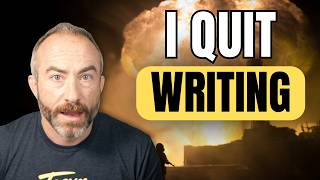
A writer spent a decade revising unpublishable manuscripts until he realized he lacked basic scene-level skills like dialogue and point-of-view. Using Shawn Coyne's Story Grid and weekly coaching focused on one skill at a time, he completed and published his novel The Shithead. The fix was mastering fundamentals, not more revisions.
Chapters
In 2013, I hit a wall with my writing and I decided to quit. I had this manuscript I'd been working on for 2 years. I wrote an entire draft, then I revised it, then I revised it again, then revised it again, and it still was a complete mess and nowhere near publishable. And this was after like a decade of trying to do this on my own, writing books, realizing they're not good enough, getting halfway through, giving up, and on this just write-revise loop. And so finally I threw up my hands and decided to quit. And I want to know if this is something that you can relate to. So think about this. Maybe you write a draft of something. It could be a few chapters, it can be half a book, an entire manuscript, and then you put it in a drawer like you're supposed to and leave it alone for a couple of weeks. Then you come back and read it and you realize something's wrong. It's not working. And so you decide, okay, I need to go learn more about writing. So you go read a book. Maybe take an online course, maybe watch a masterclass by some famous writer. You learn a bunch of stuff and you realize like, okay, now I've got all this knowledge. I'm going to go back and I'm going to revise that novel. So then you do that, then you put it in a drawer, then you read it, realize, well, you made some things a little bit better. Other things maybe got worse. You're not really sure. And so you have to go learn some more. So back to reading and courses, and then you try to revise it and round and round you go trying to write and revise this novel over and over and over. So is that something that you can relate to? This is what I call the writer doom loop, this endless write and revise loop we get stuck in trying to write a novel that actually works, that's actually publishable. And if you're nodding along right now, you know exactly what I'm talking about. Most writers spend years in this loop. I spent over a decade in it, and by 2013, I'd had enough. So I decided to stop. I give up on writing. I must just not have the talent or the writing gene or whatever it is, so it's just time to cut my losses and on. So I left that manuscript in the folder on my desktop with the other dozen half-done manuscripts in various states of unfinished, and I decided I'm going to move on with my life and find something else to do with my time. So what was actually going wrong here? Because I was following all of the conventional advice. I was working on my book, writing every day. I read the craft books. I joined writers groups. I went through online courses. And when I finished the draft, I'd start the rewrites because, you know, Ernest Hemingway said that the only kind of writing is rewriting. And he said the first The first draft of everything is shit. And so you have to revise. And then Robert Graves said, there's no such thing as good writing, only good rewriting. And then E.B. White said, the best writing is rewriting. And this goes hand in hand with what Anne Lamott says in Bird by Bird when she says, the only way I can get anything written at all is to write really, really shitty first drafts. So I was doing exactly what every famous writer said to do, all the courses said to do, and yet it wasn't working. I wasn't getting any closer to writing a draft of a novel I was actually proud to publish that readers would love. And here's something nobody ever seems to talk about. Now, at this point, I have been in the publishing industry for 18 years. I've worked with brand new writers, debut writers, all the way through career writers that have been doing it for a really long time. I've seen behind the scenes. I know lots of agents, lots of editors. I've just been around the industry. And this is one of those things that is true, but yet people don't ever talk about out loud, and I don't understand why. So I want to share it here. So let's start here. Have you ever watched interviews with professionals in the sports world, like pro basketball players, football players, golfers, that kind of thing? And have you ever watched one of the interviews after they've had a particularly bad game or bad outing? Now, many of them will admit how poorly they play. They'll use all kinds of terrible adjectives. They might even say that they played shitty. Now, how bad was their performance actually? Imagine that terrible basketball player playing one-on-one against me. Now, I haven't played basketball since I was in high school, and I wasn't very good then. So even this terrible basketball player playing terribly from the NBA, he would absolutely destroy me 100% of the time because compared to other professionals, yes, he played terribly, but compared to a normal amateur like me, he's still one of the best in the world. So here's the point I want you to see. The difference between a professional's bad outing and an amateur's good outing is still really, really big, and that goes the same for writing. The difference between a professional writer's shitty first draft and yours is huge because a professional writer's bad first draft is actually still pretty good. Yeah, it needs some tweaking, it needs some polishing, there's some things that have to be fixed, but it's a working draft on his first try. But your first draft is an amateur, it actually is really shitty. It has huge problems. The first scene is probably a mess. There's plot holes, character development that doesn't track. It doesn't need polishing. It needs rescuing. And so this is what I want you to realize, is that when a professional writer says their first draft is shitty, it's not actually shitty, and it's so much better than what you're writing on a regular basis. So let's imagine that I wanted to learn how to play the piano. I've never played before, never learned anything, but I really, really want to learn. Should I grab a piece of classical piano music and immediately start trying to play this long, complicated piece? Well, no, of course not. You and probably everybody else would say that's absolutely crazy. So think to yourself, how should I actually go about learning how to play the piano so I can play this beautiful classical piano piece of music? So what's the first thing that I should actually do to learn the piano? Well, maybe work on learning some basic chords, then learn some scales, learn some initial chord progressions, maybe learn some initial, like, how to read music. I would focus on the fundamentals, the things that every piano player has to learn no matter what kind of music they want to play. And if I really wanted to make fast progress, I'd work with a piano coach who would teach me step by step how to practice and level up those fundamental skills, point out where I'm making mistakes and help me get better. Then, After I master the fundamentals, I can start playing songs. Then I can work my way up to longer, more complicated pieces of music. Then when I wanted to sit down and learn a new song, I'd say, "Oh man, I did shitty on my first try," but really, to an amateur, it would look like I did pretty good. This is the difference between a professional and an amateur writer. The professional understands all of the fundamentals, from how to write great sentences to great scenes, to great short stories, to great novels, they've learned and mastered the fundamentals. So when they sit down to write something, they can produce a working version on their first draft. It needs polishing. Yes, it needs some fixes, but it works. It's something that readers would love. So quick aside here before we keep going, if you are wondering what these fundamentals are and how you can actually practice them, I built a free scene writing checklist that walks you through the most important fundamentals at the scene level. It's the same checklist that I wish somebody had handed me way back in 2013. So you can grab a free copy of it right now at StoryGrid.com/checklist. There's also a link down in the description. So here I am, here you are, you're following all of the conventional wisdom, you're doing all the things you're supposed to be doing— writing every day, studying craft books, learning story theory, reading all the books and going through the courses— and yet this This is the part that makes me boil with rage. The common wisdom spouted by everyone, including these professional writers, is to just sit down and start writing your novel. But that's the equivalent of telling someone who's never played the piano to grab their favorite piece of music, no matter how complicated, and just sit down and start playing it. It will literally never work, no matter how hard or how long you try. You have to first learn the fundamentals and then build up from there. This is the only way to keep you out of that writer doom loop. You're trying to play Beethoven by writing a beautiful novel on your first try before you've even learned the fundamentals of playing chords. So I keep talking about these fundamentals of writing, but what are they? And most importantly, how do you actually learn them? So remember, writing isn't a skill. It's not a skill all by itself. It's actually a collection of skills. Again, going back to the piano, playing the piano isn't just one skill. It's lots of different skills. Or you go back to basketball. Basketball isn't one skill. It's dribbling, shooting, passing, defense, footwork, court vision, all that kind of stuff. There's all these individual skills that make up one skill. And so you have to take this overarching skill and break them down and practice them individually before you can start doing them all at once. And writing is the same way. You have to slow down and practice each fundamental skill individually. So think about all the individual skills you have to learn when you're writing. So let's look at writing and let's look at those individual skills. And we're not even going to worry about writing an entire novel yet. Let's just look at one scene. What does it take to write one great scene that keeps the reader engaged, turning pages and wondering what happens next? So just think to yourself, what are some of the skills that goes into writing great scenes? Well, you have to be able to write great dialogue, some physical action. You have to be able to write exposition, character development, point of view. Tense, setting description. You have to be able to do the Five Commandments of Storytelling: the inciting incident, turning point, crisis, climax, and resolution. You have to have strong narrative drive. And these are just a handful of them. They're not even everything that goes into writing a great scene. And yet these are the skills you have to slow down and practice individually if you ever want to hope to put them into a working scene in a working novel. But once you have learned them, then everything gets so much easier, just like learning the fundamentals playing the piano make playing all future music easier, if you slow down and learn each of these fundamentals of writing individually, then everything you write in the future gets so much easier to do it right. So let me go back to that writer doom loop and the day that I decided to quit. So I actually did quit writing for 2 years, and it wasn't until I came across this book called The Story Grid by Shawn Coyne that it started to rekindle my desire to write. I ended up reading it, I loved it. I reached out to Shawn. We started a podcast together and he started working with me on my writing and we built a process. Each week I'd write a new scene, I'd turn it in. He would give me feedback. Here's what you did right, here's what you did wrong. And then he'd give me homework to practice individual skills in the coming week. And for the first time in over 10 years of trying to be a writer, I actually started making real measurable progress. Eventually, I planned out and wrote a full novel. We published it. It's called The Shithead. It sold thousands of copies and has hundreds of reviews. And I'm working on my next novel right now. Confidently, I'm working on it because I finally learned the actual skills of writing. Because if you slow down and actually study the individual skills and get feedback, this is how you improve at writing. This is how you break out of that writer doom loop of constantly writing and revising a manuscript that's never going to work. And that first step of understanding the fundamentals is at the scene level. That's the foundation of everything else that it's built on. Because if you can't write scenes that pull the reader in and keep them reading, you'll never be able to write a novel that holds a reader's attention. So that's why I built the free scene writing checklist to give you the same fundamentals I wish somebody had handed me 13 years ago. So you can grab it free at StoryGrid.com. TAO/Writing-Checklist. There's a link down in the description as well. And the next video you should watch is on your screen right now. It's the one line-by-line writing trick to engage readers. It's where we go deeper on the first fundamental almost every writer gets wrong at the sentence level. It's down in the description too. But as always, thanks for being a writer. Thanks for being a part of our community here at Story Grid, and I'll see you next time.
More from Story
This Will Help With Writing Your Novel! #author #writing #writer #publishing #novel

You NEED This to be a Great Writer! #author #writer #writing #authortube #publishing



Practice vs Performance in Your Writing! #author #writer #writing #publishing #books
Monsters vs. Villains in Writing! #author #writer #writing #authortube #publishing

How to Find Your Character’s Object of Desire #author #writer #writing #books #authortube

