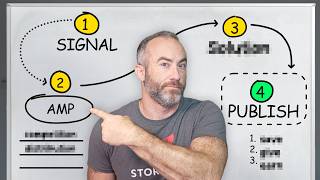
A Story Grid TA YouTube tutorial explaining a three-step method to keep readers engaged: (1) Create a clear signal by structuring scenes around the "five commandments of storytelling" (inciting incident, turning point, crisis, climax, resolution); (2) Amp the signal by intensifying the scene's crisis—make choices worse, higher-stakes, and emotionally acute using concrete examples (job vs. love, burning building/dog); (3) Cut the noise by removing distracting exposition and tightening line-level writing so the story signal reads loud and clear. The video closes with a call-to-action to apply for Story Grid coaching.
Chapters
How do you keep your reader hooked to your writing and turning pages in this world of endless distractions? At Storygrid, we work one on one with hundreds of writers to help them level up their craft and write books they're proud to publish. We've broken this down into a three part process that I'm going to teach you in this video. Remember those old transistor radios if you're under 30 years old? Probably not, but the idea is that when you first turn on the radio, it, it's all noise, it's just static. So you start turning that little knob until you catch a signal. You catch a little bit of noise, maybe a bit of melody for some music. It pushes its way through the static. Now you slow down and you keep adjusting the knob until you've cut out all of the noise and just the signal is coming through loud and clear. Now, in your writing, the signal is, is the story, the thing your reader came for. It's what keeps them glued to the book, turning pages because they're desperate to know what happens next. The noise is all of the things that distract, bore, or confuse the reader. It's the stuff that gets them to close the book and move on to a better writer. So how do you do this? How do you write stories that are pure signal and cut out all of the noise so that the reader stays glued to the story turning pages? Because they have to, to know what happens next. So step one of this process is to create a signal. Stories are about change. If something doesn't change in your scene, then nothing significant has happened. So how do you know if something changes in your story? Well, we use the five commandments of storytelling. This is the inciting incident, the turning point, the crisis, climax and resolution. Now, I've talked about these a lot on this channel. I'm going to put links down in the description if you want to dive into those individually. But the big moments here are the inciting incident and the climax. So if there's a clear inciting incident, a moment where your protagonist's life is knocked off balance by antagonism and it builds to a clear climax, a point where your protagonist takes an action that is irreversible and causes true change in their life, you now have a signal. You have a story moment that is there and has a chance of keeping the reader engaged and wondering what happens next. So these five commandments are the first thing we always look for in everybody's story. Every single scene of their story has to have these five commandments. Otherwise nothing happens. The story becomes confusing, it becomes boring, and the reader is going to move on to something else. So once you have these five commandments, you have something that changes, that matters, that changes the value in the story. Story. You now have a signal, and you've completed step one, but you're not done yet. Just like when you first hear a melody cut through that noise, you don't stop. You have to make the signal stronger. And that is step two. Amp the signal. Make the signal stronger so you have a signal from the five commandments. Something that matters has happened in your story. That's not enough. You have to amp it up to really get the reader to engage in and care about what happens next. That's what we're focused here on, is that if the reader doesn't care about what's happening in your story, they're going to close that book and they're going to move on to a better writer. And I don't want that to happen to you. So how do we do that? How do we take those five commandments you created and really amp them up so that the reader leans in, they're engaged, they care about what's going on, and they're going to keep reading. This all comes down to the crisis of your scene. The crisis is that point right before the climax. So remember, the climax is when your protagon an ultimate decision and acts on that decision and changes something. But right before that is the crisis. And this is the decision point of your story. The antagonist has backed your protagonist into a corner and forced a decision on them. Now, up until this point, your protagonist has done everything they can to avoid this decision. But now they have to choose. Will they turn and fight the tiger or jump off the cliff? Will they take the new job in Seattle, leaving the boyfriend behind, or turn it down and stay for love? Will they run into the burning building to save the dog or stay in the safety of the street? But it's not just about having a crisis. It's about making the crisis stronger. How can you make the crisis worse for the protagonist? How do you make it more emotionally excruciating for the protagonist? How do you get the reader to empathize? Or with both options, both option A and option B of the crisis. So let's look at that one where the woman's deciding between the job offer, where she has to move to Seattle, or she can stay and be with the love of her life, her boyfriend. Well, let's look at that job side of the equation. So this job, she has to Move to Seattle, maybe from Atlanta, and she gets offered this job in Seattle. But it's not just a job, it's the protagonist job, dream job, the one she has worked her entire career to get. And she finally has the opportunity, but the only place the job is located is in Seattle, Washington, which means she has to move. But then we look at the boyfriend side of the equation. It's not just any boyfriend. It's the boy she has been in love with since high school and they have finally just gotten together. And then it's not just taking the job in Seattle or keeping her job here, like her job here, where she lives in Atlanta and has already been given to someone else. So she's not choosing between her current job and her dream job. She's choosing between her dream job and losing her job completely. And then we go back to the boyfriend and the boyfriend can't go with her because he is the sole care provider for his aging and sick mother. So you see how we just took this one crisis of do I move for a job or do I stay for my boyfriend? And we made it so much worse for the protagonist. We made it so much more emotional because it's not just a job, it's her dream job. And it's not just her dream job. She already lost the current job she has. But then on the other side, it's not just some boy she started dating, it's the boy she's been in love with since high school. And he cannot leave Atlanta because he's the sole care provider for his aging and ailing mother. So you see how we took this one crisis and we made it a lot worse. Let's look at another one. So let's look at that burning building one. So the guy, the protagonist is choosing between do I run into the building to save the dog, the burning building, or do I stay in the safety of the street? Well, it's not just any dog. It's the beloved dog of his wife who recently passed. So this is a connection to his dead wife who recently passed. And so now it's like, well, if I let the dog die, I'm going to lose that connection to my wife. But he's not just staying in the safety of the street because he's scared of the fire. He's staying there with his six and eight year old children. He has two children by this woman that just recently died and they're in the street. And so now if he runs in and he dies in that fire, he's going to orphan his Children. But then the children love the dog. They know that that's their one connection to their mother. So they are pleading and screaming with him to run in and save the dog from the burning fire flames. So you can see how now it just goes from what, some dog in a burning building and I can stay out here on the street and be safe. And it's so much worse because we amped up the crisis. So the worse that you can make the crisis, the more powerful the scene becomes and the more the reader has to keep reading to find out what happens next. That is how you take the signal from step one of the five commandments and you amp the signal by turning up the the crisis. That was step two. So that leads us to step three. Cut the noise. And here's the truth. If you've got the five commandments on the page and you've amped up the crisis, at this point, your writing is at least 70% there. And I've seen this with too many writers too many times where they get caught fiddling with individual sentences, switching out verbs, rewriting description, tweaking dialogue. And the scenes don't even have a signal in the first place. That's like trying to clean up a polluted river while the evil corporation is still pumping toxins into the water upstream. The first thing you have to do is to stop the evil corporation from pumping the toxins. Then the river cleans itself up most of the way on its own, and then your effort to clean up the remainder actually has a lasting impact. So if you're trying to fiddle with sentences and dialogue and all of that, and you don't have the five commandments in a really strong crisis, you're not making the scene any better. However, once you have created and amped the signal of your story, most of the problems are going to clean themselves up. And at this point, as an editor and a writer, I'm looking for anything that would distract, confuse, or bore the reader. I get down into the nitty gritty of the line by line. So I work to make sure I'm showing and not telling. I cut unnecessary description and exposition. I make sure the dialogue reads truthfully. I focus on the verb, noun and descriptor usage to make sure they are specific and emotionally valence. In short, I spend time doing some final cleanup to make sure the story comes through loud and clear. Now, if you're able to do this in your writing, you'll create something that will keep the reader engaged in turning pages all the way to the end of your story. But here's the thing. This is really hard to figure out on your own. The only consistent way I found to get better at all of your skills of writing is to get one on one feedback from an expert. And that's what we do at Story Grid. We'll work with you one on one to level up your writing so you can finally write a book you're proud to publish. If you're interested in working with us, go to storygrid.com WM and fill out an application. We'll follow up to see if we're a good fit and and tell you the next steps. Now if you're enjoying this video and you want to keep the training going, then click on the video that's on your screen right now. That's the next one you should watch. But either way, thanks for being a writer. Thanks for being a part of our community here at Storygrid and I'll see you next time.