ADHD sleep problems in adults
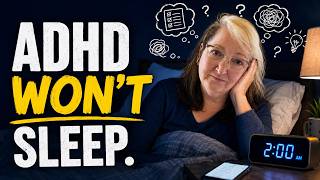
Tami Grgas explains why ADHD brains struggle with sleep: a delayed circadian rhythm and reduced sleep pressure, plus hyperfocus and racing thoughts keep you wired. She walks through concrete fixes like removing your phone, low-dopamine wind-down activities, box breathing, weighted blankets, magnesium, and coordinating medication timing with a psychiatrist.
Chapters
Hello, I'm trying to get this done while there's still enough light in here, um, because my light bulb just went out. And what I want to talk to you about is sleep. Now I thought the settings on my camera were going to mirror this, and I don't think it is, but I don't know for sure. Like, I'm like, how do I double-check? Do I push this button? Nope, that's— so I don't know. Um, sorry if it's not. Okay, so up here I've written sleep, and we're talking about sleep and how it actually works and why your ADHD brain struggles with sleep. I know mine does for sure. I was also diagnosed with chronic insomnia when I was quite a bit younger, so I've got other sleep issues as well, which is not fun, but it is what it is, right? So they say avoid screens. I say, "I don't think so." Yeah, free pass there. Uh, staying up too late is gonna make you not be able to sleep. Leave me alone. Just go to bed earlier. I don't think so. These are things that people tell you. Stop using your phone. Stop using your phone. No. So this is what I'm discovering about ADHD and sleep. It's really not about what they would say to a neurotypical type of person, and we are not neurotypical. I'm going to come up with a better term for that someday, but I don't have it yet. Yeah. So have you heard of a circadian rhythm? It's basically what our bodies are used to for getting up with the sunlight and going to sleep when it's getting darker. That is your circadian rhythm, and it's controlled by hormones, daylight, and darkness, and it tells your body when to wake up, when to focus, and when to sleep. This— they're saying in ADHD that this circadian rhythm clock inside of us, it, um, it runs 2 to 4 hours late all the time. So that's going to mess us up, really. And Then the second thing is sleep pressure. So this builds like hunger, okay? So this is the other thing that, you know, everybody's telling us to get to bed earlier and all that kind of stuff. And the circadian rhythm, they're referencing that about using our screens, the blue light, I don't know. Whatever. So sleep pressure builds like hunger. The longer you are awake, the more exhausted you get. You need time to build up between sleep periods. So, um, and it— this gets released when you nap or sleep in. So this is the trap we fall into, okay? We can't fall asleep at a normal time, so you stay up late. Then you sleep in to compensate, but sleeping in means you don't build enough sleep pressure for the next night, so you can't fall asleep again, and the cycle repeats, and you can get stuck in that. Add in the medication effects, because medication— I've got that down here— I know I take Adderall, and if I take my longer-acting Adderall, my extended release, in the morning, I have difficulty getting to sleep. I really do. And we also have— have you ever had racing thoughts at night, like thoughts about everything you didn't do? That you had intended to do through the day. I heard Mel Robbins mention that she had a lot of negative thoughts running through her head. I've never had that, and I think that's kind of because of how I have intentionally changed my life. I've gotten rid of those negative thoughts. It, that just doesn't show up. I don't have a Negative Nelly living in my head anymore, which is kind of nice. Um, so with all of this, like your sensory issues, um, you kind of have the perfect storm of sleep disruption. So that's kind of what's going on in our ADHD brains. And I want to learn how this really works. So I'm reading through this guide. So there's— they're saying there's screen hyperfocus trap. Okay, and this happens to me, I have to admit, because I have— I've switched from playing on my phone though. I no longer play the games on my phone. I play them on— I have an iPad, so I play them on that instead. And I don't like— you know, a lot of people talk about the reward and earning things and all that kind of stuff with games. That's not me. I'm not— that doesn't incentivize me at all. I've tried a lot of different ADHD apps There's one that they plant a tree and all this kind of stuff, and it just— that doesn't work for me. And apparently it works for a lot. It works for my son. Like, he loves the games and he loves winning rewards and getting so far and blah blah blah, beating the game, yay! And I'm like, okay, whatever. Like, I just play to have fun, and for me it's about the art. So I have this one app on my phone called Dazzly, and Dazzly has— it's like doing diamond art on your device instead of in person. Because I have a whole bunch of diamond art that I've done, and I do love doing it, but then I've got diamond art all over my house, you know? Like, then it becomes clutter, and I don't like clutter. I like to keep the diamond art that I have. I did one of Jesus, I did one of Starry Night, and one of the sunflowers by— I don't think it's Monet, I think it's— I did it again, I can't remember his name. It's an artist, you know, he does Starry Night and he does the sunflowers. I can't remember his name right now because I have some executive dysfunction going on and I can't remember things all the time. For some reason I want to say it's Beethoven, but I know it's not Beethoven. So yeah, anyways, um, so I do fall into that sometimes at night. I will keep doing the diamond art and I'll tell myself I'll just do one, and then I finish one, I get right to the end, and I'm like, oh, one more. And when you're doing the diamond art, it's not a quick game, it's not a quick anything. It's like, it takes a while sometimes, especially if you don't find all of the little numbers that you need to put the diamonds in for the certain color you're doing. And yeah, then it's just a hot mess. So they are saying Okay, your ADHD brain craves the dopamine hits from screens. Each scroll, notification, or video keeps your reward system firing. Which, that's not me, but I love the art part. The problem isn't willpower. The problem is that— excuse me— your prefrontal cortex, the part that makes good decisions right here, right here, okay, is already offline from exhaustion. So telling yourself, just 5 more minutes, or just one more piece of art, doesn't work when the decision-making part of your brain has clocked out. Oh my goodness. So this is the screen hyperfocus trap. And it says like the things that you're supposed to avoid with this: keeping your phone on the nightstand for the alarm, relying on willpower to stop scrolling or stop playing, setting vague boundaries like less screen time before bed, watching one more episode that autoplays into 3 more. So stop doing that. Do this instead. Put your phone in the bathroom with the charger 60 minutes before your target sleep time. 60 minutes. Okay. Yeah. Mm-hmm. So out of sight equals out of hyperfocus loop. This isn't about discipline. It's about removing the option entirely. Now my problem here is I listen to Audible when I go to sleep, but I can still have my sleep mask with the microphones in it— not microphones, with the headset things. Um, I can still listen to that when it's in the bathroom. So, so you're also supposed to set an alarm labeled Phone goes to bathroom 60 minutes before bed. When it rings, that's your cue. No negotiations. No, just one more thing. The alarm makes the decision external, not internal. Oh, there's more. Install auto-lock apps. There's a few of them. It forces the device off at the set time. Oh, that's nasty. Um, replace the phone with a low dopamine transition activity you actually want to do. Okay, they're saying old TV reruns you've seen 10 times, crossword puzzle, coloring book, knitting, Telescope, stargazing. Pick something mildly interesting but not gripping. The key is interesting enough to do but boring enough to stop. That's going to be hard. Hmm. Buy a $15 alarm clock. No, but I need my phone for the alarm excuses. If you need to wake up, buy an actual— if you need to wake up, buy an actual alarm clock. And if you absolutely must use a device, wear blue light blocking glasses starting 2 hours before bed. Not ideal, but better than full spectrum light hijacking your melatonin production. Also consider installing apps like— there's one, it's f.lux— on your computer. Let me see if they got other stuff we're supposed to pay attention to here. Oh, then there's the transition freeze. I gotta go turn on the light in here. Okay, so we have the transition freeze. Now, you can't shift from work mode, fun mode, to sleep mode. Your brain stays stuck in go gear. Yep, ADHD brains struggle with task switching. This is true. Um, especially with hyperfocus and overstimulation. Going straight from high-intensity activity to sleep is like slamming the brakes on a speeding car. Your nervous system can't shut down that fast. You need a bridge. So this is about making the bridge between, like, if you're working at night or into a heavy-duty game or, or or watching some very active sports or something that, that's giving you that internal energy, then you need to do this to transition to bed. Okay, so these are what you're supposed to avoid. Okay, avoid jumping into bed the second you feel tired. Don't end your day with work emails, arguments, or doom-scrolling news. Oh, stay away from the news. Expecting your brain to just relax without a bridge activity is not good. Starting a new engaging activity, a gripping novel, intense video game right before bed, not a good idea either. Yeah, don't do these things, okay? So what you're supposed to do is start your wind-down routine 60 to 90 minutes before your target sleep time. Your brain needs space to shift gears. This isn't optional, it's biology. Okay, set a phone alarm labeled start wind-down. 60 to 90 minutes before bed. So you can do, like, if you're doing both the put your phone in the bathroom and you have to do the wind down, because it sounds like I have to do both, then you can set one alarm and do your wind down once you put your phone in the bathroom, is what I'm going to try doing. So there's that. Um, So you're supposed to pick one transition activity that's interesting enough you'll do it, but not so engaging you can't stop. So good options are brain dump journaling. I like doing brain dump journaling. They're saying an easy puzzle, tea drinking. My husband and I drink tea every night. Stretching, that's a good one too. Skincare routine, old TV show you've seen before, uh, coloring book, crossword, uh, okay. So now this activity, this next activity, you're supposed to do outside of your bedroom. So train your brain Bedroom is sleep only. Living room couch, kitchen table, anywhere but bed. You can, um, so it doesn't say, okay, do this activity outside your bedroom. Train your brain. Bedroom equals sleep only. Living room couch, kitchen table, anywhere but bed. So you're supposed to set hard boundaries. 60 minutes before bed, no work emails, no news sites, no heated discussions with your partner or your kids. Um, then it's use environmental cues to signal transition mode. So dim the lights throughout your home. Leave a nightlight or soft table lamp on. If you can't dim, turn off lights in rooms you're not using. Play soft background music. Change your thermostat so the temperature drops an hour before bed. Take a warm bath or shower. The drop in body temperature afterwards promotes sleepiness. I'm going to be having a nice warm shower after this. Oh yeah. Put on your favorite comfortable pajamas and drink chamomile tea. So I think what I'm going to add in for myself is doing some stretching during that time because I need to do more stretching. And if your mind is racing with tomorrow's tasks, do a 5-minute brain dump. I a lot of times will use my phone to do my brain dumps. But apparently I have to stop doing that, so I'm gonna have to write them down because that's a good time. Like, I— nightly brain dumping is good. Just getting all those, those thoughts and to-dos and all that stuff out of your head onto paper makes it easier. That way they're not bouncing around in your mind. Um, write everything down on paper, then close the notebook. Your brain can let it go once it knows the list is captured. Um, tell yourself you only need to do one small thing from your routine, like flossing or putting on pajamas. The motivation will flow naturally once you start. I think, I think that probably takes a little bit of time. So then we have the Racing Mind Override. Your brain won't shut up. It's replaying conversations, it's planning tomorrow, it's spiraling into worry loops. So sometimes ADHD brains have trouble filtering the thoughts and regulating internal chatter. So when your body lies down but your mind stays revved up, it's not a character flaw, it's your brain struggling to shut down without external structure, which is true. Um, I've had it happen to me several times, and I always— because I was told that I have uh, not sleep apnea, insomnia. I was told I was a chronic insomniac, and because of that, I just always assumed that was part of it, all the thoughts going on. So you're supposed to avoid lying in bed trying to think yourself calm. Yeah, it doesn't work. Letting worries loop without capturing them anywhere. Yeah, since I've started, like, I keep a notebook beside my bed for that. Staying in bed stewing for more than 30 minutes and reaching for your phone to distract yourself. Now the phone should be in the bathroom, so you shouldn't be able to do that. So you're supposed to set strict boundaries again, 60 to 90 minutes before bed. No news websites, no arguing with internet trolls, no heated discussions, uh, no emails. You have control over this. Protect your wind-down time. Before getting into bed, do a 5-minute thought download. Grab paper and write every worry, task, or random thought bouncing around. No organizing, no prioritizing, just dump it all out. Your brain can rest once it knows everything will be forgotten. So I, I do love doing a brain dump. I always hated that terminology, but it works, it helps. So they're saying to use the box breathing technique once you're in bed. So box breathing is something that I learned quite a while ago with our foster son. So you breathe in for 4 counts, hold for 4, breathe out for 4 counts, hold empty for 4. Repeat 5 to 10 cycles. And he used to do this by drawing a box as he did it. And keep doing that. So that can be your body's calm down mode. You can extend to 5 or 6 counts if comfortable, but 4 is perfectly effective. So try progressive muscle relaxation if breathing alone doesn't work. I used to do this when I first found out I had the insomnia That is how I would get myself to go to sleep, is I would start at my toes and relax my toe muscles, and then relax my foot muscles, and just relax each little section all the way up. A lot of the time I didn't even get up to my hips. And I don't remember, like, fell asleep at some point there. But there have been times that I've had to do the whole process 2 to 3 times, and I probably should have stopped and tried something else when it didn't work the first time. So if you're still awake after 30 minutes, get out of bed. Now this one I kind of disagree with a little bit because it takes me 30 minutes to an hour to get to sleep. That's part of my issue, and I need that time to actually shut everything down. So they're saying, stand beside the bed or move to a chair, do something boring, flip through a magazine, gentle stretching until sleepiness returns. Don't teach your brain that bed equals lying awake anxiously. Well, I'm never anxious. Um, if I get to that 30-minute level and I can feel myself drifting off a little bit, I know it will happen, but it just takes me a while. That's my reality. My husband, gosh dang it, he hits his head on a pillow and he's out. I'm like, how can you be snoring already? Like, craziness. So keep a notepad by your bed. If a critical thought pops up, write it down in the dark without turning on lights. Your brain will quiet once it knows the thought is captured. Um, okay, so consider a meditation app like Headspace for guided body scans or sleep meditations if you need more structure. I tried the meditations. I, I don't know why, they just didn't work for me. For me, what works for me is listening to a book. I keep my Audible on a low level, and a lot of times it's like I'll listen to the Bible or I'll listen to different stories about godly stuff, but I just— the meditations And I even tried all that, like there's green noise and there's, I don't know how many colors of noise there are, but there's a lot. And I've tried almost all of them and they just don't work for this brain. So a lot of it's about experimenting on yourself and figuring these things out. Okay. Um, so there's another one. Your clock runs late. So your body doesn't get tired until 2 to 4 AM, no matter what you try. And that does happen to me. I will, like, so this morning I actually woke up at, I think it was 4:30 AM, and I couldn't get back to sleep. So yeah, it was, and I did grab my phone, and yeah, I probably did something I was not supposed to do. But when my body does that, I know it's not going to go back to sleep. So I don't know. So they're saying— oh, this is called Delayed Sleep Phase Syndrome. So your circadian rhythm runs 2 to 4 hours behind most people's. So they're not talking anything about when you get to sleep and then wake up. So I don't know. So they're saying to avoid fighting your natural rhythm with willpower alone is not a good idea. Avoid trying to get to bed at 10 PM when your body isn't tired until 2 AM. Napping during the day or sleeping in on weekends is no-no. Drinking caffeine after 2 PM, don't do that. Oh, apparently ADHDers metabolize it more slowly. Hmm. Making drastic decisions, um, so trying to shift bedtime by 3+ hours overnight, not gonna happen. So they're saying do this instead: keep a sleep diary for 1 week. I've never done that. Track when you naturally fall asleep and wake up. Haha, how are you supposed to know when you fall asleep? That's my question. Hmm. Base your initial sleep schedule around your natural rhythm. Hmm. So they're saying if you naturally fall asleep at 2 AM and wake up at 10 AM, start there. Work with biology first. I don't know, I have one of these fancy watches, so I bet you it tells me when I fall asleep, or when it thinks I fall asleep, because I don't always trust them. Um, so if you need to shift your schedule earlier, do it in 20-minute increments. Don't do crazy increments. And get bright light exposure first thing in the morning, within 30 minutes of waking. I do that. I have my one alarm beside my bed. It turns on natural sunlight, and that's what I wake up to. It also makes weird noises, but the natural sunlight is why I got it. Um, now, use a sunrise alarm clock. That's what I have. Or smart bulbs that gradually brighten before your alarm. Uh, whoo-hoo-hoo! Stay awake all day, no naps. Now I'm not really a napper, so, but my husband is. And cut caffeine after 2 PM. Set your alarm for the same time every day, even weekends, for 3 to 4 weeks while resetting. So this is about resetting yourself. If you're not sleepy at your target bedtime, don't lie in bed. Do something boring outside your bedroom until sleepiness arrives. Consider natural sleep support, tart cherry juice, or melatonin supplements. My husband and I take melatonin before we go to sleep. And it helps. One that we just got, we just used it for this last month, was a melatonin supplement by Melaleuca, and I found it was phenomenal, like really good stuff. It's a little more expensive than some of the other cheaper brands, but it really made a difference for me and my husband. He, he's not very good at judging how medications work, like he's just, oh yeah, I guess, I don't know, okay. So, um, your medication is still active is the next one, so it's keeping you wired at night, and they're saying 50% of people on stimulants report insomnia. But stimulants don't always worsen sleep. In some cases, they actually improve it by helping with bedtime routines and reducing mental hyperactivity. The issue is usually timing or dosage. Interesting. So don't take your dose too late in the day, uh, Don't assume you need to quit medication entirely. Don't ignore the problem and accept insomnia as inevitable. Do this instead. Excuse me, I have to yell at the cats. Cats, stop! They're trying to get in. So do this instead. Adjust timing. Take your first dose earlier in the day so it washes out earlier. Okay, so talk to your doctor first before doing this, um, but that could be a way of doing it. And for me, like, I did kind of sleep in a little bit this morning, but I wasn't— I don't know. I didn't take my XR. I take the Adderall XR in the morning usually. I didn't because I didn't want it lagging around, so I took my shorter acting, quicker acting, whatever, Adderall instead. So now it's out of my system. And yeah, I should find it easier to sleep. Okay, I'm going to move this closer and I'm going to keep talking through these. Oh, I need to put my back back. So you're supposed to track your sleep for 2 weeks after any medication changes. Um, when you take your— note when you take your dose, when you try to sleep, how long it takes you to fall asleep. And how you feel in the morning. Bring this data to your doctor. So my regular GP, and I'm also type 1 diabetic, so my endocrinologist, neither of them, um, deal with my ADHD. So for me, it would be taking this to my psychiatrist. So I don't know about you, I'm just kind of hiding the crap on the bed back there. There we go. Yeah, see, out of sight, out of mind, right? Anyways, so, um, they also say don't adjust medication on your own. So I did talk to my psychiatrist about the fact that if it's too late in the morning, I won't take my XR, and she said that's fine. And we We also, my son and I, take breaks on the weekends because I made the mistake of staying on my Adderall for almost 2 years straight, no breaks, and then it stopped working and I lost my ever-loving mind for a while. It's back now though, mostly, mostly, yeah. So your body won't relax. That's another one. And I have had this happen. So you're exhausted mentally, like your brain is shutting down, but your body feels wired and restless. I have to tell you, this is one of the weirdest things that happens. Like, ugh. They're saying that ADHD often comes with motor restlessness. Your body literally can't settle. This can show up in restless leg syndrome, uh, general fidgetiness, yeah, or feeling— just a feeling that your body is buzzing. Oh yeah, I've had that. Yes, yes. Um, oh, you might also have undiagnosed sleep disorders like Periodic Limb Movement Disorder? I don't know, keep hearing about weird things since I found out about this ADHD. Really weird. So you're supposed to avoid lying still and trying to force your body to relax. True. Um, ignoring the signs of Restless Leg Syndrome. Um, I've had that happen in the past, but it hasn't happened for a long time, and I think part of it was because I weighed more than I do now. Um, and avoid drinking alcohol to help you relax, and No vigorous exercise within 2 hours of bedtime. So instead, do gentle stretching 30 to 60 minutes before bed. Focus on legs, hips, back, shoulders—areas where tension builds. Stretching releases physical tension and signals your body it's time to wind down. And then they talk about the progressive muscle relaxation in bed that I was talking about earlier. I don't even know who they are anymore. Exercise earlier in the day. Um, studies show people who exercise fall asleep faster and stay asleep longer, especially people with sleep problems. But avoid strenuous activity within 2 hours of bedtime. Even a walk after work helps your body feel naturally tired at night. Use a weighted blanket. I love my weighted blanket. That was a huge help for me. Check your magnesium intake, and this is something that I know I need more magnesium. I just ordered some again from Melaleuca, and I also want to go— we have a place here called the Float District where you can float in magnesium, like in sea— not sea salts, Epsom salts. That's what it is. And if you have a bathtub and you can soak in the tub, put Epsom salts in there because that gives you magnesium. And magnesium gets into your system better through your skin than through your mouth. So little weird tips that I know about, uh, If you have the restless leg syndrome symptoms, um, talk to your doctor. Let them know. I don't know, um, it's more common in ADHD and it is treatable. Uh, you might need an evaluation for iron deficiency, which can cause it too. Get evaluated at a sleep lab if you experience frequent night waking. Snoring, irregular breathing, or daytime sleepiness despite sleeping. You might have sleep apnea or periodic limb movement disorder. Both are treatable and both are more common in ADHD. See, I don't think I have sleep apnea, but I might have the weird leg thing, I don't know. And okay, this one— oh man, there's a bunch in here. Oh, there, there's many more. There's 12 in here and I'm at 7. Wake at 3 AM, can't return to sleep. So this is often anxiety-driven, and do not look at your phone or turn on bright lights. Do not lie in bed stewing and watching the clock. Do not get frustrated with yourself. Do not start productive tasks that fully wake you up. Instead, keep a notepad by your bed so you can write down what's worrying you or what's troubling you. Use the same calming technique, the box breathing, for your racing mind. If you're still awake after 20-30 minutes, get out of bed. And sit in a chair or stand by the window. Just, just move somewhere else for a little while until you start feeling that draw to go back to sleep. Avoid looking at the clock. Oh, that's so hard. Oh, turn it away from you. Clock watching creates anxiety. It does. If this happens frequently, track the patterns. Same time every night, medication days versus not— non-medication days, the anxiety, like all that kind of stuff would help to have it tracked. And for bathroom trips, use dim red lights, keep eyes half closed, don't check your phone. Yeah, I usually don't turn on any lights to go to the bathroom, but I do get up a few times. So another one is alarm doesn't wake you, you sleep through alarms or hit snooze without remembering it. This happens to my brain, or to my son. Um, so it's: ADHD brains often have a delayed response to auditory cues, especially when sleep deprived. You need a wake-up system that's impossible to ignore. I have yet to find something that's impossible to ignore for my son. And he will tell you that. So avoid keeping your phone alarm within arm's reach of bed. Using the same alarm sound every day, your brain tunes it out, so avoid that. Avoid hitting snooze repeatedly, which fragments your sleep and makes you groggier. Hmm. Relying— stop relying on willpower to just get up. Okay, so do this instead. Put your phone or alarm across the room. That doesn't work for my son. Set 2 alarms, one to wake up, one for medication 30 minutes later. Um, use a sunrise alarm clock or smart bulbs. We did that with my son. Change your alarm sound weekly. Um, I also got him an alarm that part of it sits under your pillow and vibrates. That didn't work either. Uh, schedule early morning commitments. Uh, no, that's not gonna work for him. Um, like breakfast with a friend or a workout class. If you're still struggling, set a 5-minute check your phone timer. When you turn off the alarm, immediately set a 5-minute timer and throw your phone across the room. When it goes off again, you have to get up to turn it off. That one's funny. I'm gonna tell him to try that one, but maybe don't throw your phone, that could be bad. And get bright light exposure within 30 minutes of waking. So that's a huge one right there. So, morning fog: you're awake, but your brain won't come online for hours. That happened to me this morning. I was kind of dysregulated and just felt crappy. Um, sometimes it can be medication-related or circadian rhythm-related. Um, avoid expecting yourself to be productive immediately. Avoid skipping breakfast or morning hydration. Avoid staying in dim indoor lighting all morning. Avoid trying to make important decisions or do complex work before your brain is online. So what you're supposed to try is use the 2-Alarm Medication Strategy. So have 2 alarms. Get bright light exposure immediately. I did that. Prepare everything the night before. I didn't do that last night, but I usually do that. I've kind of been falling out of that for a little while. Drink water first thing. Yep, did that. Eat breakfast with protein. Yep, had my yogurt. Build a buffer time. Oh, if you need to leave by 8 AM, don't schedule tasks that require start sharp thinking at 9:50. Or at 7:50. Give yourself 30 to 60 minutes of warm-up time before anything cognitively demanding. I didn't do anything cognitively demanding. I just, yeah. Consider switching to Journae PM, delayed release methylphenidate taken at bedtime. It activates 9 hours later, so you wake up— oh, oh, I didn't know. So this is totally— this could help my son. Okay, I'm gonna talk to a psychiatrist about that one. So you're supposed to build sleep pressure all day. And you need to set up your whole day to support tonight's sleep. So it starts when you wake up, and everything you do during the day either builds or reduces sleep pressure for tonight. Sleep pressure is like hunger. The longer you're awake and active, the more it accumulates. So avoid napping during the day, avoid drinking caffeine after 2, avoid being sedentary all day, avoid irregular sleep-wake times, and avoid sleeping on the weekends, like during the daytime. Yeah, so what you're supposed to do is stay awake all day, no naps, cut caffeine after 2, Exercise during the day. I, I struggle with the consistent exercising. I really do. That's something that I need to fix. Um, Paul and I were going to Hot Works, and we were going on a regular basis, but we couldn't afford it anymore because our son was in college. It was a big long story. But I don't know, I feel like I need some external place to go to, to have that consistency. At least that's how it feels. So get morning sunlight within 30 minutes of waking, keep a consistent wake time even on weekends, stay mentally and physically engaged during the day, and avoid alcohol. Even though you think it makes you drowsy. Now, ooh, Sleep Sanctuary Setup. So this is your environment. So your bedroom is working against you instead of supporting your sleep. My— mine's getting better slowly. Um, I've been— since we don't have foster kids anymore, I've been decluttering and, and keeping things set up nicer in the house. I'm not all the way there yet. We just got my mom moved out of here in January, and it is June, and I'm still not done. It takes a long stinking time to get rid of all the crap, and my garage is full right now, so I don't have anywhere to put it right now. Um, I need to get rid of a lot of stuff. So when you have— when you're setting up your bedroom, you have to avoid using your bed for work, studying, scrolling, or hanging out. Avoid sleeping in a room with any visible light sources. Avoid keeping your bedroom too warm, and avoid leaving your phone on the nightstand. So this is what you're supposed to do. The bed is for sleep only. You need to make your room completely dark. I act— well, any nighttime light inhibits melatonin production, so they're saying use blackout curtains. Um, what I do is I use an eye mask, so that blocks out all the light, and that really does help me to get better sleep. Let me see what's the next one that they're suggesting. Keep your bedroom cool. Yep, we turn down the temperature at nighttime. Address noise based on your needs. Okay, yeah, so if you need silence, use earplugs or noise-canceling headphones. If you need sound, I need sound, um, and I listen to audiobooks over and over and over again because that puts me to sleep. Um, put your phone in another room. I'm gonna try that tonight. I'm gonna put my phone in the bedroom. I'm really nervous about it, but I will do it. Invest in comfort, weighted blanket. Like I say, I love my weighted blanket and comfortable bedding. We have, my husband and I both have body pillows. And if you have like, if you have sensory issues, remove your tags and stuff like that. Calming scents like lavender. I have, I do have a spray for my bed that I don't remember to do every night, but I do it fairly often. Um, oh man, apparently it's toxic to cats and birds, lavender oil. Interesting. We do have cats, but they're not generally allowed in the bedroom. Um, keep the bedroom clutter-free, that I'm working on. I'm getting there. Okay, so now we have when to see a doctor. Okay, so this is kind of the, the final part of this ADHD Sleep Guide. So if you have persistent insomnia despite trying these protocols for 4+ weeks, if you have loud snoring, gasping for air during sleep, or irregular breathing patterns, Frequent night waking, more than 2 to 3 times per night, multiple nights per week. Restless leg syndrome symptoms. Extreme daytime sleepiness despite getting 7 to 8 hours of sleep. Medication-related sleep problems that don't improve with time adjustments. Severe anxiety or depression interfering with sleep. You may need a sleep study. I've gone through that before. Medication adjustments, iron level testing, and mental health treatment for anxiety or depression. Let me see, final page. So you're not broken. You're not. Neither am I. Our brains just run on a different operating system. So most sleep advice assumes neurotypical brains, and they generally have a standard circadian rhythm, so, and they don't take the crazy medications that we take, the stimulants, and they have their executive functions are firing on normal levels, and so that's why all that regular advice out there has never worked. I hope that you found one thing in this whole thing that can help you, because you just need to try that one thing for a while. See if it works. Give it— I myself am going to give this putting my phone in the bathroom 1 month. I'm gonna do it, and if it doesn't become habitual and doesn't make a big difference, then I'll try something else. But if you would like a copy of this I am creating one, but I'm going to have a few other things in here that I've learned with my sleep habits, and I, I'd like to see a better explanation of walking up your body to relax your muscles, and you know, like that kind of stuff. Um, so yeah, if you want to have a checklist of all these different things that you can try, get a hold of me. Send me a message, reach out on the Facebook, the Book of Faces, or on the Instagram. On the Book of Faces, I'm Tami Grgas. On Instagram, I'm Tami6410. So yeah, get a hold of me. Just say, hey, can I have that sleep stuff? Yeah, you could say it however you want. DM me the sleep stuff, Tami. I will do that. So I hope this helped you, and I hope you don't run away from my channel because this went on longer than I thought it would. And now I'm gonna go have a shower and get ready for bed. So have a great day, evening, whatever time of day you're watching this. I don't know. Get some sleep though. Sleep is one of the most important things we can do for our body because that's recovery time. And I have been struggling with my sleep, and that's why I got this guide, but I also feel like I need more ideas than what this guide gave me. So I'm going to dig deeper and find more stuff about helping our ADHD brains to sleep better, and hopefully I find something. I think I found something for my son though, that, that one medication they talked about. I'm like, oh, that might help him. You know, if he takes it when he goes to sleep, it will— it's a stimulant that takes— that becomes active like in the morning. So I don't know, we'll see what his psychiatrist says and I'll let you know. So everybody have a great life and have fun figuring out this ADHD world, because it is what it is, you know. And oh, by the way, I'm sorry about all my other videos being the wrong way, because I'm like a girl of the '80s, and you know, that's how we took pictures and did all that stuff when phones first came out. We had a flip phone. And so yeah, my son's been on my case about, turn your phone sideways, Mom. So yay, I did it! I'll talk soon. Bye!
More from Tami



When you can't find your phone and your cats know why 😹 #catmemes #funny #fail


Rebel on Two Wheels 🤘#ADHD #ADHDWomen #adhdselfimprovement #relationship #ADHD #ADHDMom #RebelLife