August 2, 2023
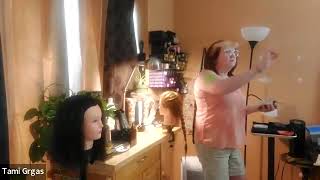
Tami Grgas braids long and short hair on two mannequins, showing how to section, add hair, and maintain tension. She explains why misting hair helps grip, how to choose the right elastic size, and the science behind how water breaks hydrogen bonds to affect curl formation.
Chapters
I'm ready. Hello, how are you doing? I am going to be showing you how to do a few different styles on your daughter's hair. Um, some of your daughters will have long hair, some will have shorter hair, so I'm going to work on both mannequins for you today. The first one I'm going to do on this lady. Let me see, what's her name? Oh, she doesn't have a name, so I'll call her Stephanie. The first one I'm going to do on her is called a French braid, and if I may recommend, some of you will not know how to do braids at all. Some of you will. Okay, sit your daughter down in front of you as you watch a Disney movie with her. And sorry, I'm just moving Stephanie over here. And play with her hair. Tell her to brush her hair, or you brush it. And the best, best brush— like, best brush is wet brush. The wet brush rules. Okay, so how are you going to do this when you're doing a French braid? Okay, there's two different types. There's an inverted braid where the, the bulk of the braid sits inside the hair. And there is— or is that the other way around? Inverted? I don't know. The other one is where the braid sits on top. Okay, so I'm just gonna do the one where the braid sits underneath for now. Later on I'll maybe do a video on having the braid on top for y'all. So we're gonna take a section at the top, big or small, depends on the thickness of the person's hair, how you want to start it, where you want it to start, how long you want it to stay in. She's just doing a daytime quick braid. Okay, so we're gonna split it into 3 sections. Now, a braid, you cross over on the outside, cross over on the outside, cross over one more time, and this is a French braid. I'm adding hair to my braid. as I go. I'm just going to use my fingers to comb it because we're not doing a high-fashion braid. We're just doing a quick braid right now. Okay? So I'm going to pull it tight, cross it over again, pull from this side. And in case you're wondering, there's little bits here that have been cut. That was like a former foster son that decided to give Stephanie a haircut. He didn't know what he was doing, so it's not so great. But anyways, so you're just going to keep going down the back. You can get her to tilt her head forward. A lot of times with younger people, I have gotten used to following them around on the chair. So as you can see, I'm just— I keep going, and I'm holding these fingers tight to the scalp. Okay. That will take some practice. Same with tightening it as you go. Like you're, you're gonna look at this braid and think, well, that looks great, but I can't do that. This took many years of practice. Okay. I used to get my baby sister to sit down in front of me while we watched shows. We didn't have access to movies back then. I won't tell you how old I am. But we used— I used to have her sit down in front of me while we watched Sesame Street and stuff like that, and I would play with her hair and I would make braids. And this is even before I got into cosmetology. I was just fascinated with playing with hair. So. As you can see, it's all coming together. And like I say, each time you just want to tighten it a little bit. Don't want to do it so tight that it cuts off their circulation. I mean, I've seen people who do that to people, and I don't think it's a good idea. But I don't know, some people want the braids to last for a long time, so that's why they get it done that way. I don't care for it myself. I'd rather do it looser so it doesn't give a headache. And do it more often. But that's, you know, a lot of people pray to have their children's hair braided, and they want it super tight so that it stays in for longer than a day. So the other cool thing about doing a braid— now, sometimes I like to mist it with water. Like, this is a mannequin's hair, and this is not real human hair. This is synthetic hair. So It tends to be slipperier and doesn't get as naughty. Um, with human hair, if you dampen it as you go, the hair will stick together better and give a more smoother braid if you just dampen it a little bit, and then the next day or 2 days later you can take that braid out and your child will have wavy hair, which is kind of fun. My daughter likes doing that with her hair. So there are a few different kind of elastics, rubber bands, whatever you want to call it. In Canada we call them— well, I call them elastics. See, my baby's shedding. Oh. So there's a basic French braid on my long-haired mannequin. I— the, the one that I used here is a very thin baby rubber band. I don't know, get that in close and see if you can see that. It's very thin. These ones have a little more substance to them, and these kind of things you can get like in packages. I keep mine in a little box because my Daughter decided to organize it for me. Now, the other thing that we're going to need on my other lady here, and her name is Kaylin. Kaylin has some shorter hair, so we're going to find with hers that some of her hair is going to want to fall out. Okay, so I'm going to show you how to use some bobby pins. A lot of people put bobby pins in incorrectly. And you know, quite honestly, I've been doing hair for like more than half of my life, and I used to put them in incorrectly as well. So I'm taking my top section like I did with Stephanie here, pulling it out, combing it— well, brushing it. And I'm going to do my 3 sections again. I'm going to cross over top. And then, as I do my third cross, I'm going to add hair to it. I have seen some people make a braid that goes down to, you know, a nice tight braid that goes down further, and then they start the French braid. You can do that. Once you figure this out, you can experiment with all sorts of things like that. So let's see here. Let's see how quickly I can get this done. So I can show you how to use bobby pins on hairs that are falling out or not cooperating. There's lots of different tools and tricks and tips and stuff like that that I, I would love to show you all. And I tend to do that with a lot of my customers when they come in. I tell them different ways that they can style their hair, different tools they can use to make it do that. I especially like to teach science when I'm doing hair, because hair is all about science. It's— when you put water in here, you're breaking hydrogen bonds. When you're— when you're— when you're applying heat, you are softening hydrogen bonds. And these things are what affect the curl in our hair. So now I'm starting to get to the shorter parts. We're going to have bits that are going to want to fall out down here. She's— oh, she's got a big part there. Well, maybe it'll reach. Here she is. Looking great so far. I like having her on this thing so I can turn her around like that. It's kind of fun. So anyways, I, I just like to give tips and tricks and tell people how they can do different things with their hair that I've learned over my many years of doing hair. Okay. So she has a very short little braid here, and it's got bits and pieces falling out. So first off, I'm going to make sure on Kaylin to use one of the thicker Elastics. Just to hold it in a little bit better. Okay. Now I want to tuck it up and underneath. I'm just gonna go like that. And so here is a bobby pin. Oh, so show you. There's a few different tools you can use to help out. There are— and of course I have giant— oh, is that a small one? No. I have like these giant hairpins. Okay, I use these to put my hair up in a bun. These are bobby pins. They have like the little bumpy side here. Now most people put the flat sha— flat shide? The flat side towards their scalp. It's the bumpy side you want to lock in and put towards your scalp. So new trick. Well, no, old trick, but new information, maybe. So I'm going to take my bobby pin, and I am going to put it in this way, so it locks it in better. If she had— let's say she had some hair falling out at the sides, I could pull that back. And just put a bobby pin there. Just make sure that you're putting the bumpy side towards the scalp. That's going to help. Like I say, it helps lock it in. With a mannequin, it's not so important because they have a plastic head that doesn't move. With people, it's more important because we have skin on our scalp, and our scalps move, and That's going to help lock that in. So here's my short French braid. Here's my long French braid, and I will include a PDF with this so that you can refer to that when you're sitting down in front of the TV with your kids and playing with hair. So I hope this has helped you, and I hope you come back for more, because I'll be teaching more. I think next time I'm going to teach a fishtail braid. That's a very popular one. Thank you. Bye. Okay, ready? There we go. She's in love. Just a minute. I'm gonna try and see if this will do nothing.
More from Tami
When you can't find your phone and your cats know why 😹 #catmemes #funny #fail


Rebel on Two Wheels 🤘#ADHD #ADHDWomen #adhdselfimprovement #relationship #ADHD #ADHDMom #RebelLife