Day 1 of Allergen Challenge
In this live workshop, Tami Grgas introduces herself as a type‑1 diabetic who developed severe seasonal allergies after moving to Nebraska. She recounts her personal history, including a frightening urgent‑care episode where a steroid shot threatened her blood‑sugar control, prompting a discussion of the interaction between steroids and diabetes. Tami then explains the immunological basis of allergies, focusing on IgE antibodies and how they trigger symptoms such as rhinitis, eczema, hives, and anaphylaxis. She lists common allergen sources (dust mites, pets, pollen, mold, foods, etc.) and describes typical reactions. The bulk of the session is devoted to practical mitigation strategies: customized home‑cleaning routines, daily dusting, saline nasal rinses, air filters and dehumidifiers, over‑the‑counter and prescription medications, and allergy immunotherapy shots. She also explores natural remedies—essential oils (with detailed usage tips), honey, spirulina, stinging nettle, quercetin, and acupuncture—emphasizing avoidance as the most effective approach. Throughout, Tami engages the audience, inviting them to share their allergens, register for a three‑day challenge, and submit take‑aways for prize drawings. The tone is conversational, personal, and instructional, with a mix of empathy for sufferers and enthusiastic encouragement to take actionable steps.
Chapters
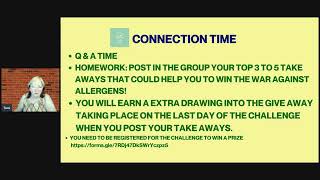
Okay, I'm back. Sorry about that. Don't know what happened. We are having a thunderstorm, so I don't know, something knocked me offline. So my name is Tami, and I am going to be helping you to understand what allergens are and where they come from. I am a type 1 diabetic. Who has had allergies since moving to Nebraska. For some reason, I wasn't allergic to things in a lot of other places, but Nebraska kicks my butt. I— oh, sorry, I've got an itchy eye. That happens when you have allergies, you know. So I wanted to tell you about my history with allergies. Okay, we first moved to Nebraska in 2008. We had moved here from England. My husband was in the Air Force and we were stationed at Mildenhall, which was fantastic. So we moved to Nebraska. And after we were here for about a year or so, I started noticing just that I couldn't breathe properly and strange things were happening. It wasn't too extreme, so I didn't put a lot of weight on it. And I just kind of, you know, people had said, oh, maybe it's allergies. So I took some allergy medication and, you know, that's what I did. Uh, so there it is. This is the free Kick the Allergens Out of Your Home Challenge. Okay. And also, I wanted to mention, if you would like to be eligible for the prizes, because I will have prizes at the end on day 3, at the end of the day, please fill out the Google Doc form. It should be pinned in the Facebook group. If you can't find it, send me a message or get a hold of me on Facebook, or, you know, there's ways to get a hold of me. And I will probably put that particular web address for the Google Doc in one of the slides tomorrow, and in one of the slides on the third day as well, just in case you guys can't get a hold of me or whatever, because, you know, it's a weird world that we live in. Anyways, so right now I want to tell you about my urgent care story. So we lived in Nebraska for 2, 2 and a half years. My husband retired from the Air Force. We went on vacation for a month or so, then came back, and my husband was looking for work here, and he just— he couldn't find anything for his career field, and I think he wasn't It's hard when you retire from the Air Force. He was in the Air Force for like 20-some-odd years, 22 years I think. And you know, when you have the same job for that long and then all of a sudden it's like, yeah, you're out now, find a new job, it's kind of difficult. And so we kind of went through that. He ended up getting a job in the DC area, so we moved to Virginia. We lived in Alexandria. We were there for a year, didn't care for Virginia. It was, um, too many people, too much traffic. It was just kind of crazy. Then he got another job in upstate New York, which when he first told me upstate New York, I, I was like, are you kidding me? Um, I am from Canada and I had never been to New York. I didn't know there was a difference between upstate New York and New York City. I thought it was all the city. So, you know, I'm like, I don't want to live in another city. And he was there, uh, interviewing at the time, and he's like, Tami, there's cow pastures all over the place here. So we ended up moving to upstate New York, and to be honest with you, that's like my favorite place on the planet. I loved it there. So we were there for 2, 2 and a half years, maybe 3, I can't remember, but Paul's contract ended and he got laid off, and there was nothing else there for him. I couldn't even find a job there, like, just doing a regular retail job. Um, I would have gotten my license to do hair if I could. Like, it was just next to impossible to get a job in upstate New York. It was just crazy. So he finally got offered a job back here in Nebraska. So we're like, okay, we moved back to Nebraska. We had started homeschooling my son when we moved to, to Virginia and continued the homeschooling process. Moved here to Nebraska, joined a homeschooling group. We moved back here, it was, um, I can't remember what month it was. It was like after the New Year though. So it was like, you know, still winter. Um, forgot how cold the wind was here. Uh, we rented— we had to rent a small apartment because we had to wait for the people who were leasing our home to be done with their lease so that we could move back into our home. So it was kind of weird moving back somewhere. I'd never done that before. It was kind of weird, kind of good, I don't know. So anyways, that In that homeschool community, I got to know some people, and I already knew some of the people who ran it. It was with Classical Conversations, which I really liked. And all the girls would talk about their allergies and stuff, and I was just kind of like, okay, I don't think I have allergies, but what do I know? So I just kind of went on with it and did my own thing. Sorry, I'm just going to— well, no, I'll keep it open so I can see the comments, I guess. No, there's no comments. Okay. Um, so anyways, we, um— I'm listening to my girlfriends. One of my girlfriends, she lost her voice. She was having trouble breathing. She like took like multitudes of allergy medication. And at that point I was just taking like one pill a day for my allergies and only when the allergies were active. And I kind of thought like, wow, these people really have extremes in their allergies. Like, I, I maybe was a little bit harsh and, and not understanding. I didn't have any empathy because I hadn't experienced that. And— And so I kind of thought maybe they were making it up. You know, like, I don't know. That's mean. And I'm sorry. However, later that fall, I— or no, it was the next fall. So that year, my allergies, that, that fall, they were difficult for me, but not terrible difficult. Then the spring, they were difficult but not terrible, you know, like they were manageable with medication and, and that kind of stuff. And then that year, like after the spring, we actually joined, joined the, the group because we came halfway through the year. So I had to finish up with James and then join Classical Conversations and It was there that then they started talking about allergies again. I was kind of like, okay, wow, you guys really suffer with this stuff. This is crazy. I don't understand. And then we had a friend in our homeschooling community who was deaf. And she and her interpreters were helping us to learn sign language, which was really cool. I liked learning sign language and using it with them to try and communicate, although I usually spelled everything out. I didn't know all the shortcut sign language other than thank you and please. But we kind of— we went through these classes during lunch with them learning new words and new things to do with our sign language. So that fall, later in the fall, I— like, it was crazy. My glands felt like giant rocks. That was the first thing I noticed. I had a sore throat. Of course, I had the sinus congestion and stuff like that. I started coughing, then I lost my voice, then I couldn't I couldn't talk at all because if I talked, I'd have coughing fits, and it was a point of not being able to breathe. So my son came with me to urgent care because I, like, I didn't know what was going on. Like, I thought, this is so weird, this has never happened to me. Went to urgent care and basically they determined that yes, these are allergies. And I was like, whoa. Is this what these ladies were talking about? Um, I had to write everything down for them. Um, James and I were using sign language a lot because I, I couldn't talk. If I started talking, I would cough my face off. Like, it was just crazy. So then the doctor, um, she talked about giving me a shot of— not cortisone, the, um, the thing that muscle builders do, uh— Steroids. She was going to give me a steroid shot, and I think she had kind of forgot that I was diabetic. And I know that the doctors have told me in the past that steroids are really bad for your diabetes because it makes your need for insulin skyrocket. At that point, I was like, I need something to help me because I, I need to breathe. Like, this is crazy. So the doctor came back and was talking about getting this shot for me. And I said to her, I said, "How's that going to affect my diabetes?" And she was like, "Oh yeah, that's right, you're diabetic. Uh-oh." So she basically went and reconfigured some stuff, and, uh, I went on some medication instead because the shots would last in my system for— I can't remember the timeline, but maybe a week or two. So my insulin needs would skyrocket for a week or two. And the medication would last for less time and not make it as bad. Like, it would— Uh-huh. Okay, so I went and got my medication, right? That night we were having dinner around the table. I had taken my first steroid pill. And it was seriously within 20 minutes I started feeling better. My voice started coming down, coming back. The swelling, the inflammation started going down. I could breathe better, like all those kind of things. And then I checked my blood sugar and it was like, whoa, okay. So I was chasing highs for— I can't remember how many days, maybe a week. Yeah. Because of that. And then when I went and saw my endocrinologist, who is my diabetes doctor, he was like, what do you mean you took steroids? And I'm like, well, at that point I think breathing was a little more important than blood sugar because, you know, if I stop breathing I'm gonna die. So, so that's where that was. Um, so I got on those and then the next thing I went to my doctor on base, and they referred me to an allergist. And I just— I, I would listen to my friends who had allergies, and I was always a little bit jealous, I guess, because my one girlfriend, she's like, well, I take this allergy medication in the morning and then I take this allergy medication in the afternoon, and then I take this one at night. And those were all ones that you were supposed to take once a day. And I was just kind of like, I don't think I can do that with my diabetes. Like, this is— I don't know. Like, I just— it was a new world to me. So when I finally got in to see my allergist— Well, I'll go into that a little bit later. I'll tell you about my, my fun with allergy tests. So that's my urgent care story. It was a little bit, it was scary. It was definitely made me look at allergies like, holy crap, they really are a bad thing. And they're kind of scary and they, they get to you. So how do allergens do this? Okay. Allergies are the result of mistaken identity. People with allergies are described as atopic, and atopic people usually have raised levels of IgE in their blood, and that's how they can tell if they're having allergy reactions, is that if they see this IgE in their blood. Okay, so this is a little bit about the LGE. Okay, so it's— okay, immunoglobulin E. So it's IgE, not LGE. Sorry. Yeah, are antibodies produced by the immune system. So it is 'an autoimmune thing,' which is kind of crazy because my type 1 diabetes is an autoimmune thing. If you have an allergy, your immune system overreacts to allergens by producing antibodies called immunoglobulin. These antibodies travel to cells that release chemicals causing an allergic reaction. This reaction usually causes symptoms in the nose, lungs, throat, and the skin. Each type of IgE has specific radar for each type of allergen. That's why some people are only allergic to cat dander. They only have the IgE and IgE antibodies specific to cat dander, while others have allergic reactions to multiple allergens because they have many more types of IgE antibodies. That would be me. I, I'm allergic to a lot of things. I'm allergic to many things. It's crazy. So where are allergens found? They are found in dust mites, pets, pollen, insects, ticks, plants, mold, foods, medications. These cover almost every allergen I believe can fit into one of these categories. And I list dust mites alone because I hate them. They're actually insects, but I hate them because they hate me. So examples of allergic reactions: allergic rhinitis. I don't know how many of you have heard of that, but that is what hay fever is. So sneezing, runny nose, and itchy red eyes. Eczema is something that happens on your skin. I've, I've I get eczema when I get— excuse me— when I get overly stressed. That's what happens to me. Hives I've never had. Asthma I don't have. Swollen glands I get. Inflammation I get. This can cause coughing, sore throat, difficulty breathing, loss of vocal ability. One thing that happens to me, which a lot of people think is really weird, is my tongue swells up and I end up biting my tongue all the time. It's kind of a pain in the butt or in the tongue. So anaphylaxis is when your throat like totally closes up and you cannot breathe, and that can cause death if untreated. That's That one is scary. So they all have one thing in common, okay? And I didn't know this before I gathered my information and started looking into this. There are many different allergens, but they all share one thing in common: protein. Some allergens do not contain protein to begin with, but they bind with protein once inside the body to provoke the allergic reaction. So they all have this protein in common. So if anybody's online, if we can get in the chat, I will put these in the chat on Facebook so that some of you can answer to them. So what allergens are you dealing with? Here. I'm gonna do capital so you can all see. Okay, what allergens are you dealing with? Who is allergic in your family? So for me, it's me and my son. 18-year-old son. I can't believe I have an 18-year-old son. Are you seeing an allergist? Are you on medications or shots? Shots. And what annoys you the most about your allergies? Or even about your family's allergies. I'm sure I annoy my family with mine. There's a lot of times that I just have to say, don't talk to me right now, just leave me alone. I'm just hoping I make it through this presentation. Okay. Like, it's just— this is a bad time of year for me. So I have a love-hate relationship with house cleaning. I really do. I've tried a lot of different things in the past. I, um, if any of you have heard of Flylady, I liked her for a while when we lived in England. I did the Flylady a lot, a lot. Um, right now I'm I'm coming up with my own, like I've kind of gathered information from different resources and I'm coming up with my own cleaning schedule and it's going to match my home and my needs. I feel like all the other people that want you, want to help you organize, want to help you declutter, clutter, want to help you to clean your home. They all have these great lists, but none of them ever really fit with me or my home. So I have created a list for myself. And right now I'm actually going through a total— I'm painting walls and cleaning from the top down because I broke my ankle back in August and couldn't do anything in the house for like 3 months, and I had 3 boys at home, so need I say more? So now I'm— that's why there was so much dust at the top of the cupboards. Um, so yeah, I've just struggled with house cleaning. My ex-mother-in-law was She was mean to me. She didn't like me. I didn't think she didn't like me when I was married to my ex-husband, but she didn't. Hindsight is 20/20. And she— my job in her house when we had to live with her for a while, her and her husband, was to vacuum. So every day I had to vacuum. Okay, fine. If those lines were not perfectly aligned and looking just right, I had to redo it. Like, she was very anal about her house cleaning. Very— she was a very anal woman, now that I think about it. But anyways, I just— there's lots of things about house cleaning that I hate doing because of my past relationship with people and house cleaning, and I'm trying to get over that. So here's some simple solutions. Okay. They say to clean and dust your house daily. Now, how I've kind of changed that up to fit me is I try— I want to— when I dust, I'm going to dust a room every day, not the entire house. And I'm not going to be a perfectionist and take absolutely everything off the shelves and dust. Um, and for me, the most important areas to dust are, of course, the main level and our bedroom. My son should be and doing his own bedroom. But, you know, he has other cleaning things to do in his own bedroom. So then we have saline nasal rinses. I don't know how many of you have tried these. Some of them are good, some of them are bad. I don't like the one that you squeeze up your nose. I like more like a neti pot that you like. Pour it in. That's my preference. And I know when I first started doing it, the, um, the salt that you put in— excuse me, the mixture that you put into your water— I didn't do a full packet because it burned. I started with like a quarter packet and moved up from there. I still am not doing a full packet. I— the most I do is a half, just because it— I I— it doesn't feel good. So, um, air filters and dehumidifiers. I have an air filter on behind me right now, uh, to help me to breathe cleaner air, and I just ordered new— a new filter for it that's coming in a week or two. And a dehumidifier, I ordered one and I'm putting it in our bathroom. Area up in our room. Um, then there's over-the-counter or prescription allergy medication, which I take both. And then there's allergy shots, and I get 2 of those a week. Fun, fun, fun. Now there are a lot of natural home remedies. I have not tried all of them. Okay. And by far, I think the best one is the avoidance. It's the hardest. But if I can stay home and not go out for a couple days, holy doodle, I feel better. As soon as I walk outside, it's like, there I go again. There's something called Butterbur. There's bromelain, acupuncture. I do get acupuncture from my— psychiatrist— no, my chiropractor. He does it in my face and it helps release my sinuses, which feels good. Uh, probiotics, which I do take. Vitamin C, I do take. Essential oils, I love my essential oils. I have a new one right now that I've started using. I keep it in my purse. Let me see if I have it here because I probably take a whiff of it now. My favorite way to use essential oils is, um, like, I use my diffusers, I, I do all that kind of stuff, I do the reads, but my absolute favorite way of doing them is having them with me. So this is my little thing for my diabetes stuff, but I keep my oil in here. And then I just take my oil and go under my nose. And it's almost instantaneous that you feel better. And this one is called— I just got it because— Roman Chamomile. And I'm really liking how this one opens me up, but it's not as— so I've tried the peppermint before, and peppermint does help. But it's a little harsh. It like opens your— opens my sinuses a little too fast sometimes. This one's a smoother, just kind of hoo-wee. But I'll go into stuff about essential oils with you later and tell you different kinds to try and all that kind of stuff. Let me see here. We've got the essential oils. Honey. Honey is kind of a weird one because I did do honey when I was first feeling the allergies before I ended up in urgent care, and I did think it was helping. So I, I feel like the honey— you need to get it, get fresh honey that's localized to your area. So that those honeybees have the local pollen. And I would just put it in my hot tea at night. And you know what? It tastes good. It opened my sinuses having hot tea. It might have just been the tea. I don't know. But the That's what I did with honey because they, in all the scientific data that I've gone through, honey has not been scientifically proven to do anything for allergies. Spirulina is another one, stinging nettle, quercetin, air conditioner and dehumidifiers. Those are some natural home remedies that can help. Now, have you tried any of these remedies? I will put these ones in the comments too, because it looks like nobody's on live with me, which is fine. You guys can watch the replay when you have time. That way you can fast forward me if you need to. Have you tried any of these home remedies? Now, I really would love for you guys to answer these questions for me because I would like to know what you've experienced with them. Like, which ones have you tried? Um, what was your experience with them? So did they work? Did they help? let me know. Um, like I said, I'm putting all these questions in the comments so it's a little bit easier for you guys. Um, and that way we can have something to talk about because I told you about like me and my essential oil, and I've tried a few things, but I haven't tried a whole lot of them. So this is about my essential oil journey. Okay, I have tried So many essential oils, it's not even funny. I've tried them from everywhere, like all over this planet I've gotten oils from to try. I— there's a certain way that you need to to look at the labels to define whether it's good or not. I've tried some that were not good at all. Like, it was just like I couldn't even smell a thing in them. My favorite, favorite all-time oil is lavender. I love lavender. They— ah, I've learned a lot in my 30-plus years of using them. And there are expensive ones, there are cheap ones, and there are ones in the middle of the road. And I have bought them like in all kinds of stores. Few different countries and have narrowed it down to a few favorites of mine, especially ones for allergies. Okay, I clean with them, I smell them, I diffuse them in our home, I spray our bed with them to help sleep. I use some for concentration when the kids are learning, so that's what I put in our, um, diffuser while the kids are doing their lessons at the table. Um, I make my own room spray with my essential oils. I don't like using those fake air spray things. My mom loves those and they give me a headache. Um, I do love the world of essential oils and I also use them to help with moodiness. Um, so my daughter that just moved in with us. She has just started her first period. And so when we get to around 25 days, I start using things in my oils to help with moodiness and stuff like that. So I use them in a lot of ways. So I am going to talk about the ones that work best. For allergies for you. Let me see here. Okay. So these are the ones that they're saying are the best for allergies. And I told you about my experience with peppermint. Peppermint was a little too harsh for me sometimes. I like it in my diffuser, but to sniff it straight up, it's too much. Eucalyptus is a good one. Frankincense is a good one. Lavender, lemon, cannabis, tea tree. I do like tea tree, but that's another one I don't like sniffing right out of the bottle. Holy basil or holly basil. Holy, holly, holly basil. Laurel leaf, clove oil, ravintsara, and Roman chamomile, chamomile. And that's the new one that I just started trying. So how they work is the scent molecules enter your nose and hits the olfactory nerve. Stimulation sends electrical pulses to your brain. The brain sends messages through bloodstream to affect area. Chemical messages— chemical message is absorbed on, on on a cellular level, enacting desired change. Once in your system, calming effects can last between 1 to 3 hours. Now, how to choose your essential oils. The best brands use the name of the plant. This is what I was saying about looking at your label. You need to see the name of the plant. Um, with the genus, species, and country of origin. You need to see all those things on the bottle, okay? Otherwise, you really can't trust the person who made that oil. Look for those labeled pure and to be in colored bottles, which prevent breakdown on the molecular level. Okay. Okay. Now, how to use your essential oils. Hold the bottle under your nose and breathe in for the quickest and best results. Having a bath or shower with essential oils, adding a drop or two on your shirt collar. There's defensors— there's defensors— diffusers, reed and electric. You can use a carrier oil to apply it to your skin. So you can just use some oil and mix your, your essential oil to it and apply it to your skin if you want. You could also mix it with unscented lotion and apply it to your skin. Both of those work really well. So I want you guys to do some homework. This is— this would be my Q&A time. But it looks like nobody's on live, and that's okay. So if you do have any questions, please post them in the comments or in the group on their own. I will get back to them. Your homework is to post in the group your top 3 to 5 takeaways that could help you to win the war against allergens. You'll earn extra drawings into the giveaway taking place on the last day of the challenge when you post your takeaways. Now you need to be registered for the challenge— sorry, I pushed the wrong button— in order to win a prize. And there is— I don't know if you can see that at the bottom— there's the, the link to go there. I don't know if I can copy it, but I will copy it and put it— well, I've got it pinned in the group if you're in the group. Okay, let's see. So tomorrow I will be back, and I hope I have armed you with information and some tools to use in this war with allergens. Tomorrow we will go over some more substantial ways to eradicate these allergens from your home. So if you have not registered yet, please do so that you can win a prize. These prizes are pretty cool. So that's it for my presentation today. I was hoping to spend the last 15-20 minutes going over questions anybody might have, but there don't seem to be any. Not yet anyways. So I will be back tomorrow. around the same time. I'm going to delete my earlier silly video that died on me. And, uh, yeah, I hope you come back tomorrow and learn some more with me about allergens and how we can get them out of our homes, because this time of year is not fun for us who have allergies. And— If you have them as well, you know what I'm talking about. If you don't and your family has them, you probably suffer from your family having them, so we can share information with you about helping them. So everybody have a great day. I will see you tomorrow. Bye-bye. Bye-bye.
More from Tami

When you can't find your phone and your cats know why 😹 #catmemes #funny #fail


Rebel on Two Wheels 🤘#ADHD #ADHDWomen #adhdselfimprovement #relationship #ADHD #ADHDMom #RebelLife