Late ADHD Diagnosis: A Mom & Son Tell the Truth
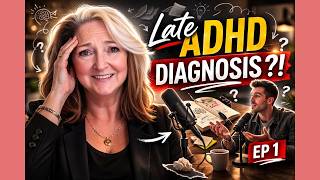
Tami and her son James share their late ADHD diagnoses and what finally got them there. Tami scored high on an online screener and was later diagnosed with ADHD, depression, and borderline bipolar disorder. Both take Adderall and emphasize how early diagnosis, therapy, and school accommodations matter.
Chapters
Hi, I'm Tami, and this is—
James. Hello, I'm her son.
So we're going to talk about ADHD in this, and I'm going to tell you a little bit about my origin story with figuring out about ADHD, because I had no idea. Growing up in, you know, I'm talking like I was born in a long time ago, yeah. And growing up, we did not talk about mental health. If you talked about mental health, you went to an institution. That's just the way it was back then. But so when James was— the very first time he did this, and he did this several times, but he was— we were living in England, so he must have been like just starting to talk, like 2 or 3 years old or something. And he reported to me that he had all these thoughts going on in his head. Mom, like, how do I get rid of these? And I was like, oh, honey, that's normal. Like, just, just, you know, sit down, be quiet for a while, it'll eventually go away. And that's how I addressed it, because that's how I always addressed it in me. Now, James, do you want to tell your story about when you were a little bit older and approached me about it?
Uh, sure. During middle school to high school is when I started being a little more educated on it and knowing, "Oh, this isn't quite normal." But it took a lot longer to convince her of that until I was, like, 17, and we ended up going to a therapist because we had foster children in the home at the time, and they were going there, so I brought up, "Hey, I'd like to go see a therapist sometime," and it kinda worked out that we already had a place to go that was near home, and now I go to therapy there, like, I try to go monthly usually, but during school right now it's been once half a year.
Yeah, that's kind of not the ideal, but I think you should start, I know they have therapists and stuff at your school, so maybe see if you can—
I was thinking of that, yeah.
Yeah, that might be a good idea. When James was going to therapy and then she said, "You need to see the psychiatrist because I cannot prescribe you medication and I cannot diagnose you, but I'm pretty sure you have ADHD." So he went and saw the psychiatrist, got diagnosed, and I let him decide. I mean, he was old enough. He decided to try the Adderall. So he went on that and was reporting to me that it was much better and kept asking me to take the ADHD test online. Eventually he got through to me, and so I took the test and I actually scored pretty high. I was like, oh my gosh, okay, um, I think I have ADHD.
Mm-hmm.
But so my husband was in the military. And I would kind of go into these depressions. And to me, it always felt like I was going down a funnel. And I get so far down that funnel, and then I'd like start pulling myself out. And I'd realize I need to go to therapy, or I need to go see a therapist. And they had therapists on base. So I went and saw the therapist there. And basically I talked to them about what was going on with my thoughts and all that kind of stuff. And their answer— I did this like 3 times, I went and saw a therapist on base, and every time it was, um, 2 times it was the same young lady and another time it was a dude. And every time they said, oh well, you're doing what you need to do, just keep doing that. Bye. So I didn't think therapy was for me. I was like, that didn't really help me. I was like, yeah, they validated what I was doing, but they didn't help me. So James trying to get me to the therapist took— I don't know, how long did that take you, James?
A few months at least. It was a while until it got through to you. Part of that was you were dealing with military therapists there. Not regular therapists. They're meant to deal with specifically things like depression and PTSD and help a veteran or someone who's currently serving get through that. So they weren't really made for a civilian to come in, especially when they have already pushed themselves out of that hole.
That's true, that's true. But it just— I don't know why they didn't tell me to go see somebody else. They just didn't. So yeah, I started, I went and saw a therapist and I just threw up on her. I've had a lot of craziness happen in my life. And I told her not everything because that would take a long, long time and we only had an hour. But I told her a lot. Mm-hmm. And her reaction to me was, "Wow, you've been through a lot of crap." And I was like, "Uh, yeah, but that's been my life, so isn't that just like normal? Doesn't everybody go through the same stuff?" And she also told me that she was pretty sure I had ADHD and— ADHD. That there might be something else going on, she wasn't sure. And so the next, I think it was like a 2-week window, and I was going to see the psychiatrist about what I was doing. And I had to do like 3 different tests with the psychiatrist. And basically she determined that yes, I have ADHD.
Mm-hmm.
And yes, I have a little bit of depression, but it's not, like I've learned how to manage it. So I think that's why it's not as bad. But she also told me that I was borderline bipolar. And I was like, whoa, okay. So I went on medication too, because I didn't know any differently. I'm also a type 1 diabetic. So I have that to deal with and figure out. And I just thought, no, I don't want to have to figure something else out right now. Mm-hmm. So I went on the medication, on the Adderall as well. And I, when my mom moved in a few years ago, I also went on— oh, I can't remember what it's called now. The generic name is fluoxetine.
Prozac.
That's Prozac. And that seemed to help because you know, my elderly mom lives with us. She has dementia and I have to care for her. So that's got some difficult moments for sure. So we found a therapist and I went for— gosh, it must have been like 6 months I was going. And it got to the point that I really she like said to me that, did I feel like I really needed it anymore? And I was like, I don't. So now I just go see the psychiatrist with James and he sees his therapist when he can and talks about what's going on in his life. I, when I first went on, The medication, I had no idea how quiet the brain could be. Like, I just always had that chatter going on. And of course, the world that I grew up in is if you admitted that to anybody, you were going into the loony bin, 'cause hearing voices in your head is not good. And, It's crazy how life has turned, and now there's much more awareness and much more education about how the brain works. So that was kind of our journey into figuring out we both had ADHD. And I'm pretty sure my mom does too, but like, she's 83 years old, so we're not gonna go through that with her. Right.
With how little, even with how little I've talked to your younger brother and sister, I really think they probably do as well.
Probably, probably. That wouldn't surprise me. Jordan was diagnosed with ADHD, and Donna and Mike fought to not have him medicated. They had to fight the school district and stuff like that.
So— Yeah, which is unfortunate. It, it's helped us, but it really should be a choice.
Yes. Yep, it should. Um, but the schools, they want little robots to make it easier.
So—
and that's why the foster kids had to be on it. And yeah. It's just, we did have to with Eliana, we first got her when she was finishing that year of school, I believe. That sounds right. She finished school here, and then her therapist told me, I asked if I could take her off the Adderall and see if she's being properly like, I felt like she was like a little zombie a lot. And so I took her off the Adderall and she was off for about 3 weeks. And I was like, okay, she needs something. So that's when we started going with lower doses. And her dosage after we went through all of that was about half. Half? Of what it was when we— when she moved in with us.
So yeah, her dosage was definitely a little bit high.
Yep, yep, it was crazy. So yeah, we're gonna— in this, we want to— James and I want to talk about our journey with mental health, ADHD, depression, all that stuff because we have some experience with it and we really want to share that it's okay to talk about it. And it, you know, in all honesty, like when it comes to depression, you need to talk about it. And that I figured out years ago that that is the key. That is the key is— Yeah. When you feel yourself in that funnel, and sometimes it's hard to recognize when you're in that funnel. But if you can recognize it, you need to talk to somebody. You need to, like, so one time, I can't remember which kids we had in the home. But so we've been— It's a long story, I might— Foster kids, yeah. So one of the other kids went through a depression and I helped them through it. Then Mom went into a depression. She wasn't living with us at that time. It might have been Gavino.
No, that sounds like it would have been Eugene.
Maybe, yeah, maybe, yes, it was Eugene now that you say that, yeah. So then Mom was going through it and I was helping her through her depression. And then you went through a depression and I helped you through that. And from doing that, I really learned that getting you guys to talk about what was going on was what helped you pull out of that funnel and start climbing out. And then, I don't know, it was like not too long after I'd helped you get through it, then I felt myself going down the funnel. And I came to you that morning and I said, "James, I need your help." And you're like, "What?" What?
No, I was more panicked about it because you didn't usually come to me with help for stuff, to ask for help with stuff at that point.
That's true. But yeah, you were like a little bit like, "What?" And I said, "I'm going through what you went through and I need your help." And you were like, "Oh, okay." And you came right out and we sat on my bed, just, I unloaded on you and we talked about life and we talked about everything. I think we were there for like 3 hours talking.
Something like that. If I remember correctly, you woke me up. It might have been in the middle of the day, but I think I was still asleep.
No, it was fairly— it was when I first woke up, but I was also stuck in sleeping because of the depression. And that's kind of what made me realize that, oh, this isn't right. So yeah, it's— it is what it is. I mean, we have to deal with it. And right now we are— I'm doing a lot of research about different tools to use, different ideas about how to help with the ADHD because— so one of the things you can do for your ADHD is to exercise. And I know we don't like hearing that.
Mm-hmm.
But exercise ADHD makes you low on— what is it, James?
Dopamine.
Dopamine, yes. And that dopamine is like your, your pleasure feeling thing that comes in your, in your brain. It's something that your brain produces.
And it's the happiness chemical.
Yes. And we don't have enough of it. And that's a big part of the problem in ADHD. So if you want to get your body to produce more, you need to exercise. That's one of the ways that you can do that. There's others that I'm going to learn about, but I haven't yet. I'm just— I'm getting— I kind of exercise for a while and then I get off it. And this last week I haven't been going to Hotworx very much. That's why place of choice. And, uh, I started going today, and I'm just gonna go every day and stretch because stretching feels so good, except for when I get really hot and sweaty in that sauna. That's weird. But, uh—
I will say this to people who are around my age, because I know you've talked about this a little bit, um, if you're gonna doom scroll, don't do it first thing. That is where your brain gets fucked up, is when you do it early in the morning.
Yep, that depletes your, um, I keep wanting to say melatonin.
Nope, it's dopamine. Yeah, melatonin is the other thing we're lacking.
Yep, so, so yeah, like, um, I don't think the— I don't know, does melatonin have to do with The ADHD, do you think, or—
Uh, not quite. That's more so our brains not being able to shut up, keeping us awake.
Yeah.
But we also have insomnia.
That's more on the insomnia end of things. So apparently we're penguins. That's what a little test did that told me anybody who has insomnia is probably a penguin. So, so I think we're gonna wrap it up here. We will get back on and talk about more ADHD-related things. I hope this has helped somebody. Just know that there are many ways that I figured out how to help your child deal with it. I know that I ultimately made a mistake and didn't take him to a therapist soon enough. And maybe that will help someone out there to understand, like, even, even if you don't want to medicate, just have it diagnosed. Because if your child is in school, then they can get compensation. Yeah. So James needs that at university because I didn't set that up properly. And that's our next step right now is making sure that they have the documentation and can give him some compensation for getting stuff done when he needs to get it done.
The most important thing that I think parents need to understand is therapy is not a bad thing. Needing a therapist is not a bad thing. And your child having something that we've grown to call mental illnesses, that's not a bad thing. Neurodivergency is extremely common. It is not a bad thing to have have a child whose brain isn't normal. Most people's brains aren't that normal. It's just how we work. If your kid is struggling in school or in life, if you can afford it, therapy is an amazing option to help them.
And there are places that have some, um, free therapy. Out there, some churches, places like that. And like, it's important, very important. And I've come to realize this. Yeah, I, like I say, I erred. I was human. And it just— is what it is. We can't change the past, but we can move forward and change the future. So that's kind of what we're doing, and we're hoping to help other people to see the path that we took, or that I took with my son, and to change that. Number one is to have it diagnosed, and then you can make decisions. I personally would not put a single-digit age child on Adderall. I just don't think it's right because their brains are so spongy and still figuring out, growing at that point. But once they hit double-digit age, if they're really asking for it and talking about craziness in their heads and stuff like that, they need help. Mm-hmm. I should have listened. So I hope that you're listening out there and maybe reassessing your kids' needs in this area. Thank you.
More from Tami


When you can't find your phone and your cats know why 😹 #catmemes #funny #fail


Rebel on Two Wheels 🤘#ADHD #ADHDWomen #adhdselfimprovement #relationship #ADHD #ADHDMom #RebelLife