How Can We Make This Message Even Stronger?
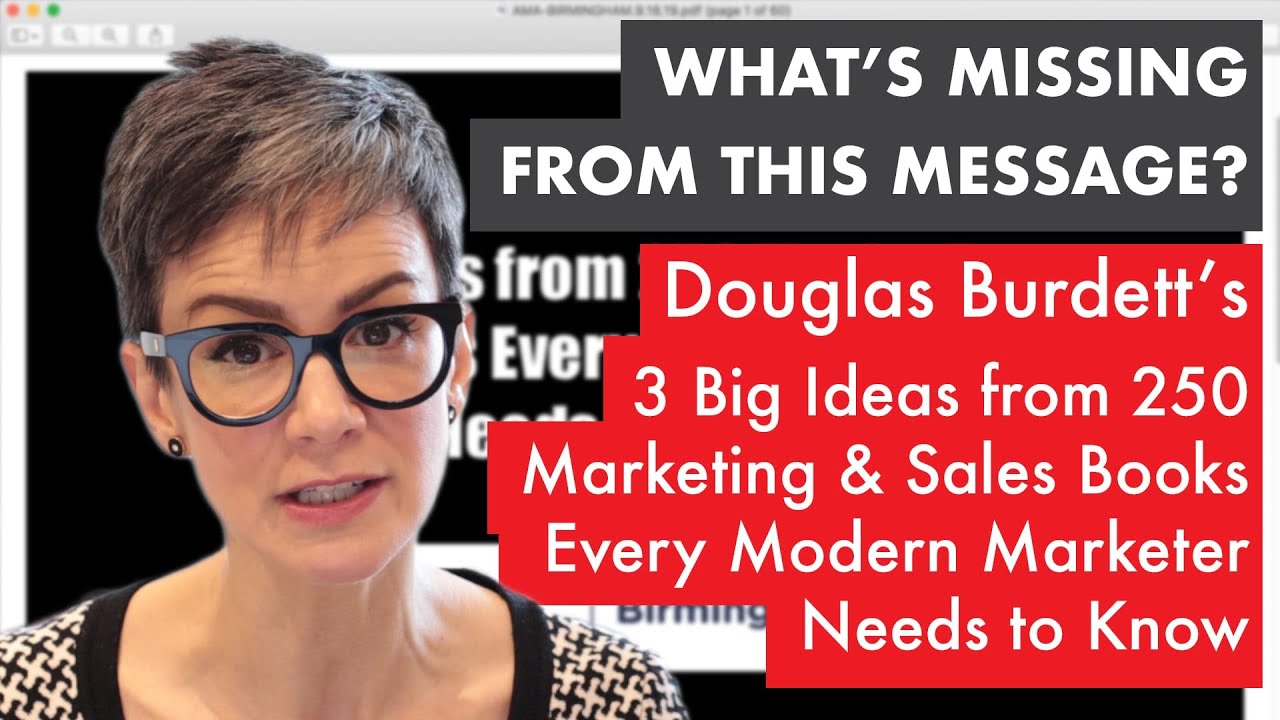
Tamsen Webster critiques Douglas Burdett's keynote on marketing books, analyzing the opening, slides, and structure. She recommends getting to the audience problem faster, clearly signposting the three big ideas, and tying examples directly to the theme instead of letting them float.
Chapters
How can you make a keynote opening even stronger? 2 things: simplification and a little bit of restructuring. That's what we're talking about on this episode of What's Missing from This Message. I'm Tamsen Webster of TamsenWebster.com. So let's take a look at Douglas Burdett's keynote that he apparently gave to the American Marketing Association in Birmingham. Okay, first impression. I told him I wasn't gonna be able to review the whole keynote, but since the title of his keynote is "Three Big Ideas from 250 Marketing and Sales Books Every Modern Marketer Needs to Know," my— what I'm gonna do is try to get us to the first big idea and just talk about how he opens his talk and gets gets into that point. All right, so the first thing, first impression, is kind of my keynote reaction video, uh, is that is a really, really long title. Um, and I love the fact that it's clear that I'm gonna get 3 big ideas and it's coming from 250 marketing and sales books. Um, it's— I, I like it. At the same point, like, it's super hard to say. Uh, so, you know, one of the themes that I come back to over and over again here is that You need to check things out loud just because it's really hard to say, hey, I saw this great talk by Douglas Burdett and it was called 3 Big Ideas from 250 Marketing and Sales Books That Every Modern Marketer Needs to Know. But at the same time, I think it probably stands out from a list of other things. And like I said, it delivers on what you're gonna get. But I think one other thing that would make this title stronger is the outcome. So it needs to know why, what am I gonna get as a result of this talk? Okay, so let's look at what he says when he first opens. So he says, "Marketers, would you like to be the kind of marketer that every CEO wants to hire and you can't afford to lose? You can do it." So that's his, I think that's a great way to start, kind of starts with a big question that people may want answered. And then he starts to go on and explain how in the next few minutes he's gonna talk about these 3 big ideas that he's gleaned from 250 marketing and sales books. And then he explains really quickly in this opening that he's read them for his marketing book podcast. And so he reinforces this, "You can do it," line, and then is pretty clear right up front with the fact that he's not gonna talk about tips, tricks, and tactics. He wants to give us 3 big ideas that would be helpful not only just today, but also in 5 or 25 years. And the first idea, as he says, is very specific to marketers, and the other two apply to anyone in business. So I like this as an opening. I think that it does a couple things that are, that are important. One, it sets out the question that this talk is going to answer, at least as far as I understand it right now. How can I be the kind of marketer that every CEO wants to hire and can't afford to lose? Second, I know that I'm gonna walk away with 3 big ideas, and Um, he set the expectation that this is going to be kind of useful concepts more than little tiny tips and tricks. I like doing that, particularly if you're at an event where people are used to tips and tricks, because it at least sets the expectation and you're getting the audience's permission right out of the gate that you may be doing things a little bit differently. So I like that. So let's go on to the next slide. Alright, so the next slide Douglas is showing a picture of what turns out to be himself, and so he's saying, okay, but first you might ask, well, how did I get here? And then he goes back and talks about two books that had a big impact on his career, but also why those books had an impact on his career. So he talks about getting in the— out of the Army and getting his MBA, and then talks about a buddy working on Wall Street recommending a book, and they recommended Ogilvy on Advertising. Read it and said, "Hey, that's what I want to do." And he's saying the right book at the right time can do that. Okay, two quick things on this right out of the gate is that I don't typically love starting right out with any more credentials than he's already given us. Because for instance, he told us right on the opening slide that he has read all these books for a marketing book podcast. I think people are a little bit curious about, um, you as a speaker, but most of the time they're going to want to hear something that's about them first, particularly since one of the last things he's just said was the first idea is very specific to marketers, but now I'm not going to tell you about it. Um, so I think this is probably good information for Douglas to have in his talk, I just typically like to see it backed out a little bit further until after you've established some additional credibility with your audience based on describing the world as they see it and/or introducing a new piece of information that they didn't have before. So, so one of the things is right off the, off the bat is this Ogilvy and Advertising. We don't get a lesson from that one other than that this is the one that Douglas that prompted Douglas into his career in advertising. The second thing that strikes me about this slide is this, the right book at the right time can do that. It feels like a point that's a little bit off of the theme of the talk. And what I mean is that the theme of the talk is how can you be a, you know, kind of indispensable marketer. This feels like a side point that the right book at the right time can do this, kind of a case for books. And it's just one of those things where it's not that it's wrong to include it, but when you've got precious time, we need to be super careful to make sure that everything that you're talking about is directly related to the theme or the red thread of the talk itself. Okay, now let's keep going. Um, so, uh, after he decides he goes into advertising— I love the fact that he uses a Mad Men, uh, slide here. Um, and so he says, you know, he went and started to work, uh, at some pretty big firms. Um, and then he started an advertising agency, and then he started to see some changes happening. And that's when he's saying that the ad industry carnage from the growth from the internet had begun because there's all these Google guys and there's question all these— getting all these questions about social media. I like that he's a little self-deprecating here because he realizes that he's a dinosaur, as he says, having had a background in advertising agency. It's very difficult to grow old in one. Let's just say that. And so when he was again trying to figure out what was happening, he is again giving us this backstory of Okay, then I went to books again to start to figure things out. So now we get the second of his two books that he said had a, had a big impact on him. In this case, he's introducing David Meerman Scott's New Rules of Marketing and PR, and then started to say, okay, oh, that's the eureka moment, this is where things are going. And that sparked him to start thinking about digital media and social media. Then he tells us he didn't stop there, kept reading marketing and sales books. And the more that I said, the more he read, the more the dinosaur scales could be avoided. So I like this transition. I like that he kind of pays off the fact that, um, you know, he's showing us David Meerman Scott there. He's telling us that he gets the books autographed, sports memorabilia, and then he's, uh, talking about how he launched the Marketing Book Podcast, talks about the details there, um, then answers the questions. Okay, everybody says, what's your favorite book? Uh, he answers with this one, How to Appear Smart and meetings. Then he gives a couple of the tricks. And then now, where are we? We're on slide 13. Now, to become the kind of marketer every CEO wants to hire and can't afford to lose, there's an obstacle to your success as a marketer that will never be completely vanquished. Beware, some of you might be upset at what I'm about to say. So I just want to point out that We're 13 slides into this talk, and my spidey sense says that we're probably about 5 to 7 minutes into the content. And you, and as a listener, I actually haven't heard about my life very much. I may, if I'm, you know, if I'm of an age with Doug, or if I've had a similar experience with discovering books, I may be engaged in his story. But that's a lot of time to keep an audience from hearing more about what's— what I'm there to hear about, which is how can I become an indispensable marketer. Um, so just, this is one of those places where I was saying I would perhaps move this stuff a little earlier and the backstory a little bit later. Um, but I promised I would get to his first big point and talk about this opening. Um, so let's get to that. Okay, so what he's doing here clearly is introducing a problem. So he introduced the goal of the talk way on the first slide. It's how can you be an indispensable marketer. Spent the next 12 slides, uh, next 11 slides talking about his own credentials with some interesting things to kind of interesting points. But again, not the 3 big ideas I was promised about, uh, promised by him. Uh, and now I'm being— now he's introducing the problem. Okay, and here is this big problem that marketers have an image problem. So he's talking about a study. He starts, uses this as a kind of humorous image to get into a study by the Fournaise Group. We'll go to what that says in just a minute. My one thing about this slide that I think would make it stronger is make it an image that you have paid for, or at least are giving credit. Other than the fact that it's got the watermark on it, I just, I would love to see that. It's one of those little tiny things that people notice either consciously or not when they're watching a presentation, and it's just one of those things that can communicate the level to which they can, they can trust you. And so just think about what the impression is when you're using images from online without credit and/or you're leaving evidence of the fact that this is not an image that either you took or that you're giving conscious credit to or that you paid for so that you didn't have to put a watermark on it. All right, so what is the image problem? Okay, nice big piece of pie. Then a nice piece of interaction with the audience here. Who can guess what percent of CEOs in that study trust marketers? So it's nice that he's giving them a bit of a hint with a pie chart. 20% don't trust them. Why don't they trust them? And then because CEOs believe marketers are too disconnected from the financial realities of companies. Okay. So there's a perception by some that marketers are arts and crafts party planners who work in the make it pretty department. So again, this is an image that is pulled off of a site from a career college. And I would be careful here because it does seem to be denigrating another career. And so this is one of those things that, yes, it could be perceived as funny. It could be also perceived as off-putting. I get that you're trying to— that Douglas is trying to find an image that matches this kind of party planner piece, but it's actually kind of doing a disservice to party planners and meeting professionals. And generally, you're probably speaking at an event that's organized by a quote-unquote party planner, a meeting professional, so just tread carefully. I'm still looking for the big idea. So, all right, so I'm hoping we're getting there because we have a book here. So now he's saying in The 12 Powers of a Marketing Leader: How to Succeed by Building Customer Company Value, Okay, we're being introduced to another study which gives us another insight. So, spoke with international CMOs about their work against "What would you do?" and "Manage the brand" or "Run our marketing." So, and then he's explaining why that doesn't go down well because they're talking about— they're not talking about the results that the business is looking for. This is what he says at the bottom of this. Good marketers work out how to link what they do with what other stakeholders within that organization want. Employee retention, improve profits, clear leadership. Well, amen to that, 'cause as a marketer who talks to other marketers, I 100% believe that the brand doesn't matter if people don't want what you have to sell. So, all right, so we're getting another book, Four A's of Marketing. Also talk about the negative perception of marketers. Okay. Another book, There's No BS Like Brand BS. Okay. All right. Then here's the simple recommendation. Get in the revenue camp. So that's what the most successful marketing leaders do in the minds of company leaders and also in reality, they get in the revenue camp. And so he's backing this up with this book, the podcast, this quote. CMO who is related to revenue stays and the CMO who is not related to revenue Leaves. It's as simple as that. So get in the revenue camp. That's what most successful marketing leaders do in the minds of company leaders and also reality. Now, I'm gonna skip ahead here a little bit because we're at slide 25. I, by the way, don't buy into any of the, you know, one slide per minute piece here, though interestingly there are about 60 slides in this deck. But there's some that are constructed in such a way that it's clear that he's going quickly through them. I do like the fact that once he's made it clear that you need to get in the revenue camp, that he giving some specific examples of what our company financial goals are, what our company sales goals are, profitable customers, etc. He's giving the, the audience specifics about what it sounds like to be in the revenue camp. But like I said, I'm gonna skip forward a little bit because what he's doing here is he's— it seems like after this he's continuing to bring some of these books in and, and making additional points, I think, also about revenue. And to kind of back up this piece that he's already set up pretty well, I would say. So now we're, I think, at the third additional book, and then we come back to the book he was talking about originally. And then here's where I want to stop this review of this so far, because he said, back to the first talk, here's what the successful marketer is doing. Our interviews revealed that the most successful marketers have one thing in common: a top management viewpoint. So I think what he's doing is reinforcing that this kind of get in the revenue camp piece. I believe this is the first big topic that he's talking about. And then I think what he's doing after this is starting to move to the second point, which is how to change that perception. And he goes on to the other two points from here. So my challenge is just that it's not really clear, at least based on the voiceover and the slides from, from Douglas, that he's finished the first point and he's moved to the second one. Just the way that slides are typically built and the way that audiences are kind of conditioned to look at slides, that after those 4 revenue camp questions, I think people would expect him to move to the second point. But it seemed from, at least from what I could understand, what he was doing was continuing to validate that first point before moving to the second one. What would make this particular keynote message stronger just based on what we've seen so far? Well, 2 things. One is a bit of simplification, and 2 is a bit of restructuring. Simplification piece, meaning make it very clear when we've hit the major points that you've promised. If this talk is about 3 big ideas, I want to make it super clear when we are still— like, when we are talking about point 1, what point 1 actually is, and when we're moving to point 2 and why. So that's one real big piece, because I want to make sure that that really comes through clearly so that the audience doesn't keep going to themselves as I did a little bit working through, like, is this the next point? Is this the next point? Oh, I thought it wasn't going to be a whole bunch of tips and tricks, but what we're getting is a lot of different mini perspectives on one big idea. And so I'd love to see that simplification happen around those points. Show me when I've made— when you're entering that point, or at least the very least summarize that major point in a visually and in your voiceover before you move to the next point. The second piece on the restructuring, I get why, given the structure of this particular talk and that it's based on the books and this marketing book podcast, why the temptation is very strong to start with his own story. But as we could see, it meant that we were probably about 5 minutes, maybe even 7 minutes into the talk before we started hearing about what we were promised when we first sat down. So, what I would suggest from a restructuring standpoint is to get really quickly into the problem that marketers are facing because he's got great backup for that, good studies, good examples from the interviews that he's had. And that's— once they've started to go, "Oh, this is interesting. You know something about this." That's a place to back up and say, "But let me explain to you either how I got interested in this or where I started to look for an answer and where that came from. It may not be the perfect answer for Douglas in this particular talk, but I just think that— I think this is something that most people can benefit from— is move back into the talk, much further back, the temptation to talk about yourself first, because the audience wants to hear from you about them. And once they've heard about themselves, then they start to get curious about why you're the one to listen to about that. So, so many thanks to Douglas Burdett for sending me his keynote for 3 Big Ideas from 250 Marketing and Sales Books That Every Modern Marketer Needs to Know. I had fun going through at least the first section of it to get to the first point. If you want to have your own short-form piece of content reviewed here on what's missing from this message, send me an email to redthreadme@tamsenwebster.com. I'm Tamsen Webster of TamsenWebster.com. Thanks so much for watching this episode of What's Missing from This Message. Don't forget to like and subscribe.










